
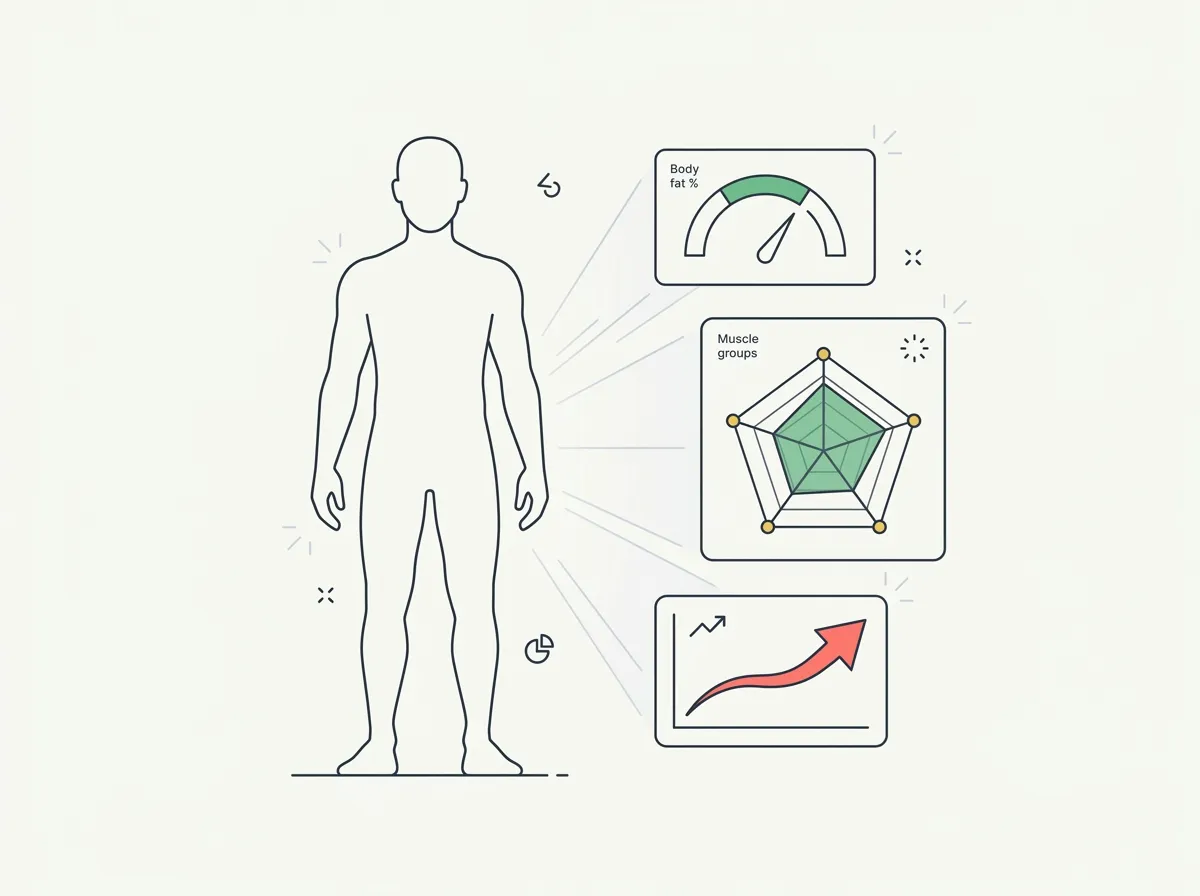
Quick answer: AI fitness analysis uses machine learning to extract body composition metrics from your data — most commonly a photo — and track them over time. Genuine AI fitness analysis tells you body fat percentage, muscle development scores, and how both are trending. An app that shows you a generic wellness number or edits your appearance is not doing fitness analysis.
Search "AI fitness analysis" and you'll get three completely different categories of app in the results. Body editors that reshape your photos with AI. Generic chatbots that dispense fitness advice without knowing anything about you. And a smaller category of apps that actually analyze your body composition from real data and track it over time.
Only the third category is doing what the phrase implies. The rest have borrowed the language without the substance.
What does AI fitness analysis actually mean?
At its core, AI fitness analysis is the use of machine learning models to extract measurable fitness metrics from data you provide — and to track those metrics across time so trends become visible.
The input is usually a photo, workout logs, or biometric readings. The output should be specific, numeric, and comparable over time: body fat percentage, muscle group scores, FFMI, trajectory direction. Not a vague "you're doing great" or a rearranged version of your photo.
The "analysis" part is the key word. Analysis means extracting information that wasn't directly visible in the input. A scale tells you weight. AI fitness analysis of a photo tells you what proportion of that weight is fat, where your muscle development sits relative to your frame, and whether those numbers are moving in the right direction. That's information the photo alone doesn't surface — the AI is reading the composition signals embedded in the image.
What should AI fitness analysis tell you?
A genuinely useful AI fitness analysis output has three layers:
1. Body composition metrics. Body fat percentage is the baseline — the number the scale can't give you. Useful analysis adds lean mass, FFMI (Fat-Free Mass Index, which shows how your muscle mass stacks up relative to your height), and BMI in context. These are the numbers that answer the questions a scale reading leaves open.
2. Muscle group scoring. Single-number body fat tells you the fat half of the equation. Muscle group scores tell you the other half — which specific areas are developed, which are lagging, and where training effort should be directed. The most useful implementations break this down to 10–12 individual muscle groups with labels that actually communicate something ("Needs Work," "Developing," "Strong") rather than unlabeled percentages.
3. Trend and trajectory. A single analysis is a snapshot. Repeated analysis over weeks and months produces a trend — whether body fat is falling, whether specific muscle groups are responding to training, whether the overall direction matches the goal. This is where AI fitness analysis becomes genuinely useful: not the single reading, but the trajectory it reveals over time.
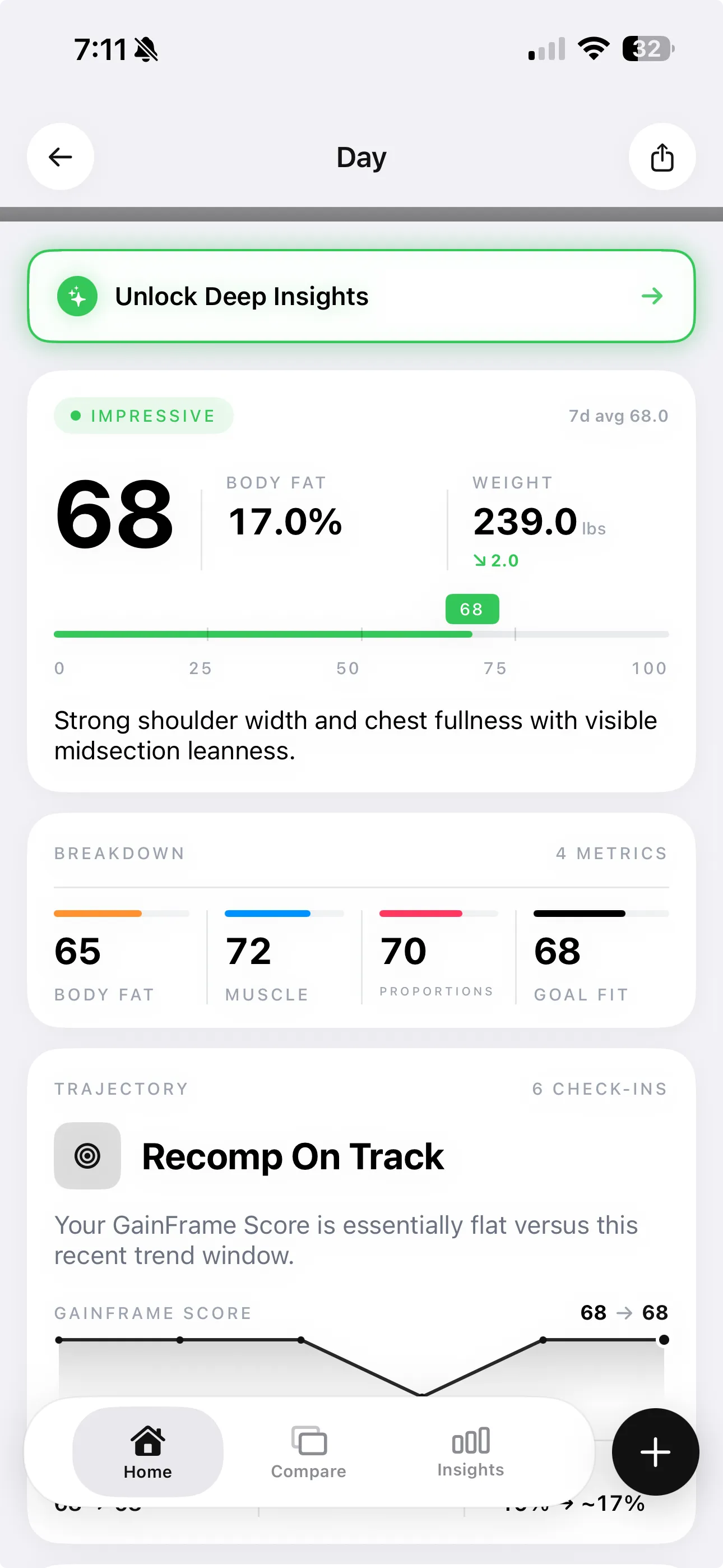
A single analysis output: body fat %, a composite score, and a 4-metric breakdown. The individual numbers are useful; the trend across eight check-ins is what makes them actionable.
The muscle map goes deeper — showing which groups have progressed since the last check-in and which are still trailing:
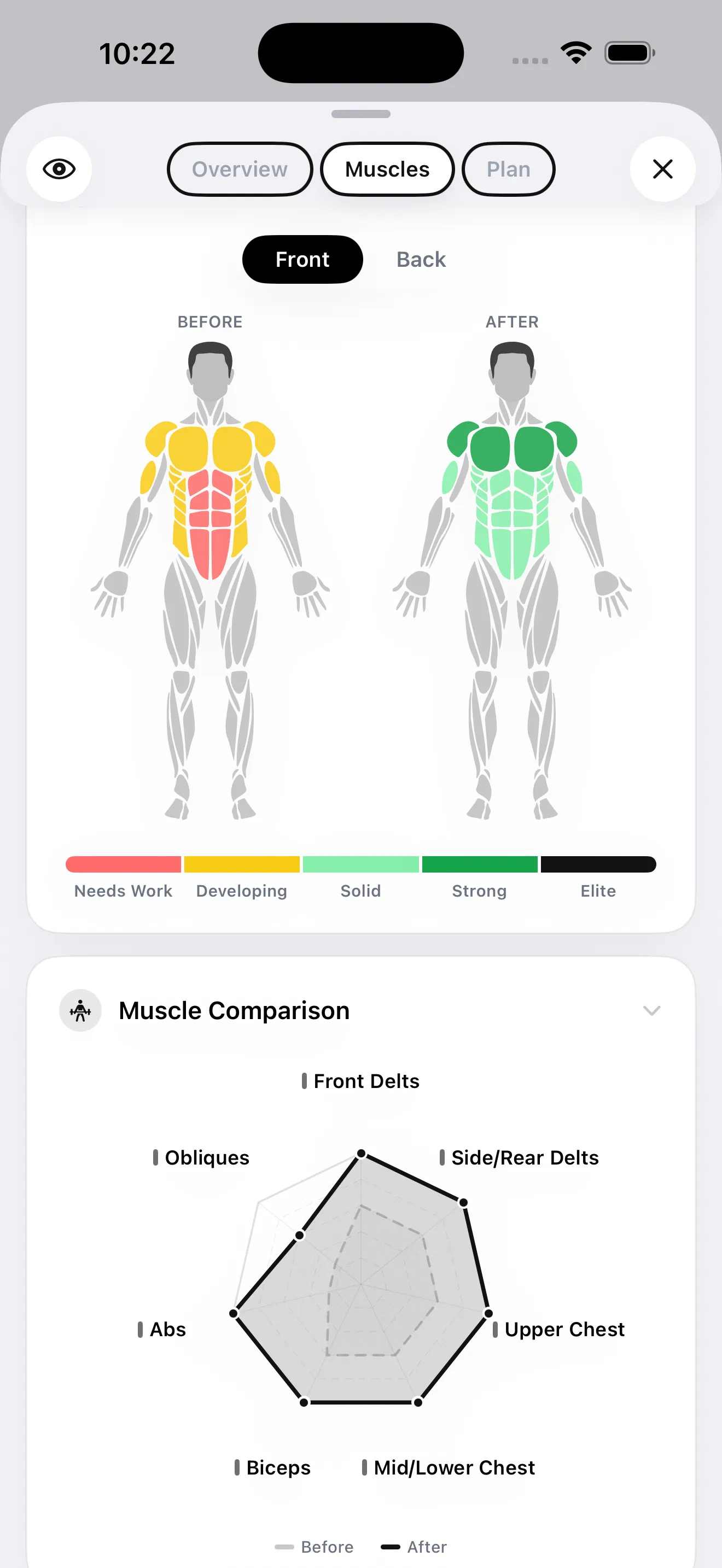
Per-muscle scoring across a training period. This is the analysis layer that a single body fat number misses — which specific groups progressed and which didn't respond to training.
What is AI fitness analysis not?
Three things that frequently appear in search results under this label but don't fit the definition:
Body editor apps. These use AI to change how your body looks in a photo — slimming, muscle enhancement, proportion adjustments. The AI is doing image generation, not measurement. One changes the image; the other reads it. Completely different purpose, confusingly similar branding.
Generic AI chatbots applied to fitness. A general-purpose LLM that you ask fitness questions isn't doing fitness analysis. It has no access to your body composition data, your training history, or your actual measurements. The responses are statistically probable fitness advice — not analysis of your specific situation.
Workout planning AI. Apps like Fitbod, GymStreak, and FitnessAI use machine learning to generate and adapt workout programs. This is genuine AI applied to fitness — but it's program design, not body composition analysis. The AI is optimizing your next session, not measuring what your body looks like.
What does good AI fitness analysis require as input?
A photo is the minimum for body composition analysis — specifically a full-body front or side shot under reasonable, consistent lighting. The AI reads posture, proportions, and visible tissue distribution to estimate composition.
Better analysis adds:
- Weight and height — necessary for accurate BMI and lean mass calculations
- Age and sex — body composition norms differ substantially; analysis without these defaults to population averages
- Stated goal — allows the output to contextualize metrics (18% body fat reads differently for someone cutting versus someone maintaining)
- Training history — workout volume from the same period connects composition changes to their cause
The most useful implementations also pull cardio and sleep data so the analysis can answer questions like "is my volume undercutting my recomp?" without requiring the user to mentally connect disconnected data sources.
What can AI fitness analysis tell you about the future?
Beyond current state and past trend, some implementations extend into projection — generating a predicted future physique based on your current trajectory. This is the most speculative layer of AI fitness analysis and the one that requires the most honest hedging.
A projection is a model output, not a guarantee. It extrapolates your current rate of change assuming consistent inputs. Useful as a goal-visualization and motivational tool; not reliable as a prediction if the inputs change.
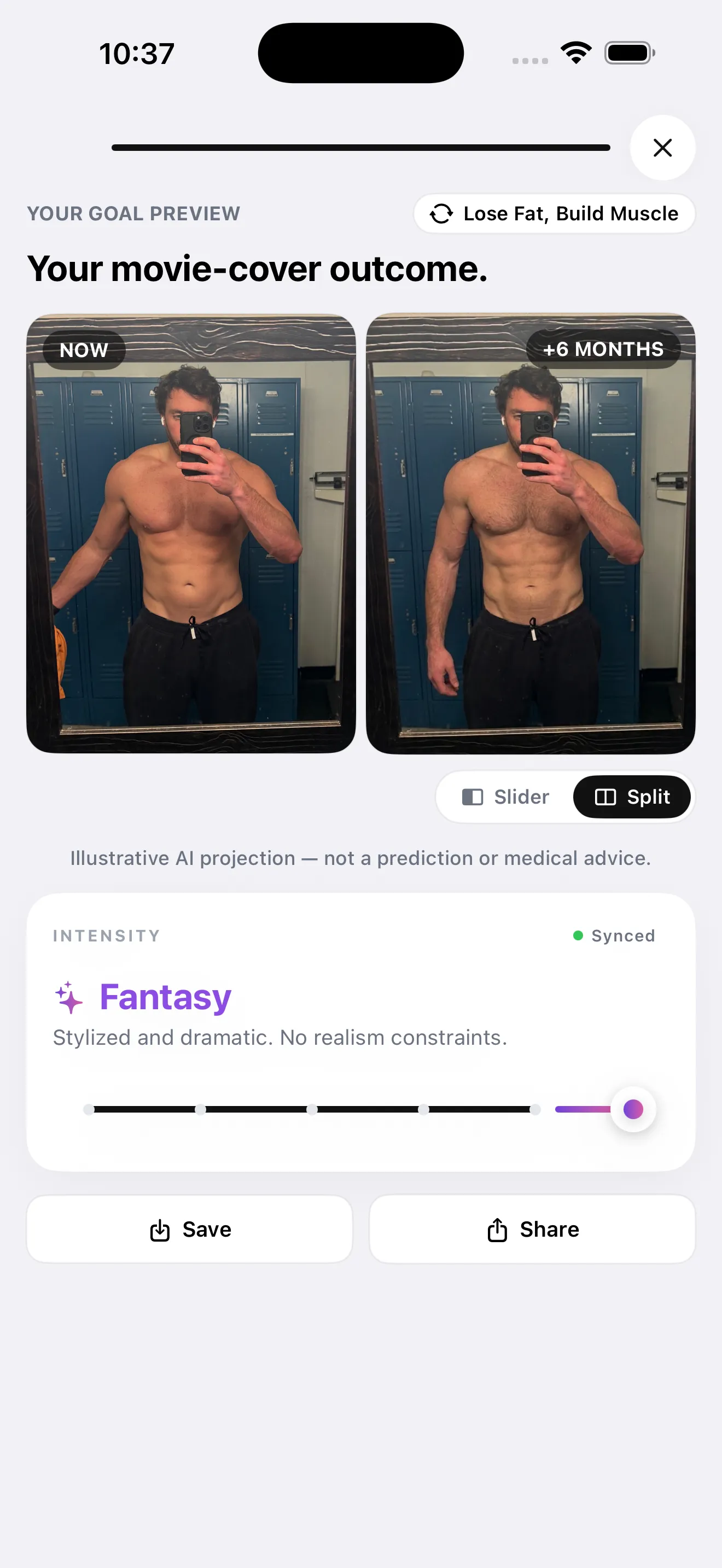
An AI-projected future physique based on current composition trajectory and stated goal. The disclaimer is accurate: this is illustrative, not a prediction — but it makes the direction of change tangible in a way a trend chart doesn't.
The honest framing: projective AI fitness analysis is useful for goal clarity and motivation. It is not a clinical forecast. Any implementation that presents it as a guaranteed outcome is overclaiming.
How do you evaluate whether an app is doing real AI fitness analysis?
Four questions that separate genuine analysis from feature theater:
- Does it produce specific, numeric body composition metrics — not just a score or a tier? Body fat percentage, lean mass, FFMI. Numbers you can compare to external benchmarks.
- Does it track those metrics over time? A single analysis is a snapshot. Real analysis is the trend. If the app doesn't show you how the number changed between check-ins, the "analysis" is decorative.
- Does it break down muscle development specifically? A single body fat number tells you the fat side. Per-muscle scoring tells you the muscle side. Genuine analysis does both.
- Is the data grounded in your actual inputs — or is it generic? If you can get the same output without providing a photo or your real measurements, what you're getting isn't analysis of you.
Real AI fitness analysis requires real inputs. If an app produces a detailed "analysis" from a height, weight, and gender alone — without a photo or biometric measurement — it's using a formula, not a model. The analysis output is only as good as the data going in.
Frequently Asked Questions
What is AI fitness analysis?
AI fitness analysis uses machine learning to extract body composition metrics from data — most commonly a photo — and track them over time. Genuine AI fitness analysis tells you body fat percentage, muscle group scores, FFMI, and how all three are trending. An app that shows a generic wellness number or alters your appearance is not doing fitness analysis.
How accurate is AI fitness analysis from a photo?
Published benchmarks generally find AI body composition estimation from photos accurate within 2–5% of DEXA for most users under consistent conditions. Accuracy drops with poor lighting and inconsistent poses. AI photo analysis is a consistent trend tool, not a clinical measurement — the same methodology used weekly produces reliable directional data even if absolute accuracy varies.
What is the difference between AI fitness analysis and an AI fitness coach?
Analysis produces metrics — body fat %, muscle scores, FFMI, trajectory. Coaching interprets those metrics and answers questions about them. The best implementations combine both: the coach uses your actual analysis history to answer "is my recomp working?" rather than giving generic advice disconnected from your numbers.
Is AI fitness analysis the same as a body editor app?
No. Body editor apps use AI to change how you look in a photo. AI fitness analysis measures your actual body composition from a photo and tracks it over time. One alters the image; the other reads it. Confusingly similar branding; completely different technology and purpose.
What data does AI fitness analysis need to work?
A full-body photo is the minimum. Better analysis also uses weight, height, age, sex, and stated goal. The most useful implementations additionally pull workout history and cardio data so the analysis can connect composition changes to training inputs.
Which apps offer real AI fitness analysis?
Apps offering genuine AI body composition analysis from photos include GainFrame, trackBod, Spren, and BodyScan by FitnessAI. The distinguishing factor is whether the app estimates actual metrics from your photo rather than a generic score. Workout AI apps like Fitbod, GymStreak, and Strong offer AI in the program-planning sense but do not analyze body composition.
AI fitness analysis that uses your actual data
GainFrame runs AI body composition analysis from a photo — producing body fat %, 12 muscle group scores, FFMI, and a trajectory trend across every check-in. Estimates run within roughly 2–4% of DEXA for most users. Not a clinical measurement, but a consistent weekly signal the scale and generic wellness scores can't give you.
Download GainFrame Free