
Quick answer: AI physique rating apps score your body from a single photo — usually 1–100 or a tier label like Bronze/Silver/Gold. The best give per-muscle breakdowns. None can tell you whether your physique is actually getting better. That requires a baseline, per-muscle deltas, and longitudinal tracking — features only one app on this list ships.
You snap a photo. The app says you're Bronze tier. You train for three months. You snap another photo. It says Silver tier. The app doesn't tell you which muscle moved, how much body fat you dropped, or whether the change is real — or just a better lighting angle and a fresh pump. The score is a vibe, not a measurement.
That's the gap in the "AI physique rating" category in 2026. Five apps now compete on giving you a number after one photo. Only one of them gives you the data you need to decide whether to keep doing what you're doing.
This is an honest review of all five — what each one does well, where each one breaks down for a serious lifter, and what's missing from the entire category.
What does an AI physique rating app actually measure?
A physique rating app takes a photo, runs it through a vision model, and outputs an aesthetic score. The score is the model's best guess at how your physique would be graded against a template — usually some weighted combination of body fat level, muscle definition, symmetry, and proportions. The output is a number (1–100), a tier (Bronze → Gold or Iron → Supreme), or both.
This is distinct from an AI body composition app, which outputs biological numbers — body fat percentage, lean mass, FFMI. Body composition apps measure what your body is made of. Physique rating apps grade how your body looks. Some apps do both. Most don't. If you're looking for biological measurement (BF%, lean mass, FFMI) rather than aesthetic rating, the body composition category is covered separately in our best AI body composition apps roundup.
The pattern-matching part is real. Vision models trained on enough physique data can reliably tell a 25% body fat photo from a 10% body fat photo. They get less reliable at the margins — telling 12% from 14% from a single photo is harder than telling 12% from 22%. None of the popular raters have published DEXA validation studies, so treat the absolute numbers as estimates.
Want a score right now, before the comparison?
Disclosure first: this one is ours, which is why it sits outside the numbered list below rather than being scored against apps we don't control.
The free AI physique rater takes one photo in your browser and returns a 1–100 score split into four sub-scores — body fat, muscle, proportions, and goal fit. Three free ratings, no account, nothing installed, photo not stored. The scoring methodology is documented in full, including what each band means and where a single casual photo introduces error.
The limitation is the one every browser rater shares, ours included: three ratings in a browser is a sample, not a tracking system. Everything below is the honest comparison of what else is out there.
How do the 5 AI physique rating apps stack up?
Ordered from free-and-frictionless to paid-and-detailed. Each one solves a slightly different problem.
1. Galaxy.ai Physique Rater — Free web tool, no login
Galaxy.ai's physique rater lives inside a broader all-in-one AI platform. Upload a photo in the browser, get a rating in seconds, close the tab. No account, no history, no subscription.
The strength is friction: it's the fastest way to get a number on yourself in 2026. The weakness is everything else. There's no way to come back next month and see if anything changed — your previous score doesn't exist outside that browser session. It's the "horoscope" of physique apps: directionally fun, zero memory.
Best for: One-time curiosity. People who want to see what AI thinks of their physique and then move on.
2. AestheticRank — Web with public leaderboard
AestheticRank's distinguishing move is the leaderboard. After your rating, you can compare against a Top-100 list of other users' physiques, ranked Iron through Supreme. Per-muscle breakdown is included; symmetry and proportions are weighted heavily.
The community angle is novel. No other rater in this list publishes a leaderboard. The trade-off is that the leaderboard format turns physique assessment into a vibes contest — your score is partly a function of how the community photographs itself, not just your physique. Lighting wars are real on these leaderboards.
Best for: People who want a community / competitive frame for their physique work. Not a tracking tool.
3. Rate My Physique — iOS, by MWM
Rate My Physique is the most polished consumer-grade app in this list. Native iOS, iOS 26 ready, with a future-physique image generator and a chat-with-results feature that lets you ask follow-up questions about your rating.
The future-physique generator is genuinely interesting — upload a photo, get an AI-generated image of what you could look like with continued training. The catch: it produces an image only, not projected numerical stats (predicted body fat, FFMI, weight). It's motivational, not analytical. Per-muscle ratings and a polished UX make this the best "consumer entry point" to the rater category.
Best for: Motivation visualization. People who want a pretty UI and a "what could I look like" image, not a measurement system.
4. Aesthetics AI – Physique Rated — iOS
Aesthetics AI takes the competition-judge approach. Front and back photos are both required. Scoring breaks out by body part — chest, back, arms, abs, legs — with symmetry and proportions layered on top.
This is the most thorough scoring rubric in the rater category. If you're prepping for a photoshoot, a physique competition, or just trying to evaluate yourself the way a bodybuilding judge would, the part-by-part breakdown is more useful than a single overall number. Like the others, though, it's still a one-photo-per-session score. There's no time dimension.
Best for: Physique-focused trainees, photoshoot prep, anyone who wants competition-style aesthetic scoring.
5. BodyScore AI — iOS + web, $12.99/mo
BodyScore AI is the most data-forward app in this list. Body fat percentage, muscle group scores, even hormone-level estimates from a photo. Web dashboard plus iOS app. The marketing leans heavily on a "95–98% accurate" claim.
Two things to be honest about. First, the 95–98% accuracy claim has no published DEXA validation behind it on the public site at the time of writing — there's no methodology paper, no comparison study, no sample size disclosed. Treat it as a marketing number until the receipts show up. Second, the hormone-level estimation from a photo is methodologically unsupported — you can't reliably infer testosterone levels from a photograph, and the app's own copy notes it's "not a replacement for blood tests." The detailed-output framing is appealing, but the strongest claims need to be discounted.
Best for: People who want a detailed-looking output and haven't yet looked at the receipts behind the headline accuracy claim.
Where do AI physique raters break down for serious lifters?
The five apps above differ in polish, pricing, and depth. They share three category-wide gaps that matter if you're trying to use any of them as a real training feedback loop.
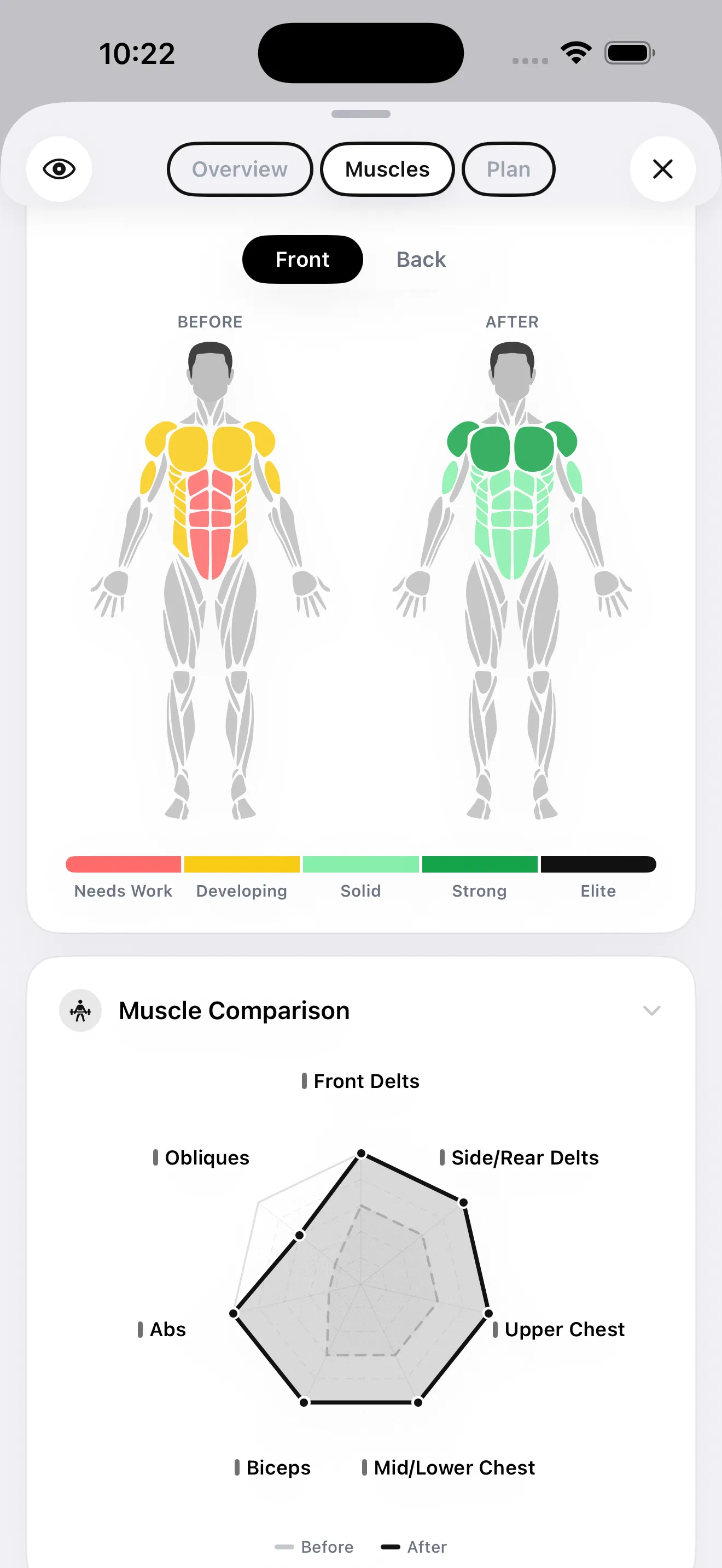
What per-muscle assessment looks like when it includes deltas — not just current scores, but progression labels across a training block.
No baseline. Every rater gives you a score on the photo you just uploaded. None of them re-score your old photos against your new ones using a consistent reference. That matters because a "Bronze → Silver" jump might mean you actually built muscle, or it might mean your lighting got better, or that you took the photo two hours after a training session instead of two hours before. Without a baseline run on a comparable photo, the score is just a one-shot impression.
No per-muscle delta. Even apps that show per-muscle ratings show current scores, not changes. You can see that your rear delts are rated lower than your front delts today, but you can't see what eight weeks of face pulls and reverse flyes did to that ratio. The most useful information in a per-muscle breakdown — which muscles moved and by how much — is the information none of the rater apps surface.
Overclaim on accuracy. BodyScore's 95–98% claim is the most flagrant, but it's a category problem. Most rater apps don't publish DEXA comparisons, sample sizes, or methodology at all. The honest framing — "AI photo apps land within roughly 2–4% of DEXA for most users, but they're estimates, not measurements" — is something none of the rater apps in this list use in their marketing copy. Honest hedging is rarer than it should be.
What's the difference between a physique score and physique assessment?
A score is a number. An assessment is a number plus the context to interpret it.
Assessment is what you get when the same score system runs on your first photo and your fiftieth, so the trend line is comparable. When the overall score decomposes into the underlying pieces — body fat percentage, lean mass, FFMI, individual muscle group scores with progression labels ranging from "Needs Work" through "Developing" to "Strong." When it's paired with workout context — sets, reps, and volume from your gym sessions — so you can attribute movement on the score to specific training work. When accuracy is hedged honestly instead of marketed at 95–98%.
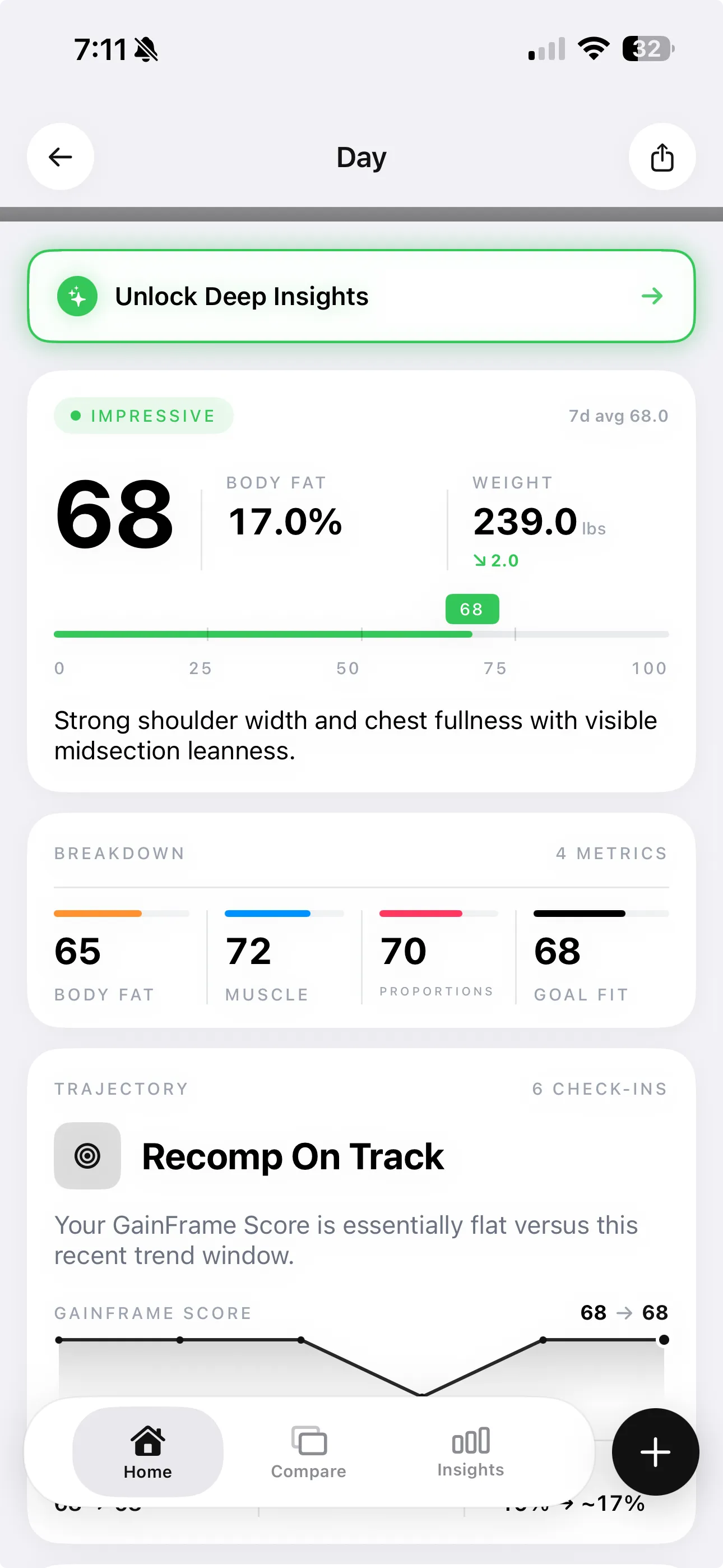
A 1–100 score is more useful when it decomposes — body fat, muscle, proportions, and goal fit — than when it's a single number.
GainFrame is the one app on this list built around that framing rather than around a single-photo rating. Each photo gets a 1–100 physique score (broken out as Body Fat / Muscle / Proportions / Goal Fit), per-muscle ratings across 12 muscle groups, body fat percentage, FFMI, lean mass, and a hedged accuracy framing — within roughly 2–4% of DEXA for most users, not a marketing-friendly absolute. Sets and tonnage from Hevy auto-attach to the same-day photo, so a strong shoulder day shows up next to the photo that captures the pump it produced. The full methodology of the 1–100 score is documented separately. If you want to try that scoring before installing anything, the free AI physique rater runs the same four-part framework on one photo in your browser — three free ratings, no signup — and the body fat estimator gives you the single number behind it.
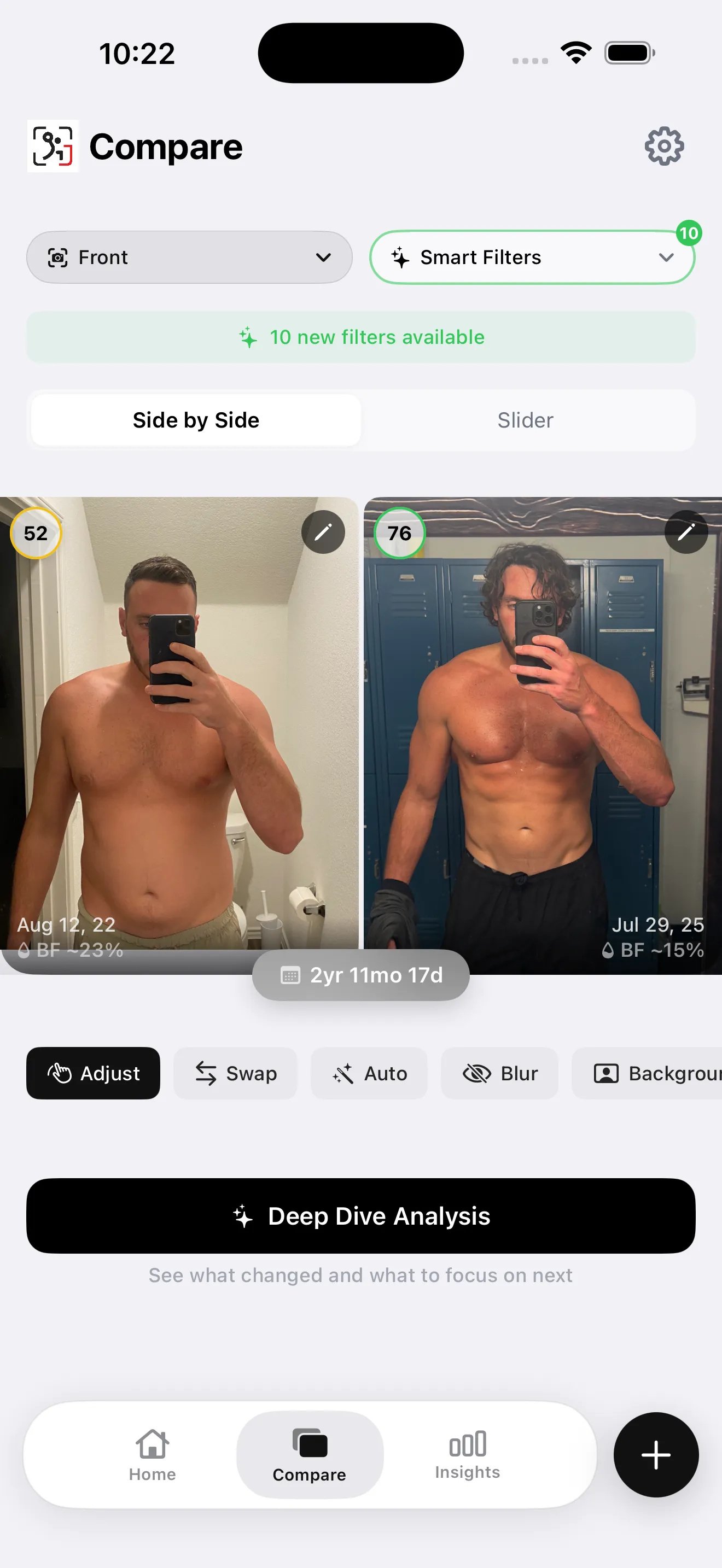
The longitudinal piece raters can't do — same scoring system applied to photo #1 and photo #N, with deltas surfaced explicitly.
This is the assessment-versus-rating distinction made concrete: same-system-over-time, decomposed metrics, workout context, honest accuracy hedging. It's not a better rater — it's a different category.
How do the 6 apps compare side by side?
| Feature | GainFrame | BodyScore AI | Aesthetics AI | Rate My Physique | AestheticRank | Galaxy.ai |
|---|---|---|---|---|---|---|
| Platform | iOS | iOS + web | iOS | iOS | Web | Web |
| Price | Free / $5.99 mo | $12.99/mo | Subscription | Free + IAP | Subscription | Free |
| Per-muscle scoring | 12 groups + progression labels | Muscle scores | Front + back, by part | Per-muscle ratings | Per-muscle + symmetry | Overall rating only |
| Longitudinal tracking | Yes — Compare + history | Limited | Photo history | |||
| Body fat % output | Hedged ~2–4% of DEXA | Claims "95–98%" | ||||
| Workout integration | Hevy (auto-attach) | |||||
| Free tier | 25 photos lifetime | 3-day trial | Free with IAP |
Which AI physique rating app should you use in 2026?
Match the tool to the problem:
- Want a vibe check / one-time curiosity? Galaxy.ai's free web tool. Done in 30 seconds, no commitment.
- Want a community / leaderboard angle? AestheticRank. Just remember the leaderboard is partly a lighting contest.
- Want motivation and a "future me" image? Rate My Physique. The image generator is the differentiator; ignore the rest.
- Want competition-style aesthetic scoring for photoshoot prep? Aesthetics AI. Most thorough rubric in the rater category.
- Want a detailed-looking single-photo report? BodyScore AI — but discount the 95–98% accuracy and hormone claims until methodology is published.
- Want longitudinal tracking, per-muscle deltas, workout context, and honest accuracy hedging? GainFrame.
Three steps to actually track your physique
A score is only as useful as your ability to compare it to your last score under similar conditions.
- Pick one app and commit to it for at least 8 weeks. Switching apps mid-training-block resets your baseline. Whichever tool you pick, its scoring system is the reference frame — it only works if you stay inside it long enough for trends to emerge.
- Standardize your photo conditions. Same lighting, same time of day (morning, fasted, before training), same pose, same distance from the camera, same clothing. Vision models are sensitive to all of these. A "rating drop" caused by softer lighting at 6 PM is indistinguishable from a real composition change unless you control the inputs.
- Re-shoot every 4–8 weeks and look at direction, not magnitude. Body fat moves at 0.5–1% per month under a calorie deficit. Muscle gains are slower. Any score change inside two weeks is mostly noise. What matters at the end of a training block is whether the trend is going the right way — not whether your number jumped by three points.
The rater apps give you a number on one photo. Real assessment is what happens after photo number two — when you can see whether the number moved, and whether the work you did between them is the reason.
Track your physique with deltas, not just scores
GainFrame is the iOS body composition app for serious lifters — 1–100 physique score, 12 muscle group ratings, body fat and FFMI estimates (hedged honestly against DEXA), Compare with same-day Hevy workout context, and unlimited longitudinal history. Free tier covers 25 photos lifetime; Pro is $5.99/month.
Download GainFrame Free