
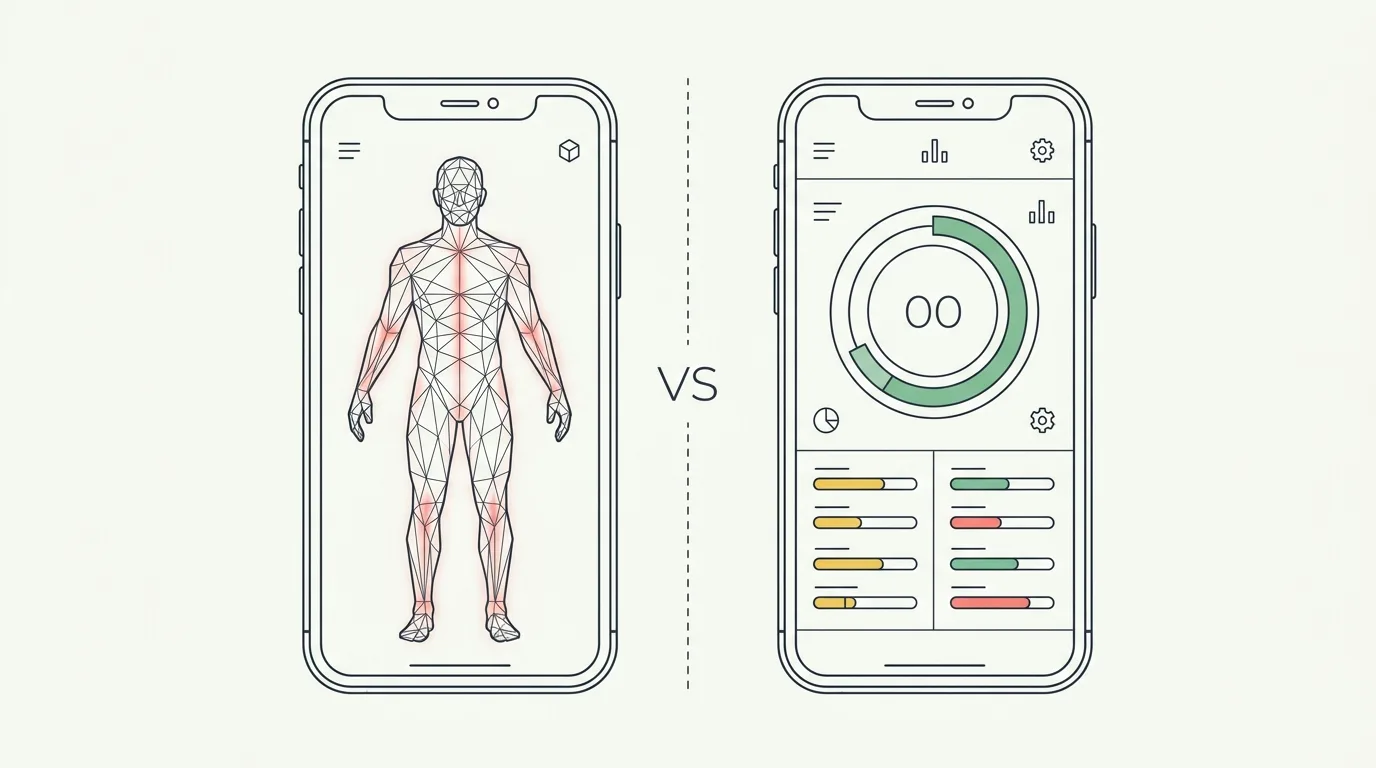
Quick answer: FitnessAI BodyScan is a 3D body-scan feature bolted onto a workout app — you pay about $9.99/month on top of a FitnessAI subscription to capture a tight-clothes camera scan. GainFrame is body-composition-first: a single photo returns body fat %, FFMI, and 12 muscle-group scores for $5.99/month. Pick BodyScan if you want workouts and a scan in one paid bundle; pick GainFrame if body composition itself is the point.
FitnessAI BodyScan vs GainFrame: Which Should You Use?
Short answer: these two apps look similar on the surface — both turn your iPhone camera into a body fat estimate — but they're built around opposite priorities. FitnessAI leads with workouts and added BodyScan as a measurement module. GainFrame leads with the measurement and builds everything around it.
- FitnessAI BodyScan is for people who want one app for their training program and a periodic 3D scan, and don't mind a tight-clothing scan ritual plus a stacked subscription.
- GainFrame is for lifters who want low-friction, frequent body-composition check-ins from a single photo — with per-muscle scoring and a projected future physique that BodyScan doesn't offer.
Neither is a scam, and neither is "objectively better." It comes down to whether you want a scan inside a workout app, or a body-composition tool built for that one job. Let's break down each one.
What Is FitnessAI BodyScan?
FitnessAI is an AI workout app (programmed strength training) that launched a body composition feature called BodyScan in September 2024. BodyScan uses your iPhone camera to capture a 3D bodymap, which is processed by a third-party scan engine — Prism Labs — to estimate your composition. For best results, FitnessAI recommends wearing tight, form-fitting clothing or underwear, in consistent lighting, with a neutral pose.
What does FitnessAI BodyScan offer?
3D Bodymap Scan
Captures a 3D mesh of your body from your iPhone camera, processed by Prism Labs into measurements.
Body Fat & Lean Mass
Returns body fat percentage and lean muscle mass, plus metabolic estimates, from each scan.
Waist & Dimensions
Estimates waist circumference and other body dimensions a single body fat number can't show.
Built Into a Workout App
Lives inside FitnessAI's programmed-workout app, so your training and scan sit in one place.
How accurate is FitnessAI BodyScan?
BodyScan's scan engine, Prism Labs, markets results as close to a DEXA scan and references a peer-reviewed validation paper. It's worth being precise about that claim: the validation is published by the technology vendor, not by an independent lab, so treat "nearly DEXA-accurate" as a vendor accuracy claim rather than settled third-party fact.
The honest framing applies to every camera-based estimate, BodyScan and GainFrame alike: accuracy is strongest in the middle body fat ranges (roughly 15–30% for men, 20–40% for women) and weaker at the lean and high-fat extremes. The real value isn't the absolute number on any single day — it's directional consistency over time, provided your scan conditions (lighting, clothing, posture) stay consistent.
What Is GainFrame? AI Body Composition Built for Lifters
GainFrame is an iOS app built by a solo developer (Michael Rode — that's me, 20 years lifting) for serious gym-goers who want body composition data without a clinic visit. Instead of a 3D scan ritual, a single photo generates a full readout — and the analysis goes to the muscle-group level, not just one body fat number.
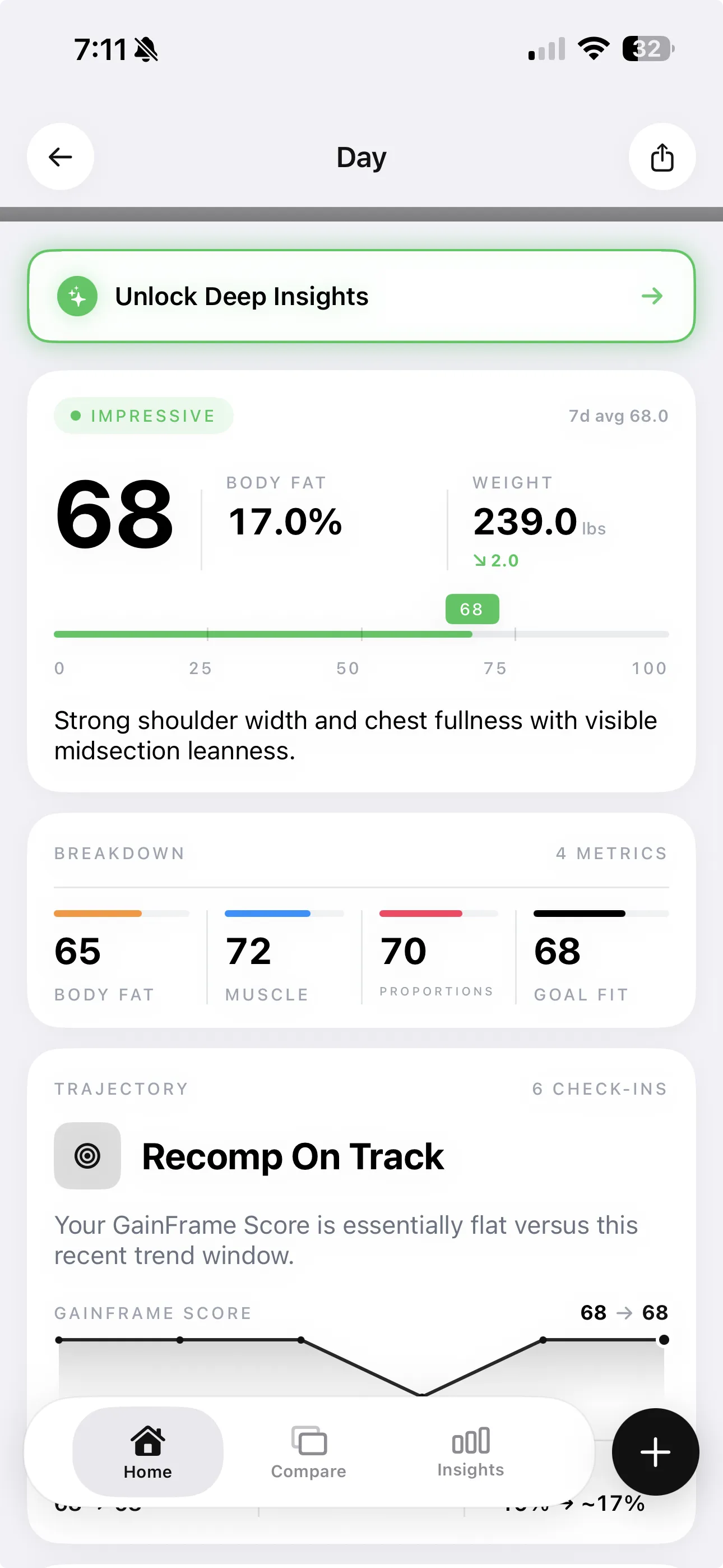
A single GainFrame check-in: physique score, body fat %, FFMI, and 12 individual muscle group ratings — from one photo, no special clothing required.
What does GainFrame do?
| Feature | What it does |
|---|---|
| AI Deep Dive | Each check-in returns a physique score (1–100), body fat %, BMI, FFMI, lean mass, and 12 individual muscle group scores |
| Deep Dive Compare | Pick any two check-ins for a side-by-side breakdown: body fat delta, weight delta, FFMI shift, and per-muscle comparison |
| Future Physique | AI projects an image of your physique at 3, 6, or 12 months out, with predicted stats at each milestone |
| Smart Import | Batch-import years of camera-roll photos; AI classifies each by pose (Front, Back, Side, Flexed) |
| Hevy integration | Workout volume from Hevy auto-attaches to that day's check-in, so training load sits next to your physique |
| On-device & private | No account required; results stored on-device. Photos are analyzed by AI but never persisted on a server |
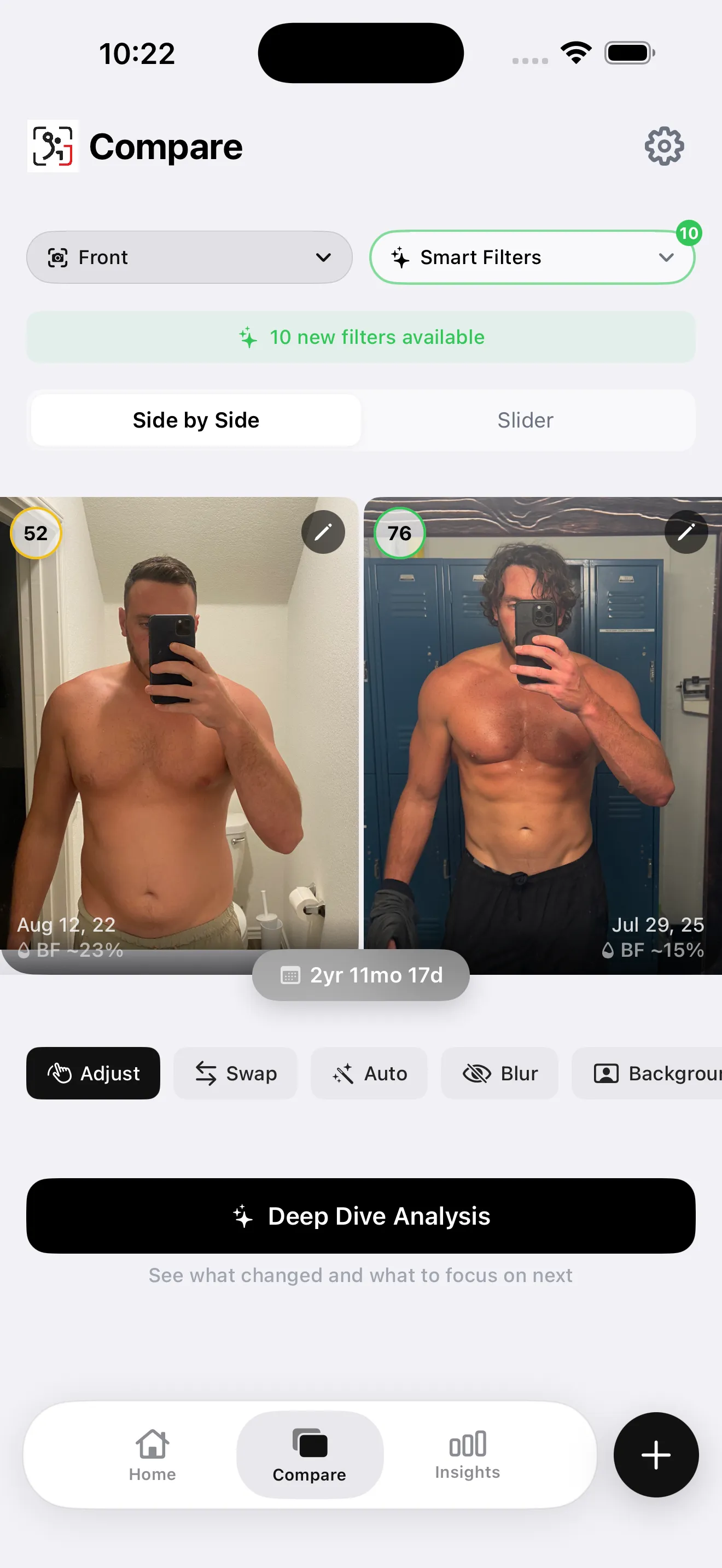
GainFrame's Deep Dive Compare: pick any two check-ins and see exactly what changed — body fat, FFMI, and each muscle group.
The Real Difference: 3D Scan Ritual vs Single Photo
This is the dimension that decides it for most people. BodyScan and GainFrame represent two philosophies of phone-based body composition:
- BodyScan wants a 3D bodymap. That means tight clothing or underwear, careful lighting, and a turning scan to build the mesh. The upside is richer geometry (waist circumference, body dimensions). The downside is friction — and friction kills consistency. A scan you do once a month tells you less than a check-in you'll actually repeat.
- GainFrame wants one photo. The AI infers body fat, FFMI, lean mass, and per-muscle scores from a single image — even one already in your camera roll. Less geometric detail than a 3D mesh, but low enough friction that weekly check-ins are realistic, which is where trend data actually comes from.
GainFrame also reports FFMI in every check-in — a lean-mass-to-height ratio that's much harder to game with lighting or a pump than a raw body fat number. It moves slowly and reflects real muscle gain. Here's why FFMI is the metric that doesn't lie.
FitnessAI BodyScan vs GainFrame: Feature Comparison
| Feature | FitnessAI BodyScan | GainFrame |
|---|---|---|
| Body fat estimate from your phone | 3D scan | Single photo |
| Capture method | 3D bodymap (tight clothing) | One photo, any clothing |
| Lean mass | ||
| Waist circumference & 3D dimensions | ||
| FFMI | Every check-in | |
| 12 individual muscle-group scores | Yes | |
| Future physique projection | 3/6/12 month | |
| Camera-roll batch import | Auto pose-sorted | |
| Workout integration | Native (FitnessAI workouts) | Hevy (volume auto-attaches) |
| Published DEXA-validation paper | Vendor-published (Prism Labs) | Not published; hedged ~2–4% of DEXA |
| Platform | iOS & Android | iOS only |
| Pricing | ~$9.99/mo + workout sub | $5.99/mo or $39.99/yr (free tier) |
| Best for | Workout + scan in one bundle | Body-composition-first lifters |
Who Should Use FitnessAI BodyScan?
BodyScan earns its place for a specific user:
You want workouts and a scan in one app
If you're already using FitnessAI for programmed strength training, adding BodyScan keeps your training and a periodic body scan under one roof. One app, one login, one place to look.
You're on Android
This is the simplest deciding factor. FitnessAI ships on both iOS and Android. GainFrame is iOS only — so if you're on a Pixel or Galaxy, BodyScan is the one that runs on your phone at all.
You want waist and 3D body dimensions
The 3D bodymap captures waist circumference and other geometric measurements that a single-photo estimate doesn't output. If circumference tracking matters to you specifically, that's a real BodyScan advantage.
Who Should Use GainFrame?
Lifters who want body composition to be the main event
If the scan is the reason you're here — not a workout add-on — GainFrame is built around it. Physique score, body fat %, FFMI, lean mass, and 12 muscle-group scores in every check-in, with no workout app you have to pay for first.
People doing a recomp, cut, or lean bulk
Scale weight goes quiet during recomp. The only way to confirm it's working is measuring composition with enough detail to see muscle groups move over months — exactly what Deep Dive Compare is for. Here's how to track recomp with photos.
Hevy or Strong users who already log workouts
You don't need a second workout app. Keep logging in Hevy — GainFrame auto-attaches that day's volume to your check-in, so you see training load next to physique without paying for a programmed-workout subscription you won't use.
Anyone with years of progress photos sitting unused
Smart Import batch-imports your camera roll and auto-classifies each shot by pose. If you've taken gym photos for years but never had a tool, you can backfill your whole history in one pass — no re-shooting in tight clothing.
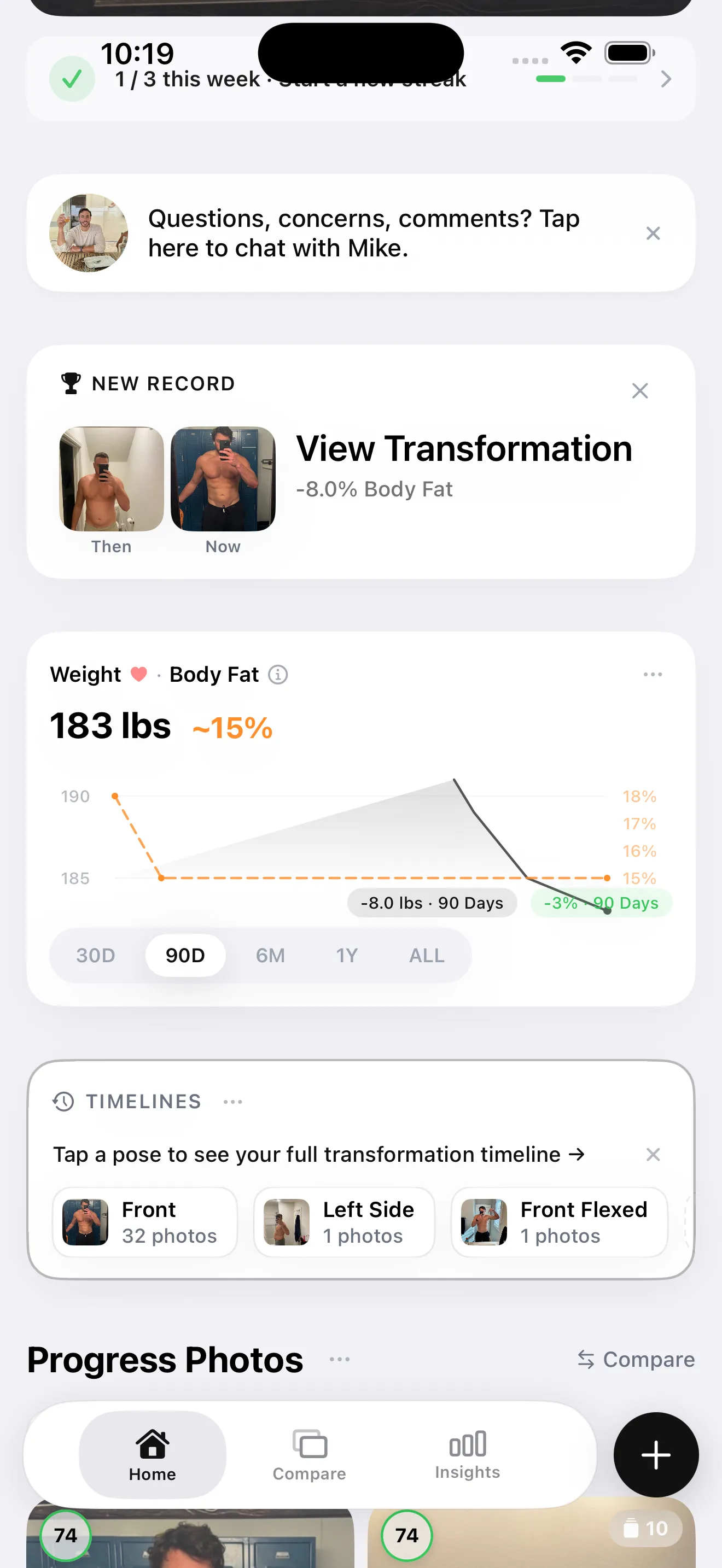
GainFrame's home view: recent check-ins, physique trend, and quick access to AI analysis.
Pricing and Value: BodyScan vs GainFrame
This is where the "module vs first-class product" split gets concrete. Always confirm current prices in the App Store before subscribing.
| FitnessAI BodyScan | GainFrame | |
|---|---|---|
| Free tier | Free app download; features paid | Yes (limited AI analyses) |
| Body-comp cost | ~$9.99/mo for BodyScan | $5.99/mo or $39.99/yr |
| Requires a workout sub? | Positioned as add-on to FitnessAI (~$9.99–$19.99/mo) | No — standalone |
| Check current price | fitnessai.com/bodyscan | App Store listing |
The value question isn't just the BodyScan line item — it's the stack. BodyScan makes the most sense if you're already paying for FitnessAI workouts, because then the scan is an incremental add. If you only want the body composition, you're potentially paying for a workout app you won't use. GainFrame is one standalone subscription that does the body-composition job, and the free tier gives you enough analyses to judge the depth before paying.
Which Should You Use in 2026?
The honest bottom line
Choose FitnessAI BodyScan if you want programmed workouts and a periodic 3D scan in a single app, you're on Android, or you specifically want waist and 3D-dimension tracking — and you don't mind the tight-clothing scan ritual and stacked subscription.
Choose GainFrame if body composition is the whole point: you want a single-photo check-in you'll actually repeat weekly, per-muscle scoring, FFMI, and a future-physique projection — without paying for a workout app first. It's iOS only, and built for serious lifters.
Both are legitimate. The real question is whether you want a scan inside a workout app, or a body-composition tool built for that one job.
See What GainFrame Shows You
Download free and run your first AI analysis — physique score, body fat %, FFMI, and 12 muscle group scores from a single photo. No account required.
Download GainFrame FreeFrequently Asked Questions
What is FitnessAI BodyScan?
BodyScan is a body composition feature inside the FitnessAI workout app, launched in September 2024. It uses your iPhone camera to capture a 3D bodymap (processed by a third party, Prism Labs) and returns body fat percentage, lean muscle mass, waist circumference, and metabolic estimates.
How accurate is FitnessAI BodyScan?
Its scan engine, Prism Labs, cites a peer-reviewed validation paper and markets results as close to a DEXA scan — but that validation is published by the technology vendor, not an independent lab. As with all camera-based estimates, accuracy is best in the middle body fat ranges, and the real value is consistent trend tracking rather than a single perfect number.
How much does FitnessAI BodyScan cost?
BodyScan is listed around $9.99/month and is positioned as an add-on to FitnessAI's workout subscription (roughly $9.99–$19.99/month). GainFrame is a single standalone subscription at $5.99/month or $39.99/year, with a free tier. Always confirm current pricing in the App Store.
Is FitnessAI BodyScan or GainFrame better for lifters?
It depends. BodyScan suits people who want workouts and a 3D scan in one app and don't mind the scan ritual and stacked cost. GainFrame suits lifters who want frictionless single-photo body composition with per-muscle scoring and future-physique projection, especially if they already track workouts in Hevy or Strong.
Can I use FitnessAI BodyScan and GainFrame together?
Yes. Some people run FitnessAI for programmed workouts plus a periodic 3D scan, and use GainFrame for frequent single-photo check-ins, per-muscle scoring, and visual before-and-after comparison. They overlap, so there's redundancy, but nothing stops you using both.
Does FitnessAI BodyScan work on Android?
Yes — FitnessAI is on both iOS and Android, so its audience is cross-platform. GainFrame is iOS only, so if you're on Android, that alone may decide it.
Does FitnessAI BodyScan score individual muscle groups?
No. BodyScan reports whole-body metrics like body fat percentage, lean mass, and waist circumference. GainFrame additionally scores 12 individual muscle groups per check-in and projects a future physique, which BodyScan does not do.
Sources
- FitnessAI BodyScan product page — tagline, what it measures, DEXA comparison claim, $9.99/mo
- FitnessAI launches BodyScan — Athletech News — launch context and positioning
- FitnessAI BodyScan launch — Fitt Insider — Prism Labs technology, September 2024 launch
- How accurate are AI body scans — FitCommit — accuracy ranges and trend-over-precision framing
- GainFrame: What is FFMI — the lean-mass metric GainFrame reports in every check-in
- GainFrame: I compared my AI body scan to a $150 DEXA scan — GainFrame's own accuracy hedge vs DEXA