
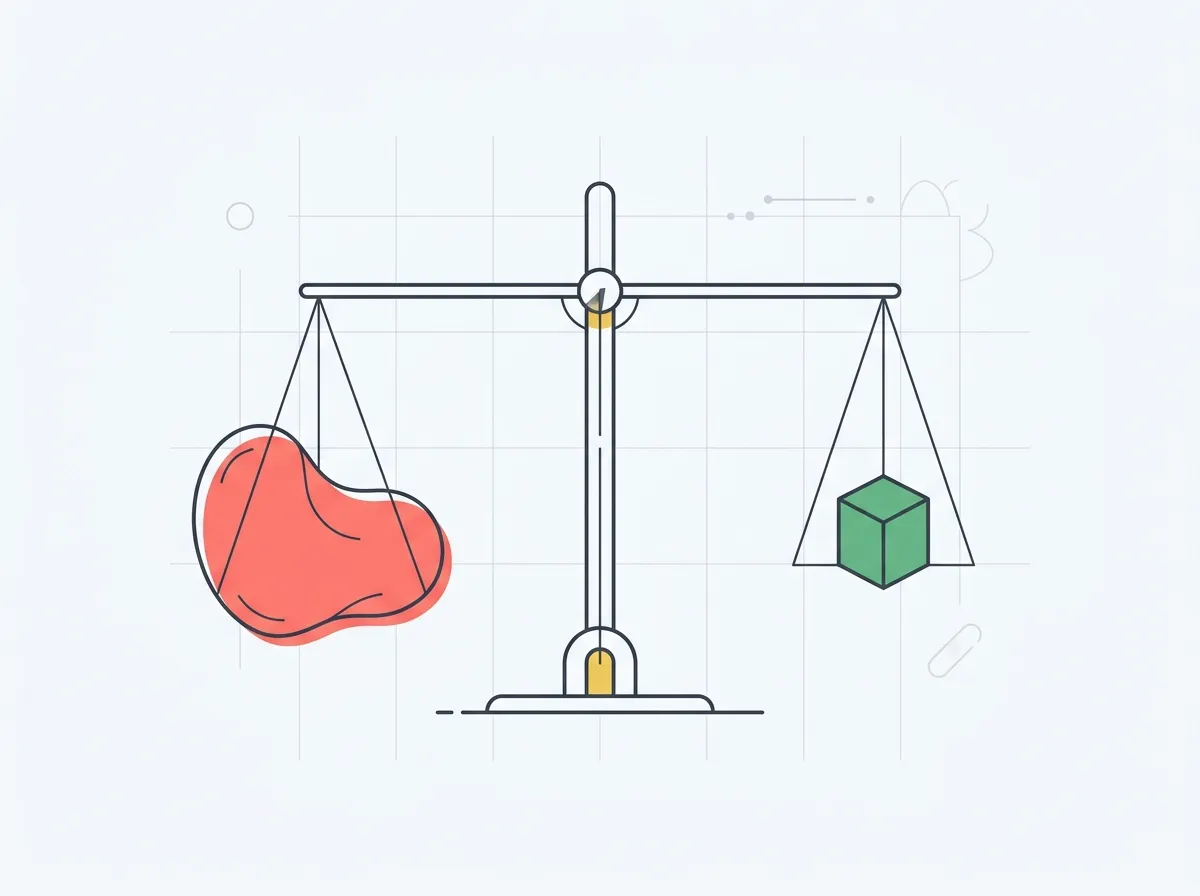
Quick answer: Ten pounds of fat and ten pounds of muscle weigh exactly the same — but muscle is roughly 15–20% denser, so the fat takes up noticeably more space on your body. That's why swapping fat for muscle can leave the scale flat while your waist shrinks and your clothes fit differently.
You've been training four days a week for three months. Your jeans need a belt they didn't need before. Your shoulders fill a shirt they used to swim in. And the scale has moved exactly 1.5 pounds — in the wrong direction.
So which measurement is lying? Neither. The scale is answering a question you didn't ask. It reports total mass, and total mass says nothing about what that mass is made of or how much room it takes up. The fat-vs-muscle comparison explains the whole disconnect, and it comes down to one word: density.
Does muscle actually weigh more than fat?
No — and the phrasing is where the confusion lives. A pound is a pound. Ten pounds of muscle and ten pounds of fat weigh precisely the same amount, the way ten pounds of feathers and ten pounds of bricks do.
What people mean is that muscle is denser than fat. Commonly cited values put skeletal muscle around 1.06 g/ml and adipose tissue around 0.9 g/ml — figures vary slightly by source and by hydration, but the gap is consistently in the 15–20% range. Denser tissue packs the same weight into less space.
So the accurate sentence isn't "muscle weighs more than fat." It's "a pound of muscle is smaller than a pound of fat." That one correction explains almost everything about why the scale misleads people who lift.
How much more space does 10 pounds of fat take up?
Run the commonly cited densities and 10 pounds of fat works out to roughly 5 liters of volume, while 10 pounds of muscle comes in around 4.3 liters. The difference — roughly 0.7 liters — is about a large water bottle of extra bulk, carried mostly at your waist, hips, and chest, the places fat prefers to live.
| 10 lbs of fat | 10 lbs of muscle | |
|---|---|---|
| Weight | 10 lbs | 10 lbs (identical) |
| Density (commonly cited) | ~0.9 g/ml | ~1.06 g/ml |
| Approximate volume | ~5.0 liters | ~4.3 liters |
| Where it sits | Waist, hips, chest — layered over muscle | Shoulders, back, legs — shaped, under the skin |
| What the scale sees | 10 lbs | 10 lbs |
The location matters as much as the volume. Fat layers over your frame and smooths out shape; muscle is the shape. Ten pounds of muscle distributed across your back, shoulders, and legs changes your silhouette. Ten pounds of fat mostly changes your waistband.
What does swapping 10 pounds of fat for muscle look like?
Numbers are one thing. Here's the visual version, using standardized, photorealistic AI renders from our body fat visualizer — same build, pose, and lighting, so only body fat percentage changes between images.

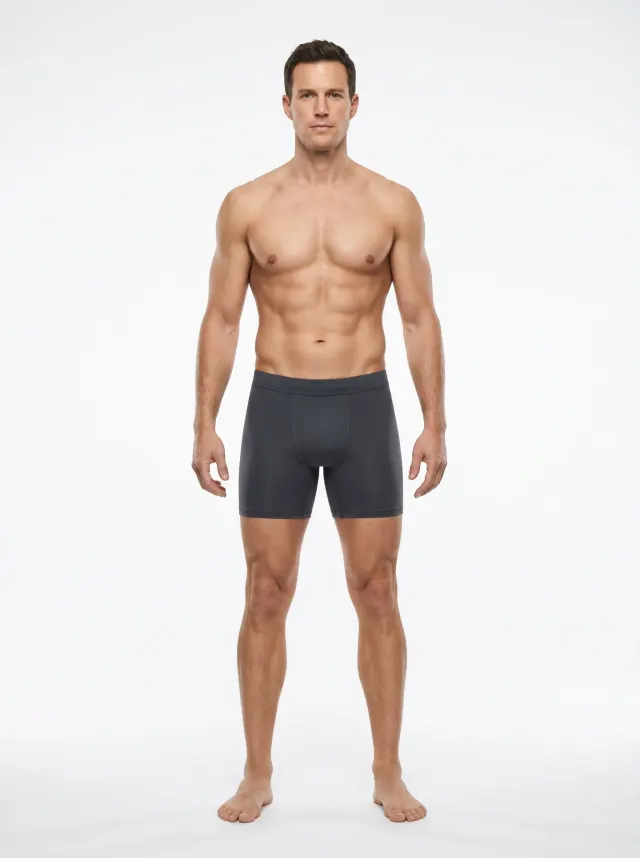
23% body fat (left) vs 18% (right) on the same frame. For a man in this weight range, a shift like this at a similar scale weight is roughly what trading ~10 lbs of fat for muscle looks like — illustrative, since individual results vary with starting size and genetics.
Look at what changed and what didn't. The frame is identical. The height is identical. If these were the same person at the same weight, the scale would report nothing happened. The waist, the chest line, and the arm definition report something very different — because the same mass now occupies less space and sits in better places.
Why does this matter for anyone actually training?
Because the fat-for-muscle swap is exactly what happens during body recomposition — and it's the phase where most people quit. Lose fat and gain muscle simultaneously and the scale can stay flat for months while your body visibly changes. People who only track weight interpret that flat line as failure and abandon a program that's working.
The volume math says the opposite. Trade 10 pounds of fat for 10 pounds of muscle and you've removed roughly a water bottle of bulk from your midsection while adding shape everywhere else. That's commonly enough to drop a pants size at an identical scale weight. It's also why body fat percentage beats BMI for anyone who lifts — BMI, like the scale, can't tell which tissue it's counting.
How do you track a change the scale can't see?
You measure the things density actually moves: waist circumference, how clothes fit, and standardized photos. A tape measure catches the shrinking waist. Photos catch the shape change — if you control lighting, distance, and pose, which is harder than it sounds.
This is the specific problem GainFrame was built for: it estimates body fat percentage and rates 12 muscle groups from your progress photos, then auto-aligns any two check-ins so the comparison is honest. They're estimates from photos, not clinical measurements — but they track the fat-vs-muscle question the scale structurally cannot answer.
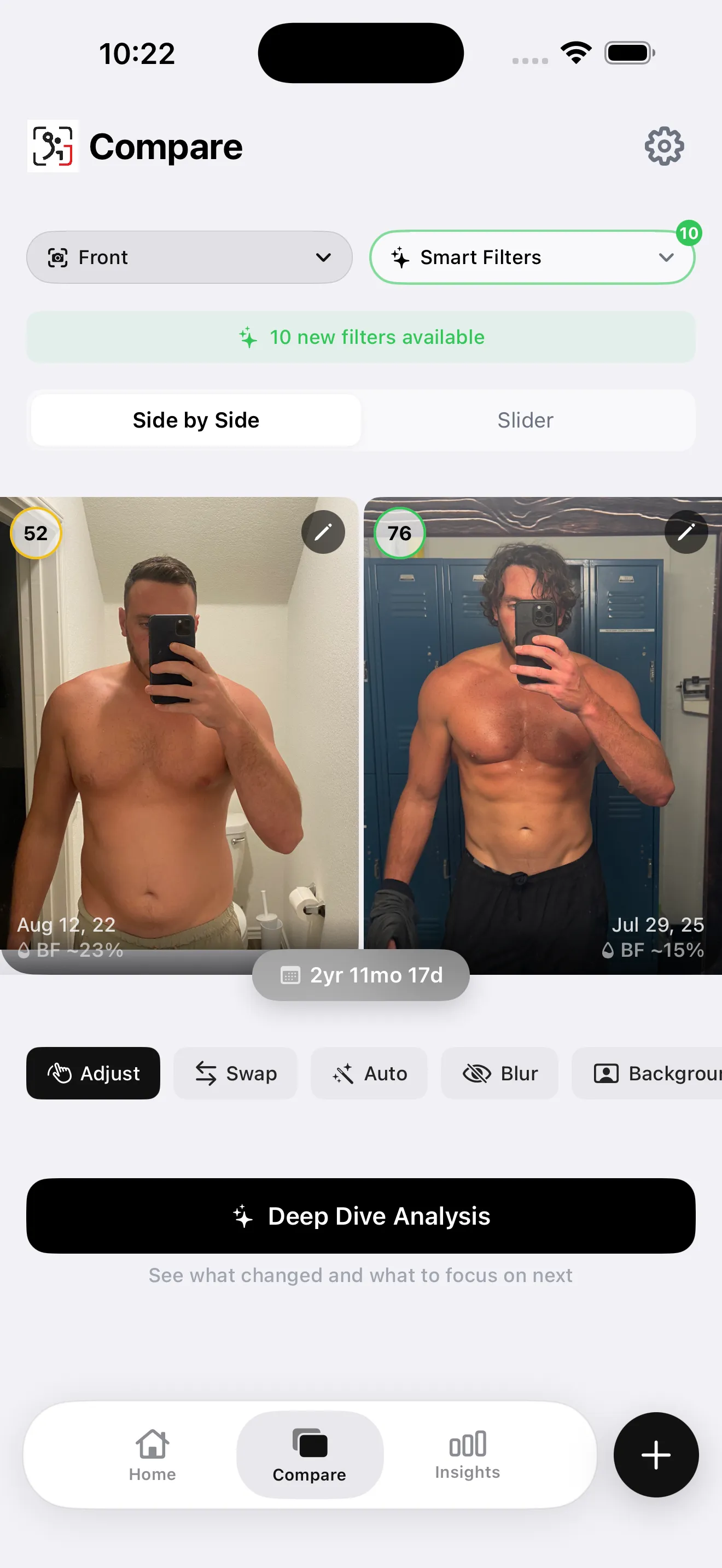
Two check-ins, auto-aligned. Same scale weight can still mean a visible composition change — this is where it shows up.
If you want the full toolkit for scale-free tracking — tape spots, strength benchmarks, photo protocol — we've covered it in how to measure muscle gain without a scale.
Frequently asked questions
Does muscle weigh more than fat?
No — a pound of muscle and a pound of fat weigh exactly the same, by definition. What people mean is that muscle is denser: commonly cited values put muscle around 1.06 g/ml and fat around 0.9 g/ml, so the same weight of muscle packs into roughly 15–20% less space. Same scale reading, visibly different body.
How much more space does 10 pounds of fat take up than 10 pounds of muscle?
Using commonly cited density figures, 10 pounds of fat occupies roughly 5 liters of volume while 10 pounds of muscle occupies roughly 4.3 liters — about a large water bottle of extra bulk for the fat. Exact numbers vary by tissue composition and hydration, but the direction never changes: fat is the bulkier tissue at any given weight.
Why doesn't the scale move when I'm losing fat and building muscle?
Because the scale measures total mass and a recomposition trades one tissue for the other. Lose 5 pounds of fat while gaining 5 pounds of muscle and the scale reads identical — even though you've dropped volume around your waist and added it to your shoulders. That's why waist measurements and standardized photos catch recomp progress the scale structurally cannot.
What does 5 lbs of fat vs 5 lbs of muscle look like?
The same density math at half scale: roughly 2.5 liters of volume for the fat versus about 2.2 liters for the muscle, using commonly cited figures. On a body, a 5-pound swap is subtle in the mirror day to day but usually visible in side-by-side photos taken weeks apart — often as a slightly tighter waist and fuller shoulders at the same scale weight.
Can fat turn into muscle?
No. Fat and muscle are different tissues, and one never converts into the other. What actually happens during a recomposition is two separate processes running at once: stored fat gets burned for energy while resistance training stimulates new muscle tissue. The visual result looks like a conversion — same weight, tighter body — which is why the myth persists.
See the change the scale hides
GainFrame estimates body fat %, FFMI, and 12 muscle-group scores from your progress photos — so a flat scale week still shows you whether fat is trading places with muscle. Free to start on iOS.
Download GainFrame Free