
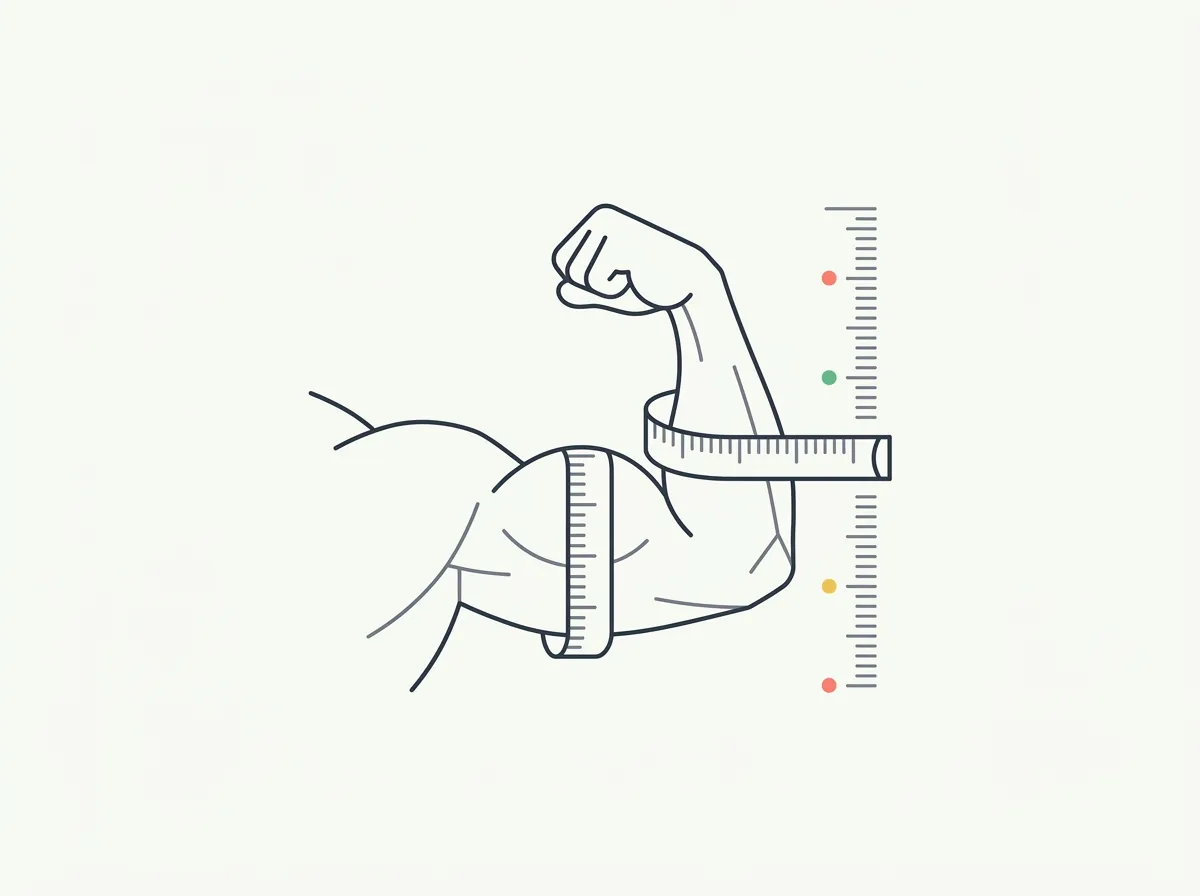
Quick answer: Commonly cited measurement data puts the average flexed bicep for adult men around 13 to 14 inches. Consistent lifters typically reach 14 to 16 inches; anything over 16 inches lean is genuinely big. Context matters: a lean 15-inch arm looks larger than a soft 16-inch one.
You measure your arm for the first time: 14.5 inches, flexed, and you're honestly a little proud. Then you search "is 14.5 inch arms good" and a forum thread informs you that anything under 17 is small and you should, quote, keep your sleeves down.
That thread is calibrated to enhanced physiques and heavyweights. Actual measurement data tells a very different story about where the average man sits - and once you see the real numbers, your tape reading gets a lot more interesting. Here's what's average, what counts as big, and the one variable the tape can't see.
Looking for the distance along your arm rather than around it? Our bicep-length guide separates upper-arm length, muscle-belly shape and circumference so you can use the right reference.
For another dimension that affects perceived proportions, compare hand length and span separately from upper-arm circumference. Each measurement needs its own landmarks.
What is the average bicep size for men?
Measurement data commonly cited puts the average adult American man's upper arm around 13-14 inches - and that's flexed. Unflexed, most men tape roughly half an inch to an inch less.
Two things inflate and deflate that average, and both are worth understanding before you compare yourself to it. First, the average includes every body fat level, and arm circumference rises with body weight whether or not any of the weight is muscle. A 250-pound sedentary man can tape 15 inches without a single curl. Second, the average barely moves with age through the 20s-to-50s range - it drifts up slightly with the same weight gain that drags the waistline up, then declines past 60 as muscle loss wins out.
So the honest baseline is this: an untrained man at a healthy weight typically tapes somewhere around 12.5-13.5 inches flexed. Everything above that is either training or body fat, and the tape alone can't tell you which. A photo can: the free browser body fat estimator reads body fat from a single picture - one scan a day, no signup - which settles the training-or-fat question the tape leaves open.
What counts as big? Bicep size by height and training level
Height matters because a 15-inch arm on a 5'6" frame is proportionally enormous and the same arm at 6'4" is a rounding error visually. Shoulder breadth changes that proportion too, so use the average male shoulder-width benchmarks alongside the arm chart for better frame context. The chart below reflects ballparks commonly observed in lifting communities for natural lifters at moderate body fat - treat it as orientation, not gospel.
| Height | Untrained (typical) | 1-2 years training | Advanced natural, lean |
|---|---|---|---|
| 5'6" | ~12-13 in | ~13.5-15 in | ~15.5-16.5 in |
| 5'9" | ~12.5-13.5 in | ~14-15.5 in | ~16-17 in |
| 6'0" | ~13-14 in | ~14.5-16 in | ~16.5-17.5 in |
| 6'3" | ~13-14.5 in | ~15-16.5 in | ~17-18 in |
A few honest readings of that table. The jump from untrained to two years trained is about 1.5-2 inches - that's the fast phase, and it never comes back. The advanced column assumes leanness; add 10 points of body fat and those numbers inflate by an inch or more without any extra muscle. And the far-right column at 17-plus inches lean is rare enough that you will notice it across a gym floor - those arms sit near the ceiling of what natural frames support, which is the same territory our natty limit guide maps for whole physiques.
Is 15 inch arms big?
For a lean natural lifter - yes, unambiguously. Fifteen inches flexed puts you above the commonly cited 13-14 inch average, above nearly every untrained man, and solidly into the range that takes most naturals two-plus years of consistent training to reach.
The qualifier doing the heavy lifting in that sentence is lean. Fifteen-inch arms at 12-15% body fat show separation between biceps and triceps, a visible peak when flexed, and read as "this person lifts" in a T-shirt. Fifteen-inch arms at 28% body fat tape identically and read as an ordinary heavy arm - the circumference is real, but the shape that signals muscle isn't visible under the fat layer.
So the answer scales with context: at 5'8" and lean, 15-inch arms are legitimately big. At 6'3", they're good and clearly trained, but not yet remarkable for the frame. Against the general population, they're big in every scenario - the forum thread telling you otherwise is comparing you against the top fraction of a percent.
Why does body fat decide how big your arms look?
Here's the physics the tape ignores: your arm measurement is muscle plus a sleeve of fat wrapped around it, and the tape counts both equally.
That has a counterintuitive consequence. A lean 15-inch arm almost always looks bigger than a soft 16-inch arm. The lean arm has visible boundaries - the biceps peak, the triceps horseshoe, a vein or two - that tell the eye exactly where the muscle is. The soft arm is an inch larger in circumference but has no edges, so the eye reads it as bulk, not muscle. Definition is information, and the leaner arm simply broadcasts more of it.
It also means tape progress can lie in both directions. Gain fat on a bulk and your arm "grows" half an inch without a gram of new muscle. Cut hard and your arm "shrinks" while the muscle underneath is fully intact - commonly a half inch or more of circumference is fat and water you can lose from the arm alone. Anyone who has panicked mid-cut about losing their arms has met this exact illusion; the signs you're actually building muscle are mostly visible ones, not tape ones.
How do you measure your biceps correctly?
Sloppy measurement swings readings by an inch, which is several months of real progress. The protocol:
- Cold, not pumped. Measure before training, or on a rest day. A pump commonly adds around half an inch that's gone by dinner.
- Flex at the peak. Raise your arm to shoulder height, bend the elbow fully, flex hard. Wrap the tape around the tallest point of the biceps and the thickest part of the triceps.
- Tape perpendicular to the upper arm, snug against the skin, not compressing it.
- Same arm, every time. Your dominant arm commonly tapes up to a quarter inch bigger. Measure both once to know your asymmetry, then track one.
- Monthly, not weekly. Arms grow too slowly for weekly measurement to show anything but noise.
Write the number down with the conditions. "15.1, right arm, cold, flexed, morning" is a data point. "About 15" is a memory.
How do you know your arm gains are actually muscle?
The tape gives you one number for a body part that's really three - biceps, triceps, and the fat over both. Separating them takes a second signal, and the practical one is visual.
GainFrame approaches it from a photo: its AI analysis rates 12 muscle groups individually - biceps among them - alongside an estimated body fat percentage and FFMI, so you can see whether the arm trend is muscle-shaped or fat-shaped. The muscle map below is what that looks like across a real before-and-after. Estimates come from photos rather than clinical measurement, but the per-muscle breakdown answers exactly the question the tape can't.
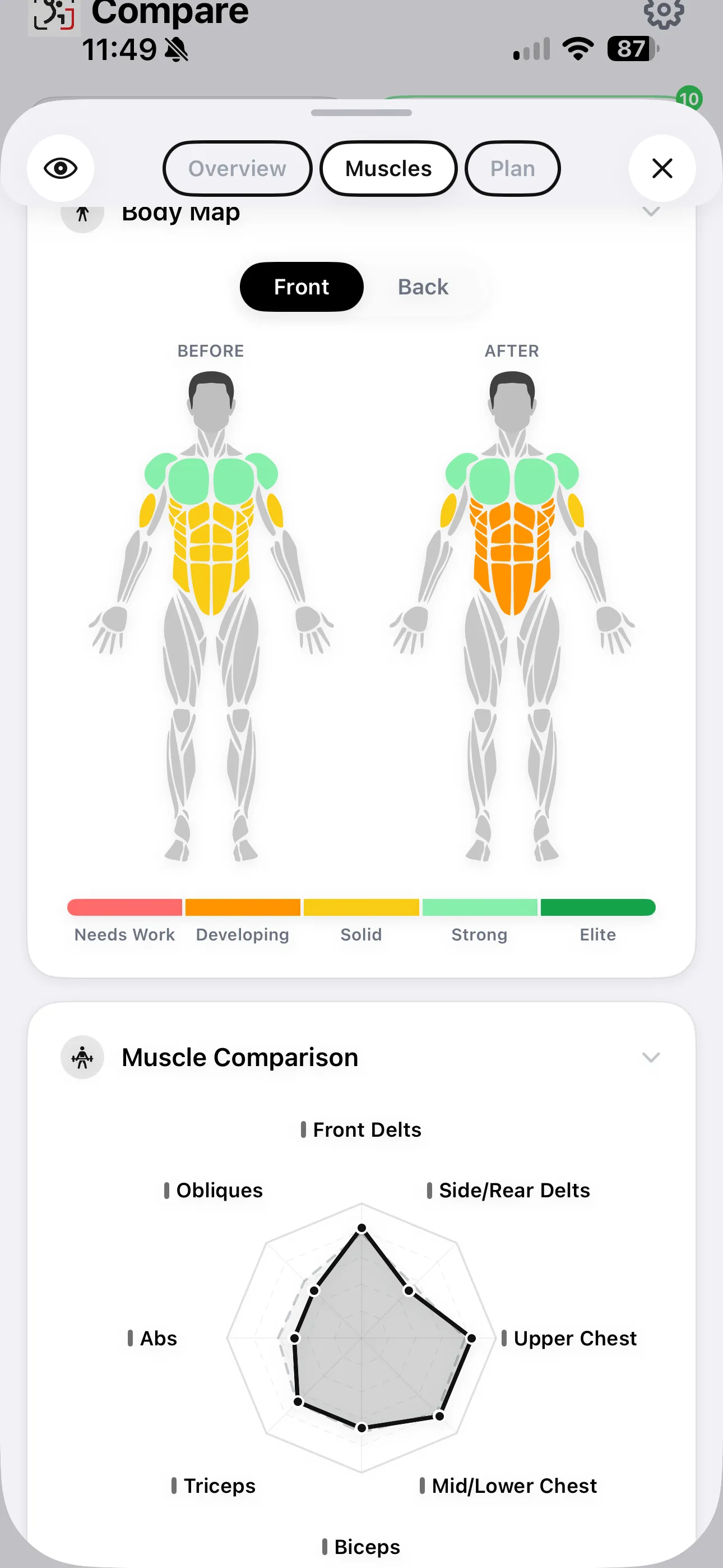
Per-muscle ratings over time: if the biceps score climbs while body fat holds, the tape gain was muscle.
Pair that with the tape and a strength log and you have the full picture - circumference, composition, and performance. Our guide to tracking muscle gain progress covers how to run all three without turning it into a part-time job, and FFMI is the single number that summarizes how much total muscle your frame carries.
What else should you know?
Is 15 inch arms big?
For a lean lifter, yes. Commonly cited averages put untrained adult male arms around 13-14 inches flexed, so 15 inches sits above the large majority of men. The caveat is body fat: 15-inch arms at 12-15% body fat look unmistakably trained, while the same tape reading at 28% mostly doesn't.
What is the average bicep size for a man?
Measurement data commonly cited puts the average adult male upper arm around 13-14 inches flexed, varying with age and body weight. That average includes untrained men at every body fat level - heavier men tape larger without carrying more muscle. Consistent lifters typically land in the 14-16 inch range at moderate leanness.
Are 14 inch arms small?
No - 14 inches flexed is right around the commonly cited adult male average, and above it for lean men. On a lean frame, 14-inch arms look athletic. The 17-inch expectations on lifting forums are anchored to enhanced or heavyweight physiques; for a natural lifter at a healthy body fat, 14 is a normal waypoint.
Should I measure my biceps flexed or unflexed?
Pick one and never switch - flexed at the peak is the standard most size charts assume. Measure cold, not after training, since a pump commonly adds around half an inch. Keep the tape perpendicular to the upper arm at the tallest point of the flexed biceps: same arm, same spot, same time of day.
How fast do biceps grow?
Slowly. Dedicated beginners commonly add around half an inch to an inch of flexed arm circumference in their first year of proper training, and the rate drops sharply after that - a quarter inch in a year is respectable for an intermediate. Fast jumps on the tape usually mean body fat or a pump, not muscle.
Know if the tape gain is muscle
GainFrame rates your biceps - and 11 other muscle groups - from a photo, next to estimated body fat and FFMI. See whether your arms are growing or just getting softer. Free to start on iOS.
Download GainFrame Free