
Quick answer: The earliest signs of muscle growth are progressive strength gains (more weight or reps week over week), clothes fitting tighter across the back and shoulders, and per-muscle composition scores improving. Visible changes in the mirror typically lag the real changes by 4–8 weeks — strength data and body composition tracking show progress first.
Eight weeks into consistent training. You feel stronger. Your lifts are up. Your sleep is better. But you look in the mirror and see almost no change, and you start wondering if any of it is working.
It is. You're just looking in the wrong place.
The mirror is the last signal. By the time you can clearly see muscle growth in your reflection, the physiological process has been happening for weeks. Understanding the earlier signals — the ones that precede the visible change — is what separates people who stick with a program long enough to see results from those who quit in week ten.
Why can't you see muscle growth in the mirror for weeks?
Two things are happening that make the mirror unreliable.
First, your brain adapts to your own appearance through daily exposure. Looking at yourself every day means gradual changes become invisible through a process called adaptation habituation. Friends who haven't seen you in six to eight weeks often notice dramatic changes that you've completely stopped seeing. Progress photos taken four to six weeks apart bypass this bias by forcing a direct visual comparison.
Second, the early stages of muscle growth are largely invisible. The first adaptations to resistance training are neurological — your nervous system learns to recruit more muscle fibers more efficiently. Strength improves substantially before the fibers themselves grow. You're genuinely stronger before you look noticeably different.
What is the most reliable early sign that you're building muscle?
Progressive strength is the single most reliable early indicator. Week over week, you're lifting more weight on your primary compound movements, or performing more reps with the same weight, or both.
This happens within two to four weeks of starting or resuming training — weeks before size changes are visible. The causal chain runs directly from progressive overload to muscle protein synthesis to eventual hypertrophy. If your squat is going up consistently, your quads and glutes are growing. The size confirmation comes later.
Tracking this is simple: log your working sets each session. If the numbers are trending up over a four-week window, muscle is accumulating.
What strength stagnation actually means: if lifts have been flat for four to six weeks AND body fat isn't falling, something in training, nutrition, or recovery isn't working. Stalled strength is an early warning signal, not just a plateau to push through.
What physical changes signal muscle growth before visible definition appears?
These are the signs most people notice before the mirror confirms anything:
Clothes fit differently. Sleeves become tighter across the upper arm and shoulder. Shirts feel tighter across the back. Jeans feel tighter in the quads and hamstrings while looser in the waist. This happens 4–8 weeks before the physique change becomes obvious in photos.
Muscle fullness after training. The pump — increased blood flow and glycogen in trained muscle — becomes more pronounced and lasts longer as muscle tissue develops. A muscle that's grown holds more glycogen and produces more visible fullness post-training.
Improved endurance on the same weight. If you're completing sets that previously required maximum effort with noticeable energy left, your muscles have adapted. This is a functional sign of growth, not just adaptation.
Increased appetite. Growing muscle tissue increases your resting metabolic rate and post-workout caloric demand. A sustained increase in hunger, when not explained by other factors, often correlates with meaningful muscle-building activity.
Better body awareness in compound movements. The ability to feel the target muscle working in squats, rows, and presses — what coaches call the "mind-muscle connection" — improves as the muscle develops and neural recruitment becomes more efficient.
How do progress photos show muscle gains before the mirror does?
The mirror lies to you by updating too frequently. You see every day's noise — water retention, digestion, pump variation, lighting — and never see the signal underneath.
A photo taken four weeks apart under the same conditions (same pose, same lighting, same time of day, same level of pump) bypasses all of that noise. The comparison shows four weeks of accumulated change at once, which is often dramatic even when the daily mirror experience felt like nothing.
Specifically, what photos reveal before the mirror does: muscle definition at lower body fat, shoulder cap development, thickness across the upper back, and the waist-to-chest proportion change. All of these accumulate gradually in a way that daily mirror checks miss entirely.
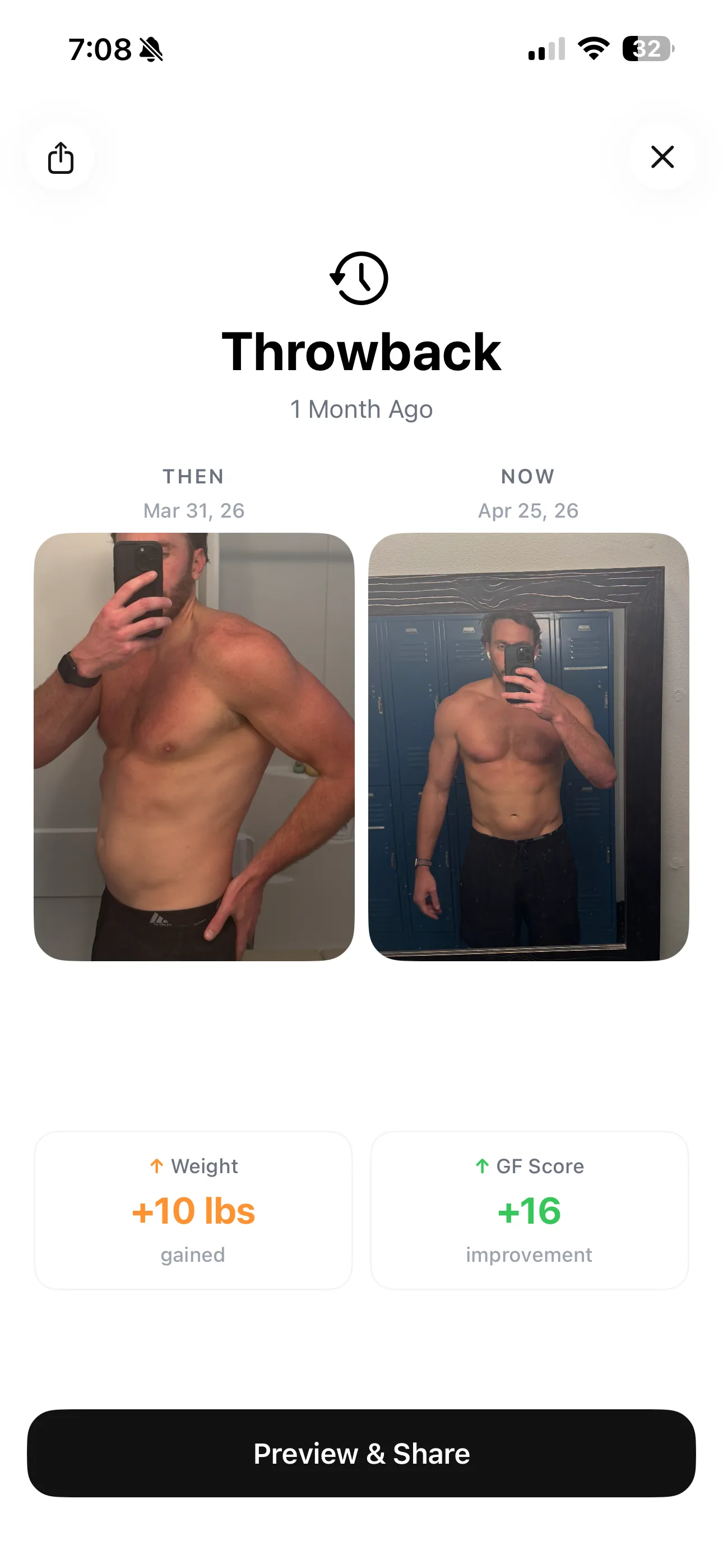
A one-month before/after comparison. The scale delta is small; the composition score delta is +16. This is what muscle gain looks like when the scale doesn't show it — the sign is in the score and the shape, not the weight.
What do per-muscle scores tell you that a scale can't?
The scale tells you total mass. It cannot distinguish between a pound of fat lost and a pound of muscle gained. Both could happen simultaneously, leaving the scale unchanged, while the actual result is significant progress.
Per-muscle composition scores add the granularity the scale lacks. If your shoulder score moves from "Developing" to "Strong" over a 10-week training block, that's a confirmed muscle development signal. If your chest score improves while your body fat percentage holds flat or drops, you're gaining lean tissue, not fat.
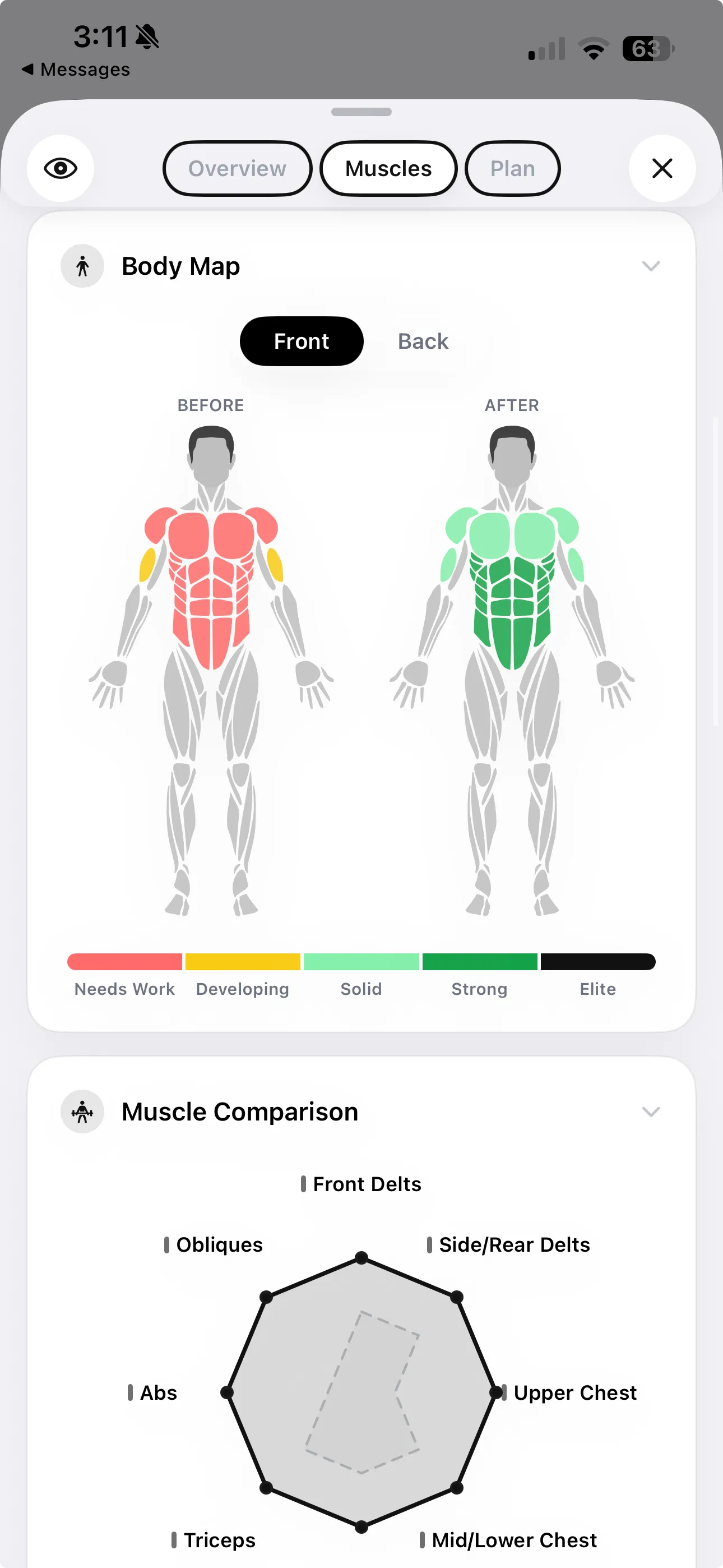
The radar comparison shows where muscle development has accumulated since baseline. Shoulder and chest moving outward from the dotted baseline is confirmation that the training is working — weeks before definition becomes visible in the mirror.
GainFrame tracks body fat percentage and per-muscle scores from each check-in photo, creating a progression record across the training block. When the mirror hasn't confirmed anything yet, the trend in the data already has.
The Signs Checklist
If you're asking whether your training is working, run through these:
- Are your lifts trending up? More weight or reps on your main compound movements over a 4-week window. If yes: muscle is being built. This is the most reliable early signal.
- Are clothes fitting differently? Tighter across back, shoulders, or legs. This typically shows up 4–6 weeks before the mirror confirms anything.
- Have you compared progress photos? Not daily mirror checks — actual side-by-side comparisons four weeks apart under consistent conditions. If you haven't taken any, start now.
- Is body fat percentage trending down while weight holds flat? If so, you're gaining lean mass and losing fat simultaneously — the scale is lying about your progress.
- Are per-muscle scores improving? If you're tracking composition, look for specific muscle groups moving up in rating. This is the earliest data-layer confirmation available.
Frequently Asked Questions
What is the first sign that you're building muscle?
Progressive strength — lifting more weight or more reps on the same movements week over week. This happens within 2–4 weeks of training, often before any visible size changes. Early strength gains are largely neurological: your nervous system recruits more fibers before the fibers grow.
How long before you can see muscle gains in the mirror?
Around 8–12 weeks for most people with consistent training and adequate protein. Progress photos under consistent conditions show changes 4–6 weeks earlier than the mirror, because they eliminate the daily adaptation bias that makes gradual changes invisible.
Does muscle soreness mean you're building muscle?
Not necessarily. DOMS indicates mechanical stress on the muscle but doesn't confirm growth. You can be sore without building meaningful muscle, and you can build muscle without significant soreness once your body adapts to a movement.
Can you build muscle without gaining weight?
Yes. During body recomposition, fat loss offsets the weight of new muscle tissue. Scale weight stays flat or drops while lean mass increases. Body fat percentage trending down alongside increasing strength is the correct signal to watch.
Why does muscle growth look different to others than to yourself?
Your brain adapts to your own appearance through daily exposure, making gradual changes invisible. People who haven't seen you in 6–8 weeks register the cumulative change at once. Progress photos four to six weeks apart replicate this effect.
How do you know if you're gaining muscle or fat?
Track body fat percentage alongside weight. If weight increases and body fat percentage stays flat or drops, lean mass is growing. If body fat percentage rises significantly with the weight, fat gain is outpacing muscle. A fat fraction above 60–70% of total weight gained means the surplus is too large.
How long does it take to see noticeable muscle definition?
3–6 months of consistent training and sufficient protein for most people. The timeline is longer if body fat is high, because definition only becomes visible as fat thins. Someone losing fat while building muscle may see definition emerge faster than someone bulking, even with slower total muscle gain.
See the signs in your data before the mirror shows them
GainFrame tracks body fat percentage and per-muscle scores from your weekly check-in photos — creating a composition progression record that shows muscle development accumulating before it becomes visible in the mirror. The trend in the data is the early confirmation the scale can't give you.
Download GainFrame Free