
Quick answer: For athletes, choose an AI fitness app by sport and planning needs. Shortlist Athletica for adaptive endurance plans, HumanGO for schedule-aware endurance and multisport planning, and Fitbod for gym sessions. Check device connections, race support and how missed workouts change the plan before relying on an app for training decisions.
An app can generate a convincing workout while missing the main constraint in your week: a race, team practice, a long ride or a strength session that needs to fit around it. Athlete-focused planning starts with that calendar.
Research basis: We reviewed current publisher documentation and US App Store listings on September 24, 2026. This is a source-based shortlist, not a hands-on comparison of training outcomes. The screenshots are publisher images. Michael Rode, founder of GainFrame, wrote the guide.
Which app fits your main training goal?
| App | Best reason to shortlist it | Published focus | What to verify in a trial |
|---|---|---|---|
| Athletica | You want endurance sessions that adapt to completed training | Running, cycling, triathlon and other supported endurance formats | Your exact event, sport profile and connected device |
| HumanGO | Your endurance schedule changes and you need replanning | Adaptive plans, availability and goal-based scheduling | Whether your plan includes multisport and multiple goals |
| Fitbod | You need a personalized strength session for the gym you have | Exercise selection, logged training and equipment | How you will coordinate gym load with your sport training |
These are recommendations by use case. We have not established that one algorithm produces superior performance or fewer injuries. If your main need is general workout guidance, start with the broader AI personal trainer comparison.
What does Athletica offer endurance athletes?
Athletica describes an adaptive training engine that responds to completed workouts and fitness and fatigue information. Its published sport options include running, cycling, triathlon, duathlon, rowing and Hyrox. Its FAQ separates that training engine from the conversational coach: a chat explanation is not itself an automatic plan change.
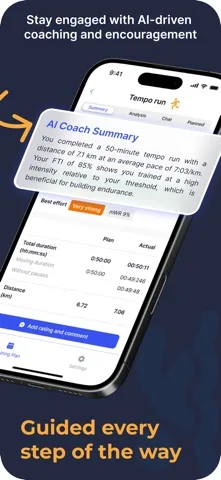
Athletica publisher image from its US App Store listing, checked September 24, 2026. The performance statements shown are illustrative app content.
That distinction matters during evaluation. Ask why a session changed, then inspect the calendar itself. Check that the plan uses the event and available training time you entered. The publisher's mobile-versus-web guide also makes clear that the interfaces do not contain identical features.
Best fit: an endurance athlete willing to review an adaptive calendar and its device workflow. Main limitation to check: whether the features you need are available on the device you actually use. Athletica on iOS.
When should you consider HumanGO?
HumanGO describes plans shaped by goals, fitness and available training time, with replanning when availability changes. Its current product page distinguishes a single-sport Essential offering from Premium features that include multisport, multiple goals and a race planner. Confirm the plan you are trialing includes the capability you need.
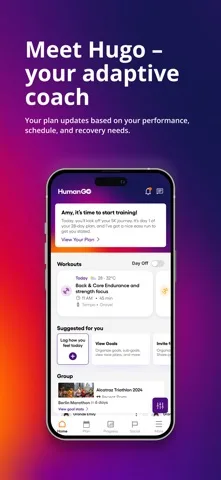
HumanGO publisher image from its US App Store listing, checked September 24, 2026. It illustrates the coaching interface rather than a tested result.
Best fit: an endurance athlete whose work, travel or family schedule changes frequently. Main limitation to check: how a revised week balances your priorities when every planned session no longer fits. A useful trial task is changing availability and reviewing exactly what the app removes or moves.
Use the HumanGO iOS listing to check current device requirements and purchase options. Confirm your particular watch or activity service during setup; a broad promise of connected training does not establish every integration you might need.
Where does Fitbod fit an athlete's plan?
Fitbod's published focus is personalized gym training based on goals, equipment, experience and recorded workouts. Its training-system explanation describes adapting exercise and progression suggestions using those inputs. The iOS listing also includes building and saving your own workouts.
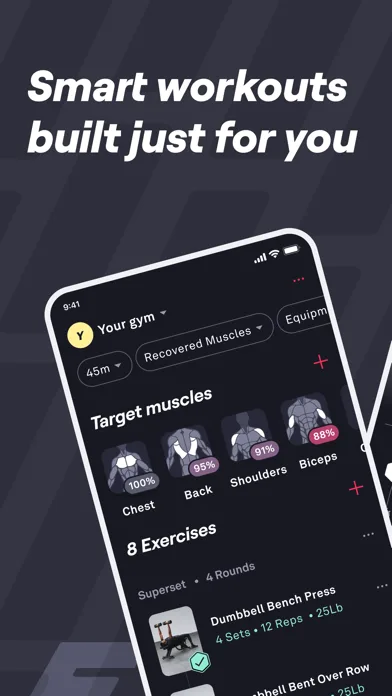
Fitbod publisher image from its US App Store listing, checked September 24, 2026. Muscle-recovery percentages represent an app model, not direct tissue measurements.
Best fit: an athlete who wants help selecting and logging strength sessions. Main limitation to check: coordination with sport training. Do not assume an app-generated gym session automatically accounts for every practice, competition or endurance load in another system.
If a coach already prescribes your strength program, saved workouts and reliable logging may matter more than fresh suggestions. See our Gravl vs Fitbod guide for that gym-planning decision. Fitbod on iOS.
What do the current App Store ratings tell you?
| US App Store snapshot | Rating | Number of ratings |
|---|---|---|
| Athletica | 4.2/5 | 41 |
| HumanGO | 4.5/5 | 21 |
| Fitbod | 4.8/5 | 285,465 |
Retrieved from Apple's lookup data on September 24, 2026 and rounded to one decimal place. The different audiences and sample sizes make these poor measures of coaching quality. Use them as store context, then evaluate the workflow yourself.
What should an athlete test before subscribing?
Start with a realistic week from your existing routine. Keep your training decisions within your ability and any professional guidance while you assess the software.
| Trial task | What a useful result looks like |
|---|---|
| Enter your event and availability | The calendar reflects both, with assumptions you can review |
| Connect your usual device | Completed sessions arrive with the fields the app actually uses |
| Change one available training day | You can understand which sessions moved, changed or disappeared |
| Correct a mistaken activity | The training history reflects the correction |
| Add your other sport or gym work | You know whether the app incorporates it or you must coordinate it yourself |
| Inspect the renewal offer | You understand the billed total and the included plan features |
Check whether a subscription is purchased through the website or the App Store, and compare the actual renewal offers over the same period. We do not assign a universal price winner because offers and feature tiers can differ.
How should you judge whether the app is useful?
Track whether the plan fits your schedule, whether you understand its recommendations, and whether logging creates extra work. Review sport-specific performance with the context of your training and recovery. A few sessions can reveal usability problems; they cannot establish that an algorithm caused a performance improvement.
For photo-based physique goals alongside sport, GainFrame can organize visual check-ins. It is a separate progress tool, not a claimed integration with these planners or a substitute for race and workout records.
What else should you know?
Which AI personalized fitness app is best for athletes?
The best starting point depends on the sport and planning task. Athletica and HumanGO focus on adaptive endurance planning, while Fitbod focuses on gym workouts. Check your exact event, device connection and scheduling needs before choosing. This comparison does not establish a single winner for performance outcomes across different sports.
Can an AI app plan both strength training and endurance?
Some products advertise multiple training formats, but support depends on the app and subscription tier. Check whether the plan actually coordinates those sessions or merely records them. If you use separate gym and endurance apps, you may still need to manage the combined workload yourself or with a coach.
Will these apps adjust when I miss a workout?
Athletica and HumanGO describe adaptive planning, but the useful question is how the revised week changes in your situation. Test a schedule edit and inspect the resulting calendar. Do not assume a chat response, an activity sync or a moved session means the whole plan has been recalculated appropriately.
Are App Store ratings proof that the coaching works?
No. Ratings summarize user reviews from different audiences and sample sizes. They do not isolate the quality of a training algorithm or demonstrate improved race performance. Use them alongside publisher documentation and your own workflow trial, and keep claims about training outcomes separate from claims about app usability.
Should I replace my human coach with an AI app?
That depends on the support you need. An app may help with scheduling, logging and routine recommendations, while a coach can interpret broader context and communicate about competing priorities. If you already work with a coach, agree on how the app fits the plan instead of following conflicting prescriptions.