
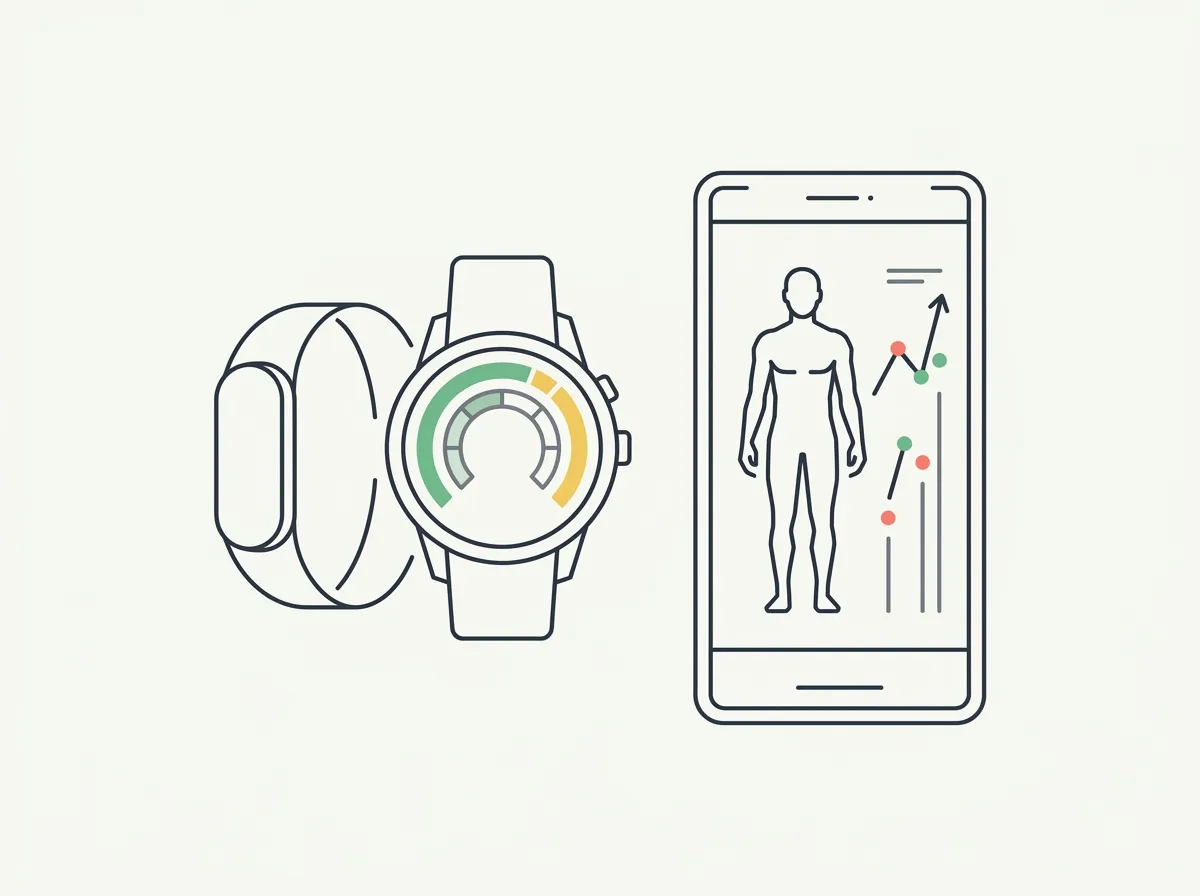
Quick answer: The best WHOOP alternative for most lifters is the Apple Watch they already own plus Athlytic, which turns Apple Health data into WHOOP-style recovery and strain scores for a small subscription. Want zero subscription? Garmin's Body Battery is built into the watch. Want zero hardware? Welltory reads HRV through your phone camera. And for the question WHOOP can't answer — is my body actually changing? — GainFrame reads your progress photos.
WHOOP earned its reputation. The band is comfortable, the app is polished (4.73 stars across 34.9K+ ratings), and its recovery model — sleep, HRV, resting heart rate rolled into one morning number — genuinely changed how athletes think about readiness.
But WHOOP is hardware plus a membership. The subscription tiers have shifted over the years, so check whoop.com for current pricing — the structural point is that you're paying continuously for a model built around endurance strain: cardiovascular load measured by heart-rate time-in-zone. A tempo run lights that model up. A heavy squat session — long rests, low average heart rate, brutal systemic fatigue — barely registers.
If you lift, you're paying an ongoing fee for a score that undercounts your hardest work. These five alternatives each fix a different part of that.
What should a WHOOP alternative give a lifter?
Be honest about what you actually use WHOOP for, because the fixes differ:
- "I want the recovery score without the membership" → the signals (sleep, HRV, RHR) are commodity data now. A watch you own — or already own — can produce the same score.
- "I want to know if I'm recovered enough to train hard" → any of the recovery tools below covers this. How to read that number as a lifter is its own skill — we wrote a full guide on recovery scores for lifters.
- "I want proof the training is working" → no strap measures this. Strain and recovery are inputs. For a lifter, the output is a changing physique — and that takes a different kind of tool entirely.
| Tool | What it measures | Cost structure | What it fixes |
|---|---|---|---|
| Apple Watch + Athlytic | Recovery + strain from Apple Health | Watch + small app sub | WHOOP scores without new hardware |
| Oura Ring | Sleep-first recovery | ~$299+ ring + ~$5.99/mo | Best-in-class sleep signal, no wrist strap |
| Garmin (Body Battery) | Energy/recovery, built in | Watch only — no subscription | Kills the membership entirely |
| Welltory | HRV via phone camera | App only — no wearable | Recovery signal with zero hardware |
| GainFrame | Physique change + recovery score | Free / $5.99 mo | Shows whether your body is actually changing |
1. Apple Watch + Athlytic — Best like-for-like replacement
Platform: iOS App Store · Price: small subscription (check listing) — plus the Apple Watch you likely already own
Here's the quiet truth about WHOOP's data: an Apple Watch collects almost all of it. Sleep stages, overnight HRV, resting heart rate, workouts — it's all sitting in Apple Health. What Apple doesn't do is compute a recovery score from it.
Athlytic (4.79 stars, 10.6K+ ratings) fills exactly that gap. It reads your Apple Health data and produces daily recovery and exertion scores that closely mirror WHOOP's model — same signals, same morning-number workflow — for the price of an app subscription instead of a hardware membership.
Best for: anyone with an Apple Watch who wants WHOOP's core experience without buying or renting new hardware. Limitations: score quality depends on wearing the watch to sleep; the strain side inherits the same endurance bias as WHOOP's.
2. Oura Ring — Best sleep-first recovery
Platform: iOS & Android app · Price: ~$299+ for the ring, ~$5.99/mo membership
Oura (4.86 stars, 265K+ ratings — the largest review base in this roundup) comes at recovery from the sleep side. The ring form factor is its argument: nothing on your wrist in the gym, nothing snagging on a barbell, and a sensor that sits closer to the skin for overnight readings. Its readiness score weighs sleep quality heavily, which suits lifters — sleep is the single most actionable recovery lever you have.
There's still a subscription, so it doesn't fix the membership complaint — but the hardware is yours, the monthly fee is modest, and the sleep data is the best consumer-grade signal in this list.
Best for: lifters who know sleep is their weak point and hate wearing anything on their wrist. Limitations: subscription remains; no meaningful in-workout data — it's a recovery device, not a training tracker.
3. Garmin — Best no-subscription pick
Platform: Garmin watches + Connect app · Price: watch only — no subscription
If the membership is the thing you resent, Garmin ends the argument. Body Battery — Garmin's energy score built from HRV, stress, sleep, and activity — ships built into the watch. Buy once, and the recovery features work for the life of the device. No tier to lapse, no card on file.
The catch is that Garmin's software ecosystem is built for endurance athletes even more than WHOOP's is. The lifting experience (strength logging, muscle-load mapping on newer models) has improved, but the design center is still running dynamics and VO2 max.
Best for: the "whoop alternative no subscription" searcher — this is the answer. Limitations: endurance-first software; watch prices range widely; Body Battery is a coarser model than WHOOP's recovery percentage.
4. Welltory — Best zero-hardware option
Platform: iOS & Android · Price: free tier; premium subscription (check listing)
No band, no ring, no watch. Welltory (4.74 stars, 130K+ ratings) measures HRV through your phone's camera — fingertip over the lens for a couple of minutes — and turns it into stress and recovery readings. It also pulls in data from other sources if you have them.
The trade-off is obvious: a morning spot-check isn't continuous overnight monitoring. You get a snapshot of your nervous system, not a full sleep architecture breakdown. But as a free-to-start way to learn how HRV responds to your training, it's the lowest-commitment entry point in this list.
Best for: testing whether recovery data changes your training decisions at all — before spending anything on hardware. Limitations: spot-checks depend on consistent timing; no sleep staging; premium tier needed for depth.
5. GainFrame — Best for the question WHOOP can't answer
Platform: iOS App Store · Price: Free (25 photos) with Pro at $5.99/mo or $39.99/yr
Full disclosure: GainFrame is our app, and it is not a WHOOP replacement for strain or continuous HRV monitoring. It doesn't measure strain at all, and it isn't a wearable. It sits in a different lane — the one every tool above stops short of.
Strain and recovery are inputs. For a lifter, the output is a changing physique — and no strap on your wrist can see it. GainFrame reads your progress photos with AI and returns an estimated body fat %, FFMI, a 1–100 physique score, and ratings for 12 muscle groups, building a scored timeline you can compare check-in to check-in.
It also closes the loop on the recovery side: GainFrame's recovery score reads the signals your Apple Watch already writes to Apple Health — sleep, HRV, resting heart rate — so your morning readiness number and your physique trend live in the same app. Recovery tells you when to push; the photo timeline tells you whether the pushing is working. Our recovery score guide for lifters covers exactly how to read that number.
Best for: lifters whose real question is "is my body actually changing?" — used alongside a watch, not instead of one. Limitations: iOS only; no strain measurement; the recovery score depends on a wearable feeding Apple Health.
Which WHOOP alternative should you pick?
- Own an Apple Watch? Start with Athlytic. You already own the sensor; you're just missing the score. This is the closest like-for-like WHOOP replacement for the least new money.
- Hate subscriptions? Buy a Garmin. Body Battery ships in the watch, forever. Accept the endurance-flavored software as the price of freedom.
- Sleep is your weak point? Consider Oura. The best consumer sleep signal, in a form factor that never touches a barbell.
- Not sure recovery data matters to you? Try Welltory free. Two weeks of phone-camera HRV readings will tell you whether a readiness number changes your decisions.
- Whatever you pick, add an outcome layer. Recovery optimization with no evidence of physique change is optimizing an input nobody can see. Photos — scored or not — are the lifter's ground truth.
Frequently asked questions
Is there a WHOOP alternative with no subscription?
Yes — Garmin. Its watches include Body Battery, a recovery-style energy score built from HRV, stress, sleep, and activity, with no subscription required. You pay once for the watch and the recovery features keep working. That makes Garmin the default pick for anyone whose main complaint about WHOOP is the ongoing membership.
Can an Apple Watch replace WHOOP for recovery tracking?
Mostly, with one addition. The Apple Watch collects the same underlying signals WHOOP uses — sleep, HRV, resting heart rate — but Apple doesn't compute a recovery score from them. Apps like Athlytic (4.79 stars, 10.6K+ ratings) read that Apple Health data and produce daily recovery and strain scores that closely mirror WHOOP's, for a small app subscription instead of a hardware membership.
Do lifters actually need strain tracking?
Usually not in the form WHOOP provides. Strain models are built around cardiovascular load — heart-rate time-in-zone — which maps well to running and cycling but poorly to a heavy 5x5 session that barely elevates average heart rate. Lifters get more value from the recovery side (sleep, HRV, resting heart rate) plus direct evidence that their physique is changing.
What is the cheapest way to get a recovery score?
Welltory (4.74 stars, 130K+ ratings) measures HRV through your phone's camera — you place a fingertip over the lens — so there's no wearable to buy at all. It's a spot-check rather than continuous overnight monitoring, but for a daily morning readiness reading the price is hard to beat.
Does GainFrame replace a WHOOP band?
No. GainFrame doesn't measure strain and isn't a wearable — it's the outcome layer. It reads recovery signals your Apple Watch already collects (sleep, HRV, resting heart rate) into a recovery score, and pairs that with AI analysis of progress photos: body fat percentage, FFMI, and 12 muscle-group ratings. It answers the question no strap can — whether your body is actually changing.
See the output, not just the inputs
GainFrame turns progress photos into scored check-ins — body fat %, FFMI, 12 muscle ratings — and reads your watch's recovery signals alongside them. Free to start on iOS.
Download GainFrame Free