
Quick answer: A recovery score combines overnight signals — sleep, HRV, resting heart rate, temperature, and recent strain — into one readiness number. For a lifter, it's a heuristic, not a command: use a high score to push hard and a low one to trim intensity, not to skip the gym. The two-week trend matters more than any single day.
You wake up wrecked. Bad sleep, heavy legs, a meeting that ran late. Leg day is on the calendar. Do you grind through it, back off, or skip it?
Most lifters answer this with ego or guilt — push because skipping feels weak, or bail because they "don't feel it." Both are guesses. A recovery score is an attempt to replace the guess with a signal. The catch is that these scores were built for endurance athletes chasing performance, and a lifter chasing a physique has to read them differently.
What does a recovery score actually measure?
It's a single number that bundles several overnight signals into an estimate of how ready your body is for hard training.
Most implementations pull from the same inputs: sleep duration and quality, heart rate variability (HRV), resting heart rate, body temperature, respiratory rate, and how much training strain you've accumulated recently. Each gets weighted and rolled into one score, usually out of 100.
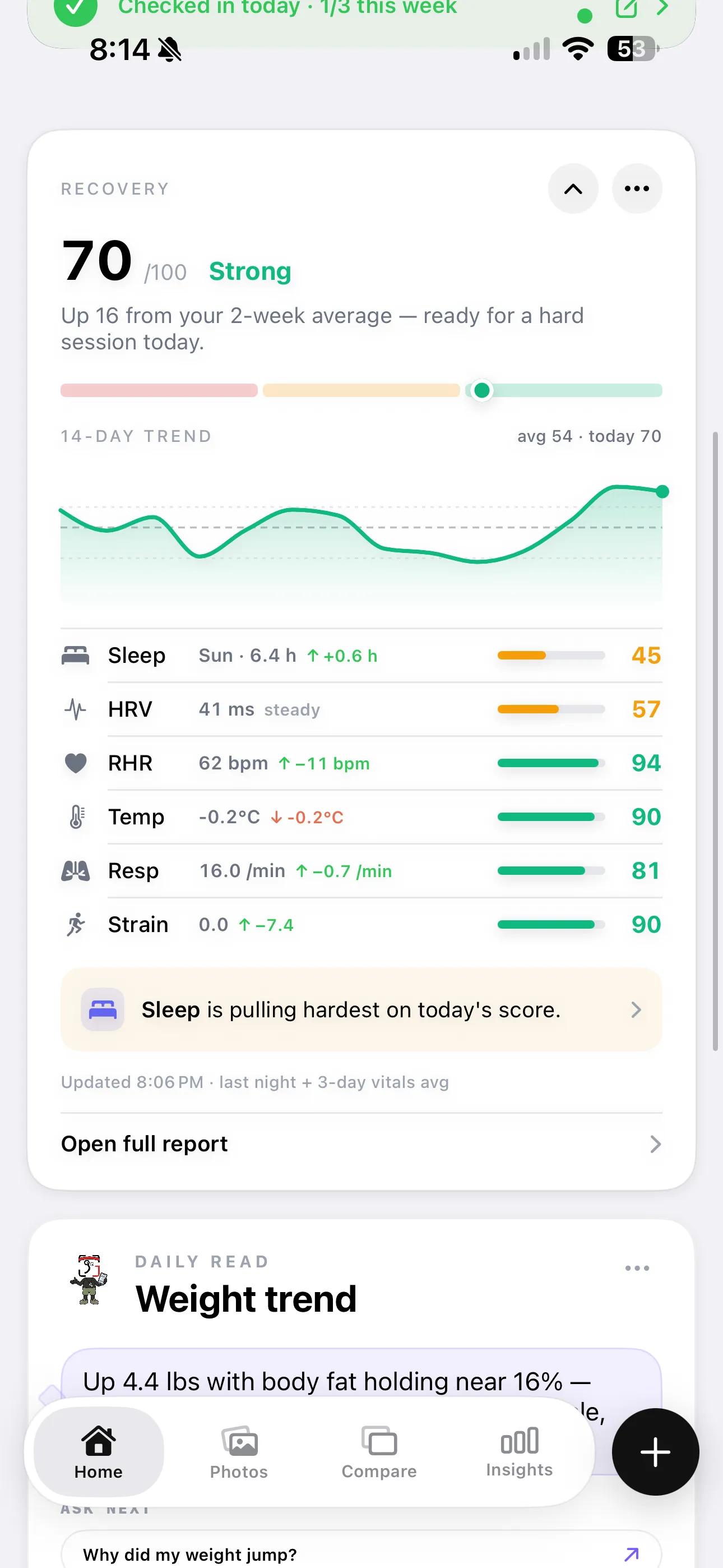
A recovery score with its underlying signals — and a note on which one is pulling hardest today.
The useful detail is not the number itself but which signal is driving it. A 60 because you slept four hours means something very different from a 60 because your HRV dipped after a hard week. A good recovery view tells you what's dragging — and overnight sleep is usually the heaviest lever.
This is also the honest limitation: it's a weighted heuristic from wearable data, not a direct readout of muscle recovery. It reflects systemic, autonomic readiness, which correlates with how a session will go but doesn't measure your actual tissue.
Do recovery scores matter for lifters, or just endurance athletes?
They matter — but the way you use one should be different.
Endurance platforms frame recovery around hitting a performance peak: train hard when green, ease off when red, optimize the workout. A lifter's goal isn't peaking for a race. It's accumulating quality training over months without digging a fatigue hole. So the value of a recovery score for a lifter is mostly defensive.
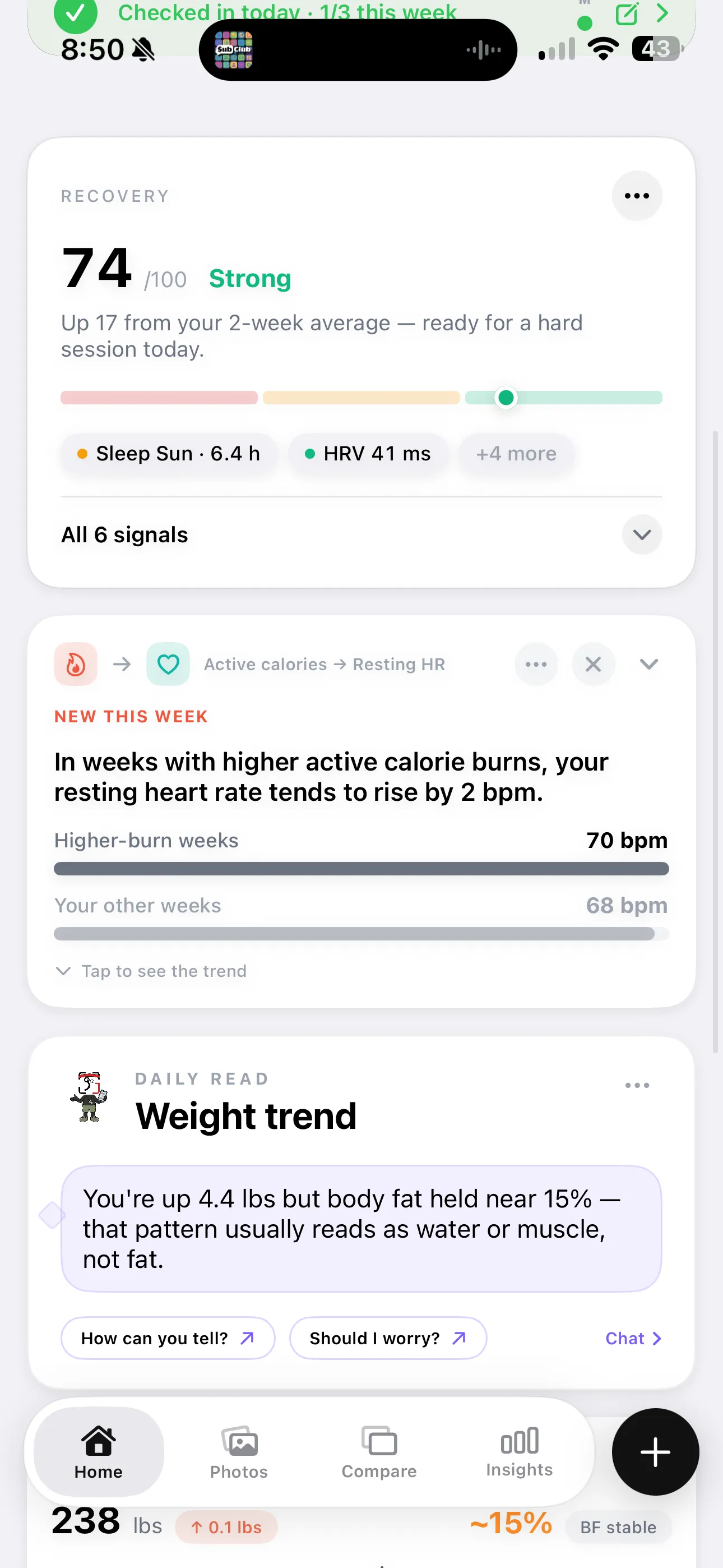
The lifter's use case: spot when fatigue is accumulating — like sleep drifting below your range — before it eats your training quality.
Under-recovery rarely makes you collapse in one session. It erodes you slowly — slightly worse sleep, slightly blunted appetite, slightly lower output — until your hard sessions aren't actually hard and your progress quietly stalls. A recovery score is an early warning for that drift, not a daily performance optimizer.
Should you skip the gym on a low recovery day?
Almost never. The right response to a low score is to adjust the session, not cancel it.
- Green / high: train as planned, and if you've been waiting to push a top set or add load, this is the day.
- Yellow / moderate: train, but cap it. Hit your working sets, skip the all-out top sets and the optional extra volume.
- Red / low for one day: still go. Drop intensity — lighter loads, more technique work, lower volume. Movement and consistency beat sitting out.
- Red for several days running: this is the real signal. Take a planned deload or fix the obvious cause (usually sleep) before fatigue compounds.
Skipping sessions outright is the worst default, because consistency is the variable that actually builds a physique. One low-readiness day handled with reduced intensity costs you nothing. A habit of bailing whenever a number is low costs you everything.
How does recovery actually connect to your physique?
Indirectly — which is exactly why it's easy to over- or under-rate.
Recovery doesn't build muscle. Training hard, eating enough protein, and being in the right energy balance build muscle. But chronic under-recovery caps the quality of all three: poor sleep flattens your sessions, drives cravings, and slows the adaptation that turns training into tissue.
So the honest framing is this: a recovery score is a supporting signal layered on top of the things that matter, not one of them. The real scoreboard is still your body-fat trend, your strength, and your progress photos over months. Recovery just helps you keep showing up to that scoreboard with quality work. In GainFrame the recovery view sits alongside your body-composition tracking and pulls its signals from Apple Health and your watch — context for your training, not a replacement for measuring the result. It's iOS only.
Read a recovery score like a dashboard light, not a verdict. Green means push. Yellow means trim. Red means adjust — and only a red streak means rest.
Frequently Asked Questions
What does a recovery score measure?
A recovery score combines overnight signals — usually sleep, heart rate variability, resting heart rate, body temperature, respiratory rate, and recent training strain — into one number that estimates how ready your body is to handle hard training. It's a weighted heuristic from wearable data, not a direct measurement of muscle recovery.
Do recovery scores matter for lifters or just endurance athletes?
They were designed around endurance load, but the underlying signals — sleep and HRV especially — still reflect systemic readiness for lifters. The difference is how you use it: not to chase a performance peak, but to avoid grinding junk volume when you're under-recovered, which adds fatigue without adding muscle.
Should I skip the gym if my recovery score is low?
Usually no. A low score is a reason to adjust intensity, not skip the session. Drop the top sets, cut volume, or swap a heavy day for technique work. Missing sessions entirely costs you consistency, which matters far more for a physique than any single day's readiness.
Is a recovery score accurate?
It's a directional estimate, not a precise instrument. The trend over a week or two is more reliable than any single day, and the score is most useful when one signal — like sleep — is clearly dragging. Treat a sustained drop as worth investigating and a single low day as noise.
How does recovery connect to building muscle?
Recovery doesn't build muscle directly, but chronic under-recovery quietly stalls progress: worse sleep means worse sessions, blunted appetite, and accumulating fatigue that caps your training quality. Used well, a recovery score helps you keep training hard sustainably, which is what actually drives body composition over months.
Keep recovery next to the result it protects
GainFrame layers a recovery readiness view — built from your Apple Health and watch signals — right alongside your body-fat trend and per-check-in scores, so you can see when fatigue is building before it eats your training quality. Free for your first 25 photos, iOS.
Download GainFrame Free