
Quick answer: To identify lagging muscle groups, define your visual goal, compare repeatable front, side and back photos, and review the training those areas actually receive. Use exercise records to assess performance separately. A smaller-looking area or a low AI rating does not by itself establish weakness, injury or a need for more training.
Your chest looks fuller in a front photo, but your shoulders look smaller from the back. You add extra shoulder work, then take another picture under the gym lights and everything looks different again. Before changing the program, you need a comparison you can trust.
Learning how to identify lagging muscle groups starts with separating three questions: what you want to look different, what you want to lift better, and whether something hurts or has lost function. One photo cannot answer all three.
What does a lagging muscle group actually mean?
In a physique discussion, a lagging group usually means an area you would like to develop relative to the rest of your body. That is an aesthetic priority, shaped by your goals and proportions. It is not automatically a problem that requires correction.
A performance limitation is different: perhaps your left side consistently completes fewer controlled repetitions in a particular exercise. A clinical concern is different again: pain, a new loss of strength, or difficulty with everyday movement. Keep these categories separate when deciding what evidence to collect.
| Your question | Useful evidence | What a photo cannot establish |
|---|---|---|
| “Would I like more shoulder development?” | Comparable photos over time and your own preferences | A universal ideal shoulder size |
| “Is one side performing differently?” | The same exercise, range of motion, load and effort | Force production or the cause of a difference |
| “Why does this movement hurt?” | Assessment by an appropriate clinician | An injury diagnosis |
You also do not need every body part to develop identically. A small MRI study of resistance training found nonuniform growth across muscles and body regions. It involved only three young men, so it cannot provide a universal rule for which area should grow fastest or how your physique should look.
Which photos help you assess visual development?
Use front, side and back views. Pick either relaxed or a particular flexed pose and repeat that same pose; keep separate comparisons for each. A slightly different arm position can change the apparent outline of the shoulders, chest and back.
Keep the camera height, distance, lens and lighting consistent. Take the photos at a similar point relative to training so one comparison is not pumped and the other rested. Wear clothing that lets you see the area you care about without changing how it sits between sessions. The solo progress photo guide gives you a repeatable setup.
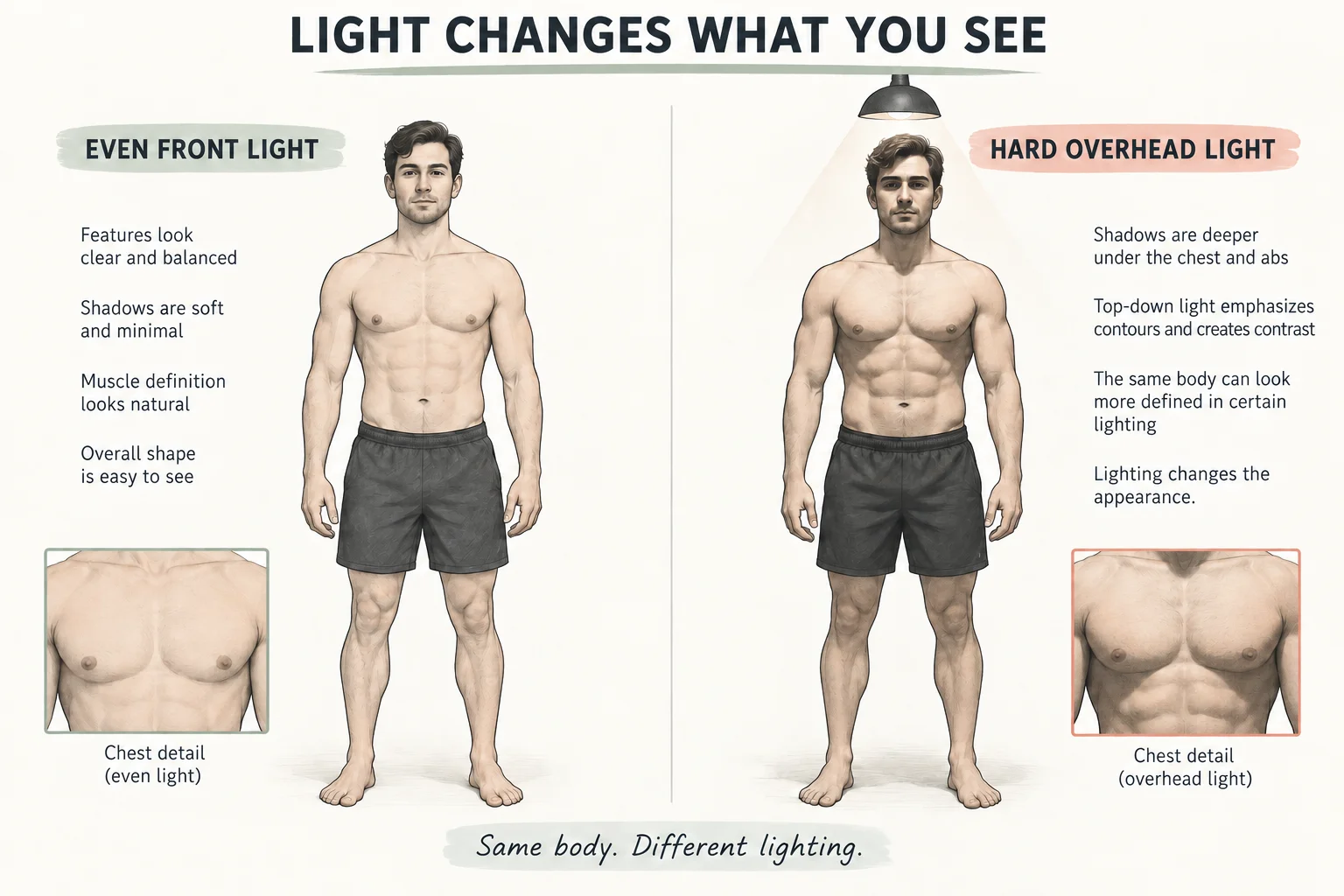
Illustrated comparison: stronger shadows can make the same physique look more defined. This is an illustration of lighting, not a measured body-composition result.
Look for a pattern across comparable dates and more than one useful view. If an area looks different only in one frame, check the photo setup first. Fat loss can reveal outlines that were already there, while a change in pose can make one side look larger. Neither observation by itself quantifies new muscle tissue.
You can write a neutral note such as “I want to review rear-shoulder appearance in the next matching back photo.” That is a more useful starting point than declaring a muscle weak from a single image.
How do you separate appearance from actual strength?
For strength, use the training log. Compare the same exercise on the same equipment, with the same range of motion, rest interval and approximate effort. If one set ended with several repetitions available and the next went to failure, the repetition counts do not describe the same task.
A bench press improvement also cannot isolate which muscle changed. Compound movements involve several muscles, and the way you perform the movement matters. In a study of knee-extensor training, both neural and muscle-size changes contributed to strength improvements. A lift is useful performance evidence, but it is not a direct photograph of muscle growth.
For a side-to-side concern, record comparable sets on both sides without forcing extra repetitions through pain. A qualified coach can help review setup and technique. Persistent pain, unexplained new weakness or loss of function warrants clinical assessment rather than a photo score.
What should you check before adding more exercises?
Review what you actually completed, including indirect work from compound exercises. A program on paper and a month of logged workouts can tell different stories. Use this short audit before adding volume:
- Attendance: Did you consistently complete the planned sessions for the area?
- Execution: Did technique and range of motion stay comparable as load changed?
- Effort: Were sets challenging in a way you can repeat and record?
- Exercise fit: Can you perform the movement comfortably and consistently?
- Recovery: Are you arriving at the next session ready to perform, or repeatedly carrying symptoms and fatigue?
- Goal: Is the concern about visible development, a specific lift, or someone else's proportions?
If the log has large gaps, start by making the existing plan repeatable. If the log is consistent and the priority still matters to you, choose one manageable programming change. The point is to make its effect interpretable. Changing five exercises and your photo setup together makes that harder.
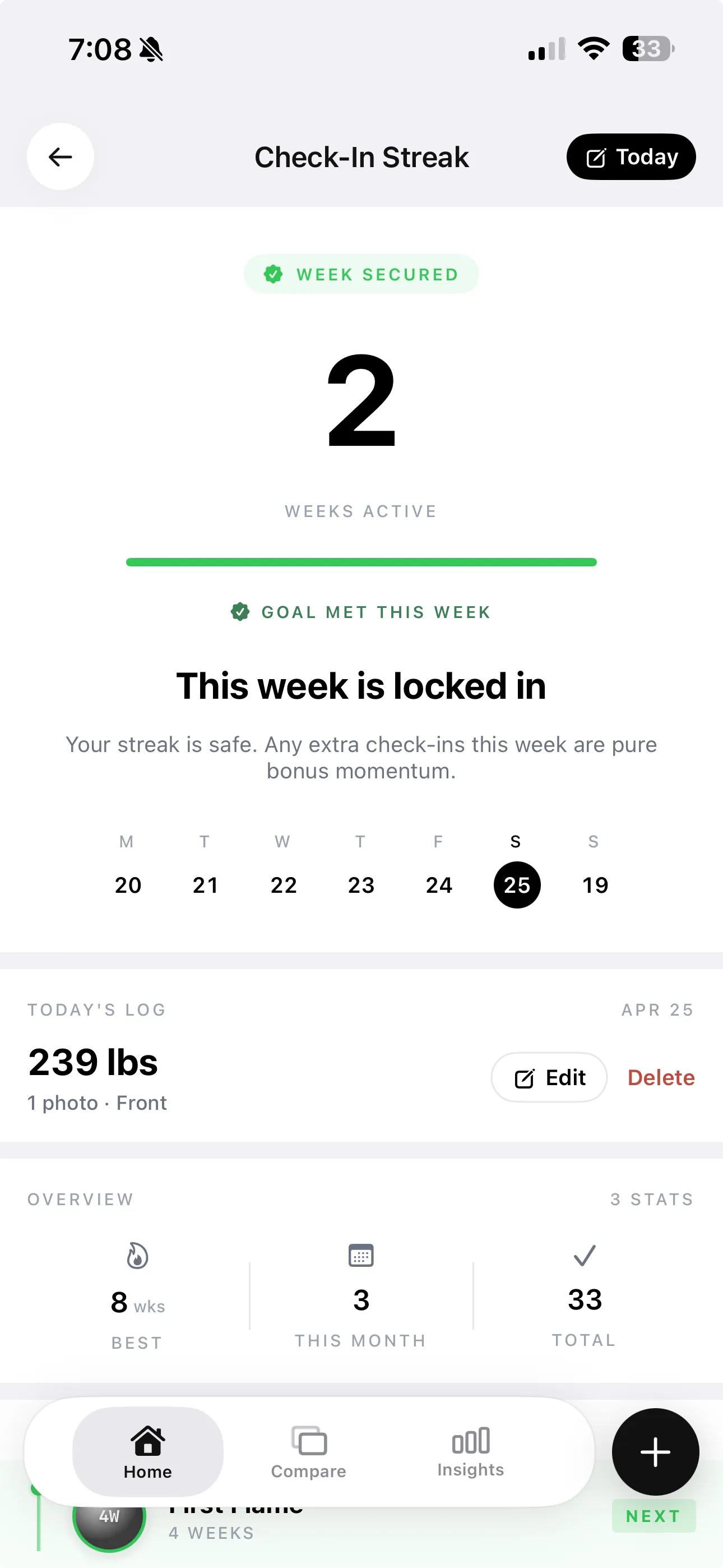
The calendar records whether you checked in. A streak measures the habit, not whether a particular muscle grew.
For a broader recording system, use how to track muscle gain progress. It combines the photo log with exercise performance and measurement context, without assuming any single signal proves growth.
Can a muscle map help you choose what to review?
A visual map can organize your attention. GainFrame offers photo-based ratings across 12 muscle areas and a comparison view, alongside a dated photo library. Those ratings describe the model's visual assessment. They do not measure muscle strength, diagnose an imbalance or establish that a red area needs extra training.
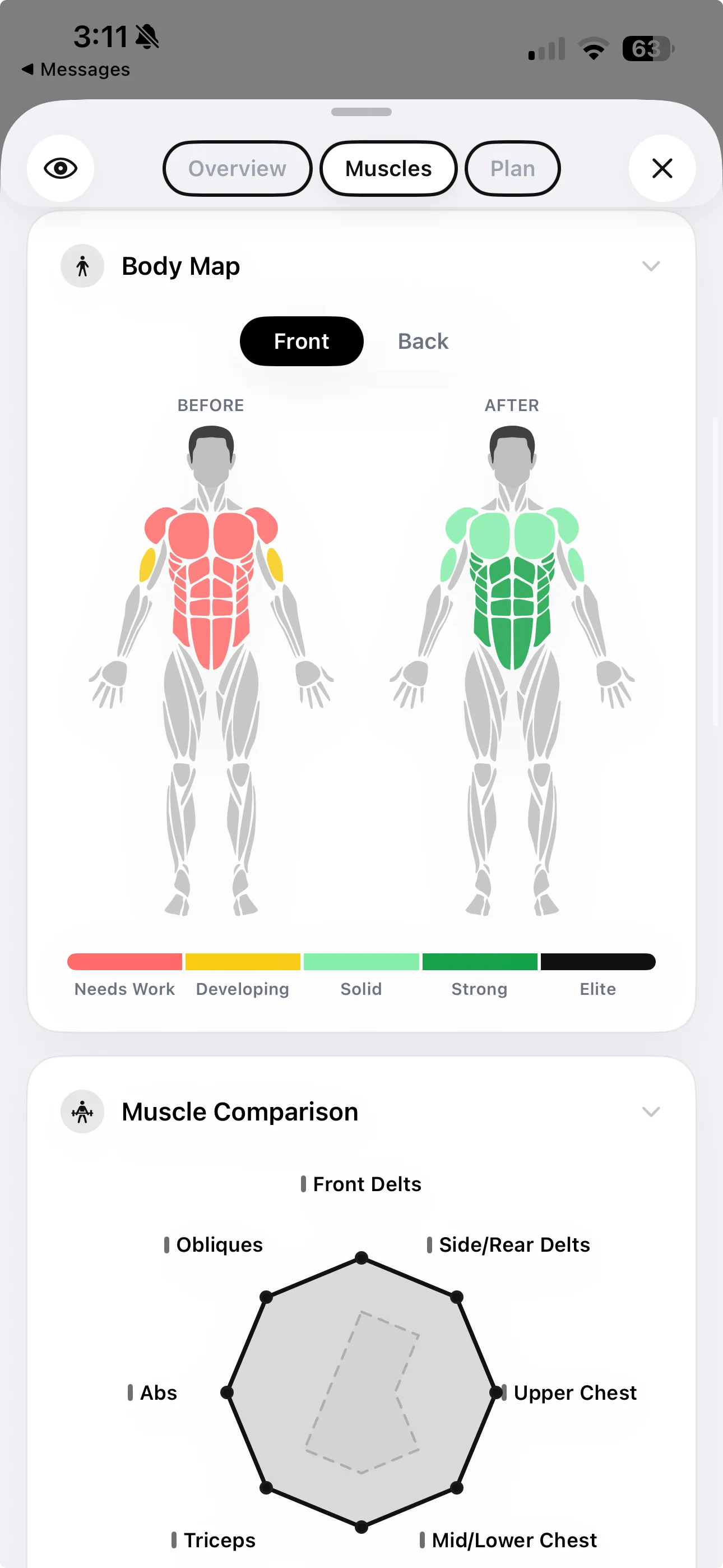
Example visual ratings in the app. Labels such as Strong describe its appearance scale; they are not strength tests or clinical findings.
If a rating surprises you, inspect the original image. Was that area visible? Did the pose or light change? Does the same observation appear across comparable photos? Check the exercise log before making a program change. The app's photo library remains on-device; selected photos are sent for AI processing and are not stored on its servers.
A score moving upward also cannot establish how much tissue grew. Read the signs of muscle gain guide for a way to weigh several observations together.
What can this approach establish, and where are its limits?
It can help you choose a personal development priority, improve the quality of your records and notice whether your training is becoming more consistent. It cannot determine an ideal physique, calculate the size of an individual muscle from a casual photo, or diagnose the cause of weakness.
The research above concerns measured adaptations under specific training conditions. It does not validate an AI rating system or this home photo checklist. The checklist is a practical way to keep your decisions tied to comparable information.
How should you review a possible lagging muscle group?
Use the same evidence at each review so the goal stays clear. You can schedule a check-in without promising that visible growth will appear by that date.
- Name the goal. Choose one visible development goal or one exercise performance goal, and write down which one you mean.
- Repeat the photos. Take comparable front, side and back views without a workout pump, using the same light and camera setup.
- Audit the training record. Review completed exercises, sets, repetitions, technique and effort before assuming the muscle needs more work.
- Make one manageable change. Choose a change you can recover from and record consistently; use a qualified coach when you need programming help.
- Review the same evidence. Compare the next set of photos and exercise records under the original conditions before deciding what to adjust.
To keep your dated photos and visual comparisons together, download GainFrame for iPhone. Free download with limited check-ins. Optional Pro subscription; current price and limits are shown in the app.
What else should you know?
How can I tell which muscle groups are lagging?
Define what lagging means for your goal, then compare repeated front, side and back photos under similar conditions. Check your training records for the area you want to develop. A consistent visual pattern can help choose a priority, but photos cannot directly measure individual muscle size, strength or injury.
Does a smaller-looking muscle mean it is weaker?
No. Appearance and performance answer different questions. Pose, lighting, body fat and your proportions affect how a muscle looks. Strength also depends on the exercise and how it is performed. Use comparable exercise records for performance questions, and seek assessment for persistent pain, unexpected weakness or loss of function.
Can AI identify my weak muscles from a photo?
AI can offer a visual rating or suggest areas to review, but it cannot test force production, diagnose injury or determine your training needs from appearance alone. Treat a low rating as a prompt to check the image and your records. It is not a prescription to add more volume.
Should I train a lagging muscle every day?
A photo or rating does not justify daily training. First check whether the area already receives consistent work and whether you recover between sessions. A coach can help adjust exercise selection, effort or scheduling for your situation. Change one manageable part of the plan and keep a record of the response.
How long does it take to bring up a lagging muscle?
There is no universal deadline for a visible change. Training history, starting size, consistency, recovery and photography conditions all affect what you notice. Set review dates to check your records, without treating those dates as promised growth milestones. Reassess the plan if it is difficult to follow or causes persistent symptoms.