
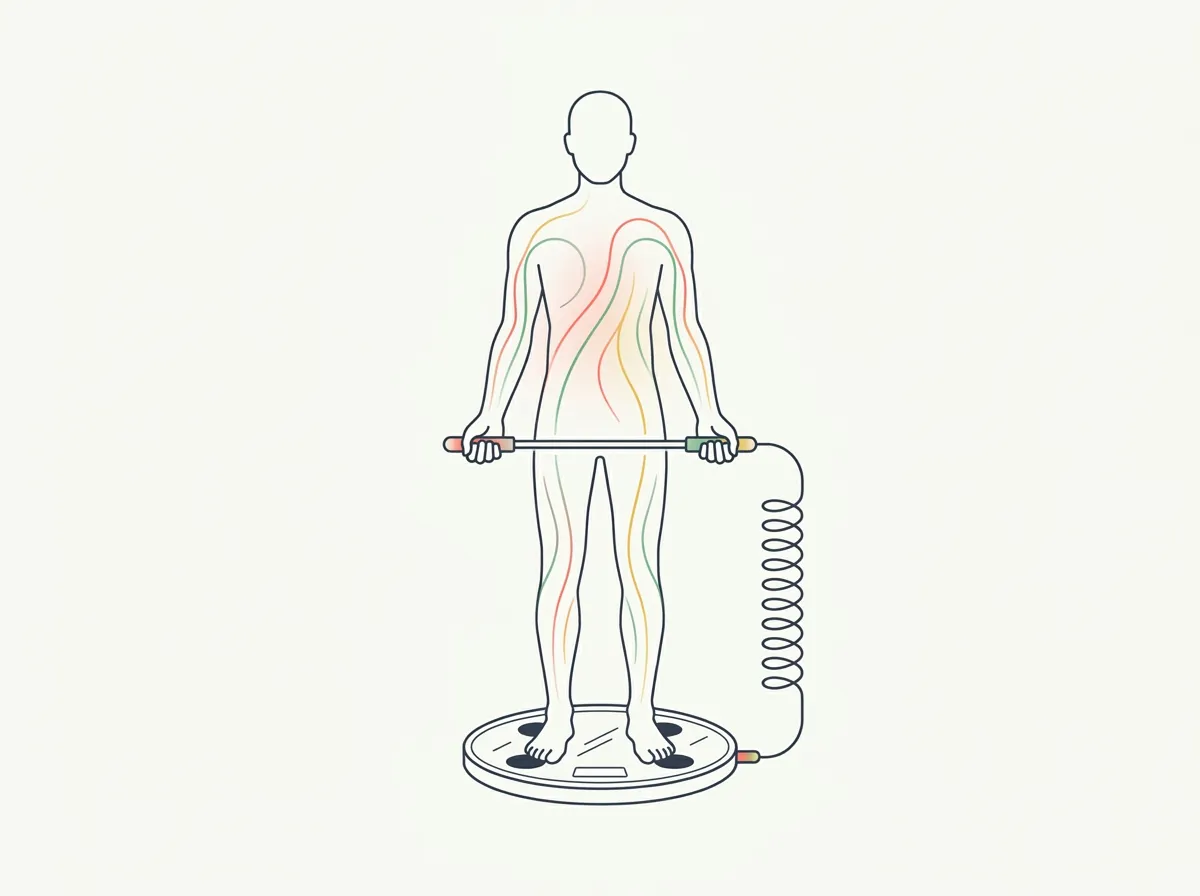
Quick answer: The Hume Body Pod (~$229) is the best consumer BIA form factor we've seen: a multi-frequency scale with a handheld sensor bar that fixes the biggest structural weakness of foot-only scales. It's worth it for committed scale users upgrading from a Renpho-class device. It's not worth it if you want absolute accuracy (that's DEXA) or if your real question is what your body looks like (that's photos).
How this review was researched
Straight up: this review synthesizes Hume's published specifications, the BIA research literature, and aggregated user reviews, without months of hands-on daily testing by us. Where experiences vary between reviewers, we say so rather than picking a side. And a disclosure: we make GainFrame, a photo-based body tracking app that pairs with (rather than competes against) a scale like this.
What is the Hume Body Pod?
The Body Pod is Hume Health's ~$229 answer to a question a lot of smart-scale owners eventually ask: why does my body fat number jump three points between Tuesday and Thursday?
Part of the answer is hardware. Cheap smart scales measure foot-to-foot only: a current goes up one leg, down the other, and the device models your entire upper body from that lower-body sample. The Body Pod adds a handheld sensor bar, so current paths run hand-to-foot through your torso and arms too. Combined with multi-frequency BIA (multiple current frequencies distinguish water inside cells from water between them), the model gets meaningfully better inputs.
That architecture, hand plus foot electrodes at multiple frequencies, is the same family as the InBody machines gyms charge for. Hume positions the Body Pod explicitly as that experience at home, and structurally the claim holds: it's a consumer-priced version of the professional BIA layout. Readings take seconds and sync to a companion app on iOS and Android, with Apple Health export putting the series alongside the rest of your data; our Apple Health scale roundup compares how the whole category handles that handoff.
What the Body Pod does well
- The form factor is the whole pitch, and it works. Hand-to-foot current paths are the single biggest accuracy upgrade available in consumer BIA. Foot-only scales are structurally blind to your upper body; this isn't.
- Readings are fast. Stand, grip the bar, done in seconds. No appointment, no gym visit, no per-scan fee: the convenience profile of a bathroom scale with better electronics inside.
- Core readings without a subscription. You buy the hardware; the composition metrics work in the app. Hume has offered premium app tiers at various points and offerings change (check the current listing), but the base proposition hasn't been rent-to-read.
- A real InBody-style metric set. Body fat, lean mass, water, and related composition metrics in one dashboard, tracked over time.
Where it falls short
- It's still BIA. No electrode layout escapes the physics: impedance readings move with hydration, meal timing, alcohol, a hard training session, and time of day. The Body Pod narrows the noise versus a foot-only scale; it doesn't eliminate it. Weigh-in discipline (same time, same conditions) is still required for comparable readings.
- It measures composition, not shape. The Body Pod can tell you lean mass went up a pound. It can't tell you whether that showed up in your shoulders or got lost in the noise; no scale can. If the visible result is what you're chasing, the scale is half the answer.
- App experience: reviewer opinions vary. Some users praise the dashboard; others report sync friction and want more from the trends view. Since we haven't lived with it for months, we'll flag the disagreement rather than adjudicate it; read recent app-store reviews before buying.
- The absolute number is still an estimate. Better inputs, better model, still a model. If you need a number you can defend, a DEXA scan is the anchor; see our DEXA alternatives guide for how to combine a periodic scan with daily tools.
| Foot-only scale (Renpho-class) | Hume Body Pod | Gym InBody / DEXA | |
|---|---|---|---|
| Price | ~$25 to 50 | ~$229 | $15 to 50/scan (InBody) · ~$100 to 200 (DEXA) |
| Current paths | Feet only | Hands + feet | Hands + feet (InBody) · X-ray (DEXA) |
| Hydration sensitivity | High | Moderate; still BIA | Moderate (InBody) · Low (DEXA) |
| Shows where change happens | No | No | Segmental estimates / regional (DEXA) |
| Convenience | Daily, at home | Daily, at home | Appointment required |
What do the Hume app and subscription actually cost?
The pricing question shows up in almost every Hume review thread, so here is the current shape of it. The Body Pod hardware is typically listed around $229, and Hume discounts it aggressively; 2026 deal listings have shown it well under $200 at times.
The app follows a freemium split. Basic body composition readings work without paying anything beyond the hardware: you weigh in, and the core metrics sync to the app and to Apple Health. On top of that sits an optional premium subscription (around $9.99 a month at the time of this update) covering personalized coaching, weekly reports, and nutrition tracking. The scale does not stop working if you skip it.
Two honest caveats. Offerings like this change without notice, so check the listing on the day you buy if a strictly subscription-free experience matters to you. And premium app tiers are where this category earns its recurring revenue, so expect the app to market the upgrade at you.
What are the alternatives to the Body Pod?
It depends on which half of the Body Pod you want to replace: the hardware or the job it does.
| Alternative | Price | The trade |
|---|---|---|
| Renpho-class foot-only scale | ~$20 to 35 | Cheapest weigh-in automation; gives up the hand electrodes that are the Body Pod's whole pitch |
| Omron HBF-516 | ~$80 | The cheapest hand-and-foot device; older hardware and a dated app |
| InBody home devices | ~$240 to 380 | Same electrode architecture with gym-brand continuity, at a higher price |
| Withings Body Scan | ~$400 to 500 | Segmental readings plus health-station extras; the same BIA physics underneath |
| Periodic DEXA scan | ~$100 to 200 per scan | The accuracy anchor; an appointment rather than a bathroom habit |
| Photo-based AI tracking | Free to start | Covers the visible-change half no scale reports; immune to hydration noise, with its own photo-consistency demands |
For another handle-equipped option, compare Hume with Oxiline using the exact models, included app features and current purchase terms.
Who should buy the Body Pod
- Committed scale users upgrading from a foot-only device. If you weigh in daily, trust the workflow, and are tired of Renpho-class body fat swings, this is the direct upgrade: the best at-home approximation of a gym-grade BIA machine.
- People who want InBody-style data without per-scan fees. A gym InBody habit at $20 a scan pays for a Body Pod inside a year.
- Data-first trackers who understand trends. If you already know to read the two-week trend and ignore single readings, the Body Pod gives you a cleaner trend than any foot-only scale.
Who shouldn't
- Photo-first trackers. If your real question is "am I visibly changing?", $229 of better impedance won't answer it. A photo timeline, which is free, will, and AI analysis can quantify it.
- Absolute-accuracy seekers. No consumer BIA device settles the "is this number even right?" doubt. A periodic DEXA scan does; everything else tracks the trend between anchors.
- Casual trackers. If you weigh in sporadically, BIA noise will dominate your sparse data points regardless of electrode count. Save the money.
Pair it, don't crown it: the Body Pod + a visual layer
Here's the honest framing, disclosure repeated: GainFrame is our app.
The Body Pod and photo-based tracking aren't competitors; they measure different signals. The scale quantifies how much: fat mass, lean mass, water. Photos capture where and whether it shows: the thing you actually see in the mirror, and the thing BIA is structurally unable to report.
GainFrame reads a progress photo and returns an estimated body fat %, FFMI, a 1 to 100 physique score, and ratings for 12 muscle groups, then compares any two check-ins with the deltas quantified. Photo estimates have their own error sources (lighting, pose consistency), but they're immune to the hydration noise that moves BIA readings, which makes the two methods good cross-checks. When the Body Pod says lean mass is up and the photo timeline shows shoulders scoring higher, you can believe both.
A sensible stack for a lifter: Body Pod (or any decent scale) for the weight and composition trend, photos for the visible result, DEXA once or twice a year if the absolute number matters to you.
Verdict
Body Pod: the right ceiling for home BIA
The Hume Body Pod is what the consumer smart scale should have been all along: hand and foot electrodes, multiple frequencies, seconds-long readings, no per-scan fee. Within the limits of BIA, it's about as good as home hardware gets at this price.
Those limits are real, though. It estimates composition rather than measuring it, hydration discipline still matters, and it can't see shape. Buy it as the best version of the scale workflow rather than the last word on your body.
Buy it if: you're a committed scale user upgrading from a foot-only device and you read trends, not single numbers.
Skip it if: you're photo-first, casual, or need clinical-grade absolutes; those needs are better served by a photo timeline or a periodic DEXA.
Frequently asked questions
Is the Hume Body Pod accurate?
More accurate in design than foot-only smart scales: the handheld sensor bar adds upper-body current paths, and multi-frequency BIA gives the model better inputs. But it's still bioelectrical impedance, so readings shift with hydration, meal timing, and time of day. Treat any single reading as an estimate and the multi-week trend as the real signal.
Is the Hume Body Pod worth $229?
If you're a committed scale user upgrading from a Renpho-style foot-only scale, yes; it's the closest thing to a gym-grade BIA machine you can keep in a bathroom. If you're photo-first, casual, or chasing absolute accuracy, no; pair a cheaper scale with photo-based tracking, or anchor with a periodic DEXA instead.
Does the Hume Body Pod require a subscription?
No. Core composition readings work once you own the hardware, and they sync to the app and Apple Health without a paid plan. Hume offers an optional premium tier (around $9.99 a month at the time of this update) that adds coaching, weekly reports, and nutrition tracking. Offerings change, so check the current listing before buying if subscription-free matters to you.
What is the best alternative to the Hume Body Pod?
It depends on the job. For cheaper automation, a Renpho-class foot-only scale covers the weight trend for about $30. For the same hand-electrode architecture with gym-brand continuity, InBody's home devices run roughly $240 to 380. For an accuracy anchor, a periodic DEXA scan beats any home device. And for the visible-change half of tracking, photo-based analysis is free to start and immune to hydration noise.
How does the Body Pod compare to an InBody machine?
Same measurement family. InBody machines are multi-frequency BIA devices with hand and foot electrodes, and the Body Pod brings that architecture home at a fraction of the price. A gym InBody still has more electrodes, more frequencies, and standardized testing conditions, so expect the Body Pod to be a strong approximation rather than a match. Full comparison landscape in our InBody alternatives roundup.
Should I use the Body Pod or progress photos to track my physique?
Both, ideally, because they measure different things. The Body Pod quantifies composition: how much fat and lean mass. Photos capture shape: where the change is happening and whether it's visible. A scale trend plus a photo timeline covers both signals; neither alone tells the full story.
Add the layer the scale can't see
GainFrame turns progress photos into scored check-ins (body fat %, FFMI, 12 muscle ratings) with no hydration noise. The visual cross-check for any scale. Free to start on iOS.
Download GainFrame Free