
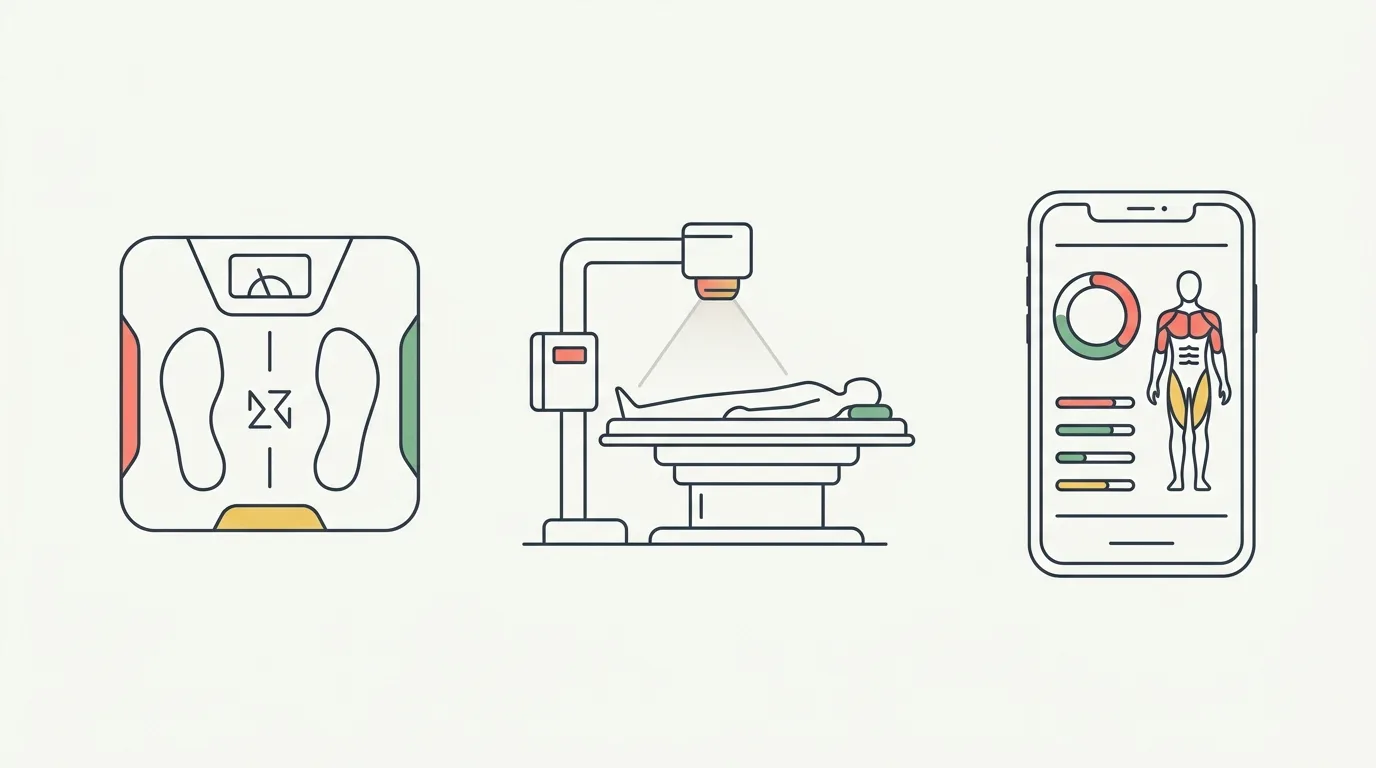
Quick answer: The closest at-home InBody alternative is a multi-frequency smart scale such as the Hume Health Body Pod or Withings Body Scan. For accuracy, a periodic DEXA scan remains the gold standard. For zero hardware, an AI photo app like GainFrame estimates body fat, FFMI, and per-muscle scores from your phone.
InBody machines are great - but they usually live at a gym or clinic, and InBody's own at-home devices run $240-$380. If you want to track body composition without driving to a scanner or buying a pricey unit, you have more options than you'd think - and beyond the InBody-replacement angle, our body scan app roundup ranks six across 3D scan, AI photo, and manual tracking.
This guide ranks seven InBody alternatives across three categories - AI photo apps (zero hardware, cheapest), at-home BIA scales (closest to InBody's method), and DEXA (the accuracy gold standard). For each, we cover the method, price, platform, and who it's actually for.
If your gym offers a named scanner, our Evolt 360 accuracy guide covers its impedance-based estimates, while the Styku accuracy guide explains optical measurements and composition-model differences.
How to Choose an InBody Alternative
InBody uses bioelectrical impedance analysis (BIA) - it sends a tiny current through your body and infers fat, muscle, and water from the resistance. That means three things when you shop for an alternative:
- If you want the same kind of reading, look at multi-frequency BIA scales. They share InBody's method (and its sensitivity to hydration and timing).
- If you want a stronger reference measurement, DEXA adds a three-compartment view of bone mineral, fat, and lean soft tissue. Our InBody vs DEXA comparison explains the accuracy evidence and why the two percentages should stay in separate histories.
- If you want zero hardware and frequent tracking, an AI photo app trades absolute precision for the ability to check in anytime, free.
The honest rule: accuracy scales with price and friction. But the best tool is the one you'll actually use often enough to see a real trend.
Quick Comparison: InBody Alternatives at a Glance
| Tool | Method | Price | Best for |
|---|---|---|---|
| GainFrame | AI from photo | Free / $5.99 mo | Zero-hardware visual tracking |
| Hume Health Body Pod | Multi-freq BIA + handheld | ~$229 | Closest at-home InBody-style scale |
| Withings Body Scan | BIA smart scale | ~$400-500 | Premium all-in-one wellness |
| DEXA scan | X-ray (DXA) | ~$100-200/scan | Accuracy gold standard |
| Tanita FitScan | BIA smart scale | ~$60-150 | Mid-range home BIA |
| Omron HBF-516 | BIA + handgrip | ~$80 | Cheapest BIA with hand sensors |
| SKOR | AI from photo | Free / subscription | Another zero-hardware app |
1. GainFrame - AI Body Composition from a Photo (iOS)
Method: AI analysis from a single photo | Price: Free (25 photos lifetime) / $5.99 mo / $39.99 yr | Platform: iOS
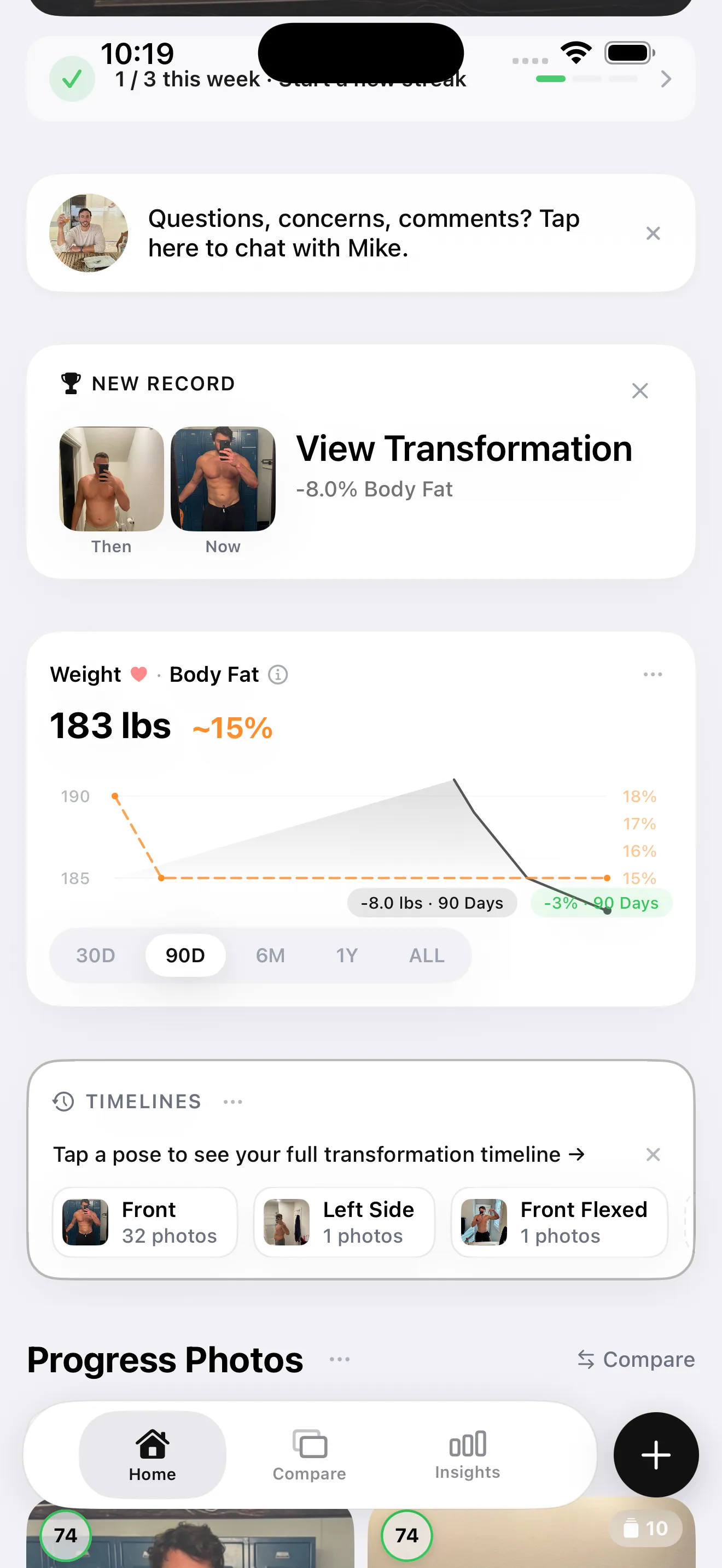
GainFrame is the zero-hardware option. You take one photo and Google Gemini AI returns body fat %, FFMI, lean mass, a physique score (1-100), and a 12-muscle-group breakdown - no scale, no scanner, no appointment. For someone who can't get to an InBody machine and doesn't want to spend $300 on a home device, it's the lowest-friction way to track composition.
Be clear about what it is: an AI photo estimate is not a BIA or DEXA measurement. Where GainFrame wins isn't a single perfect number - it's tracking change over time, plus detail the others don't give, like per-muscle development and a projected future physique. Because it's free and takes seconds, you'll actually check in often, which is what produces a usable trend.
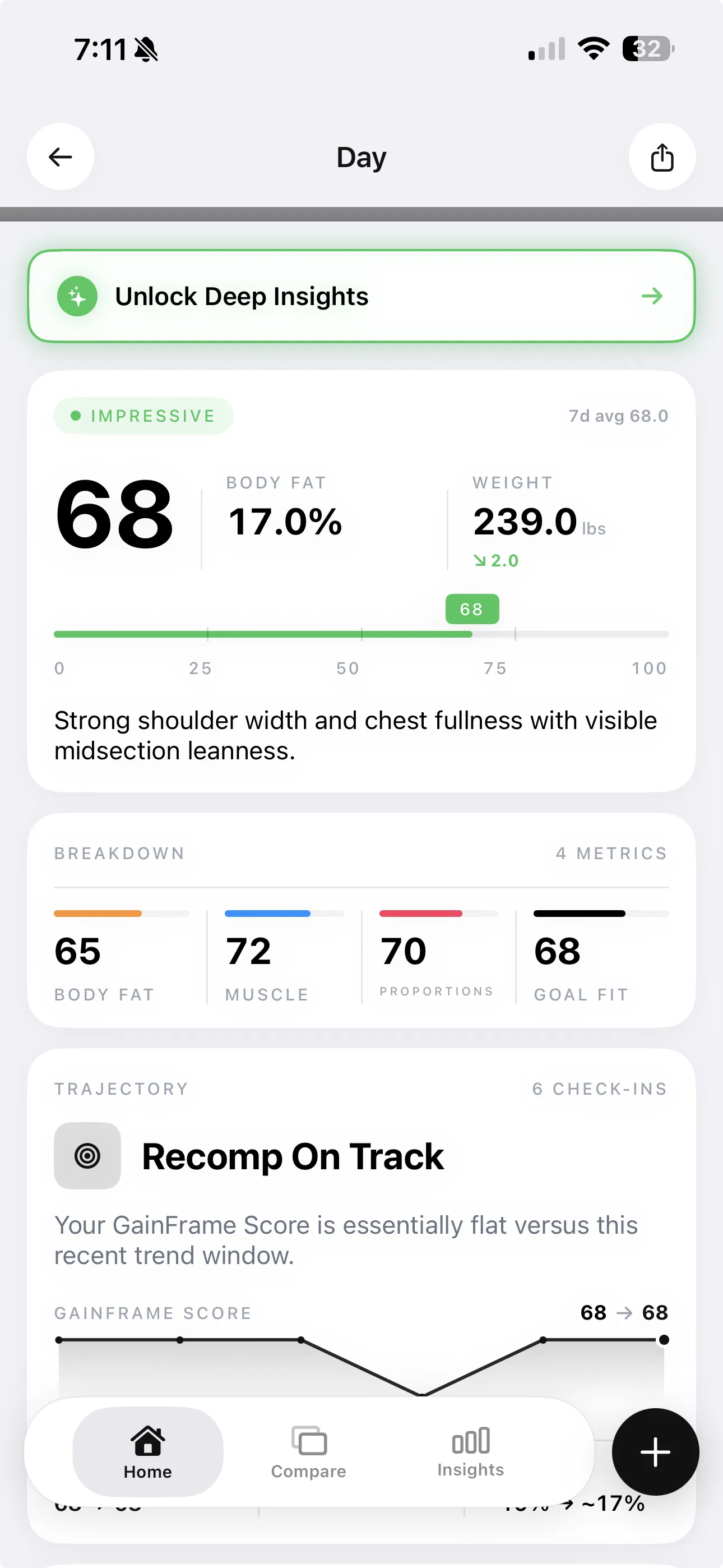
Privacy is a genuine plus over cloud-tied scales: data is stored on-device, no account required, and photos are analyzed by AI but never persisted on a server.
Best for: iPhone users who want free, frequent, zero-hardware tracking and per-muscle detail. Limitations: iOS only; estimate not direct measurement; free tier capped at 25 photos.
Before you commit: run the same AI on one photo in the free browser body fat estimator - no download, no signup - and compare the number against your last InBody printout.
2. Hume Health Body Pod - Closest At-Home BIA
Method: Multi-frequency BIA with handheld electrodes | Price: ~$229 | Platform: iOS + Android
If you want a reading that works like InBody at home, the Hume Health Body Pod is the closest like-for-like. It uses multi-frequency BIA with both foot and handheld electrodes (the hand sensors improve upper-body accuracy over foot-only scales), claims dozens of metrics, and bundles app-based coaching. At around $229 it undercuts InBody's own home Dial H30.
The caveat is BIA's caveat: readings shift with hydration, food, and time of day, so weigh in under consistent conditions.
Best for: people who specifically want a direct BIA number at home, in the InBody mold, without the InBody price. Limitations: still BIA - hydration-sensitive; hardware cost.
3. Withings Body Scan - Premium Smart Scale
Method: BIA smart scale (segmental) | Price: ~$400-500 | Platform: iOS + Android
The Withings Body Scan is the premium pick - a polished smart scale with segmental body composition, plus broader wellness metrics that go beyond fat and muscle. It's the most "appliance-grade" option here, with a mature app ecosystem. It's also the most expensive alternative on this list, and like all BIA it inherits hydration sensitivity.
Best for: people who want a premium, all-in-one home health scale and don't mind paying for it. Limitations: price; BIA limitations; more wellness-broad than lifter-specific.
InBody vs Withings Body Scan: which is better at home?
At home, the fairest comparison is the InBody Dial H30 versus the Withings Body Scan. Both are multi-frequency BIA scales with foot and hand contact, so neither removes hydration-dependent variation. The practical choice comes down to the output and workflow you want.
| Feature | InBody Dial H30 | Withings Body Scan |
|---|---|---|
| Method and electrodes | Triple-frequency BIA through foot pads and a handheld electrode bar | Multi-frequency BIA through the scale platform and a handheld electrode bar |
| Segmental output | The home product emphasizes whole-body fat, skeletal muscle, visceral fat, and body water trends | Fat and muscle trends across five body zones: arms, torso, and legs |
| Workflow | Step on barefoot, hold the bar with arms extended, then sync results to the InBody app | Complete a roughly 90-second barefoot weigh-in with the handle, then sync over Wi-Fi or Bluetooth |
| Current list price | $379 | $499.95 |
| Hydration sensitivity | Sensitive to hydration, meals, exercise, and timing; standardize test conditions | Also sensitive because it uses BIA; compare readings taken under similar conditions |
| Best use | Focused body-composition trends inside the InBody ecosystem | Segmental trends plus broader weight, heart, and wellness tracking in one app |
Choose the Dial H30 if you want a simpler body-composition-first experience and already trust the InBody workflow. Choose Withings if five-zone trends and its broader health dashboard justify the higher price. Our full Withings Body Scan review covers its daily workflow, outputs, and limitations in more detail.
4. DEXA Scan - The Accuracy Gold Standard
Method: Dual-energy X-ray absorptiometry | Price: ~$100-200 per scan | Platform: In-clinic (+ apps to track results)
If accuracy is the priority, DEXA beats InBody. It's the clinical reference method for body fat and lean mass, and many lifters do one every few months to calibrate. The downside is obvious: it's an appointment, it costs $100-200 each time, and it's not something you do weekly. Pair it with an app to log results between scans. Here's how DEXA compares to AI body composition.
Best for: periodic gold-standard checkpoints. Limitations: cost and friction; not a frequent-tracking tool. See also our DEXA scan alternatives guide.
5. Tanita FitScan - Mid-Range Home BIA
Method: BIA smart scale | Price: ~$60-150 | Platform: iOS + Android
Tanita has made BIA scales for decades and offers a wide range, like the FitScan BC-401F, at mid-range prices. They're a reliable, no-drama way to get a home BIA reading without premium-scale spend. Foot-only models are less accurate up top than handheld-equipped devices, but for trend tracking they do the job.
Best for: a dependable, affordable home BIA scale from a long-standing brand. Limitations: foot-only accuracy; standard BIA caveats.
6. Omron HBF-516 - Cheapest BIA with Hand Sensors
Method: BIA + handgrip electrodes | Price: ~$80 | Platform: iOS + Android
The Omron HBF-516 is the budget pick that still includes handgrip electrodes, which help accuracy versus foot-only scales. It tends to read body fat a touch high versus DEXA, but it's consistent - which is what matters for tracking. A solid entry point if you want hardware on a tight budget.
Best for: the cheapest BIA option that still uses hand sensors. Limitations: runs slightly high vs DEXA; basic app experience.
7. SKOR - Another AI Photo App
Method: AI from photo | Price: Free / subscription | Platform: iOS + Android
SKOR is the other notable zero-hardware app. It generates a "Body SKOR" from a photo and, like GainFrame, is honest that it tracks relative change rather than an absolute body fat percentage. It's cross-platform, which GainFrame isn't. GainFrame goes deeper on lifter-specific output (FFMI, 12 muscle-group scores, future-physique projection); SKOR is simpler and Android-friendly.
Best for: Android users who want a free AI photo tracker. Limitations: estimate not measurement; less lifter-specific detail than GainFrame.
Which InBody Alternative Should You Choose?
Pick by what you actually need
Want a direct BIA reading at home (closest to InBody)? Hume Health Body Pod, or Withings if you want premium. Tanita or Omron if you're on a budget.
Want the most accurate number? A periodic DEXA scan - accept the cost and the appointment.
Want zero hardware, free, and frequent tracking? GainFrame (iOS) or SKOR (also Android). You trade absolute precision for the ability to check in anytime and watch the trend - which, for most people, is what actually drives progress.
The smartest setup for a lot of lifters is a combo: a DEXA scan once or twice a year for a calibrated baseline, and a free AI photo app in between to track week-to-week change and per-muscle development. That gives you accuracy and frequency without buying a $400 scale.
Track Body Composition With Zero Hardware
GainFrame estimates body fat %, FFMI, and 12 muscle-group scores from a single photo - free, on-device, no account. The easiest at-home InBody alternative to start with.
Download GainFrame FreeFrequently Asked Questions
What is the best at-home alternative to InBody?
It depends what you want. For a direct BIA reading like InBody gives, a multi-frequency smart scale such as the Hume Health Body Pod or Withings Body Scan is the closest at-home match. For the most accurate body composition, a periodic DEXA scan is the gold standard. For zero hardware and free daily tracking of visible change, an AI photo app like GainFrame is the most convenient alternative.
Is there a free InBody alternative?
Yes. AI photo apps are the only truly free option. GainFrame has a free tier that estimates body fat, FFMI, and per-muscle scores from a photo with no hardware. It is an estimate from an image rather than a BIA measurement, so treat it as a trend tracker rather than a clinical reading.
How accurate are InBody alternatives compared to InBody?
DEXA is more accurate than InBody. Quality multi-frequency BIA scales (Hume, Withings, Tanita) are in the same general category as InBody and share BIA's sensitivity to hydration. Cheaper foot-only scales are less consistent. AI photo apps don't measure directly at all - they estimate from an image, so they are best for tracking relative change over time rather than absolute numbers.
Can I get InBody-style body composition without going to a gym?
Yes. InBody sells home devices (the Dial H20N and H30, roughly $240-$380), and several other smart scales offer similar BIA readings at home. If you don't want any device, an AI photo app like GainFrame gives you body fat, FFMI, and muscle scores from your phone for free.
Why do InBody, smart scales, and DEXA give different numbers?
Each method measures differently. DEXA uses X-ray attenuation, BIA devices (InBody, smart scales) send a small current and infer composition from resistance, and AI apps estimate from a photo. They make different assumptions and have different error margins, so absolute numbers won't match across methods. What matters is picking one method and tracking the trend with it consistently.
Is Withings Body Scan better than InBody for home use?
Withings Body Scan is better if you want five-zone fat and muscle trends plus broader wellness features in one home scale. InBody Dial H30 is the simpler choice if you prefer the InBody app and a body-composition-first workflow. Both use BIA, so neither produces a hydration-proof reading. Compare trends under consistent conditions rather than treating one scan as exact.
Is GainFrame a good InBody alternative?
GainFrame is a good alternative if you want zero hardware, a free tier, and frequent visual tracking - it estimates body fat, FFMI, lean mass, and 12 muscle-group scores from a single photo and projects a future physique. It is not a BIA or DEXA replacement for absolute accuracy; it shines at tracking change over time and per-muscle development, and it's iOS only.
Sources
- InBody at-home devices (Dial H20N / H30) - home device pricing
- Withings Body Scan product page - current US specifications and list price
- InBody vs Withings - Wareable - Withings Body Scan positioning and price
- Hume Health Body Pod vs InBody - Cybernews - Body Pod metrics, BIA method, and price
- Best body composition apps - SKOR - SKOR's photo-AI method and positioning vs InBody/DEXA
- GainFrame: DEXA scan vs AI body composition - how AI photo estimates compare to a $150 DEXA scan