Two posts ago I wrote about spending $5,674 on ads and paying $114 for customers worth $18. Last post was the flip side: organic search grew about 15x in 90 days with nothing behind it but writing. This post is the next chapter. SEO keeps compounding in the background, so the question became what to do with the marketing budget I'm no longer setting on fire.
The math that decides everything: GainFrame Pro Yearly is $39.99, and after Apple's Small Business Program cut I keep about $34. Any channel where a paying customer costs more than roughly $30 is dead before it starts. I re-confirmed this on July 2 by putting $180 into boosting my best-performing TikTok. It bought a pile of views and exactly zero new subscribers.
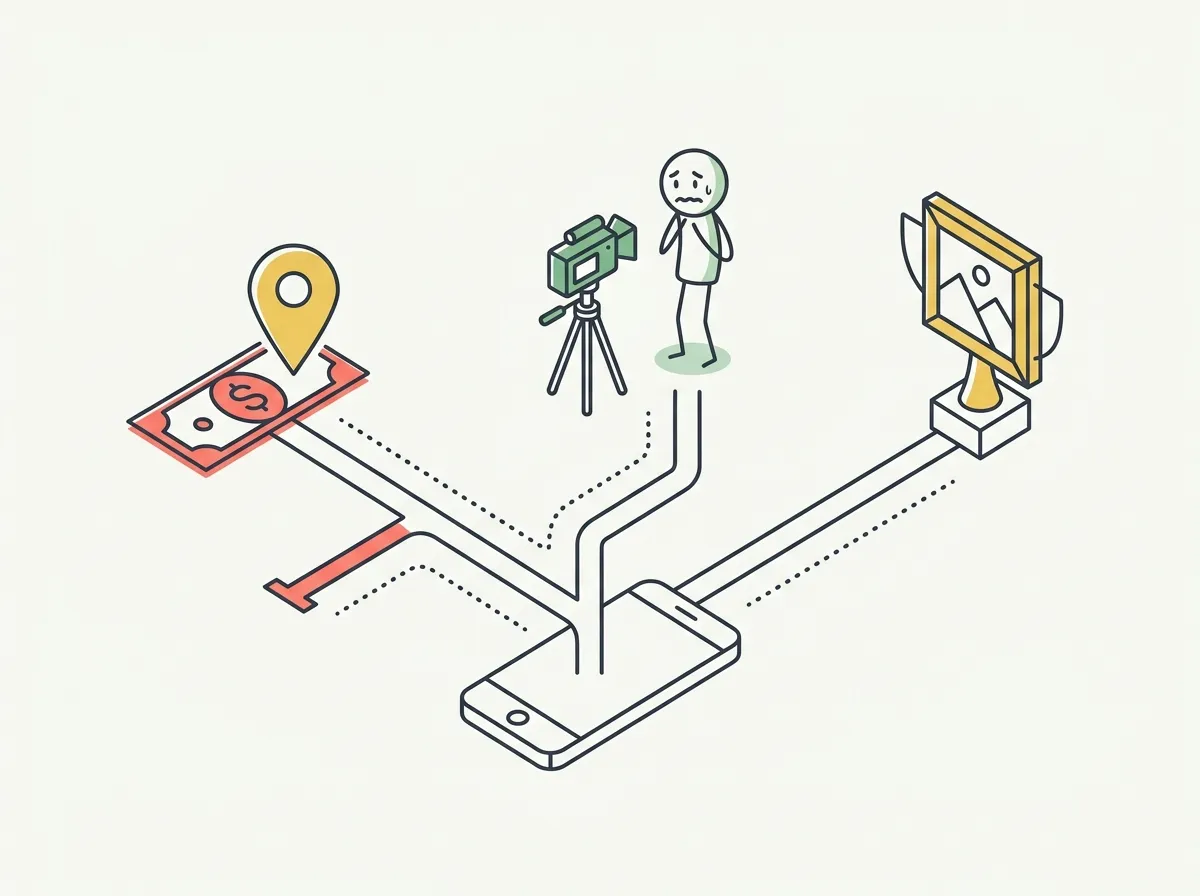
So instead of feeding ad platforms, I'm running three experiments that cost $150, roughly $0, and $450. Cheap enough to be wrong about all three. Here they are, with the results I have so far, including the one that already failed.
Experiment 1: Sponsoring a Guy Who Hides Cash Around Town ($150)
There's a TikTok account in my city called @cashstashwilmington. About 10k followers. He hides real cash around Wilmington, NC, posts clues, and people race to find it. Local businesses sponsor the drops. It's genuinely fun local content, and I figured a fitness app with a local founder was as good a sponsor as a taco shop.
I paid $150 to sponsor the July 3 drop. My accounts posted the clue, his posts described GainFrame and linked to it.
The part I'm glad I did: before the drop, I built a full attribution stack so I would know whether it worked instead of guessing. All of it was free.
- An App Store offer code,
CASHSTASH— 50% off the first year of Pro, $19.99 up front. Anyone redeeming it is deterministically from this promo. - A campaign-tokened App Store link (
ct=cashstash-wilm) so App Store Connect buckets the installs. - A landing page at gainframe.app/wilmington with a custom mascot hero — GainFrame Guy coaching a college seahawk on a beach. AI image generation made this a four-cent asset instead of a commission.
- A PostHog insight filtered to first opens from Wilmington.
The result: zero offer-code redemptions. Two first opens from Wilmington on drop day, against a baseline of 40 to 45 downloads a day from everywhere else. No trial lift, no subscriber lift, nothing.
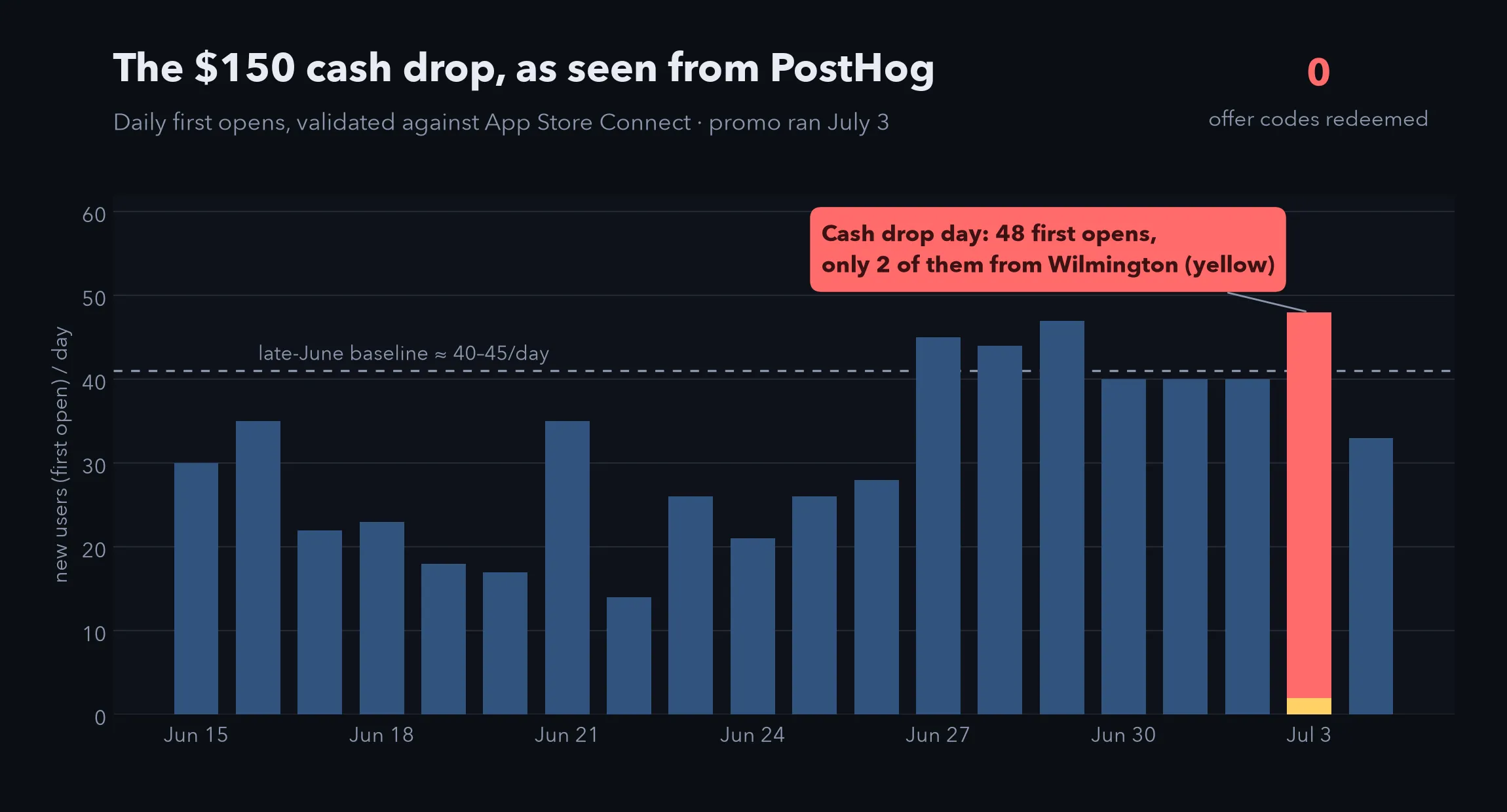
The asterisk: I gained 67 TikTok followers and 85 Instagram followers from the drop posts. For an account my size that's not nothing, and those people are at least local and now see my content. But nobody paid, and followers were not what I was buying.
What the $150 Bought
Not customers. Certainty.
Without the attribution stack, I'd be telling you "I think it didn't work" and wondering if some of last week's installs were secretly from the drop. Instead I knew, definitively, within 48 hours. That's what made this a cheap experiment instead of an open wound — I could close it and move on.
The piece I'd point other indie devs at is offer codes. I used to run AppsFlyer, and I dropped it on purpose: without ATT consent, most installs show up as "organic" and you've paid for an MMP that shrugs at you. An offer code is deterministic. If someone redeems CASHSTASH, they came from the cash drop, full stop. It costs nothing to set up in App Store Connect and it turns any offline or hard-to-track promo into something you can measure. Almost nobody I've seen in the indie community uses them this way.
The lesson on the failure itself is less flattering: audience mismatch. People who chase hidden cash around town are hunting a fun free thing. People who pay for a gym progress tracker are in a completely different headspace. I knew this was a risk going in and did it anyway, partly because $150 was cheap enough to find out and partly because I liked the idea too much. The idea being fun is not a targeting strategy.
Experiment 2: Putting Myself on Camera ($0)
This is the one I've been avoiding since launch.
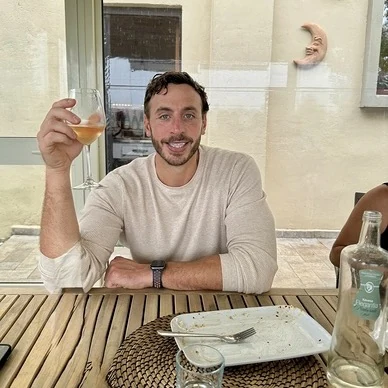
I've never been on camera. I'm a new dad with a full-time job and I've gained about 15 pounds, which is its own kind of awkward when you build a fitness app. So I started a 30-day challenge: get back in shape using my own app, posting a TikTok every day — check-ins, goals, one feature a day, the actual numbers. Goal is to lose 10 pounds, with the before/after at the end. This is day one:
Day 1 of 30. Watch on TikTok if the embed doesn't load.
I'll be honest about why this one is uncomfortable. I don't know what to say on camera. I recorded the first video several times and it's still stiff. But everything I've watched about small accounts growing points the same direction: faceless clip accounts stall, and founder-story content is the format that pulls people in. I can't verify that beyond my own scrolling, but the pattern is consistent enough that it's worth 30 days of being embarrassed.
There's also a simpler reason: I am the target user right now. The app exists for exactly this situation — someone out of shape, starting over, wanting proof it's working before the mirror shows it. If I can't make my own app carry me through a 30-day comeback, that's worth knowing too.
Too early for results. Day one is posted, that's the whole dataset. I'll report the follower numbers and the weight either way.
Experiment 3: A Transformation Contest With Cash Prizes ($450)
This one just went live today. The #GainFrameChallenge runs July 5–31: post your GainFrame before/after share card on TikTok with the hashtag, follow @gainframeapp, best transformations win. Prizes are $300, $100, and $50, each with a year of Pro on top. The Pro grants cost me nothing — RevenueCat promotional entitlements, zero marginal cost.
A few design decisions that might be useful if you ever run one:
- It's a judged contest, not a sweepstakes. Skill-based judging keeps the legal side much simpler. Random-draw giveaways trip state sweepstakes rules fast.
- The rules include a repost clause. Entrants grant marketing rights to their entry. The honest accounting here is that the prize money isn't really buying subscribers — it's buying a library of authentic before/afters from real users, which is the exact content I can't fake or commission.
- Photo import kills the friction. You don't need to have used GainFrame for months to enter. Import two old gym photos from your camera roll and you have a share card in about five minutes.
- The built-in blur tool answers the real objection. "Post myself shirtless on TikTok" is a hard no for a lot of people. Face blur makes it a maybe.
- One gotcha that cost me a redo: hyphenated hashtags silently break on TikTok. #gainframe-giveaway becomes #gainframe the moment it's posted. Everything now says #GainFrameChallenge, one word.
Amplification is all channels I already own: an announcement email to the full list (1,389 addresses, sent through my own Resend + Supabase pipeline with a queue table so I'm not paying for a marketing email tool), an App Store In-App Event so the challenge shows as a card on the product page, and a handful of micro-creators paid to enter — seeding real entries people can model, not running ads.
Since the results don't exist yet, here's the success frame written down before I can fudge it: entry count, follower delta, and how many entries are strong enough to repost. Break-even on the $450 is a handful of yearly subs, but that's explicitly not the primary goal. If I get twenty real transformations tagged with my app's name, that's the win.
Meanwhile, SEO Kept Compounding
The reason I can afford to be relaxed about three maybe-failures is the boring channel underneath them.
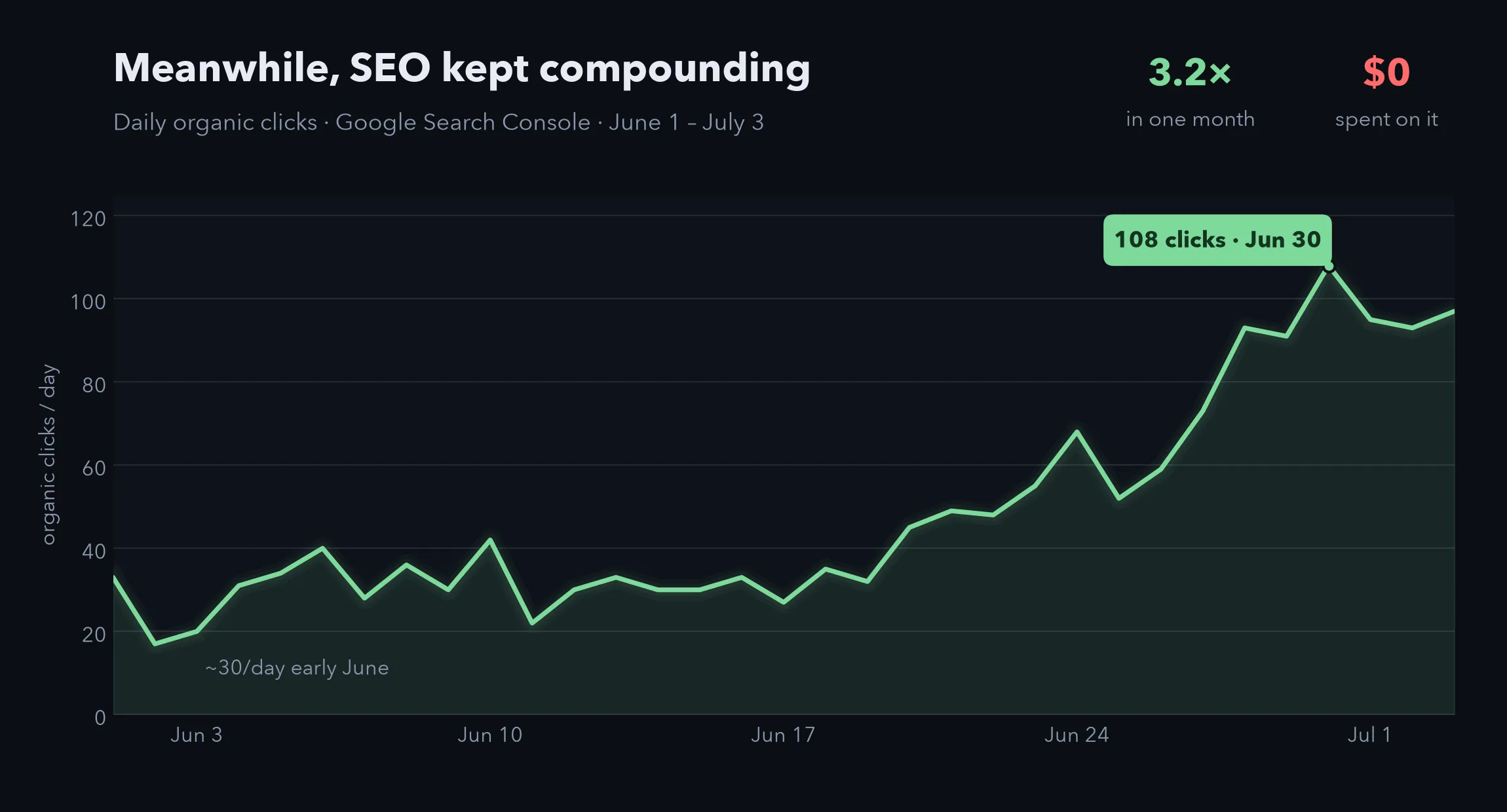
While I was hiding cash clues and re-recording TikToks, organic search went from about 30 clicks a day at the start of June to 90–108 a day now. The keyword movement under it is the part I watch: "ai body fat calculator" went from position 21 to 6.7 in a month, "ai body fat estimator" sits at 6.3, "best body composition app" is at position 1, "progress photo app" at 5.3. Those are people shopping for exactly what I sell, arriving daily, for free.
The business this all feeds, honestly stated: $859 MRR, 185 active subscriptions, 26 trials running, and new trials holding steady at 24 to 30 a week through June. Small. Which is exactly why the experiment budget is $780 total and not $5,000 — I've already run the version of this story where the spend outruns the revenue.
None of these three may work. The cash drop already didn't, and it told me so in 48 hours for $150, which is the cheapest marketing lesson I've bought yet. The camera experiment costs nothing but pride. The contest is live until July 31, and I genuinely don't know what happens.
Paid reach disappeared the day I stopped paying for it. These are bets on things that stick — followers, a face people recognize, real transformations with my app's name on them. SEO pays the bills while I find out.
If you use GainFrame and have two old gym photos sitting in your camera roll, you can have a challenge entry posted in about five minutes: gainframe.app/giveaway. And if you're a founder who's tried weird channels like these, I'd like to hear what worked.
Track your progress with GainFrame
Take or import a gym photo and get an AI body fat estimate, physique score, FFMI, and per-muscle breakdown, plus a Coach that explains what changed using your photos, weight, and workouts. Free to start, no account required.
Download GainFrame Free