
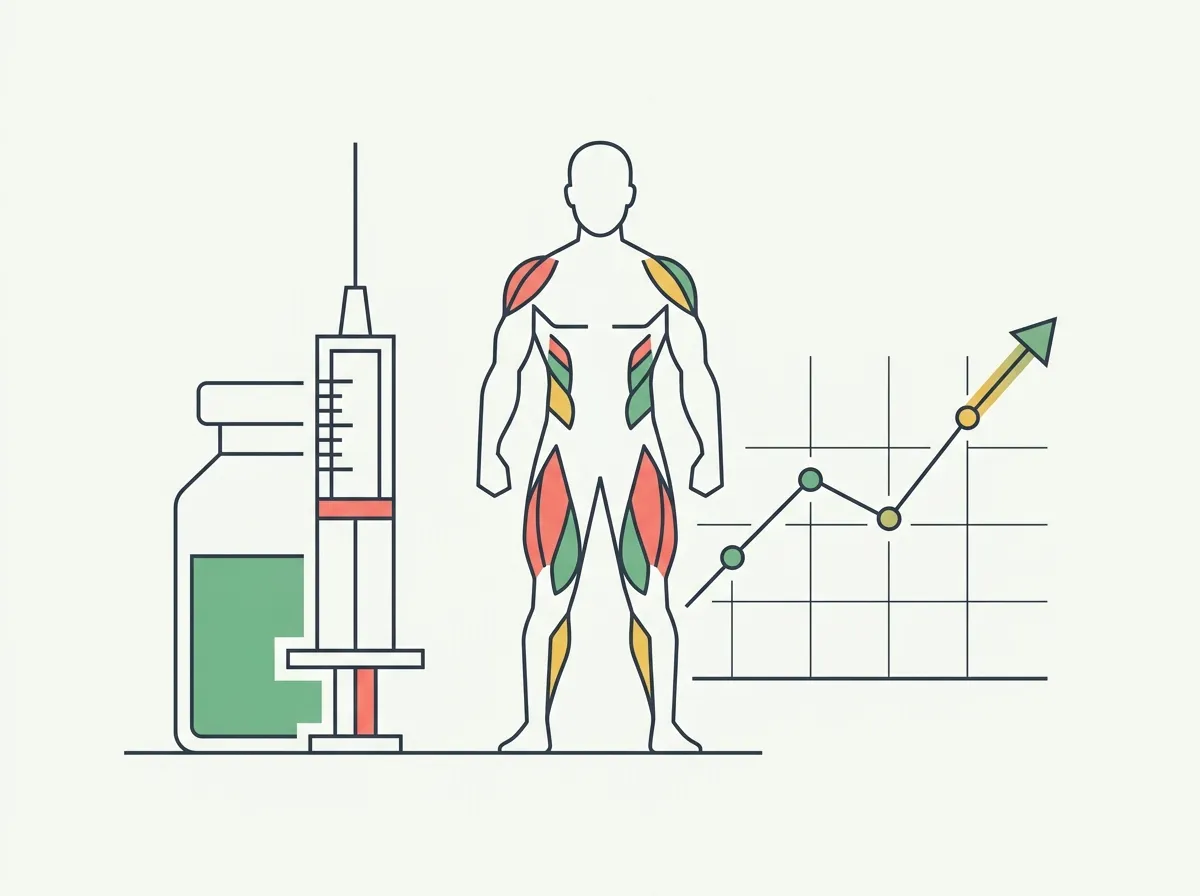
Quick answer: Studies of men with diagnosed low testosterone generally report increased lean mass and decreased fat mass on TRT, developing over months, with magnitude varying widely. Track photos, FFMI trend, waist, and a strength log to separate real recomposition from water and expectation effects — and make every treatment decision with your prescribing clinician.
The TRT forums have a house style: a gray "before" photo, a lit-up "after" photo, and a caption implying the vial did all of it. Then you start therapy — prescribed, monitored, legitimate — and at week six you look exactly like you did at week zero, minus a few pounds of what might be water. Is it working? Is it slow? Is it doing anything at all?
That's a measurement question, not a medical one, and it's the only question this article answers. To be explicit up front: this is not medical advice. TRT is prescription therapy for diagnosed testosterone deficiency, whether to start, adjust, or stop it belongs entirely with your prescribing clinician, and nothing here substitutes for that relationship. What an article can responsibly cover is the tracking — how to see what's actually changing, so your conversations with that clinician run on data instead of forum-calibrated expectations.
What does research commonly report TRT changes?
The clinical literature on testosterone therapy in men with diagnosed hypogonadism generally reports a consistent directional pattern: lean mass tends to increase and fat mass tends to decrease. The magnitude varies widely between studies and individuals — baseline levels, dose, age, training, and diet all move the number — so treat any specific figure you read online as one study's average, not your forecast.
Two hedges matter more than the headline. First, those findings come from men with diagnosed deficiency; they say little about what testosterone does at already-normal levels, and clinical guidelines generally don't support therapy for cosmetic goals. Second, the timeline: reviews commonly describe composition changes developing over months, often continuing to accrue past the first year. The forum photo pair taken eight weeks apart is either an outlier, better lighting, or a story with details missing.
Why does tracking matter more on TRT than off it?
Because TRT introduces two new ways to fool yourself, in opposite directions.
The first is water. Fluid retention is a commonly reported effect of testosterone therapy, especially early — so the scale can jump several pounds in the first weeks while actual muscle tissue, which accrues slowly, has barely changed. Read that jump as muscle and you'll conclude the therapy is dramatic; watch it plateau and you'll conclude it stopped working. Both readings are wrong, and both are just water.
The second is expectation. You're paying for therapy, you want it to work, and the mirror is famously agreeable to motivated reasoning. The fix for both distortions is the same: measurements that don't care what you hope is happening, collected on a schedule, compared over months. That's also exactly the kind of record that makes your follow-up appointments useful — your clinician tracks labs and symptoms; a composition trend completes the picture.
What should you actually track?
Five signals, none of which require anything beyond a phone except the last:
| Signal | How often | What it catches |
|---|---|---|
| Progress photos | Weekly, same conditions | Visible recomposition the scale can't parse |
| FFMI trend | Monthly | Whether lean mass is genuinely rising |
| Waist measurement | Weekly | Fat trend, independent of water swings |
| Strength log | Every session | The earliest functional signal |
| DEXA scan | Every 3–6 months | Clinical-grade lean/fat numbers for your clinician |
Photos are the anchor. Same spot, same light, same relaxed pose, weekly — our recomposition photo guide covers the setup. Over months they show what a scale reading never can: whether the shape is changing, not just the weight.
FFMI — fat-free mass index — is the single most relevant number for this use case, because it isolates muscle-per-height and moves only when lean mass moves. If TRT plus training is genuinely adding lean tissue, FFMI drifts up over months; if the scale is up but FFMI is flat, you're likely looking at water or fat. Here's the full FFMI explainer. This is where GainFrame fits if you want the tracking automated: it estimates body fat %, FFMI, and 12 muscle-group ratings from your weekly photos and charts them over time, with weight milestones alongside. iOS only, and photo-based estimates rather than clinical measurement — think of it as the trend line between DEXA anchors, not a replacement for them.
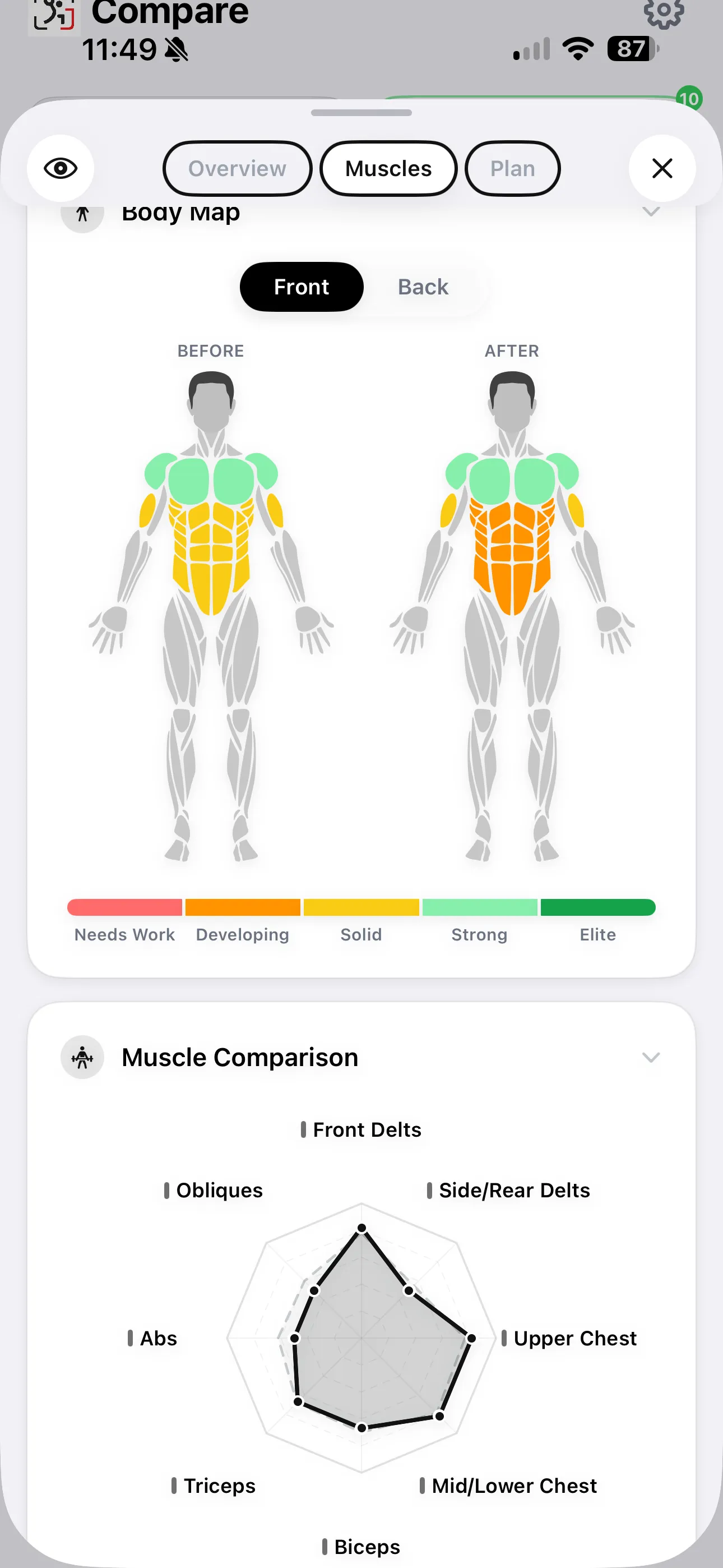
The question that matters on TRT: are the muscle-group ratings and FFMI actually trending, or is it just scale weight?
Waist and strength are the cheap corroborators. A shrinking waist at stable weight suggests fat down, lean up. A strength log that climbs steadily is the earliest functional evidence of real tissue change — and it's also the honest tell if your training, not your prescription, has stalled.
Periodic DEXA is the ground truth. Every three to six months, a scan gives you clinical fat-mass and lean-mass numbers — the format your prescriber is most likely to take seriously. Everything else on the list tracks the months in between; here's how the alternatives compare if scans aren't accessible where you live.
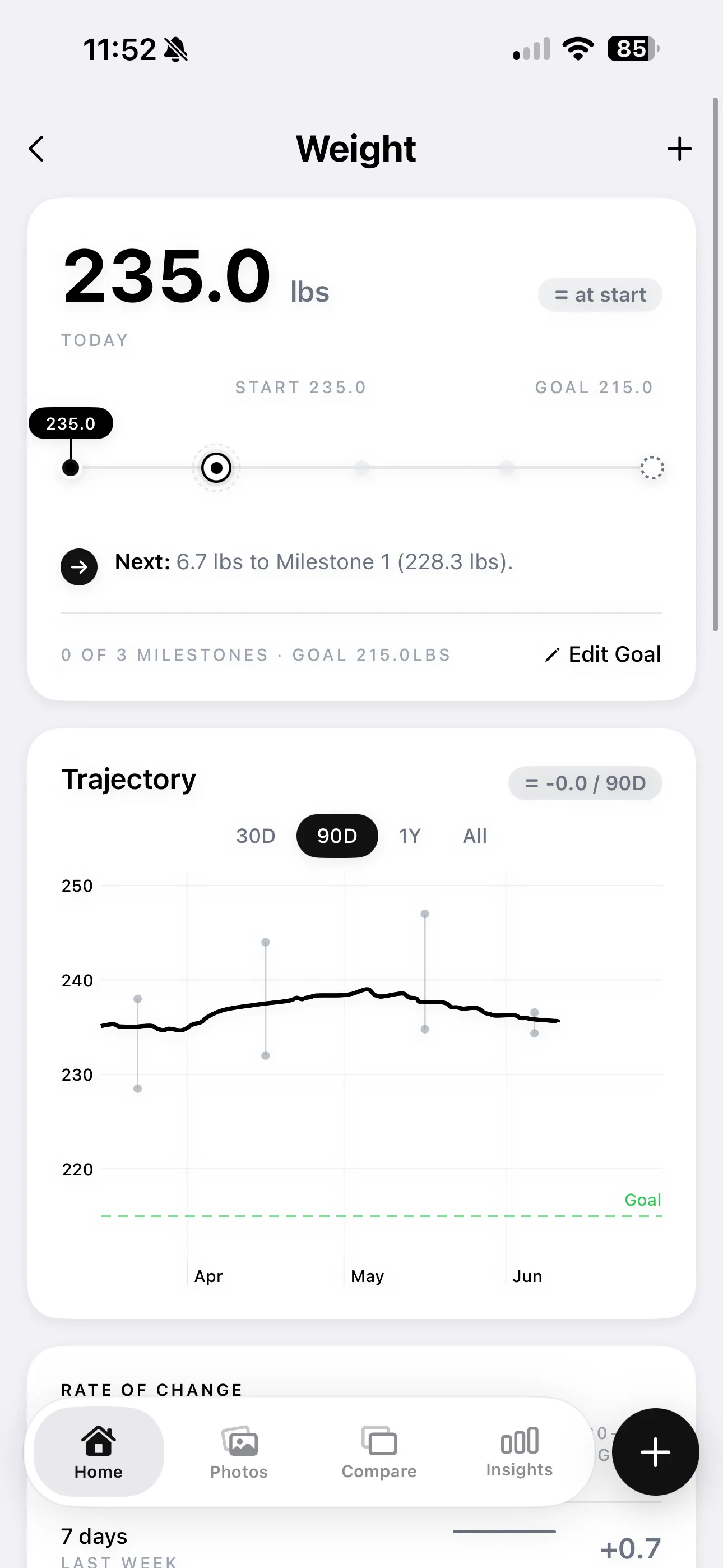
Months-long trends are the honest unit of measurement here — early scale jumps are usually water.
What should you not expect from TRT?
The clinical literature is consistent on one point worth engraving somewhere visible: testosterone therapy is not a substitute for training and diet. Studies commonly report that lean-mass changes without resistance training are modest, and that therapy plus training outperforms either alone. TRT, where it's prescribed, changes the physiological backdrop — the muscle is still built in the gym and the kitchen, on the same timeline every natural lifter knows.
Which reframes the tracking. If your photos, FFMI, and lifts are flat six months in, the first questions are the boring ones — training progression, protein, sleep — and the medical questions belong to your prescriber, who can see your labs. What the tracking gives you is the ability to have that conversation with evidence: "here's my training log, here's my composition trend" is a far more productive appointment than "I don't feel like it's working."
One more boundary, stated plainly because the forums blur it: everything above describes physician-supervised therapy for diagnosed deficiency. Sourcing testosterone outside that structure — no diagnosis, no monitoring — is a different activity with different risks, and no tracking stack makes it otherwise.
Frequently asked questions
Does TRT change body composition?
Studies of men with diagnosed hypogonadism generally report increased lean mass and decreased fat mass on physician-supervised testosterone therapy, with the magnitude varying by individual, baseline levels, dose, and whether the person trains and eats adequately. These are group averages from clinical populations, not guarantees. What TRT does for any individual is a question for their prescribing clinician.
How long does it take to see body composition changes on TRT?
Reviews of testosterone therapy commonly describe body composition changes developing over months, with effects often continuing to accrue past the first year. Early scale movement is frequently water retention rather than muscle. That's why single before-and-after photos taken weeks apart mislead, and slow trend lines — photos, waist, strength, periodic scans — tell the truth.
Will TRT build muscle without lifting weights?
Clinical literature commonly emphasizes that testosterone therapy is not a substitute for resistance training and adequate protein — reported lean mass changes are generally modest without training, and the combination of therapy plus training outperforms either alone. If your goal is visible muscle, the lifting and diet still do the heavy lifting. TRT, where prescribed, changes the backdrop, not the work.
How should I track TRT progress for my doctor?
Your clinician manages the medical side — labs, dosing, symptoms. What you can usefully bring is a composition record: dated progress photos under consistent conditions, a waist measurement trend, a strength log, and periodic DEXA results if you get them. Objective trend data makes follow-up conversations concrete instead of impressionistic. Ask your prescriber what they'd find most useful.
Is TRT worth it just for body composition?
That framing is the wrong starting point. TRT is prescription therapy for diagnosed testosterone deficiency — clinical guidelines generally reserve it for men with consistent symptoms plus confirmed low levels on repeat testing, not for cosmetic goals at normal levels. Whether therapy is appropriate for you is a medical decision that belongs entirely with a qualified clinician.
Bring data to your follow-ups
GainFrame turns weekly photos into a composition trend — estimated body fat, FFMI, and 12 muscle-group ratings over time — so you and your clinician can see what's actually changing. Photos stay on your device. Free to start on iOS.
Download GainFrame Free