
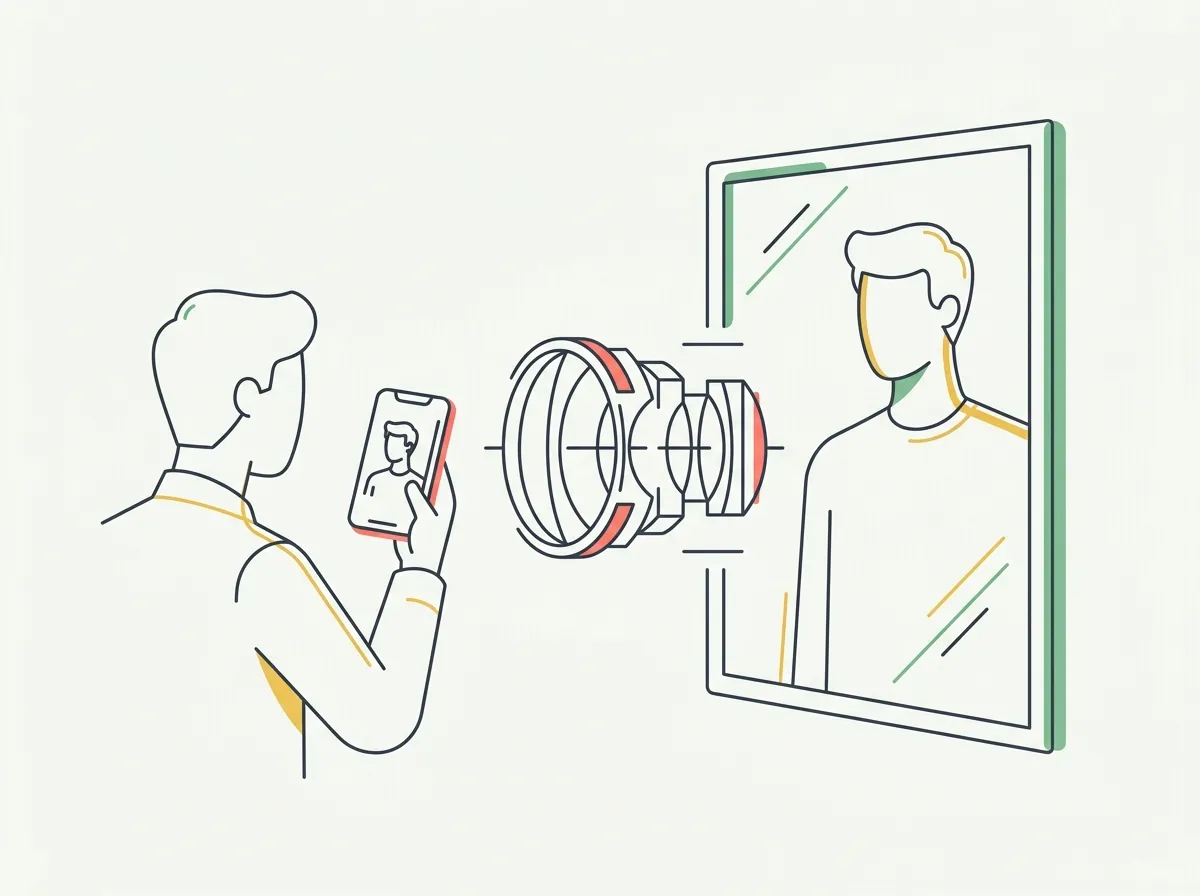
Quick answer: You look smaller in photos mostly because of optics, not your physique: phone wide-angle lenses at close range flatten and thin the subject, overhead lighting kills the shadows that show muscle, and a single frozen frame loses the depth your eyes see in a mirror. Shooting from 6+ feet with consistent light largely fixes it.
Six months of 5 a.m. sessions. The gym mirror finally agrees: shoulders wider, arms fuller, the work is showing. Then someone snaps a photo of you at a barbecue, you see it that night, and the person in the frame looks like he's been training for about three weeks.
Every lifter has had this exact whiplash, and the standard explanations — "you're just self-conscious," "cameras add ten pounds" — are both wrong. The camera isn't adding anything. It's removing things: depth, shadows, and proportion, through mechanisms that are well understood in photography. Here's what's actually happening, and why the answer ends up mattering enormously for progress photos.
Is the mirror or the camera telling the truth?
Neither, honestly. The mirror gives you a live, moving, three-dimensional view — but of a subject who unconsciously straightens up the instant he looks, under lighting he's learned by heart. The camera gives you an unposed record — but filtered through a lens, a distance, and a lighting setup that each distort in their own direction.
The useful question isn't which one is "true." It's which distortions each one carries, because once you know them, you can remove the camera's — and that turns out to be the whole trick.
How does your phone's lens make you look smaller?
The main phone camera is a wide-angle lens, and wide-angle lenses at close range distort in a way that's been demonstrated endlessly by photographers: whatever is closest to the lens gets exaggerated, and everything behind it gets pushed back and compressed. At arm's length or across a small bathroom, "closest to the lens" is usually your face or torso center — and your shoulders, arms, and chest depth fall into the compressed zone.
The commonly cited portrait-photography rule exists for exactly this reason: shoot people from farther away with a longer focal length, because close wide-angle shots visibly slim and flatten the subject. It's why professional physique photography is never shot from three feet away. Your barbecue photo was.
Selfies are the worst case. Front cameras are wider still, held at arm's length, angled down — a recipe for a bigger head, narrower shoulders, and a body that reads two sizes smaller than the mirror version.
What does distance do to how big you look?
Distance is the other half of perspective. Up close, the parts of you nearest the camera dominate the frame and the rest recedes; from farther back, your proportions flatten out toward how other people actually see you across a room.
This means the same phone produces meaningfully different bodies at three feet versus ten feet. Commonly recommended practice for anything resembling honest body photography: get the camera six or more feet away, roughly chest height, full body in frame. Not because it flatters — because it stops editorializing.
Why does the gym mirror flatter you in ways a photo doesn't?
Lighting direction. Gym lighting is typically overhead and directional, and overhead light rakes across your body, dropping small shadows under every ridge of muscle — the same reason bodybuilders are lit from above on stage. Your bathroom mirror, lit by a flat front-facing vanity light, doesn't do this, which is why you commonly look better at the gym than at home in the same day.
A casual photo usually has the least flattering light of all: on-camera flash or bright ambient light hitting you head-on, which fills in every shadow and visually erases definition that genuinely exists. The muscle is there. The light just declined to draw it.
Why does the photo version of you look "wrong"?
Two effects that have nothing to do with size:
- You've only ever met your mirror image. Photos show the unflipped you, and your face and body are asymmetrical enough that the unflipped version reads as subtly off — a familiarity effect commonly invoked to explain why most people prefer their mirror image. "Off" gets felt as "worse," and worse gets felt as smaller.
- A photo is one frozen frame of a moving body. In the mirror you see yourself in depth and in motion, continuously choosing the best of infinite micro-angles. A photo is one arbitrary millisecond, one angle, mid-breath. Nobody's average frame matches their best frame.
Stack it all up — wide lens, close range, flat light, unflipped, frozen — and the barbecue photo isn't evidence that the mirror lied. It's five distortions pointing the same direction.
How do you make photos more honest than the mirror?
Here's the flip that matters: every distortion above is a variable, and variables can be fixed. Same camera, same distance (6+ feet, timer or propped phone), same light source, same spot, same relaxed pose, same time of day. Standardize those and photos stop lying — and they gain the one power the mirror will never have: memory. The mirror updates so gradually you can't see change; two standardized photos taken 12 weeks apart make it undeniable. Our progress photo guide covers the exact setup, and this post covers how often to shoot.
Consistency is also the hard part, which is where GainFrame earns its place: it auto-aligns any two check-ins — matching framing and scale — so small differences in camera position don't masquerade as physique changes, then puts the estimated body fat delta and elapsed time on the comparison. Estimates from photos, not clinical measurement, but consistent in a way a barbecue snapshot never is.
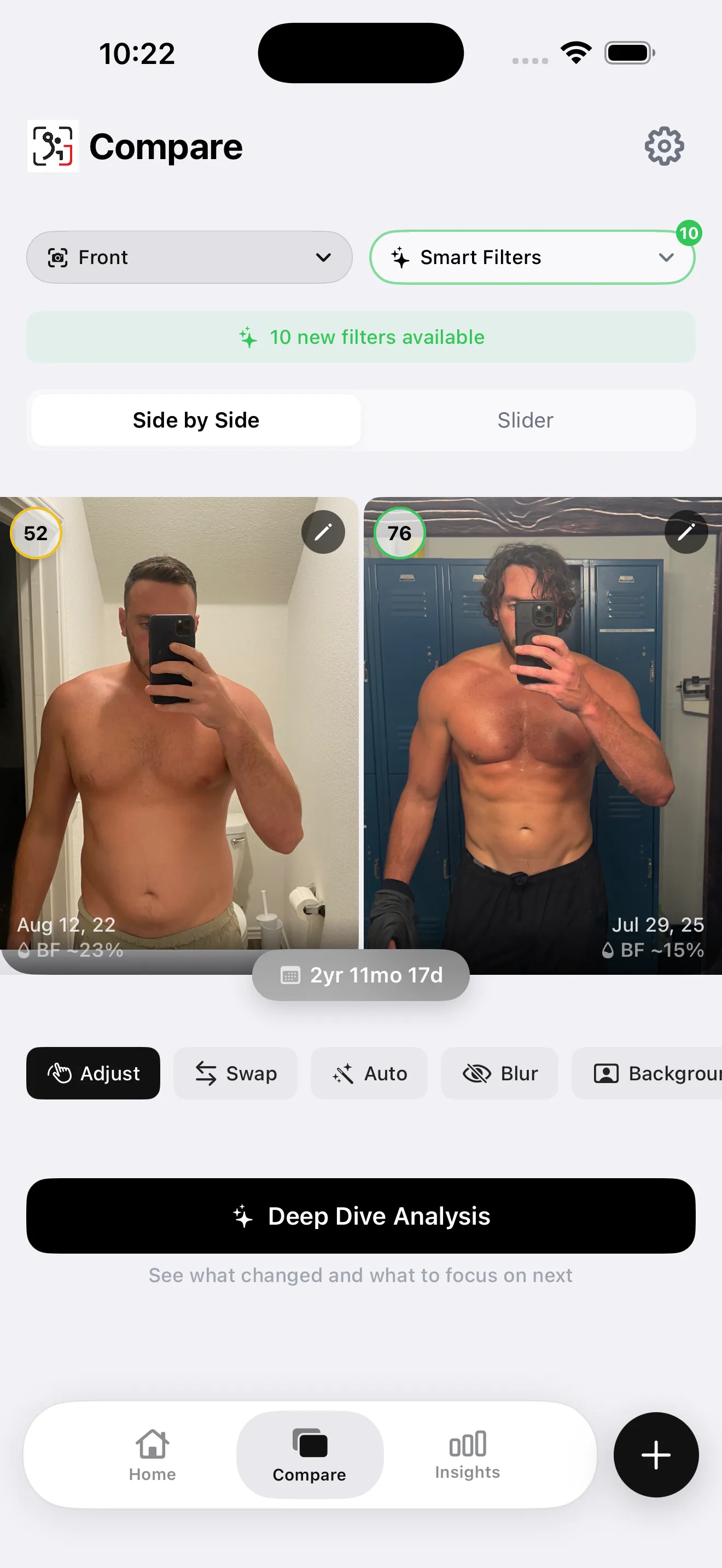
Auto-aligned check-ins: when framing and scale are matched for you, the comparison shows physique change — not camera-position change.
Do this and the hierarchy inverts. The random photo is the least honest view of you; the mirror is in the middle; the standardized photo series is the most honest instrument you own. And if the comparison also needs numbers, comparing photos properly and a body fat percentage reference chart are the next two reads.
Frequently asked questions
Why do I look skinny in pictures but not in the mirror?
Usually a stack of optical effects: phone wide-angle lenses at close range are commonly demonstrated to flatten and thin subjects, flat or front-facing light erases the shadows that show muscle, and a photo freezes one angle of a body you normally see moving in three dimensions. None of these change your actual size — they change how much of it the image preserves.
Do mirrors make you look bigger than you really are?
Flat mirrors don't magnify — but the mirror experience flatters. You see yourself in depth and motion, under lighting you've unconsciously learned, often at gym mirrors with overhead light carving definition. You also subtly adjust posture the moment you look. The mirror shows real information a photo drops; it just also shows you your most rehearsed angle.
Which is more accurate, the mirror or the camera?
Neither is accurate by default — the mirror adds familiarity bias and live posture correction, while a casual photo adds lens distortion and bad lighting. But a standardized photo — same distance of six or more feet, same lens, same light, same relaxed pose — becomes the more honest instrument, because it removes variables and creates a comparable record the mirror never can.
How far away should the camera be for progress photos?
Six feet or more is a good working rule, with the camera at roughly chest height and your full body in frame. Wide-angle distortion is strongest at close range — arm's-length selfies are the worst case — and backing the camera up lets the lens render proportions closer to how they actually are. Use a timer or a propped phone rather than a handheld shot.
Why do I look better flexed in the mirror than in my progress photos?
A gym-mirror flex stacks every flattering variable at once: a post-set pump, overhead directional light deepening every line, your practiced angle, and active tension. A progress photo taken relaxed, cold, and in flat light removes all four. That's a feature — the flexed mirror version tracks your best moment, while the standardized photo tracks the physique you actually carry around.
Make the camera the honest one
GainFrame auto-aligns your check-in photos and scores what changed — estimated body fat, FFMI, and 12 muscle groups — so lens angles and lighting stop deciding how your progress looks. Free to start on iOS.
Download GainFrame Free