Muscle & bone
BMI counts every kilogram the same. It cannot tell a bigger muscle cross-section from additional fat mass.
Start with height and weight for a clear BMI reference, or compare current and goal measurements with two illustrative 2D outlines. Switch modes and units without leaving the page.
01 · Your measurements
Enter height and weight. Your result updates instantly—nothing is uploaded or saved.
Adult range: 120–230 cm and 35–250 kg (about 3'11"–7'6" and 77–551 lb).
Healthy weight range
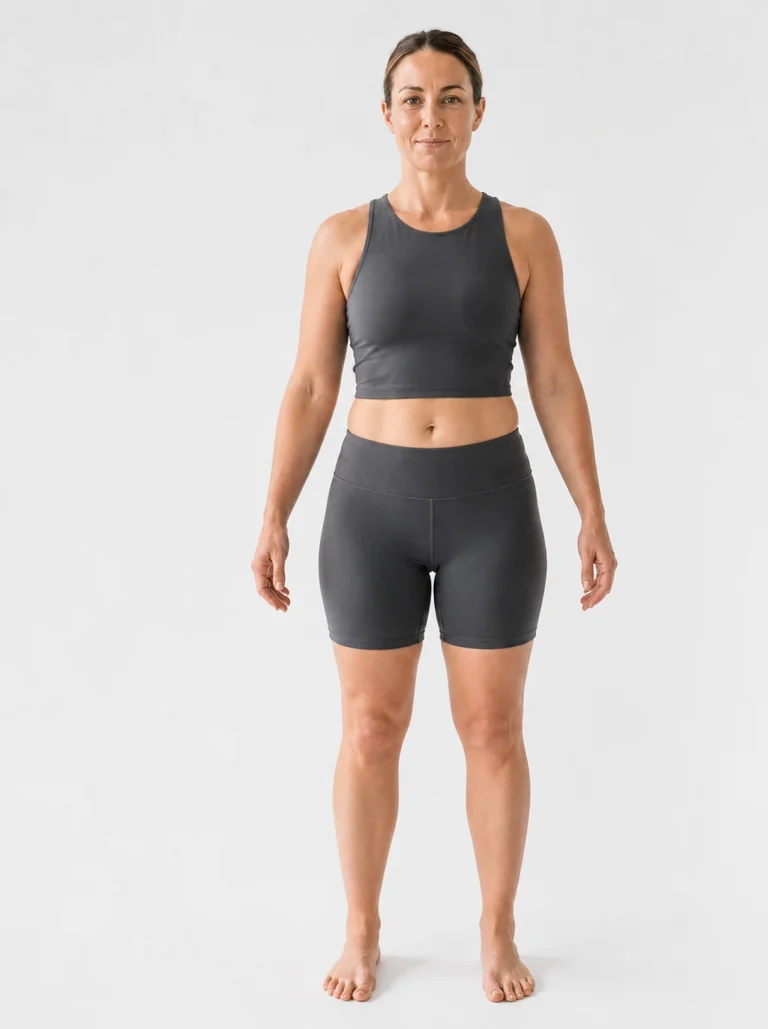
This image is illustrative, not predictive. BMI cannot tell muscle from fat or show where either sits. People at the same BMI can look very different.
01 · Two measurement sets
Enter current and goal/reference measurements to draw two proportion-led 2D outlines. Everything stays in this browser.
14 required fields remaining.
Shoulders, chest, waist, and hips are circumferences. In U.S. mode, enter height and inseam as total inches.
Complete the current and reference columns, or load the example to see how the outline responds.
Illustrative only. This 2D mapping is not a body prediction, an ideal, or medical advice. Real appearance depends on anatomy, muscle, fat distribution, posture, and measurement technique that an outline cannot capture.
Height + weight mode calculates adult BMI and selects a standardized male or female reference band. Enter cm and kg or switch to feet, inches, and pounds; the calculation and image update immediately.
Measurements mode accepts current and goal/reference sets for height, weight, shoulders, chest, waist, hips, inseam, and optional body fat. It maps those proportions into two deterministic 2D outlines and describes the entered changes without scoring either body.
Both modes are broad visual references—not personalized body predictions, definitions of an ideal, or medical assessments. The values stay in your browser and are not attached to the analytics events used to understand the tool funnel.
BMI is weight divided by height squared. It is useful as a quick screening measure, but it does not measure body fat and cannot distinguish fat from muscle or bone. A muscular lifter and a sedentary person can share a BMI while having visibly different bodies.
That limitation matters on a weight visualizer. The render above is selected from a standardized physique library to make broad bands easier to picture. Measurement mode responds to the tape values you enter, but its simplified outline still cannot know anatomy, muscle shape, fat distribution, or posture. Neither view should be treated as a forecast of how you do—or should—look.
Method and categories follow the CDC adult BMI guidance. This tool is for adults 20 and older and is not a diagnosis.
Three things BMI and simplified measurement outlines leave out can completely change the body in the mirror.
BMI counts every kilogram the same. It cannot tell a bigger muscle cross-section from additional fat mass.
Two people can carry the same amount of fat in different places, changing waist, hip, chest, and limb shape.
Limb length, shoulder width, pelvis shape, age, and posture all alter appearance without changing the BMI equation.
Compare male and female body-fat reference images across ages and percentages.
Explore the atlas →Photo analysisAI Body Fat EstimatorUpload one clear photo for a directional body-fat estimate—no tape or calipers.
Estimate from a photo →Lean massFFMI CalculatorAdd body-fat percentage to evaluate lean mass relative to your height.
Calculate FFMI →Yes. Height + weight mode calculates adult BMI, assigns the standard adult BMI category, and selects one standardized body-shape illustration from GainFrame's reference atlas. The image is an illustrative band, not a prediction of your appearance.
Yes. Switch to Measurements and enter current and goal/reference sets for height, weight, shoulders, chest, waist, hips, inseam, and optional body-fat percentage. The tool draws two proportion-led 2D outlines and reports neutral ratio changes side by side.
No. The outlines are deterministic illustrations of the numbers entered, not predictions, targets, medical assessments, or definitions of an ideal body. Anatomy, fat distribution, muscle, posture, and measurement technique all affect real appearance.
No. The BMI calculation and measurement comparison run in your browser. The funnel analytics record that the mode was viewed, started, or produced a result, but do not include the measurements you entered.
No. BMI uses only height and weight. It cannot separate fat mass from muscle or bone, so it does not calculate body fat percentage. Use a body fat estimator when body composition—not weight relative to height—is the question.
The same weight can be distributed differently across muscle, fat, and bone. Height proportions, frame size, age, and where a person carries fat also change visible body shape. That is why every physique render on this page is labeled illustrative.
Yes. Choose Female to see the standardized female body-shape reference for the BMI band calculated from your height and weight. The illustration is a broad reference, not a personalized prediction of your body.
Yes. Choose Male to see the standardized male body-shape reference for the BMI band calculated from your height and weight. Selecting male or female changes the illustration set, not the standard adult BMI formula.
Yes. Metric mode accepts centimeters and kilograms. In Height + weight mode, U.S. height uses feet and inches; in Measurements mode, U.S. lengths use total inches and weight uses pounds. Switching units converts the values already entered.
No. Height + weight mode uses standardized front- and back-view reference images, while Measurements mode draws responsive 2D silhouettes. Neither mode is a rotatable 3D scan, custom avatar, or recreation of your exact body.
The categories on this page are for adults age 20 and older. Children and teens need age- and sex-specific BMI percentiles. Pregnancy, high muscularity, and some health conditions can also make adult BMI categories less useful; ask a qualified clinician for an individual assessment.
GainFrame turns consistent progress photos into body-composition estimates, muscle scores, and comparisons you can actually track.