
Quick answer: $1,500 MRR did not make the product obvious. It proved that people will pay, while making the unanswered questions more expensive: what customers actually want, which features deserve to survive simplification, and how to judge a volatile day against a business whose revenue and organic traffic are still compounding.
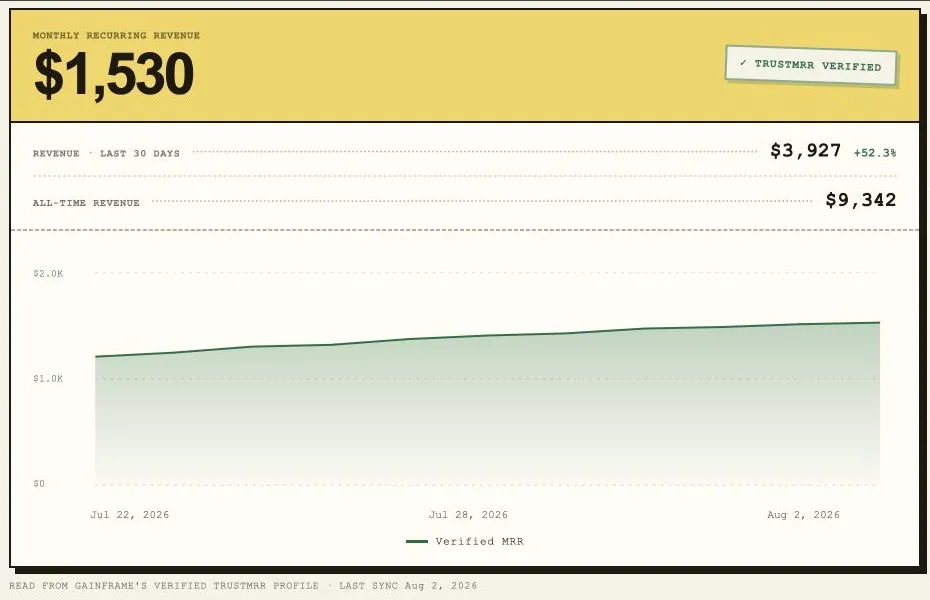
On August 2, GainFrame reached $1,536.09 MRR, 296 active subscriptions, and $9,423.14 in cumulative gross revenue. Four weeks earlier, MRR was $992.05. That is the kind of line I assumed would make me feel like I finally understood the business.
Update, August 12: GainFrame reached $1,920.18 MRR. I broke down why the next $920 took 31 days, how the free tools grew, and the website tracking I still need to fix.
I do not.
I know more than I did at $500 MRR. I have cleaner analytics, hundreds of paying customers, survey responses, support conversations, and months of behavior data. I still cannot answer the product question that matters most: what do customers want GainFrame to become?
That is the strange part of this milestone. The business is giving me stronger evidence that it works while the next decisions feel less obvious.
What did I expect $1,500 MRR to answer?
I thought customer understanding would arrive with volume. More people would use the app, the patterns would get louder, and the roadmap would become a ranking exercise. Polish the features people love. Remove the ones they ignore. Build the things they keep asking for.
The behavior patterns did get louder. The customer intent did not.
I have tried four direct feedback channels. In-app surveys produced 189 responses, founder chat produced 30 conversations, 116 cancellation emails produced zero replies, and a feature board produced zero posts. That work was useful. It surfaced score-consistency problems, price objections, onboarding friction, and bugs I could fix.
It did not produce a coherent answer to “what should this app become?” Analytics tells me what somebody tapped. A survey tells me what bothered them in one moment. Neither automatically tells me which promise should define the whole product.
At $500 MRR, uncertainty felt like a lack of data. At $1,500 MRR, I have plenty of data and still have to make a judgment.
The lesson I keep relearning: analytics can show you what people do. They cannot decide what your product should be.
What do the numbers actually say is working?
The cleanest answer is that growth has accelerated. My rough estimate was that MRR had added about $500 in four weeks after the previous $500 took nine. RevenueCat confirms it.
| Metric | Earlier period | Latest verified figure |
|---|---|---|
| MRR | $992.05 on Jul 5 | $1,536.09 on Aug 2 |
| Latest ~$500 climb | $477.32 → $992.05 in 9 weeks | $992.05 → $1,536.09 in 4 weeks |
| Cumulative gross revenue | n/a | $9,423.14 across 510 transactions |
| Active subscriptions | 185 on Jul 5 | 296 on Aug 2 |
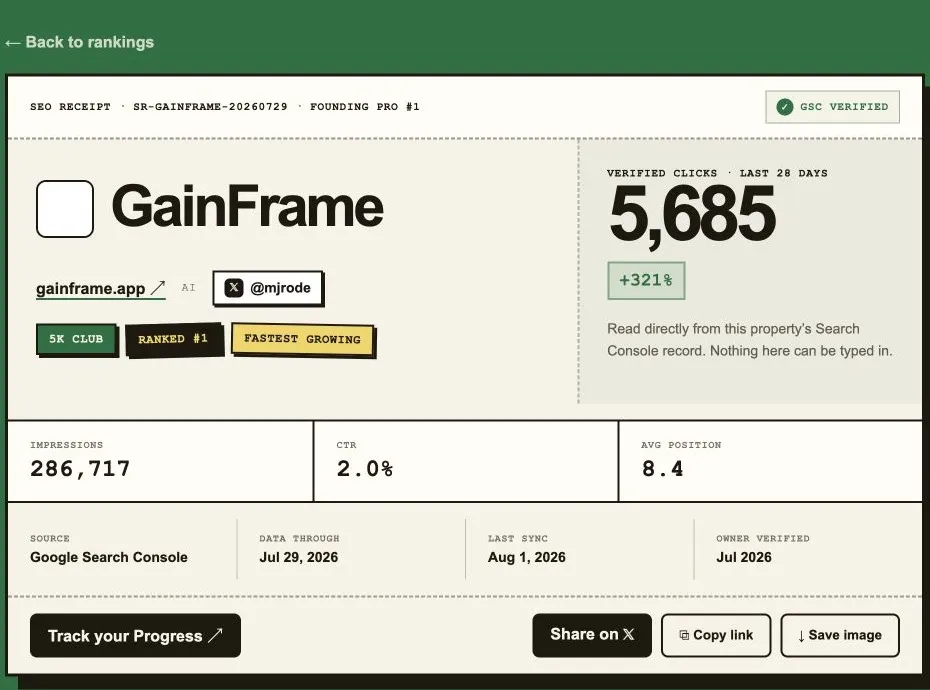
| Google clicks, 28 days | 1,474 | 6,031 (+309%) |
| Google impressions, 28 days | 61,250 | 308,843 (+404%) |
Revenue figures come from RevenueCat, checked August 2. Search figures compare July 4 to 31 with June 6 to July 3 in Google Search Console; Search Console data was complete through July 31.
The four-week MRR increase was $544.04, or 54.8%. The previous comparable climb was $514.73 over nine weeks. This is not a straight line. The weekly chart still has flat spots and dips, but the current slope is materially different from May.
Organic search is moving even faster. The latest complete 28 days generated 6,031 Google clicks and 308,843 impressions. The prior 28 days generated 1,474 clicks and 61,250 impressions. Clicks grew 309%. Impressions grew 404%.
That process turned into a separate product. I built SEO Receipts from the system I was already using for GainFrame: read the evidence, find the highest-impact problem, and turn it into one bounded task instead of another dashboard full of problems. The process that worked became a product.
Those are real wins. They also do not answer what the next version of the app should remove.
Why haven’t better analytics made product decisions easier?
The most important product feedback I have right now is simple: GainFrame needs to feel simpler. I agree. The interface accumulated features while I was trying to learn what mattered: photo scoring, comparisons, muscle maps, trends, Coach, Future Physique, workout context, recovery context, check-ins, and more.
Analytics can show which of those features people open. It cannot tell me whether they found the feature because it belongs in the core experience or because I put it in front of them. Usage proves that something is touched. It does not prove that every screen, metric, and setting deserves to survive.
That makes simplification harder than adding another feature. I can remove an unused button with confidence. I cannot confidently remove useful information from a feature people value, or merge two workflows without flattening the best part of each one.
The unresolved decision is no longer “what can I build?” I can build almost anything I can describe. It is “what is the smallest version of this product that still feels uniquely valuable?”
I do not have that answer yet. Pretending the numbers solved it would make for a cleaner milestone post and a worse product decision.
Why can one bad day still erase four good weeks in my head?
Some days I open RevenueCat and see 10 or 12 cancellation notifications. My first reaction is not a measured cohort analysis. It is that the app is failing and I have been fooling myself.
There is an important technical distinction here. Turning off auto-renew is not the same as a subscription expiring that day. In the RevenueCat movement data from July 1 through August 2, 41 subscriptions actually churned, while 155 new subscriptions started and three resubscribed. Net active subscriptions increased by 117.
The monthly view is growth. The notification feed can still feel like a verdict.
I have already written the detailed version of why retention is the hardest problem in this business. I do not want to turn every founder update into another churn article. The useful point here is psychological: a high-volume bad day gets delivered one alert at a time, while compounding growth arrives as a line you have to remember to zoom out and look at.
At $500 MRR, I thought the volatility would disappear if the app got bigger. It did not. The stakes just became real enough that I had to get better at separating a bad day from a broken business.
What changed between $500 and $1,500 MRR?
The first $500 was mostly a validation problem: will strangers install this, understand it, and pay for it? The next $1,000 has been an operating problem: can I grow acquisition, keep the product trustworthy, control costs, and choose a coherent direction without reacting to every signal?
The journey between them was not a smooth incline. I spent $5,674 on ads that did not work. Trial conversion fell to 20.7% before recovering to 44%. MRR flattened around $530 and I briefly thought I needed a new idea. AI costs reached 48.6% of weekly gross revenue before falling back under 17%.
Each failure produced something useful. Killing the ads forced me to learn organic acquisition. Broken analytics forced me to repair the measurement layer. High AI costs forced me to understand cost per feature. Weak customer outreach forced me to stop confusing a survey count with customer understanding.
That is what I would tell the version of me staring at $500 MRR: the line will move in both directions, and the work will often look useless before the lesson becomes visible. Patience is not waiting around. It is staying with a problem long enough to learn from the failed version instead of throwing it away for a new one.
$1,500 MRR did not give me the answer. It gave me better problems: customer understanding instead of basic validation, simplification instead of feature scarcity, and perspective instead of survival.
What am I doing before the next milestone?
I need a process that produces better decisions, not another motivational rule. This is the one I am using now.
- Separate the fact from the interpretation. Write down the verified metric first. Then write down the story I am telling myself about it. Ten cancellation notifications and ten churned subscriptions are not the same fact.
- Ask at the moment of friction. A narrow in-app question after a confusing step has beaten every generic outreach channel I have tried. I need more questions tied to real decisions and fewer “what should I build?” prompts.
- Simplify reversibly. Change one workflow at a time, preserve the before-and-after behavior, and keep a way back. The goal is not fewer screens at any cost. It is less cognitive load without deleting the reason somebody pays.
- Review the business weekly. Revenue, acquisition, product behavior, and one customer-learning signal belong on a weekly scorecard. Daily alerts are inputs. They are not verdicts.
If you are building your own app, the practical version is simple. Pick one verified business metric, one unresolved product decision, and one direct customer-learning method. Review them together. Growth without learning creates complexity. Learning without growth can become an excuse to keep polishing something nobody wants.
I thought traction would remove uncertainty. It removed the cheap uncertainty and left me with decisions that matter more.
Turn your SEO evidence into one next task
SEO Receipts came directly from the process behind GainFrame’s search growth. Connect Search Console read-only, publish a verified receipt if you want one, and use the private Workbench to prioritize one evidence-backed SEO task.
See SEO Receipts for Founders