
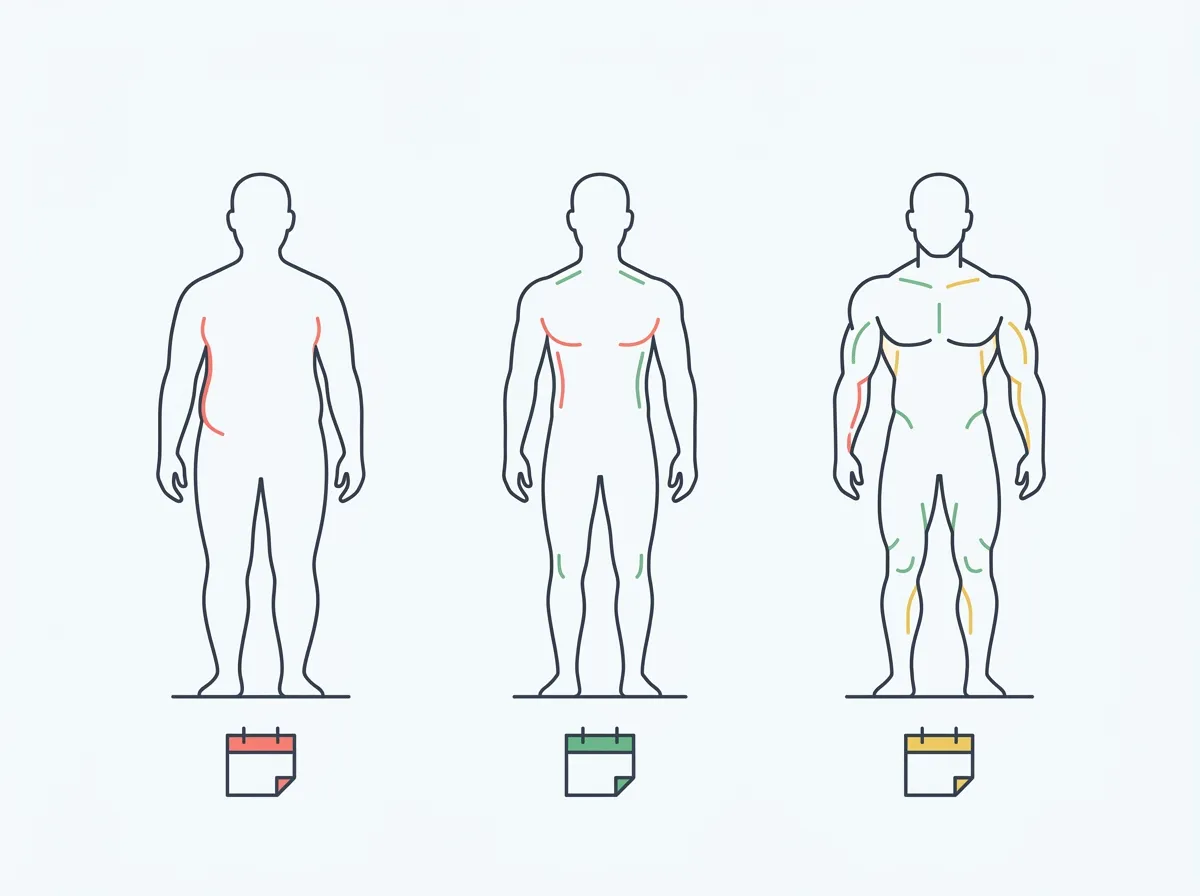
Quick answer: Real recomp results follow a predictable visual pattern: months 1-3 look almost identical in photos even as strength climbs, months 4-6 show a smaller waist and early definition, and months 9-12 are when visible muscle separation typically arrives. The scale often barely moves the entire time - photos and measurements catch what it misses.
You typed "body recomposition before and after" into a search bar and got a wall of 12-week miracles: guys who apparently went from dad bod to cover shoot in one summer. Then you looked at your own week-10 photo next to week 1 and saw... roughly the same person, maybe with better posture.
Here's the uncomfortable truth about that wall of miracles: most of it is presentation, not progress. Real recomp has a visual timeline, and it's slower and quieter than social media admits - but it's also predictable, which means you can know whether you're on track. This post is about what each stage looks like. For how long the process takes and what speeds it up or slows it down, read our realistic recomp timeline - that's the duration question, and it deserves its own post.
The images below are standardized, photorealistic AI renders from our body fat visualizer - same build, pose, and lighting, so only body fat percentage changes between images. They're illustrative of a typical pattern, not a promise: your starting point, training history, and genetics all shift the pace.
What does the starting point actually look like?
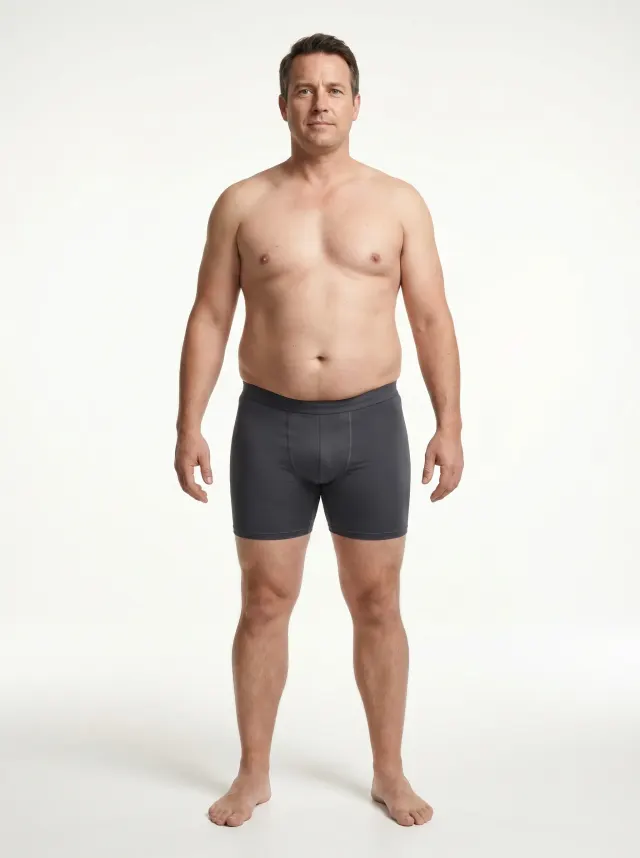
The typical recomp starting point - around 28% body fat. Muscle exists under there; it's just not visible yet.
This is where most recomps begin: enough body fat that no muscle shows, but enough muscle underneath to respond fast to training. That combination - newer to lifting, moderate-to-high body fat - is actually the best-case scenario for recomp, which is part of why recomp beats a dedicated bulk or cut for this group.
Take your baseline photos now, in conditions you can repeat. Front, side, back, same spot, same light. Your month-6 self will want them badly.
What changes in the first 3 months?
Visually? Typically very little - and knowing that in advance is the difference between staying and quitting. The commonly reported early pattern: strength climbs week over week, sleeves and shoulders feel slightly different, the waistband loosens a notch. In photos, months 1-3 usually read as "same person, marginally tighter."
The scale, meanwhile, does approximately nothing. Fat is leaving and muscle is arriving at similar rates, and the scale only sees the sum. This is the stage where the earliest signs of muscle growth are almost all non-visual: performance, recovery, fit. Trust those. The mirror is the last instrument to update. Our progress photos versus the scale guide explains why photos should lead during a recomp while weight becomes supporting evidence.
What does month 4 to 6 look like?
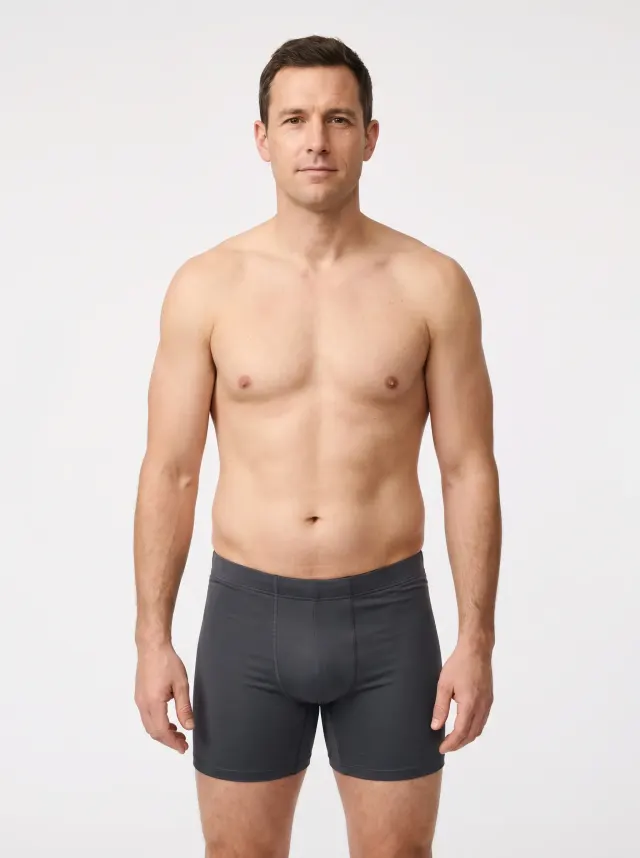
Around month 4-6 for a consistent recomp - roughly 23% here. The waist is visibly smaller and shape is arriving, but definition isn't here yet.
This is typically the first stage where a side-by-side against your baseline produces a genuine "oh." The waist is noticeably smaller. Shoulders and chest have shape. Clothes fit differently enough that other people may comment - usually with "have you lost weight?", which is ironic, because the scale has commonly moved only a few pounds.
What you won't see yet, for most people starting near 28%: abs, vascularity, or sharp lines. Definition is a low-body-fat phenomenon, and month 4-6 of a recomp usually hasn't gotten there. That's not a stall; it's the order of operations.
What does month 9 to 12 look like?
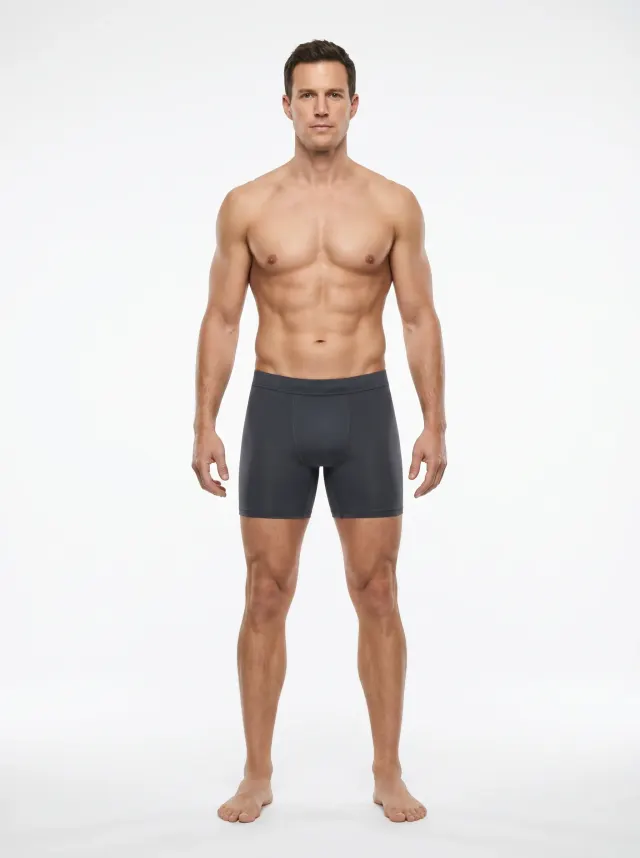
The month 9-12 zone for a well-run recomp - around 18%. Definition finally shows, and the year-long side-by-side looks like two different people.
The late stage is where recomp pays out everything it was quietly banking. Somewhere around this body fat range, muscle that's been growing all year starts showing through: delt caps, arm shape, the first hint of upper abs. The full-year before-and-after now looks dramatic - even though no single month ever did.
Note what the sequence was: waist first, shape second, definition last, scale never. If your photos are following that order, your recomp is working, whatever the scale claims. If the signals disagree, the free Recomp Reality Checker organizes your weight, waist, strength, and optional body-fat trends into one cautious read.
Why do before-and-after photos on social media look so much bigger?
Because a viral transformation photo is a comparison engineered for maximum gap, and there are commonly a half-dozen levers being pulled that have nothing to do with tissue:
- Lighting. Flat overhead light in the before; hard directional light carving shadows in the after. Lighting alone can visually swing what looks like several percent body fat.
- The pump. The after is shot minutes post-workout, when muscles are temporarily fuller.
- One good day. The after is the best of dozens of frames - low sodium, empty stomach, good sleep. Your check-in is whatever day the calendar said.
- Posing and posture. Slouched and relaxed in the before; braced, flexed, and angled in the after.
- Tan and shorts. Darker skin shows definition more; higher-cut shorts lengthen legs. Small tricks, real effect.
None of this means the underlying work is fake. It means the size of the visual jump is inflated, and measuring your own progress against it is rigged from the start. We broke down what honest photo comparison actually requires in our progress-photo comparison post.
How do you make your own before-and-after honest?
Standardize everything the influencers manipulate: same spot, same light, same distance, same relaxed pose, same time of day, no pump. That protocol is the entire difference between a photo that flatters and a photo that measures - the full recomp photo method is here.
Then compare across long gaps, not adjacent weeks. This is the part GainFrame automates: it auto-aligns any two check-ins, shows the elapsed time and the estimated body fat delta, and scores 12 muscle groups so the quiet months still produce a visible trend line. Estimates from photos, not clinical measurement - but consistent, which is what a before-and-after actually requires.
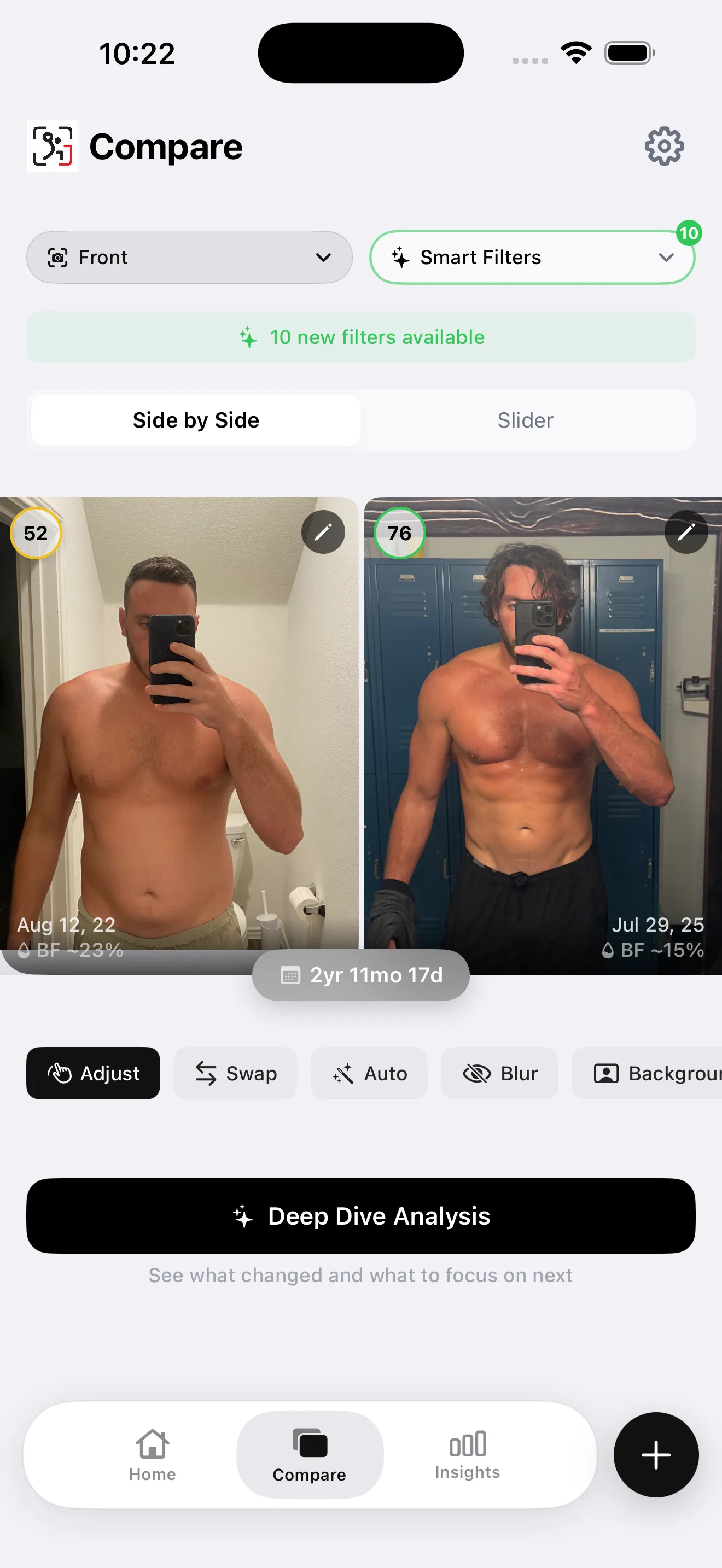
Your own before-and-after, standardized: two check-ins auto-aligned, with the composition delta the mirror can't quantify.
Frequently asked questions
What does body recomposition look like after 3 months?
Typically: not much, in a single photo. Three months of consistent recomp commonly shows a slightly tighter waist and a bit more fullness in shoulders and arms - changes that are obvious in a side-by-side comparison but nearly invisible in the mirror day to day. Strength gains usually arrive well before visual ones. Individual timelines vary with training history and starting body fat.
Why do my recomp results look smaller than transformations online?
Because most viral before-and-afters are engineered comparisons, not measurements: unflattering lighting and posture in the before, a pump, a tan, overhead lighting, and a good day in the after. Your standardized check-ins remove all of those levers, so they show less drama - and more truth. Compare your photos only against your own earlier photos, taken under the same conditions.
Does the scale change during body recomposition?
Often barely at all - that's the defining feature. Recomp trades fat mass for muscle mass, and since the scale only reports the total, months of genuine progress can register as a flat line or a swing of a few pounds. Waist measurements, clothing fit, and standardized photos are the instruments that actually detect recomp; the scale is close to blind to it.
How do I know my recomp is working if my photos look the same?
Check the signals that move earlier than photos: lifts trending up at the same effort, waist measurement trending down, clothes fitting differently, and photos compared across 8-12 week gaps rather than week to week. Adjacent check-ins nearly always look identical - the change lives in the long gaps. If all of those are flat for 2-3 months, then adjust training or nutrition.
Are the recomp before and after photos on social media real?
Many are genuine work presented under maximally different conditions - lighting, pump, posing, tan, and time of day all shifted to widen the visual gap. Some add flattering angles or lens choices; a few are simply fake. The physique change is often real; the size of the apparent change usually isn't. Standardized photos are how you keep your own comparisons honest.
Build a before-and-after you can trust
GainFrame turns weekly photos into an aligned, measurable timeline - estimated body fat, FFMI, and 12 muscle-group scores - so the slow months still show progress. Free to start on iOS.
Download GainFrame Free