
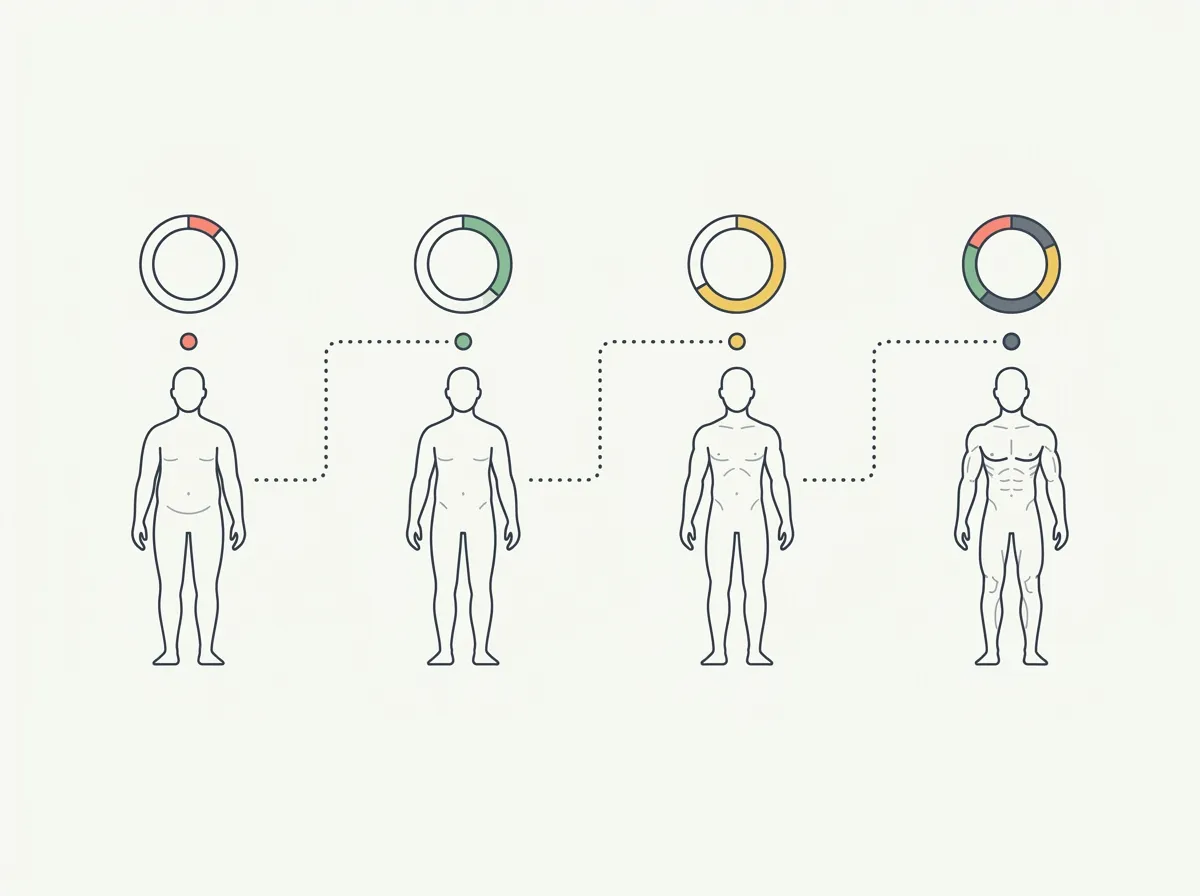

Quick answer: Body recomposition usually becomes easier to detect after 8 to 16 weeks, while a clearly visible change often takes 3 to 6 months. Beginners and people returning to training may progress faster. Judge the process with waist, strength, photos, and weight trends together because the scale can stay nearly flat.
Six weeks into a recomp, the scale may read exactly what it did on day one. That can feel like failure even when your waist is starting to shrink and your gym performance is improving.
Body recomposition means reducing fat mass while adding or preserving lean mass. Those changes can partially cancel each other on the scale, which makes recomp unusually hard to judge in real time. The practical solution is to use a longer review window and several repeatable measurements.
This timeline is a planning guide, not a biological deadline. Research supports resistance training and adequate protein as useful foundations for improving body composition, but no study can predict the exact week when a specific person will look different.
What does a realistic body recomposition timeline look like?
Use the timeline below as a set of review points. The ranges overlap because training age, starting body composition, calorie intake, sleep, and adherence all affect the pace.
| Timeframe | What may be changing | What to review |
|---|---|---|
| Weeks 1 to 4 | Training performance, glycogen, water, and routine consistency may change before your physique does. | Workout completion, exercise progression, weekly weight average, and baseline photos. |
| Weeks 5 to 8 | Early waist or clothing changes may become detectable, especially for newer lifters. | Waist trend, repeated poses, strength trend, and nutrition adherence. |
| Weeks 9 to 12 | A real visual difference may appear in a side-by-side comparison even if day-to-day changes remain invisible. | Photos from the same conditions, waist, average weight, and major lifts. |
| Months 4 to 6 | Consistent work has had enough time to create a more obvious composition trend for many people. | Whether several independent signals agree and whether the current phase still fits your goal. |
| Beyond 6 months | Progress can continue, although experienced lifters may find simultaneous fat loss and muscle gain increasingly slow. | Whether a focused cut, maintenance block, or controlled gaining phase would be easier to execute. |
The purpose of this table is to stop a normal quiet month from triggering a complete program change. It is also meant to stop endless waiting when no trend is moving. Four weeks is often too short for a verdict. Eight to twelve consistent weeks provide a more useful checkpoint.
What should you expect during the first four weeks?
The first month is mostly a setup period. You are learning how much food keeps your average weight reasonably stable, whether your program provides progressive resistance, and which photo and measurement routine you can repeat.
Scale fluctuations during this period can come from carbohydrate intake, sodium, hydration, digestion, menstrual cycle changes, and muscle soreness. A hard training session can temporarily increase water retention. A lower-carbohydrate day can move the scale in the other direction. Neither movement proves that fat or muscle changed overnight.
Performance is often the most useful early signal. Record loads, repetitions, and technique on a few stable exercises. If you are adding repetitions with similar form and effort, training is producing an adaptation signal even when your appearance has not caught up.
Take front, side, and back photos before relying on memory. Use the same camera distance, pose, lighting, clothing, and approximate time of day. Your eyes adapt to small daily changes, while a standardized comparison preserves the baseline.
What may change between weeks five and eight?
This is the first reasonable window for subtle changes. A waist measurement may trend down, a shirt may fit differently through the shoulders, or the same workout may require less effort. None of those signals needs to be dramatic.
Avoid converting a single measurement into a success story. Waist readings can shift with tape placement, breathing, food volume, and posture. Strength can improve through skill and coordination. Photos can change with lighting. When two or three signals move in a compatible direction, the case becomes stronger.
Protein supports muscle repair and adaptation, but more is not automatically better. The International Society of Sports Nutrition position stand reports that roughly 1.4 to 2.0 grams of protein per kilogram of body weight per day is sufficient for most exercising adults, with individual needs varying by energy intake and training context. Spread practical servings across the day and choose an amount you can sustain.
What should you look for between weeks nine and twelve?
At 9 to 12 weeks, compare your current data with the original baseline rather than last week. Long gaps reveal slow change more clearly.

A useful recomp pattern might include:
- A stable or gently changing weekly weight average
- A waist measurement that trends down across repeated readings
- More repetitions or load on key exercises
- Photos that show a smaller waist or more muscular shape under the same conditions
- Clothing that fits differently in ways consistent with those measurements
If only the estimated body-fat number changes while every direct measurement stays flat, be cautious. Consumer scales and visual estimates are useful for trends, but hydration and model assumptions can move the output. Look for agreement across the full record.
The free Recomp Reality Checker organizes changes in weight, waist, strength, and optional body-fat estimates into a cautious signal. It does not diagnose progress or replace a qualified coach, but it can make conflicting trends easier to review.
Why can the scale stay flat during body recomposition?
The scale measures total mass. It cannot tell whether a pound came from fat, muscle, water, glycogen, food in the digestive system, or clothing. If fat mass decreases while lean mass increases, total weight can move very little.
That does not mean every flat scale is a successful recomp. Sometimes a flat trend simply means maintenance with no meaningful composition change. This is why weight must be paired with waist, training, and photos.
Use a weekly average instead of comparing isolated mornings. Weigh under similar conditions when practical, then review the average over several weeks. A trend is far more useful than the loudest number in the week.
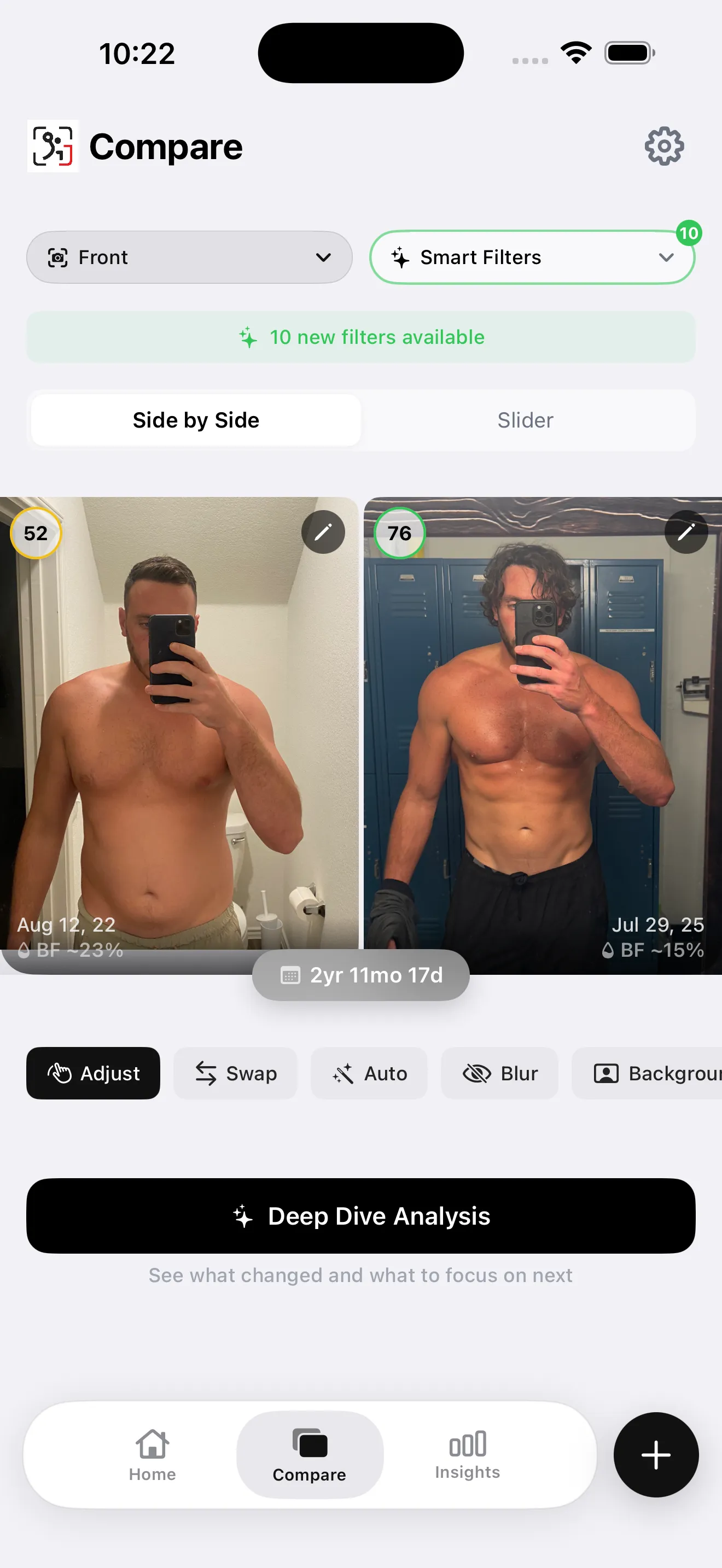
For photos, compare intervals of at least four weeks. Eight to twelve weeks is often even more revealing. Our guide to tracking body recomposition with progress photos explains how to keep the setup consistent.
What makes body recomposition faster or slower?
Training experience has a large effect. Beginners, people returning after time away, and people with more fat mass to lose often have more room to improve both sides of the equation. An experienced, already-lean lifter may need a much longer window to detect small changes.
Your program also matters. Resistance training needs enough effort, volume, and progression to challenge the muscles you want to develop. Constantly replacing exercises makes progression harder to measure. Keep a stable group of key movements long enough to see whether performance is improving.
Energy intake changes the tradeoff. A large deficit favors faster weight loss but can make muscle gain harder. A surplus favors gaining mass but may slow or reverse fat loss. Recomp usually works best when the goal is modest and the plan can be executed consistently rather than pushed to an extreme.
Recovery belongs in the same calculation. Sleep, stress, illness, and training fatigue affect performance and adherence. If every session is deteriorating, adding more training is unlikely to solve the problem.
How can you tell whether your recomp is working?
Choose a small measurement set and repeat it on a fixed schedule:
- Record body weight several mornings per week and calculate a weekly average.
- Measure your waist at the same anatomical point once per week.
- Log a few representative exercises with load, repetitions, and effort.
- Take standardized photos every one or two weeks.
- Review all four trends every four weeks, with a fuller decision at 8 to 12 weeks.
The strongest conclusion comes from convergence. If the waist is down, performance is up, and a twelve-week photo comparison looks leaner at a similar weight, recomp is a reasonable interpretation. If weight, waist, performance, and photos are all flat after a genuinely consistent block, the plan probably needs attention.
Before adjusting calories, audit execution. Check whether food tracking reflects weekends, drinks, and cooking fats. Confirm that training progressed rather than merely felt difficult. Review sleep and missed sessions. A small targeted correction is easier to evaluate than changing diet, exercises, cardio, and supplements at once.
When should you switch from recomp to a cut or bulk?
Recomp is useful when maintaining roughly similar body weight fits the goal. A dedicated phase can be clearer when one outcome becomes the priority.
A cut may fit better when fat loss is the main goal and you are comfortable accepting slower muscle gain. A controlled gaining phase may fit better when building muscle and strength is the clear priority. An experienced lifter who has spent months with no measurable change may also benefit from choosing one direction.
Use an 8 to 12 week block of reliable data before deciding that the approach failed. If the record is inconsistent, the first improvement is usually the measurement and adherence system. If the record is consistent and no signal is moving, change one lever, set the next review date, and keep tracking.
If you have a medical condition, a history of disordered eating, are pregnant, or are unsure whether changing calorie intake is appropriate, discuss the plan with a qualified clinician or registered dietitian.
Which sources support this recomp timeline?
- International Society of Sports Nutrition position stand on protein and exercise
- Journal of Strength and Conditioning Research review of body recomposition in trained individuals
- Systematic review and meta-analysis of resistance training and body composition in healthy adults
These sources support the underlying training, nutrition, and measurement principles. The week-by-week checkpoints above are practical review intervals, not promises taken from a single trial.
What do people ask about body recomposition timelines?
How long does body recomposition usually take?
Most people should evaluate body recomposition over months rather than weeks. Early training and waist trends may appear within 4 to 8 weeks, while a clear visual difference often needs 8 to 16 weeks or longer. Training history, starting body fat, nutrition, sleep, and measurement consistency can all move that timeline.
Can you see body recomposition results in one month?
You may notice better gym performance, a small waist change, or a different clothing fit in one month, especially if you are new to resistance training. A dramatic visual transformation is unlikely. Water, glycogen, digestion, and lighting can easily hide or exaggerate the small tissue changes that occur during the first four weeks.
Why is my weight not changing during a recomp?
A flat scale can be compatible with recomp because fat mass may decrease while lean mass increases. It can also mean that neither is changing, so use more evidence: a weekly weight average, waist measurements, repeat photos, and strength trends. Review several weeks together instead of treating one weigh-in as a verdict.
How do I know whether body recomposition is working?
Look for agreement across several trends: a stable or slowly changing weight average, a smaller waist, improved repetitions or loads, and clearer differences in standardized photos. One signal can be noisy. If all of them remain flat for 8 to 12 consistent weeks, review adherence, calorie intake, protein, training progression, and recovery.
When should I stop recomping and choose a cut or bulk?
Consider a dedicated phase when your main goal becomes clearer than maintaining weight, or when 8 to 12 well-tracked weeks show no useful change. A cut prioritizes fat loss; a controlled surplus prioritizes muscle gain. Your health, training experience, starting body composition, and preferences should guide the choice.
See the changes your scale misses
Turn consistent progress photos into an aligned visual timeline with estimated body-fat and muscle-group trends. Use the record alongside your waist, weight, and training log.
Download GainFrame Free