
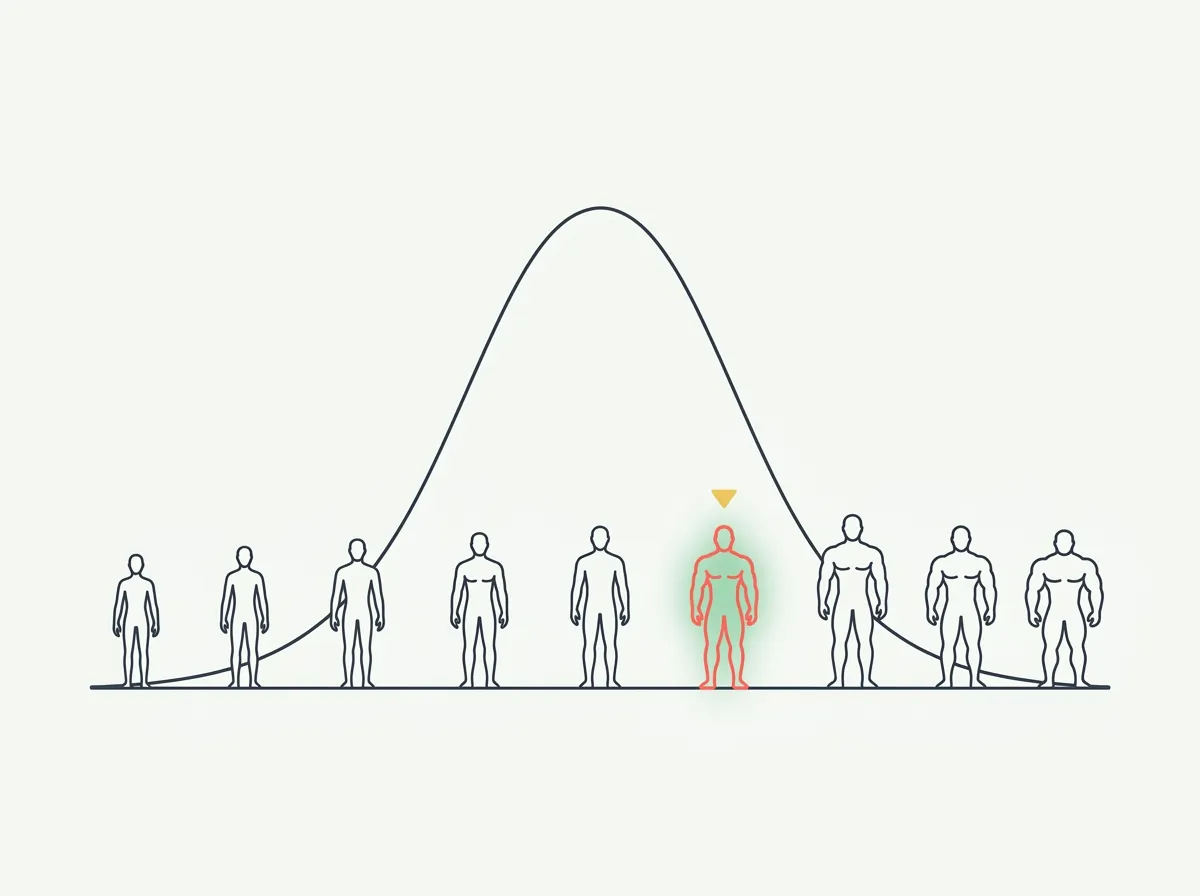
Quick answer: Most untrained men have an FFMI around 17–19. A couple of years of consistent lifting typically lands you at 20–22, which already puts you ahead of the vast majority of men. Values above 23 are uncommon, and 25 is widely cited as near the natural ceiling.
You've been lifting for two years. You've added maybe 15 pounds of weight, your shirts fit differently, and yet you genuinely cannot tell if you're "big" or just less small. Reddit is no help — every thread is populated by guys claiming a 315 bench and a 21-inch neck.
FFMI cuts through that. It's a single number that describes how much muscle you carry for your height, and unlike gym lifts, it has recognizable landmarks — you can place yourself on the distribution the way you'd place a height or an income. This post is that placement. If you want the metric itself explained, start with our FFMI explainer; the one-sentence version is that FFMI is your fat-free mass in kilograms divided by your height in meters squared.
What is the average FFMI for men?
One honest caveat before the numbers: nobody has run a formal FFMI census of the male population. The landmarks below are the values commonly repeated across fitness literature and coaching practice, anchored by a handful of well-known studies — treat them as reliable signposts, not decimal-precise percentiles.
With that said, the signposts are remarkably consistent:
- Untrained men most commonly land around 17–19. This is the average guy who has never followed a program.
- Recreational lifters — a year or two of reasonably consistent training — typically reach 19–21.
- Dedicated lifters with several years of structured training and eating commonly sit at 21–22.
- Advanced naturals grind into the 22–24 range over many years.
- 25 is the number most commonly cited as near the natural ceiling, based largely on a widely cited 1995 analysis that compared steroid users with non-users, including bodybuilders from the pre-steroid era.
Where do you rank? The FFMI distribution
Here's the same information as a ladder. Find your number, read your row honestly.
| FFMI | Bracket | What it usually means |
|---|---|---|
| Below 17 | Below average | Little muscle mass for your height — common for lighter or very lean untrained men |
| 17–19 | Untrained average | Where most men who don't lift end up; genetics scatter people across this band |
| 19–21 | Recreational lifter | 1–2 years of consistent training; visibly ahead of the average man |
| 21–22 | Dedicated lifter | Several years of structured training; clearly muscular in clothes |
| 22–24 | Advanced natural | Uncommon; most men never reach this regardless of effort |
| 24–25 | Exceptional natural | Rare — elite genetics plus near-perfect years of training |
| 25+ | Near or beyond the cited natural ceiling | Achieved naturally by a small number of outliers; increasingly unlikely without enhancement |
Two things jump out of this table. First, the gap between "never lifted" and "lifted seriously for two years" is only 2–3 FFMI points — muscle is slow, and the metric reflects that. Second, the entire natural career of most lifters plays out between roughly 19 and 23. That's the whole game.
Why does 25 keep coming up as the natural limit?
The number traces mostly to a widely cited 1995 steroid-era analysis: researchers compared the FFMI of steroid users, non-users, and champion bodybuilders from before steroids were available, and the non-enhanced group clustered below roughly 25. That's why 25 became the shorthand for "the natural ceiling."
It's a statistical landmark, not a law of physics — some naturals with outlier genetics appear to reach or slightly exceed it, and the original sample was small. We unpack the debate, the exceptions, and what the number means for your own expectations in our natty limit deep dive. The practical takeaway is simpler: if your FFMI is under 23, the ceiling is not your problem yet.
Why is FFMI a better muscularity measure than your bench?
"How much do you bench" is the culturally accepted muscularity question, and it's a bad one. Bench press measures one skill on one lift. It rewards short arms, a big arch, and extra bodyweight — a 240-pound man with 28% body fat will usually out-bench a leaner, more muscular 180-pound man.
FFMI measures the thing you're actually asking about: lean mass relative to height. You can't inflate it with technique, you can't buy it with fat gain (fat mass is excluded by definition), and it lets a 5'7" lifter and a 6'3" lifter compare on equal footing. Strength is worth training for its own sake — it's just a noisy proxy for muscularity, and FFMI is a direct one.
The one thing FFMI can't see is your body fat level itself — a lean 21 and a soft 21 look very different. That's why it pairs naturally with a body fat percentage estimate rather than replacing one.
How do you track your FFMI over time?
A single FFMI reading is a ranking. A series of readings is a progress measure — and that's the more useful mode, because your competition is your own number from six months ago.
The friction is the body fat input. DEXA scans are accurate but cost money and scheduling; calipers are cheap but operator-dependent. GainFrame computes FFMI as part of every photo check-in — the AI estimates body fat from your progress photo, combines it with your logged weight and height, and plots the result over time alongside a physique score and per-muscle-group ratings. They're estimates from photos, not clinical measurements, but the method is consistent check-in to check-in, which is what a trend needs.
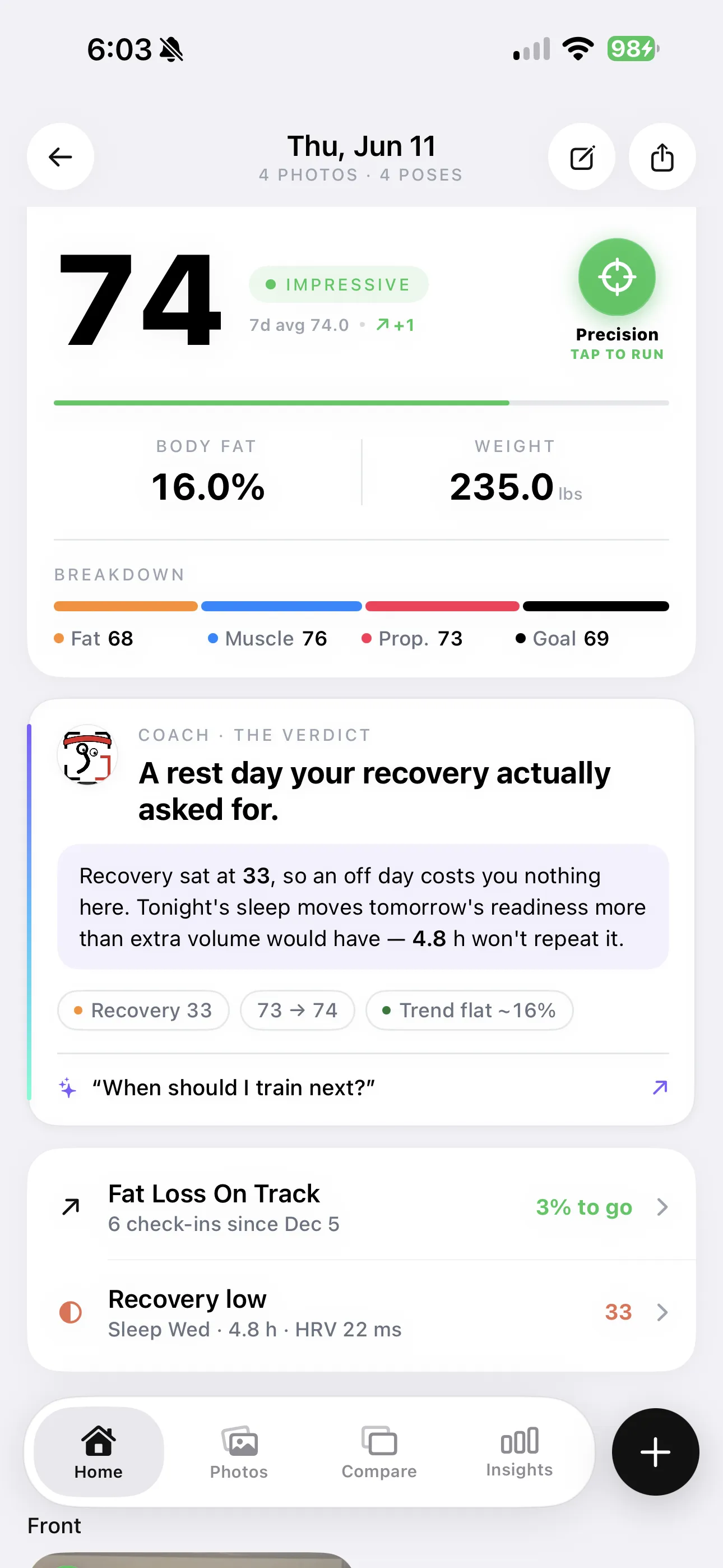
FFMI is computed at every check-in — the ranking becomes a trend line instead of a one-time number.
Whatever method you use, use the same one every time. Switching from calipers to a BIA scale to a photo estimate will move your FFMI a point in either direction for reasons that have nothing to do with muscle.
What should you do with your number?
- Under 19: you have the most room to grow of anyone reading this. A basic program and adequate protein will move your FFMI faster now than at any later point.
- 19–21: you're past the beginner window. Progress now comes from consistency measured in years — track it, because the mirror updates too slowly to notice.
- 21–23: you're ahead of nearly everyone. Gains arrive in fractions of a point per year; celebrate them accordingly.
- 23+: you're near rare territory. Verify your body fat estimate before celebrating — at this level, a 2-point body fat error is the difference between advanced and exceptional.
For the full number-by-number breakdown at every height and weight, see our FFMI chart.
Frequently asked questions
What is the average FFMI for a man?
Untrained men most commonly land somewhere around 17–19, with values varying by genetics, height, and how body fat was measured. There's no official census of FFMI — these are landmarks repeated across fitness literature, not a formal population survey — but they're consistent enough that 18–19 is a reasonable picture of the average man who doesn't lift.
What is a good FFMI for a natural lifter?
Anything above 20 reflects real trained muscle, and 21–22 is a result most men never reach. Above 23 is advanced territory. But "good" depends on training age: an 18.5 after one year of lifting is on track, while a 22 after eight years is an excellent outcome. Judge your number against your own timeline, not a stranger's.
Is an FFMI of 25 achievable naturally?
It's commonly treated as near the natural ceiling, based largely on a widely cited 1995 analysis comparing steroid users and non-users from the pre-steroid era. Some naturals with exceptional genetics appear to reach or slightly exceed 25, so it's a strong statistical landmark rather than a law of physics. For most lifters it's a career-defining target, not a waypoint.
How do I calculate my FFMI?
You need three inputs: weight, height, and a body fat percentage estimate. FFMI is your fat-free mass in kilograms divided by your height in meters squared. The body fat number is the weak link — a DEXA scan, a consistent photo-based estimate, or calipers all work, but switching methods between measurements will move your FFMI for reasons that have nothing to do with muscle. For a quick photo-based number, the free browser body fat estimator gives you one scan a day, no signup.
Why is FFMI better than bench press for measuring muscularity?
Bench press measures one skill on one lift, and it's heavily influenced by leverages, technique, and bodyweight — a heavier man benches more without being more muscular. FFMI measures the thing itself: how much lean mass you carry for your height. It can't be inflated by arching harder or gaining fat, which is exactly why it's the standard for comparing muscularity between people.
See where you rank — and watch it climb
GainFrame estimates your body fat and FFMI from a weekly photo check-in, then tracks both over time alongside a physique score and 12 muscle-group ratings. Free to start on iOS.
Download GainFrame Free