
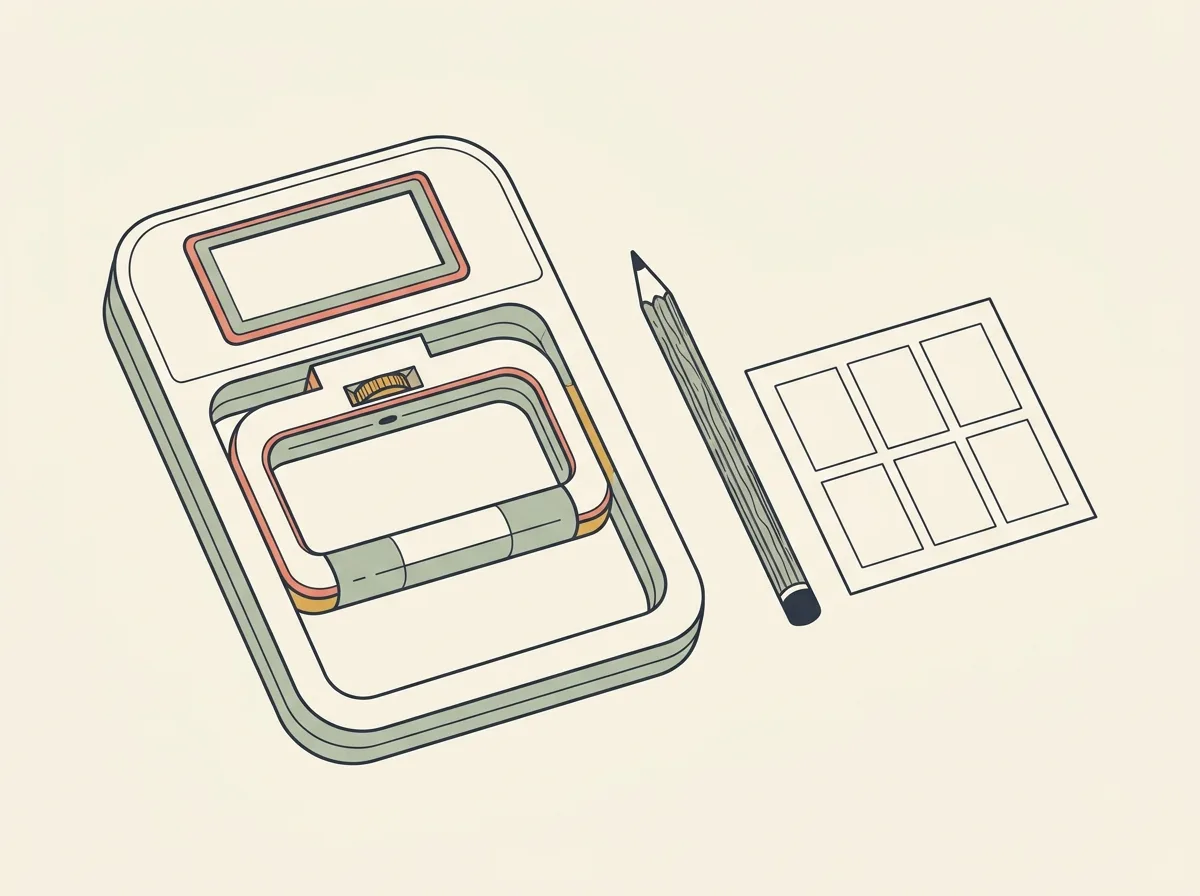
Quick answer: To measure grip strength, fit a hand dynamometer to your fingers and squeeze with your arm straight at your side. Alternate hands for three recorded attempts per hand, allowing at least 60 seconds before retesting the same side. Keep the highest reading for each hand and write down the device, handle setting and unit.
You squeeze a gym dynamometer and get 32. You might remember the number next month. Will you remember whether it was kilograms or pounds, which hand you used, or whether your elbow was bent? Those three details decide whether you can compare today's 32 with your next test.
Print the one-page grip strength scorecard (PDF). It has room for the setup, six attempts and your best result for each hand.
What does your grip strength actually measure?
A grip dynamometer records how much force your fingers and palm apply to its handle in a squeeze. The handle barely moves. This is an isometric test. A tape can tell you your hand length and span or your forearm circumference. Neither measurement gives a force reading.
This guide uses the standing test from the 2011 to 2012 US National Health and Nutrition Examination Survey (NHANES). The survey used a calibrated Takei T.K.K.5401 dynamometer. The instructions below give you a consistent way to use an adjustable device for your own records. A reading from a different instrument can have a different baseline. NHANES grip-test documentation
How do you adjust the handle to fit your fingers?
Sit down for the setup. Shake both hands three times, then bend and straighten all your fingers three times. Remove rings or wrist jewelry that would interfere with holding the device. Note your dominant hand and the hand you will test first. NHANES assigned the starting hand. For a personal log, choose one, write it down and repeat that order next session.
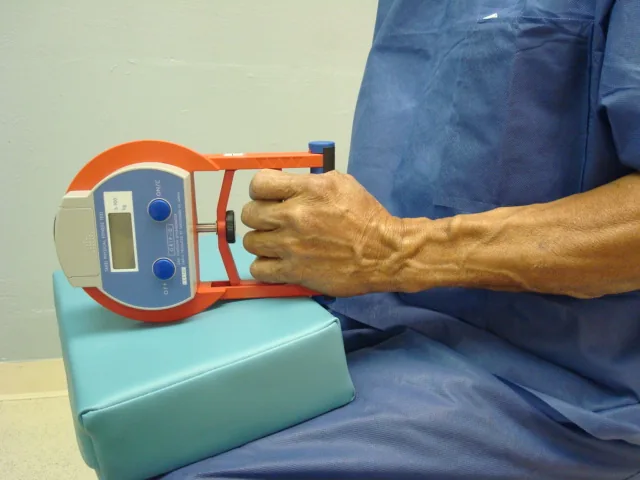
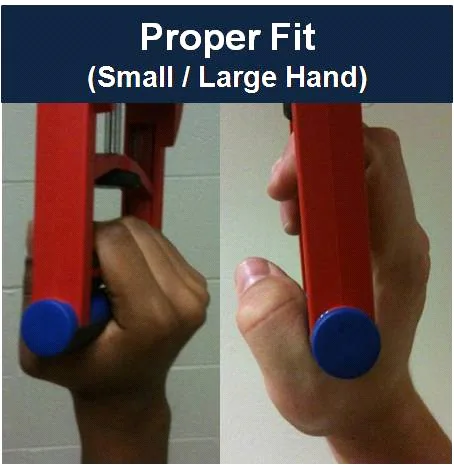
Support the dynamometer while you adjust the handle. Line up hand, wrist and forearm. The middle joint of your index finger should form roughly a right angle around the handle. Check the fit on both sides and note each setting if the spacing differs.
How should you stand for the grip strength test?
Stand with both feet even and about hip-width apart. Face forward with your head level and shoulders back. Let the testing arm hang straight beside you, palm toward your leg. Hold the device at thigh level with your wrist straight. Leave a gap between the device and your body.
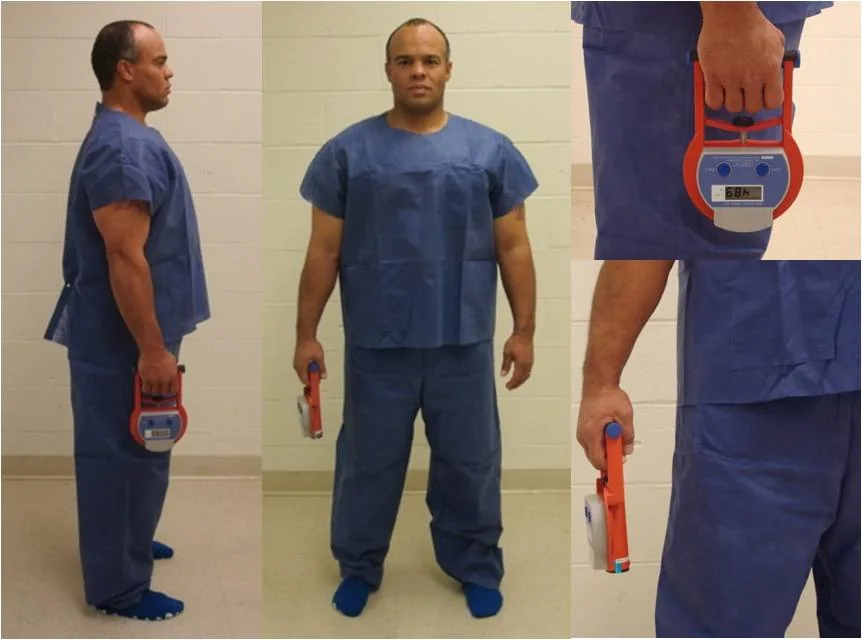
The front and side views show the testing position. The close-ups show how the device clears the thigh. CDC/NCHS, Figure 3-7.
The three photographs come from the CDC's National Center for Health Statistics. The original NHANES Muscle Strength Procedures Manual is available free. Use of these materials and links does not imply endorsement by CDC, HHS or the US government.
NHANES allowed a seated test when someone could not stand unassisted. Record the position so you can repeat it. A seated test with your elbow bent to 90 degrees is a different protocol from the standing test pictured here. The survey also skipped testing a hand that had undergone hand or wrist surgery within the previous three months. If squeezing hurts, stop the test.
How do you measure grip strength across six trials?
- Practice once. Make one gentle squeeze with the hand you plan to test second. Get comfortable with the movement and keep this trial off the scorecard.
- Zero the device. Check the unit on the display and fit the handle setting for the first hand. Recheck the position of your arm and wrist.
- Squeeze and record. Breathe in, then exhale as you squeeze as hard as you can. Release and enter the peak reading under the correct hand. If you lean on the device or lose your form, mark the attempt instead of counting it as a clean result.
- Time the rest. The published study specifies 60 seconds of rest between measurements on the same hand. The examiner manual also describes waiting for a 60-second timer after entering each reading. On this scorecard, wait one minute after every recorded trial before passing the device back.
- Switch hands. Alternate the starting hand and the other hand until you have three results for each. Reset the display between trials. If only one hand can be tested, leave at least 60 seconds between its practice or recorded attempts and the next squeeze.
Which grip reading should you write down?
Save all six. In this worked example, the right hand went first and the display read kilograms. The trials alternated right, left, right, left, right, left.
| Hand | Trial 1 | Trial 2 | Trial 3 | Best |
|---|---|---|---|---|
| Right | 32.0 kg | 34.0 kg | 33.0 kg | 34.0 kg |
| Left | 29.0 kg | 31.0 kg | 30.0 kg | 31.0 kg |
The NHANES combined score adds the two best readings, here 34.0 + 31.0 = 65.0 kg. No individual squeeze produced 65 kg. When only one hand was tested, NHANES left the combined score blank. The researchers report kilograms, so label a pounds reading explicitly if that's the unit your device uses. NHANES combined score definition
How can you compare your next result with today's?
Keep the device, handle settings, starting hand, posture, rest schedule and unit the same. Test at a similar point relative to your workout. If today’s test came straight after heavy carries, make a note. Compare the right-hand best with the next right-hand best and keep the combined number in its own column.
If you switch devices or switch to a seated protocol, start a new series. You can still keep the earlier records. A difference between two days tells you what the dynamometer registered under those conditions. By itself it cannot tell you how much muscle you gained, how strong your legs are or why a hand feels weak.
What else should you know before retesting?
What does a hand dynamometer measure?
It measures the force you apply while squeezing a handle. A digital dynamometer can retain the peak for that trial after you let go. Write down the unit it displays. Grip force, hand span and the time you can hang from a bar are three different measurements.
How many times should you test each hand?
In the 2011 to 2012 NHANES test, each hand had three recorded trials. The examiner alternated hands and kept the highest reading for each side. A gentle practice squeeze came first. Leave it out of your three test results so a practice effort never becomes your baseline.
Should you test your dominant hand first?
NHANES assigned the starting hand rather than automatically starting on the dominant side. The practice squeeze usually used the other hand. For your own repeat sessions, write down both your dominant hand and your starting hand. Use the same order when you check again.
How much rest should you take between grip tests?
NHANES specifies at least 60 seconds before another measurement on the same hand. The examiner manual also describes a 60-second timer before handing the device back. To follow that timing on your scorecard, wait a full minute after each recorded squeeze, then test the other hand.
Can you measure grip strength without a dynamometer?
You can time how long you hang from a bar or carry an object, but the result is a duration under a particular load. It does not give peak squeezing force in kilograms or pounds. Log those timed exercises separately and use a dynamometer when you want a force reading.
Keep a copy for your next test
Print a fresh scorecard for each session and keep the sheets together to compare your left-hand and right-hand results.
Download the grip strength scorecard