
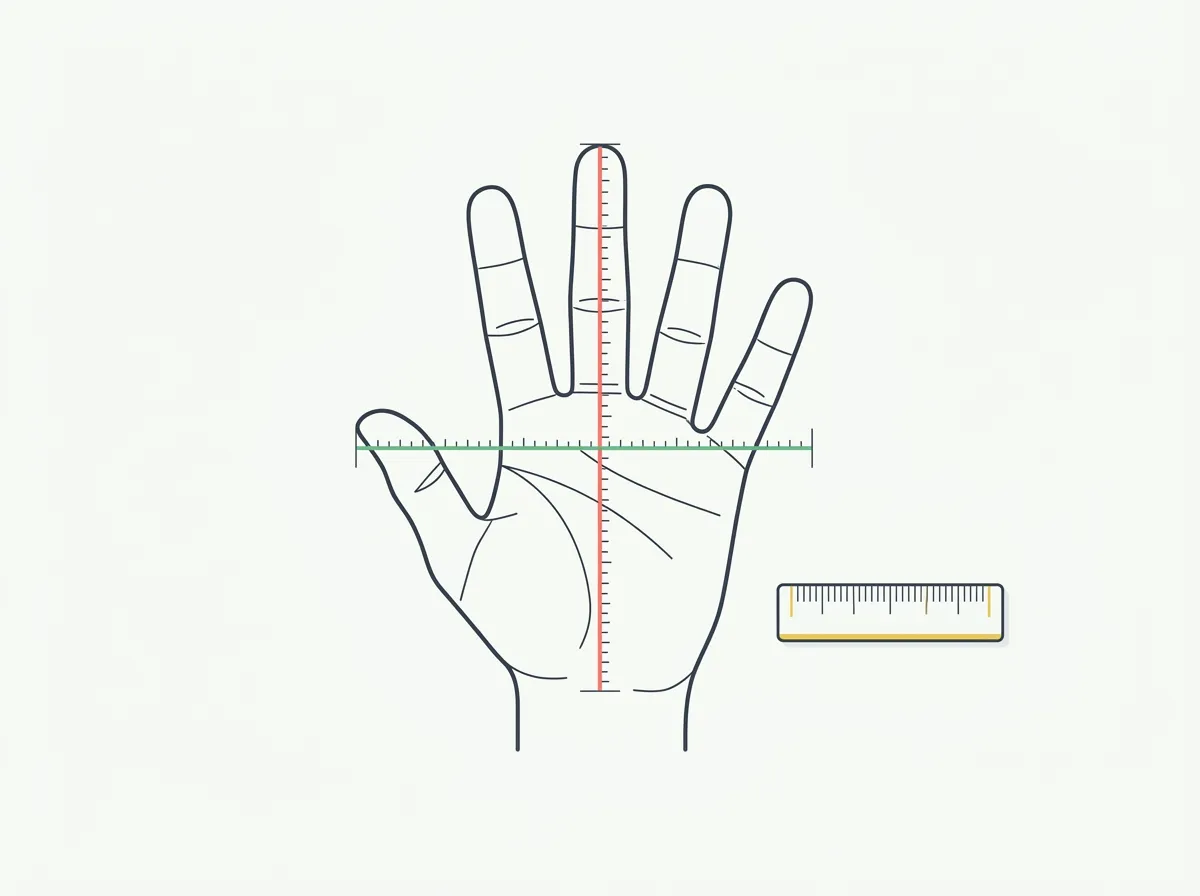
Quick answer: Commonly cited reference values put adult hand length around 7.4 inches for men and 6.8 inches for women, but averages depend on the sample and protocol. Length runs from the wrist crease to the middle fingertip; span runs from thumb to little finger. Label the dimension before comparing your measurement.
Which hand dimension should you measure?
| Search term | Measurement to take |
|---|---|
| Hand length | Wrist crease to the middle fingertip |
| Hand span | Thumb tip to little-finger tip with the hand spread |
| Hand breadth | Width across the palm at the specified knuckle line |
Label the hand and dimension in your notes. A long hand, wide palm and large span are related descriptions, but they are not interchangeable measurements.
You watch a broadcast graphic claim some quarterback has 10-inch hands, spread your own against a ruler, get 8.5, and briefly conclude something is wrong with you. Nothing is. You just compared yourself against a population selected partly for having enormous hands , and you need to check whether the graphic reports span or length before comparing it with your ruler.
This page sorts it out: the commonly cited averages for both measurements, how to take each one correctly, how hand size relates to height, and the honest answers on grip, sports, and the folklore. Hands are also the odd one out in the measurement family , unlike a waist or chest, they never change, which turns out to be their most useful property.
What is the average hand size?
Commonly cited figures from anthropometric surveys , the military and ergonomics datasets most hand-size charts trace back to , land here:
| Measurement | Men (commonly cited avg) | Women (commonly cited avg) |
|---|---|---|
| Hand length (wrist crease to middle fingertip) | ~7.4 in | ~6.8 in |
| Hand span (thumb tip to pinky tip, spread) | ~8.5 in | ~7.8 in |
| Hand breadth (across the palm) | ~3.5 in | ~3.1 in |
Treat the decimals as orientation rather than precision , different surveys, measurement protocols, and populations shift these by a few tenths of an inch. The structure is the reliable part: span runs roughly an inch larger than length for most people, and the male-female gap is a bit over half an inch on both numbers.
That length-versus-span distinction is where most confusion lives. Sports and ergonomic references can report different hand dimensions. Check the measurement definition in the source rather than inferring it from the phrase "hand size." Get both, label both, and half the internet's hand-size arguments dissolve.
How do you measure hand length and span correctly?
Two measurements, one flat surface, thirty seconds:
- Length: find the wrist crease. Bend your hand slightly toward you , the deepest crease where palm meets wrist is the landmark.
- Measure crease to middle fingertip with the hand flat and fingers together, straight up the middle of the palm. That's hand length.
- Span: spread the hand as wide as it goes on the flat surface, no straining to the point of pain.
- Measure thumb tip to pinky tip in a straight line across the spread. That's hand span.
- Use your dominant hand and note which number is which. The two hands commonly differ slightly; the labeled pair is what makes your numbers comparable to any chart.
Common errors, since the tape has nowhere to hide on a hand this small: starting length from the base of the palm's heel instead of the crease (adds half an inch), curling the middle finger slightly (subtracts a quarter), and measuring span along the finger contour instead of straight across (adds plenty).
How does hand size scale with height?
Loosely. Taller people tend toward longer hands, and hand length commonly runs somewhere around 10 to 11 percent of height. As a rough orientation table , hedged hard, because the spread around these midpoints is wide:
| Height | Rough expected hand length |
|---|---|
| 5'4" | ~6.7-6.9 in |
| 5'8" | ~7.1-7.3 in |
| 5'10" | ~7.3-7.5 in |
| 6'0" | ~7.5-7.8 in |
| 6'4" | ~7.9-8.2 in |
The correlation is real but leaky , plenty of 6'2" men carry 7.2-inch hands, and plenty of 5'8" men beat them. Hands, like wrists, are frame variables: set by bone, finished by early adulthood, and untouched by training. The wrist is the classic proxy for overall frame size; the hand is its next-door neighbor, and the same logic applies. A bigger-than-expected hand for your height usually just means a bigger frame, not a taller destiny that missed you.
Does hand size affect grip strength?
Modestly , and this is the question where honesty earns its keep, because both extreme answers are wrong.
The mechanical case is real: a longer hand closes further around a barbell, makes the hook grip available at all, and gives the fingers better leverage on anything thick. Research on grip dynamometry is commonly reported as finding a positive correlation between hand dimensions and grip strength , but a moderate one, well short of destiny.
What dominates instead is everything trainable: forearm muscle, tendon adaptation, and time spent actually gripping heavy things. A rock climber with 6.8-inch hands will out-grip an untrained man with 8-inch hands without noticing the contest. Hand size sets the leverage; forearm development supplies the force; training history decides who wins. If your deadlift grip is failing, the fix is straps, hook grip practice, and heavy holds , not different hands.
How does your hand compare to NBA players and pianists?
The two comparisons everyone actually searches for, kept factual.
Basketball. NBA combine measurements are commonly reported around 8.5 to 9.5 inches of hand length , a full inch-plus past the male average , with spans commonly past 10 and the famous outliers (Kawhi Leonard's are commonly cited near 9.75 length and 11.25 span) approaching the absurd. Palming a ball is commonly estimated to want a span around 9.5 inches or more plus real hand strength, which is why most average-handed adults can shoot and dribble fine but never palm anything. It's an outlier skill built on outlier anatomy.
Piano. A piano octave spans roughly 6.5 inches, comfortably inside almost every adult hand. The intervals that discriminate are wider: reaching a tenth cleanly is commonly put around an 8.5-inch span or better , right at the male average, a stretch past the female one. Which is a tidy way to see the whole topic: the average hand does almost everything, and the famous exceptions are famous precisely because they're rare.
What does hand size actually matter for?
Day to day, three practical fits and one piece of folklore.
Gloves. Sizing charts run on hand circumference around the knuckles and sometimes length , measure rather than guess, because between-brand sizing is chaos.
Climbing. Hand and finger dimensions change which holds are comfortable , smaller hands often fit crimps and thin cracks better, bigger hands win on slopers and wide jams. Climbers mostly treat it as a style input, not a verdict.
Lifting. Covered above: hook grip and bar thickness favor longer hands, straps and chalk erase most of it. If anything, small-handed lifters should just befriend straps earlier and skip the guilt.
The folklore. Hand size does not reliably predict anything about the rest of your anatomy , the correlations people joke about haven't held up under actual study, and that's the whole answer.
The better use of a hand is holding a phone. Hands are fixed; nearly everything else on your frame responds to training, and that's the part worth measuring. Our measurement guide covers the ten sites that do move. GainFrame tracks the visual side of the same story , body fat percentage, twelve muscle-group ratings, and a physique score estimated from progress photos, iOS only, photos analyzed on device and never stored on a server.
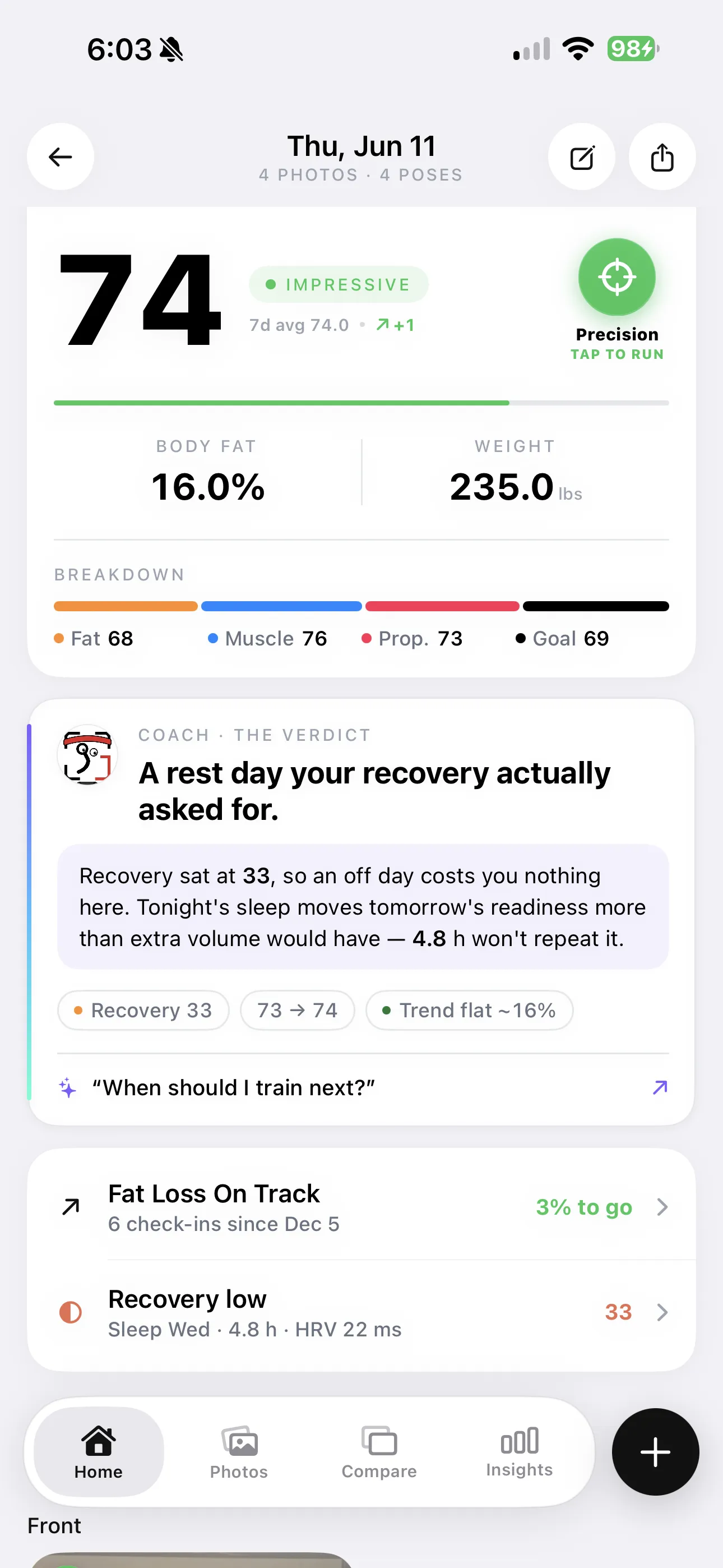
A physique score card estimated from a progress photo , body fat, muscle, and proportions in one place. The parts of your frame that actually change, tracked; the hands get a pass.
What else should you know?
What is the average hand size for a man?
Anthropometric survey data commonly cited puts the average adult male hand length around 7.4 inches , wrist crease to middle fingertip , with a spread span around 8.5 inches. Different surveys and populations vary by a few tenths of an inch. Hand breadth across the palm commonly averages around 3.5 inches for men.
How do you measure your hand size correctly?
For length, measure from the crease at the base of the palm, where wrist meets hand, straight up to the tip of the middle finger. For span, spread the hand as wide as it goes and measure thumb tip to pinky tip in a straight line. Flat surface, ruler or tape, dominant hand , and note which you measured, since the two are often confused.
Is hand size related to height?
Loosely, yes , taller people tend to have longer hands, and hand length commonly runs somewhere around 10 to 11 percent of height. But the correlation is far from tight: plenty of tall people have average hands and vice versa. Exceptions are common enough that hand size makes a poor height predictor in either direction.
Does hand size affect grip strength?
Modestly. Research is commonly reported as finding a positive but moderate correlation , bigger hands give more leverage around a bar and an easier hook grip, but forearm muscle and training history matter more. A trained average hand out-grips an untrained large one comfortably. For lifting, grip work closes the gap that hand size opens.
What hand size do you need to palm a basketball?
Commonly cited estimates put comfortable palming around a 9.5-inch span or larger, paired with decent hand strength , noticeably above the roughly 8.5-inch male average. For reference, NBA combine hands are commonly reported around 8.5 to 9.5 inches long with spans well past 10. Most adults can grip and shoot fine; palming is the outlier skill.
Track the measurements that move
GainFrame estimates body fat percentage, muscle ratings, and a physique score from your progress photos , the parts of your frame training actually changes, in one trend. Free to start on iOS.
Download GainFrame Free