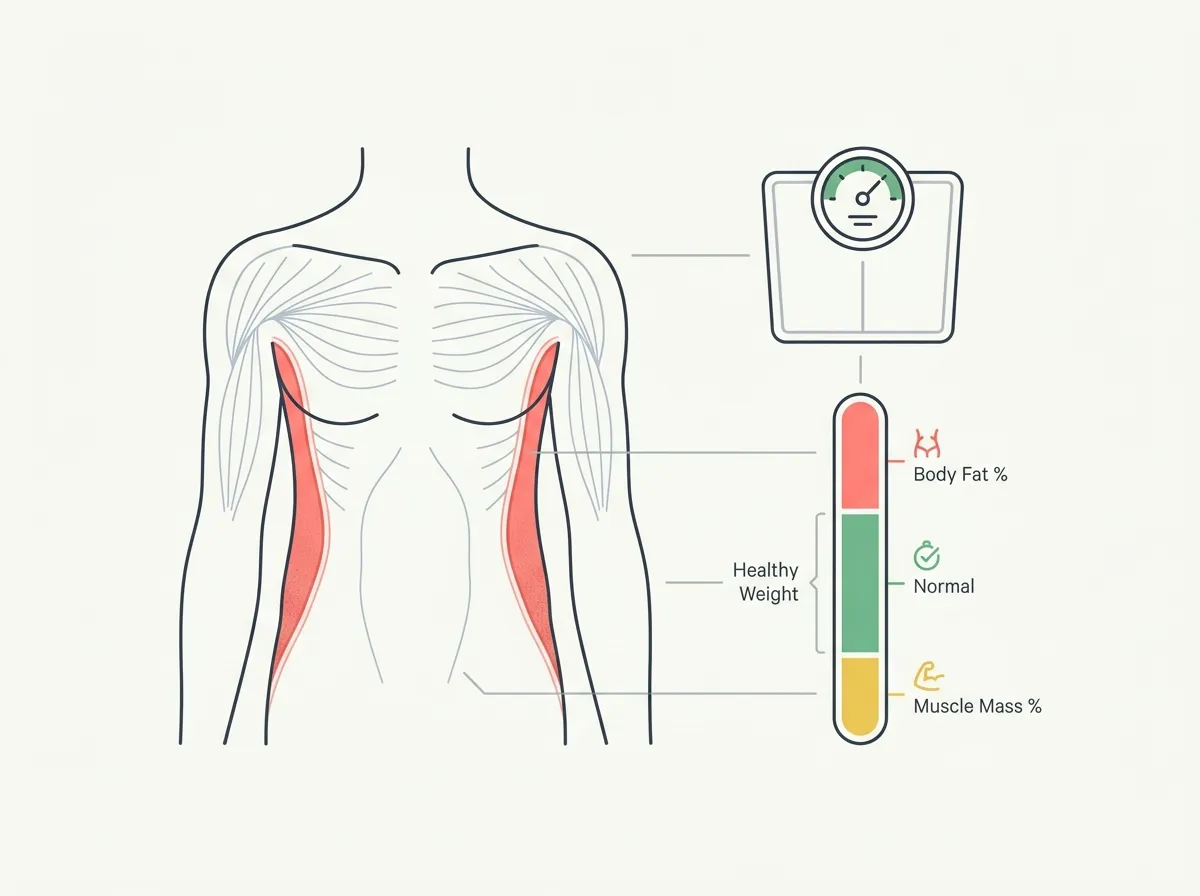
Quick answer: You're likely skinny fat if you have a normal weight and BMI but higher-than-expected body fat alongside low muscle mass. Common signs: soft belly at a healthy weight, no definition shirtless, weak strength relative to your size. The only way to confirm is measuring both body fat percentage and muscle mass — the scale alone cannot tell you.
You step on the scale: 167 lbs. You look up your BMI: 22.8. Both numbers wave you through with a green light. Then you take your shirt off and the mirror tells a completely different story — a soft midsection that doesn't match your "healthy" weight, no chest definition, arms that look undertrained for the years you've been going to the gym.
The scale didn't lie to you. It just couldn't see what it wasn't measuring: the ratio of fat to muscle hiding inside that number.
That's the skinny fat problem. If you've been confused by your own reflection at a perfectly normal weight, you're not imagining it.
What does "skinny fat" actually mean?
Skinny fat is a body composition state, not a weight category. The technical name is "normal weight obesity" — you carry enough fat relative to your muscle mass to affect your health and appearance, but your total body weight lands in the "healthy" range.
Two numbers define it: body fat percentage and muscle mass. A skinny fat person has higher-than-appropriate body fat for their weight and insufficient muscle development underneath. On the scale: normal. In the composition breakdown: a problem.
It's more common than people realize. Sedentary desk jobs build it quietly. So does yo-yo dieting without lifting — you lose weight but lose muscle alongside fat, leaving fat at a higher proportion of a smaller total.
Why can't the scale or BMI tell you if you're skinny fat?
The scale measures total mass — all of it. Muscle, fat, bone, water, the meal you just ate. It has no way to separate the tissue types. Two people at 165 lbs can have wildly different bodies: one at 11% body fat with visible abs, the other at 26% fat with no definition. Identical scale reading. Completely different composition.
BMI is even blunter. It divides your weight by your height squared. That's it. A competitive bodybuilder at 200 lbs of lean muscle scores "obese" on BMI. A skinny fat person at 160 lbs scores "healthy." BMI's limitations as a body composition tool are well established — it was designed for population statistics, not individual assessment.
Neither tool can diagnose skinny fat because neither tool measures composition. They measure mass and geometry. That's the wrong instrument for the wrong question.
What are the physical signs you might be skinny fat?
These are the most reliable signals before you get to actual measurement:
- Soft belly at a healthy weight. You're not overweight, but there's a consistent softness around the midsection that doesn't firm up with diet alone. This often signals visceral fat — the kind stored around organs that behaves differently than the fat you can pinch.
- No visible definition at a normal weight. You carry muscle somewhere, but there's no visible shape — no chest separation, no shoulder definition, arms that look flat even when flexed.
- Weak strength relative to your size. If you're 175 lbs but struggle with basic compound movements, your muscle-to-weight ratio is low. Strength is a reasonable proxy for muscle mass when you don't have body composition numbers.
- Clothes fit fine, but your reflection doesn't match your weight. The classic tell. A normal-weight body can look very different depending on whether that weight is mostly fat or mostly muscle.
- Years at the same weight, but gradually less defined. If you've barely moved the scale but steadily lost tone — a common pattern with age and inactivity — your composition has shifted even though the number hasn't.
Any one of these is a signal. Multiple together is a strong case for actually measuring.
How do you measure whether you're skinny fat?
This is a five-step process. Each step adds precision to the last.
Check your BMI baseline. Calculate it. If you're in the normal range (18.5–24.9) but feel soft and underdefined, the scale just gave you a false green light. Normal BMI only confirms you're not overweight — it says nothing about what that weight is actually made of.
Measure your waist circumference. Wrap a tape measure around your navel, relaxed, first thing in the morning. Men over 94 cm (37 in) and women over 80 cm (31.5 in) carry elevated visceral fat risk — regardless of what the scale says. A normal BMI with a wide waist is the textbook skinny fat profile.
Get a body fat estimate. This is the number BMI can't give you. DEXA is the most accurate method (clinic or gym, roughly $50–150 per scan). AI body composition apps estimate from photos within roughly 2–4% of DEXA for most users — less precise but free and accessible. BIA scales are middle-ground. Men over roughly 20–22% at a normal BMI and women over roughly 30–32% is the primary skinny fat signal.
Calculate your FFMI. Fat-Free Mass Index measures how much muscle you carry relative to your height: lean mass in kg divided by height in meters squared. An FFMI below 18–19 for men indicates genuinely low muscle development — the second half of the skinny fat equation. This is the number BMI was supposed to measure but can't.
Look at both numbers together. High body fat plus low FFMI at a normal BMI is the diagnostic combination. Either number alone might not tell the full story. Both together do.
Body fat percentage and muscle scores together give you the read the scale never will. Here's what that dual breakdown looks like in practice:
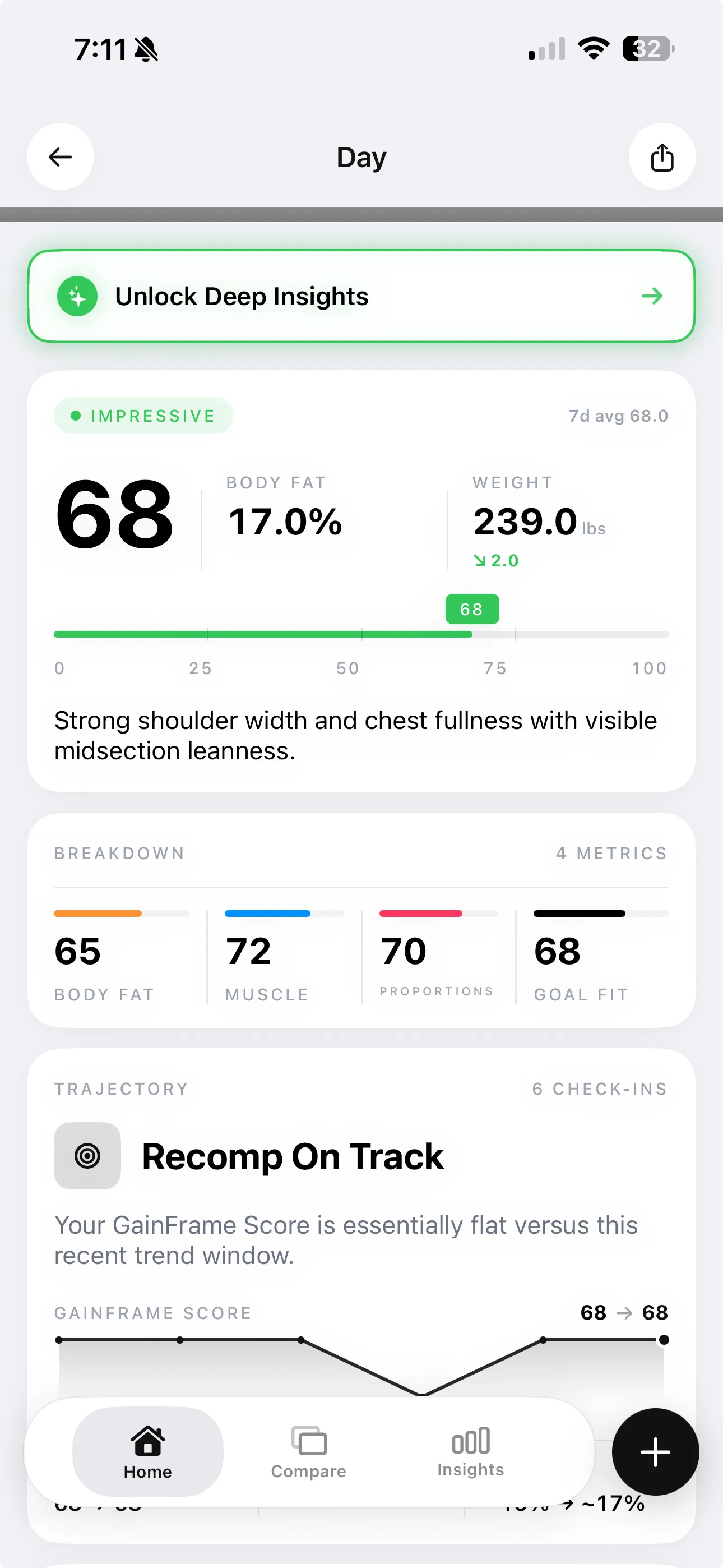
Body fat %, a muscle score, and a 4-metric breakdown — all the numbers the scale skips. The muscle score and body fat reading together are what identify skinny fat that weight alone misses.
And FFMI in context — where your lean mass actually sits on the range from below average to excellent:
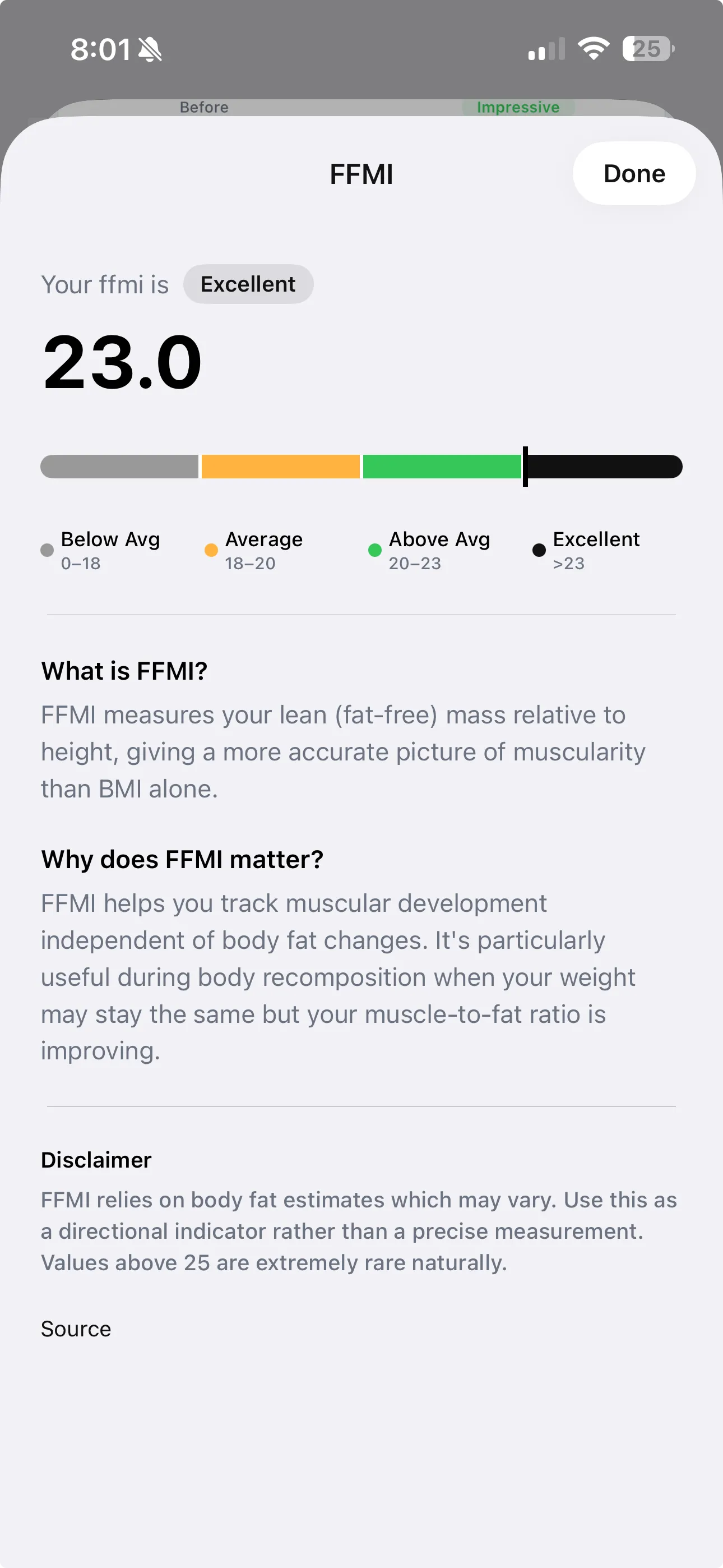
FFMI shows how your lean mass stacks against what's typical for your height — a much cleaner signal of low muscle development than weight alone. An FFMI under 18–19 for men is the low-muscle half of the skinny fat diagnosis.
How do you know if you're making progress out of skinny fat?
The scale will not tell you this either. A successful skinny fat fix — losing fat while gaining muscle — often shows almost no weight change for months. The scale stays flat while your body composition improves. If you're watching only the number, it looks like nothing is happening.
What actually shows progress:
- Body fat percentage dropping (even if total weight holds steady)
- Individual muscle group scores improving (shoulders progressing from "Needs Work" to "Developing," chest getting visible separation)
- Strength increasing on compound lifts at the same body weight — more muscle in a stable frame
- Waist circumference decreasing while shoulder and arm measurements hold or grow
Progress photos under consistent conditions — same pose, same lighting, every two to four weeks — show changes the scale misses entirely. The honest measure is the comparison between a check-in now and one from eight weeks ago, with body composition numbers alongside.
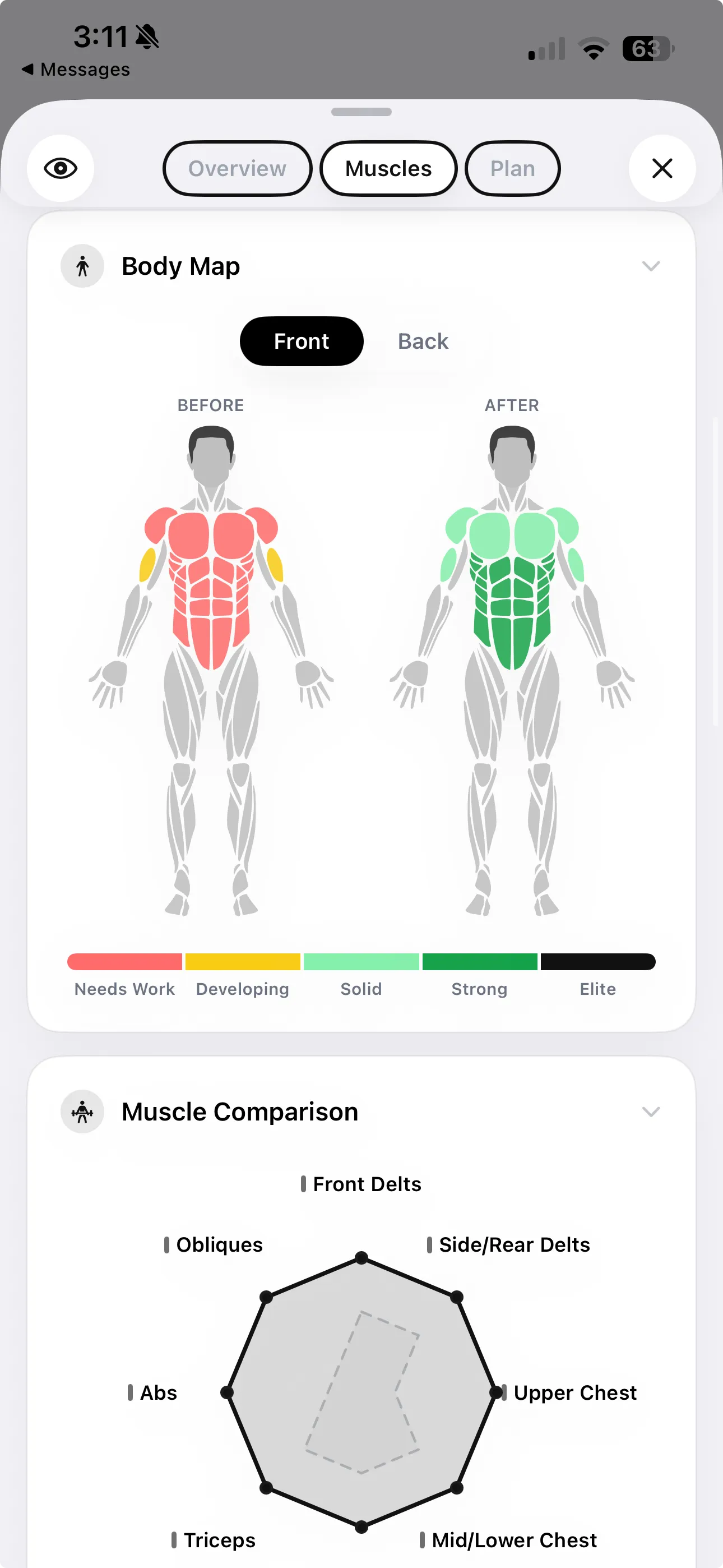
A before/after muscle radar showing which groups have progressed and which still trail. During a skinny fat fix, this is how you see muscle development happening — even when the scale says nothing is changing.
Tracking this systematically takes more than a photo folder. GainFrame tracks body fat percentage and per-muscle scores across every check-in so the trajectory is visible without spreadsheets or mental math. The AI Coach goes further: it holds the full context of your check-in history, current body fat, goal, and muscle development — and you can ask it directly what's actually happening.

The AI Coach has your current body fat, your check-in history, and your goal — so when you ask "am I actually making progress?" it answers from your real numbers, not generic fitness advice.
Ask it why your score isn't moving, whether you're gaining fat or muscle right now, or what muscle group is your biggest weak point. It answers using your actual photo history and composition trajectory — the loop that makes skinny fat progress visible when the scale keeps saying nothing is happening.
Frequently Asked Questions
How do I know if I'm skinny fat or just out of shape?
Both involve excess fat and insufficient muscle, but skinny fat specifically means your weight and BMI read as normal while body fat percentage is elevated and muscle mass is low. The distinction is in the numbers, not the mirror. If you're at a healthy weight but have over 20–22% body fat (men) or 30–32% (women) with an FFMI under 19, that's the skinny fat combination.
Does BMI detect skinny fat?
No. BMI only divides weight by height squared and cannot distinguish fat from muscle. A skinny fat person typically has a BMI of 20–23 — clinically "healthy" — while carrying excess fat and insufficient muscle. This is the core limitation of BMI as a health metric: it is body composition blind.
What body fat percentage is considered skinny fat?
There is no single cutoff — the combination matters more than one number alone. Men at a normal BMI with body fat above roughly 20–22% and an FFMI below 19 fit the profile. Women at normal BMI with body fat above roughly 30–32% and low muscle development. Fat-high and muscle-low together is what defines it.
Can you be skinny fat at a low body weight?
Yes. Skinny fat is a composition ratio, not an absolute weight. You can be 130 lbs and carry fat at a high proportion of your total because muscle mass is low. This is common in people who reduce calories without lifting — weight drops, but muscle drops with it, leaving fat at a higher ratio of a smaller total.
Can a skinny fat person do body recomposition?
Yes — and skinny fat is actually one of the better starting points for recomposition. Higher relative body fat means your body has more energy stored to mobilize. Being undertrained means early muscle gains come quickly. Most skinny fat people gain muscle and lose fat simultaneously in the first months of consistent lifting with adequate protein.
How long does it take to fix skinny fat?
Visible progress typically takes 10–16 weeks of consistent training and sufficient protein. Significant body composition change — meaningful fat loss alongside visible muscle gain — typically takes 6–12 months. The timeline depends on your starting composition, protein intake, sleep quality, and training consistency. The scale will underreport the change the entire time.
What is the best way to track whether a skinny fat fix is working?
Track body fat percentage and muscle development together — not weight. Take progress photos every two to four weeks under consistent conditions (same lighting, same time of day, same poses) and compare composition metrics. If body fat is falling and strength is increasing, the fix is working regardless of what the scale says.
The Five-Step Skinny Fat Check
If you're not sure whether this applies to you, run through this in order:
- Get your weight and BMI. If BMI is 18.5–24.9 but you feel soft and undefined, proceed. You're in the zone where the scale lies most convincingly.
- Measure your waist. Tape around the navel, relaxed, morning. Men over 37 in, women over 31.5 in — that's visceral fat regardless of the scale reading.
- Estimate your body fat. DEXA if you have access. An AI body comp app or a BIA scale if not. Men over ~21% at normal BMI, women over ~31% — that's the fat half of the equation.
- Check your FFMI. Lean mass in kg divided by height in m². Under 18–19 for men means the muscle is genuinely low — not "could be more defined," but low. That's the second half.
- Track composition, not weight. If you have both numbers and they're in the skinny fat range, start tracking them monthly with progress photos and composition measurements. The scale won't show the fix. Your composition numbers will.
See your body composition, not just your weight
GainFrame estimates body fat percentage, FFMI, and per-muscle scores from a photo — giving you the dual read that diagnoses skinny fat and tracks whether you're fixing it. AI estimates run within roughly 2–4% of DEXA for most users. Not a medical measurement, but a consistent, weekly signal the scale can't give you.
Download GainFrame Free