
Quick answer: A body recomposition tracker isn't one app - it's a stack. You need a workout log (strength is going up), a progress photo timeline (visual change is happening), a body fat trend (composition is shifting), and a weekly average bodyweight (overall direction is correct). Most apps track one of these well. The honest tracker is whichever combination shows you all four trends together.
You stepped on the scale. It said the same number it said three weeks ago. You stand there for a second, trying to figure out: is this recomp working, or am I just spinning my wheels?
Welcome to the cruel math of body recomposition. Fat is leaving. Muscle is arriving. Both move the scale, but in opposite directions. The number that's supposed to validate your effort gives you no information at all.
This is why most people who attempt a recomp quit at week six. Not because it isn't working - but because they have no way to see that it's working. The scale lies during recomp the way the calendar lies during a long winter. You need a different kind of tracker.
What does a body recomposition tracker actually need to do?
A body recomposition tracker has one job: show you whether fat is going down AND muscle is going up - at the same time. That requires more than one data stream. The scale alone is useless. The mirror alone is unreliable. A workout log alone tells you about strength but not about body composition. A body fat estimator alone tells you about composition but not about strength.
The honest tracker is a stack of four:
- Strength progression - workout log, ideally Hevy or Strong, tracking total volume and top sets per muscle group week-over-week.
- Body fat trend - body fat percentage estimate, taken every 2 to 4 weeks. DEXA is the gold standard but expensive. AI from progress photos is a reasonable home alternative.
- Visual progress - photos every 7 to 14 days in the same lighting, same poses. The integrated check on whether the other two are translating to a body that looks different.
- Weekly bodyweight average - not a single weigh-in. The 7-day rolling average to filter out daily noise (water, sodium, last night's dinner).
When all four agree - strength going up, body fat trending down, photos showing visible change, weight stable or slightly down - recomp is working. When one disagrees, you debug. When two disagree, the recomp probably isn't happening yet. The free Recomp Reality Checker combines those signals and flags whether the pattern looks more like recomp, a cut, a surplus, or mixed evidence.
How long does it take to see body recomposition?
Most people notice initial changes in 8 to 12 weeks. Significant visual change typically takes 3 to 6 months. The first thing that moves is usually strength - you out-lift your old PRs before you out-look your old photo. The second thing is body fat percentage on photos and DEXA. The last thing to move, by months, is the scale.
This means a 4-week tracker check-in is mostly noise. A 12-week check-in is signal. Don't make scope decisions on month one of a recomp. The first month is where you build the habit and calibrate the tracker; the data doesn't have a clear shape yet.
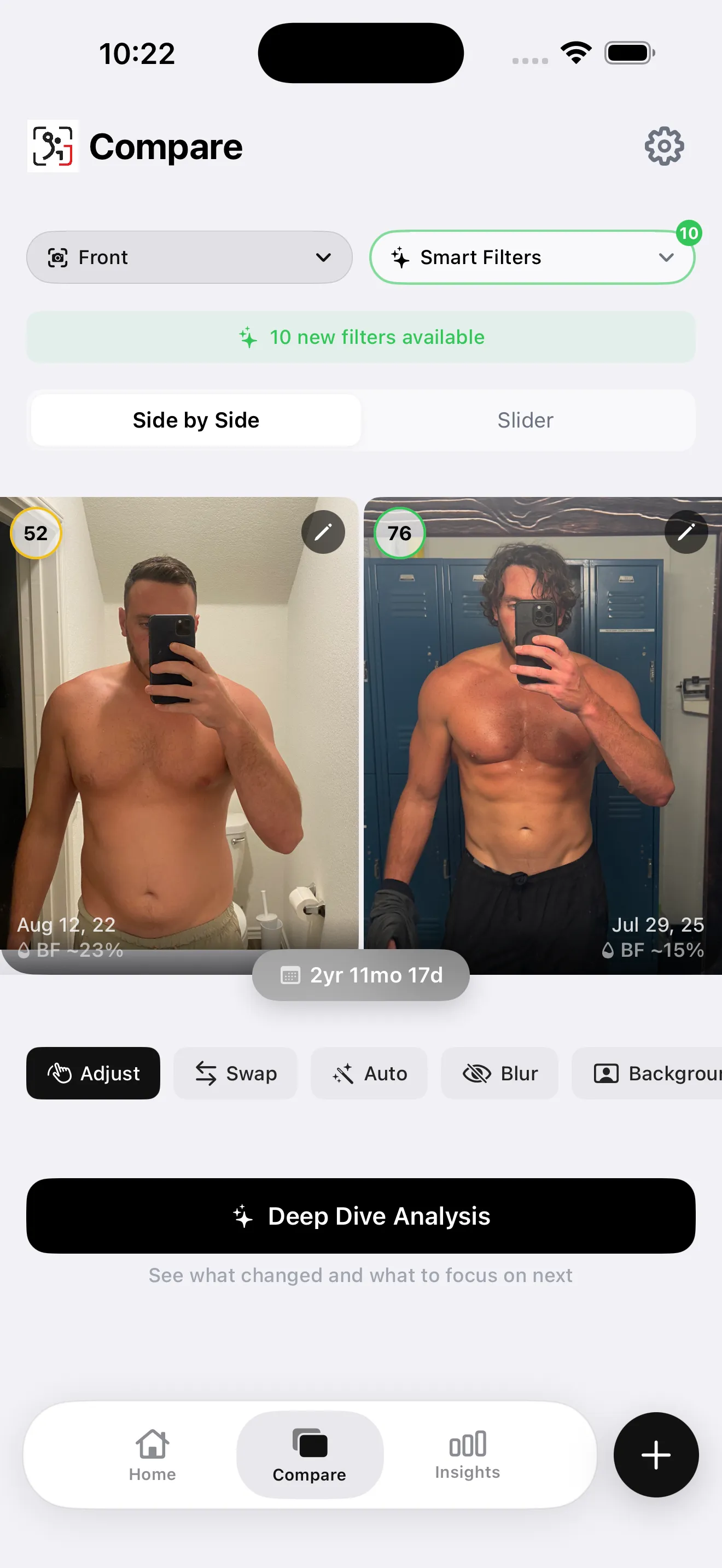
A side-by-side compare with body fat delta and time elapsed - this is the integrated answer to "is it working?" once you have months of data.
What's the cheapest way to track body recomposition at home?
Free tier, in priority order:
- A scale, used weekly, averaged into a 7-day mean. Not a smart scale unless you want body fat readings (BIA from a scale is unreliable enough that you might be better off without).
- A free workout app like Hevy or Strong. Log every set. Watch your top set on a key lift each week. If your top working set is going up while your bodyweight stays flat, that's muscle.
- Your phone camera. Same lighting, same poses, every 10 to 14 days. Save them in a folder named with dates. The folder itself becomes the tracker.
- A measuring tape, optional. Waist (navel level) and one upper arm flexed. Re-measure every 4 weeks. Waist down + arm up = the textbook recomp signal.
You can run a recomp on free tier indefinitely with this stack. The reason most people add an app is the photo organization - a folder of 60 photos becomes hard to navigate manually, and side-by-side comparison from two random dates requires real friction. That's the layer where dedicated apps earn their keep.
How does AI body composition tracking fit into a recomp?
The AI body composition layer adds two things a basic photo folder doesn't: a body fat percentage estimate from each photo, and a side-by-side compare with deltas overlaid. Studies generally report AI body fat from photos within 2 to 4 percent of DEXA for most users. That's not clinical, but it's tight enough to spot a directional trend across 8 weeks of photos.
For recomp specifically, the AI body fat estimate is the input that moves first. Strength gains take 4 to 8 weeks to register on the workout log; bodyweight barely moves; the mirror is your daily delusion. But a body fat reading on a photo from week 1 versus week 6 will frequently show a 1-2 percent drop while everything else looks flat. That's the early signal that the recomp is on rails - and it's also the moment most people quit because nothing else is showing it.
GainFrame is one example of an AI body composition tracker built specifically for recomp. The Compare view shows two photos side-by-side with body fat delta, time elapsed, and a per-muscle progression breakdown. The Insights tab shows a 90-day weight + body fat trend chart so you can see the simultaneous fat-down and muscle-up shape that defines a successful recomp. It's iOS-only and the body fat estimates are AI-derived, not clinical - be honest about that limitation when interpreting the numbers.
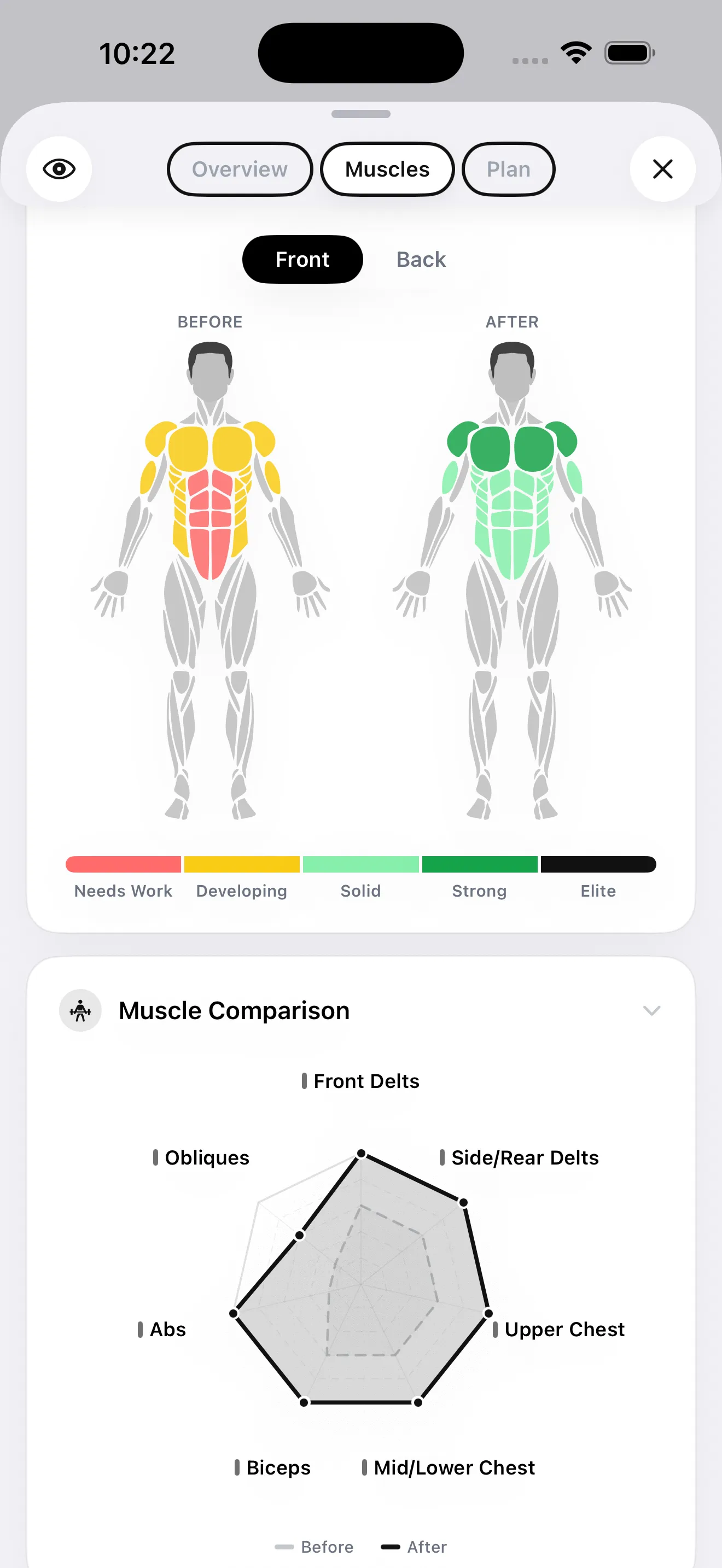
Per-muscle progression on a recomp: chest, biceps, abs, obliques, and front delts each tracked separately. The muscle side of the recomp equation isn't visible from the scale.
What metrics matter most for body recomposition?
Three primary, two supporting:
Primary signals (must move):
- Strength on key compound lifts. Bench, squat, row, overhead press, weighted pull-up. If your top working set goes up across 4 to 8 weeks while your bodyweight is flat, you are gaining muscle. This is the cleanest signal recomp gives you.
- Body fat percentage trend. Going down on a flat scale = recomp. Use AI photos, BIA, calipers, or DEXA - pick one method and stay with it. Switching methods is how you confuse yourself.
- Visual photos. The integrated check. If strength is up and body fat estimate is down but photos look identical at week 12, recheck the methodology - one of the inputs is probably wrong.
Supporting signals (helpful, not decisive):
- Weekly average bodyweight. Should be flat to slightly negative during a recomp. A drop of more than 1 lb per week means you're cutting, not recomping.
- Tape measurements. Waist and arms. Slow-moving but objective.
Anything outside this list during a recomp phase is noise. Heart rate, sleep, daily steps - useful for general health, not for answering the recomp question. Keep the tracker tight; you'll keep going longer.
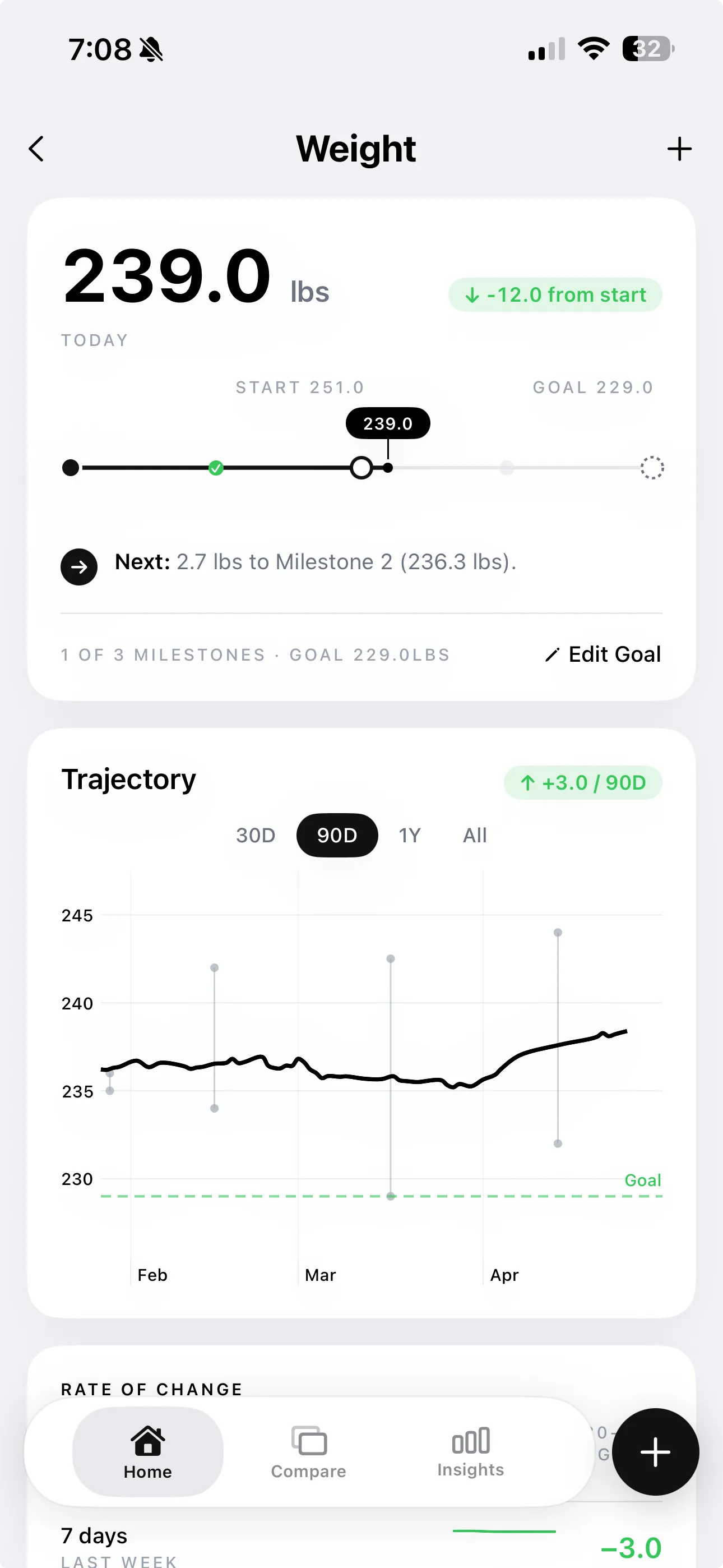
Weight chart with 90-day trajectory. During a recomp this should be near-flat. The story of the recomp is told by the body fat and muscle layers - not by this line.
How often should you check the recomp tracker?
Frequency depends on the metric:
- Strength: every workout. It's already in your log.
- Bodyweight: daily, averaged weekly. Look at the weekly average, not the daily.
- Body fat / photos: every 7 to 14 days. Less frequently and visual change won't register; more frequently and noise dominates.
- Tape measurements: every 4 weeks.
- Tracker review (the moment you actually look at all of them together): once per week, ideally Sunday evening. Block 10 minutes. Compare strength, weekly bodyweight average, and the most recent body fat estimate against four weeks ago. Photos: side-by-side compare with the photo from 4 to 8 weeks ago.
The weekly review is what most people skip and what most people need. The data in the trackers is fine. The judgment call lives in the comparison.
Quick checklist: Is your recomp working?
A recomp is working when most of these are true four to eight weeks in. If 4 of 5 are true, you're on rails. If only 1 or 2 are true, debug.
- Strength is up. At least one working set on a key compound lift is heavier or higher rep than 4 weeks ago.
- Body fat estimate is trending down. AI photo, calipers, or DEXA - your method of choice - shows a 0.5 to 2 percent decrease.
- Weekly bodyweight average is flat or slightly negative. Within ±2 lb of the four-week-ago average.
- Photos look different in side-by-side compare. Not necessarily dramatic, but visibly leaner or more defined.
- Tape measurements show waist down OR arm up. Ideally both. One is enough at week 4; you want both by week 8.
If only 1 or 2 are true at week 8, the recomp probably isn't happening. The most common causes: protein too low (target 1g per lb of bodyweight), training volume too low, or calorie intake too far from maintenance in either direction. Recomp lives in a narrow band - slight deficit, high protein, hard training. Drift outside that band and you're cutting or bulking, not recomping.
Frequently Asked Questions
What is the best body recomposition tracker?
There is no single "best" tracker because recomp requires multiple data streams. The honest answer is a stack: a workout log (Hevy, Strong) for strength progression, a progress photo app for visual change, a body fat estimator (DEXA, BIA, or AI from photos) for composition shift, and a weekly average bodyweight for the overall trend. Most apps track one of these well. Few track all four.
How long does it take to see body recomposition?
Most people notice initial changes in 8 to 12 weeks. Significant visual change typically takes 3 to 6 months. Strength gains often appear before visual changes - you'll out-lift your old PRs before you out-look your old photo. Patience is part of the protocol; recomp is slower than a cut and slower than a bulk.
Can you track body recomposition with the scale?
No, not on its own. The scale shows total body weight, which can stay flat or fluctuate within a few pounds during a successful recomp. The scale doesn't distinguish between fat loss and muscle gain. Use weekly average bodyweight (sum 7 morning weigh-ins, divide by 7) as one input among several - never as the only signal.
How often should I take progress photos for recomp?
Every 7 to 14 days is the right cadence for recomp. More frequent and the visual changes are too small to register. Less frequent and you lose the consistency that makes side-by-side comparisons useful. Take photos in the same lighting, same poses, and ideally same time of day for a fair comparison.
What metrics matter most for body recomposition?
Strength on key compound lifts (going up means muscle is being built), body fat percentage trend (going down means fat is being lost), and visual progress photos (the integrated check on both). Weekly bodyweight is supporting evidence. Body measurements (waist, arms) are useful but slower-moving. Anything else is noise during a recomp phase.
Can AI accurately track body recomposition from photos?
AI body composition apps estimate body fat from photos within roughly 2 to 4 percent of DEXA in most users - not clinical accuracy, but enough to spot a trend across weeks of photos. Studies generally report this range. Combined with strength logs and weekly bodyweight, AI photo analysis is a reasonable home replacement for repeated DEXA scans during a recomp.
Is body recomposition possible after the beginner phase?
Yes, but it's slower and the inputs matter more. Beginners can recomp easily because they have a large adaptation gap. Intermediate and advanced lifters can still recomp on a slight calorie deficit with high protein (around 1g per pound of bodyweight), heavy compound training, and adequate sleep - but the rate of fat loss and muscle gain is slower, and tracking has to be more careful to detect signal under noise.
Where to go next
If you're starting a recomp now: pick your stack first, then start. A workout log app, a phone-camera photo cadence, a weekly weigh-in habit, a body fat estimate every two weeks. Set a 12-week check-in on your calendar. Don't make scope decisions before then.
For more on the timeline, see How long does body recomposition take and the broader framework in Bulk, cut, or recomp: which is right for you. For the AI body composition layer specifically, our deeper take on what AI can and can't see is in AI Fitness Coach vs ChatGPT and the methodology behind GainFrame's body fat estimates is documented in How AI body composition analysis works.