
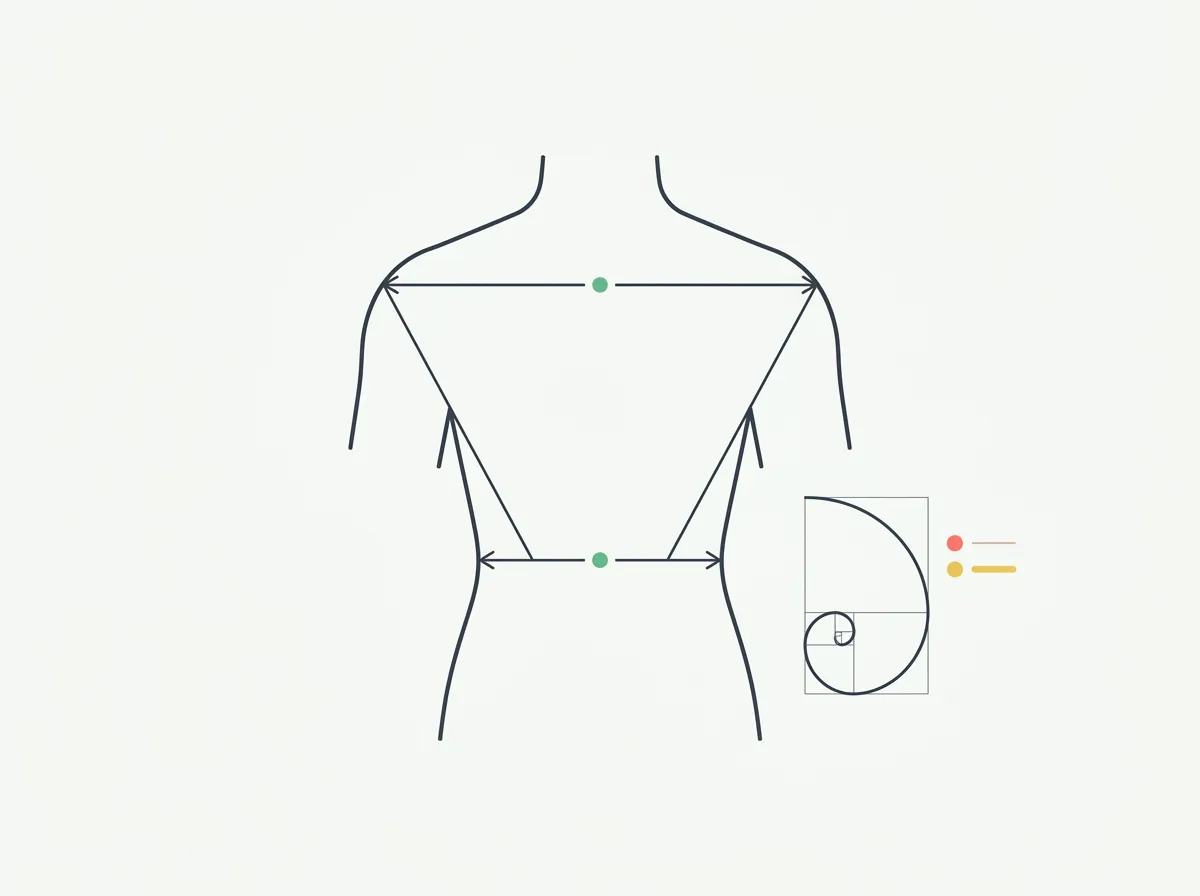
Quick answer: The ideal shoulder to waist ratio for men is 1.618, shoulder circumference should be about 1.6× your waist. Measure shoulders at the widest point and waist at the navel. Most men start from 1.3 to 1.5. Improving it means building lateral delts and lats while reducing waist body fat, both trackable with consistent measurements and progress photos.
Most physique goals come down to one visual: the V-taper. The shoulders wider than the waist, the chest tapering down to a narrow midsection, the silhouette that signals muscle without bulk. The shoulder to waist ratio is the math behind that visual.
It's simple arithmetic. Shoulder circumference divided by waist circumference. But understanding what moves that number, and why most people focus on the wrong lever, is what actually produces results.
Calculate your shoulder-to-waist ratio
For adults, using circumference measurements. The bands are the aesthetic reference ranges published in the chart above. They describe proportion preferences rather than health thresholds.
If your comparison uses hips rather than waist, use the separate shoulder-to-hip ratio guide. The denominator and measurement type change the meaning of the result.
What is the shoulder to waist ratio?
The shoulder to waist ratio (SWR) is a body proportion measurement. Divide your shoulder circumference by your waist circumference. The result tells you how much wider your shoulders are than your waist.
A ratio of 1.5 means your shoulders are 50% wider than your waist. A ratio of 1.618, the golden ratio, also called the Adonis Index, means your shoulders are 61.8% wider. That proportion appears repeatedly in classical sculpture, Renaissance art, and modern research on physical attractiveness.
The number matters because it captures the visual that "I can tell you're fit" depends on. Someone can have a perfectly healthy BMI and body fat percentage and still look undefined if their shoulder and waist measurements are nearly the same. And someone can look impressively athletic without being particularly large if the ratio is high.
What is the ideal shoulder to waist ratio for men?
The golden ratio, 1.618, is the widely cited ideal. Research published in Archives of Sexual Behavior found women rated men most attractive when shoulders were approximately 1.6× the waist. The Adonis Index formalization takes the same math and calculates your target waist from your shoulder width.
In practice, 1.618 is a ceiling most natural lifters approach asymptotically. A realistic target range is 1.45 to 1.618:
| Ratio | Description |
|---|---|
| Below 1.3 | Minimal V-taper; shoulders and waist close to the same width |
| 1.3 to 1.44 | Some taper; beginning to see the silhouette |
| 1.45 to 1.54 | Clear V-taper; visually athletic |
| 1.55 to 1.617 | Strong aesthetics; noticeable shoulder dominance |
| 1.618+ | Golden ratio; rare naturally, achievable with wide clavicles + shoulder development + low body fat |
Most natural lifters land between 1.4 and 1.55 at their best composition. Anything above 1.5 produces a clearly athletic silhouette.
What the targets actually require in tape measurements, find your waist, read across:
| Waist | Shoulders for 1.45 | Shoulders for 1.5 | Shoulders for 1.618 |
|---|---|---|---|
| 28 in | 40.6 in | 42.0 in | 45.3 in |
| 30 in | 43.5 in | 45.0 in | 48.5 in |
| 32 in | 46.4 in | 48.0 in | 51.8 in |
| 34 in | 49.3 in | 51.0 in | 55.0 in |
| 36 in | 52.2 in | 54.0 in | 58.2 in |
Two things jump out of that table. First, the golden ratio demands a lot of shoulder, a 32-inch waist needs nearly 52 inches of shoulder circumference to hit 1.618. Second, the waist column is the cheaper lever: dropping from a 34-inch to a 30-inch waist moves you from needing 55 inches of shoulder to 48.5 for the same ratio.
For a wider set of tape measurements, the classic bodybuilding proportions chart scales chest, arms, neck, calves and waist from wrist size. Use it as a historical reference alongside your shoulder-to-waist ratio, rather than treating the chart as a health standard or a required physique.
What is the ideal shoulder to waist ratio for women?
For women, the widely cited ideal is around 1.4, a less extreme V-taper than the male standard. This is partly aesthetic preference and partly structural: female shoulder-to-hip proportions are built differently, so the hourglass measurement (hip-to-waist) typically matters as much as shoulder-to-waist for women's aesthetics.
A shoulder-to-waist ratio of 1.3 to 1.4 is considered athletic and proportionate for women. Above 1.5 starts to read as very muscular rather than classically aesthetic.
How do you measure your shoulder to waist ratio?
Measure your waist. Wrap a soft tape measure around your waist at navel level, relaxed exhale. Don't suck in. First thing in the morning before eating for the most consistent reading.
Measure your shoulders. Wrap the tape around the widest point of your shoulders, roughly midway between your collarbone and your nipple line, at the level of the deltoid heads. Keep it horizontal. Record relaxed, not flexed.
Divide shoulder by waist. Example: 46 in ÷ 31 in = 1.48. That's your current ratio.
Compare to the range. Below 1.4 = minimal taper. 1.45 to 1.55 = clear V. 1.55+ = strong aesthetics.
Remeasure monthly under the same conditions. Same time of day, same tape position, same relaxation state. The trend over 3 to 6 months is the useful signal.
What determines your shoulder to waist ratio?
Two variables control the numerator. Two control the denominator.
Shoulder width (numerator):
- Clavicle width, bone structure. You cannot change this. Wider clavicles create a naturally higher starting ratio and make the 1.618 target more accessible. This is why some people look naturally athletic with minimal training.
- Deltoid and back development, trainable. Lateral deltoids add apparent width to the shoulder cap. Latissimus dorsi development adds the flared width visible from behind. Both can meaningfully increase the apparent shoulder width beyond what the clavicle alone provides.
Waist width (denominator):
- Bone structure, pelvic width and rib cage shape. Not trainable. Some people have naturally narrow waists; others have wider frames.
- Body fat, especially abdominal fat, highly trainable. Subcutaneous fat around the midsection and visceral fat around the abdominal organs directly increase waist circumference. Reducing body fat, particularly the midsection accumulation, is the fastest way to improve your ratio.
The practical implication: if your current ratio is around 1.35, both levers likely need attention, body fat reduction and shoulder development together. If your ratio is already 1.5 and you want to push toward 1.618, shoulder muscle development is the primary remaining lever since a very lean waist can only narrow so much.
Here's how much of the ratio is just body fat, the same frame and the same muscle at two body fat levels, rendered by our body fat visualizer:
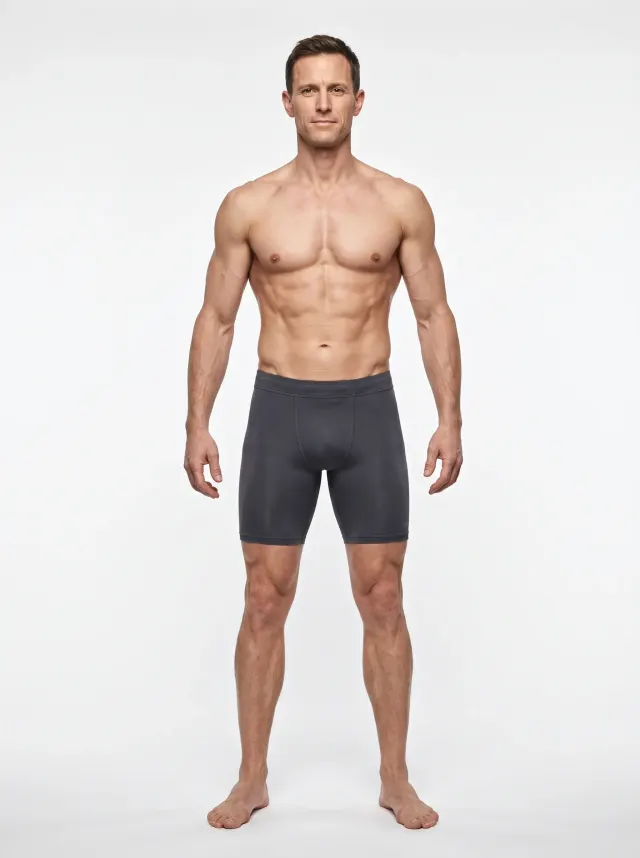
~13% body fat: the waist is at its natural width, so whatever taper the frame has is fully visible.
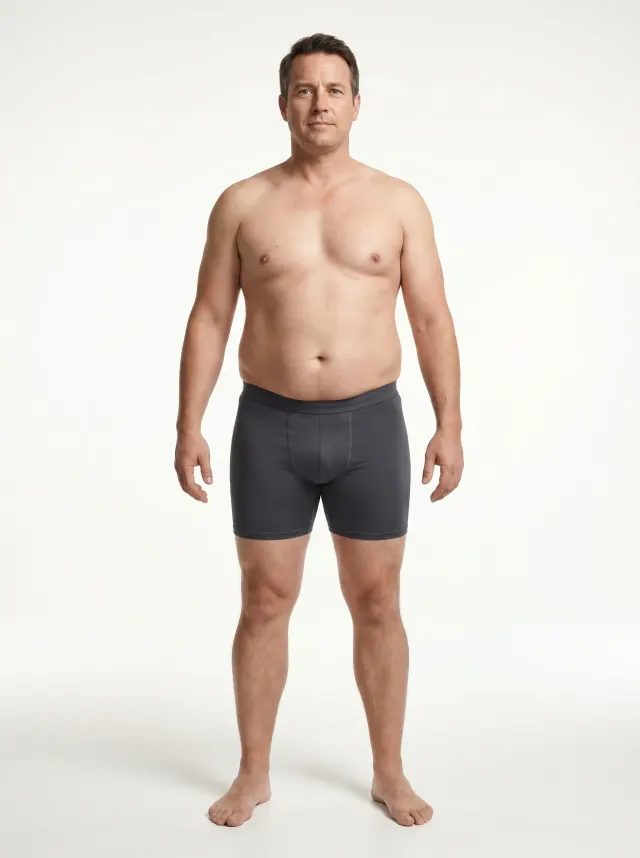
~28% body fat, same skeleton: abdominal fat has widened the denominator and the taper is gone. No amount of delt work outruns this.
How do you improve your shoulder to waist ratio?
To widen the numerator (shoulders):
- Lateral raises, the primary exercise for developing the lateral deltoid head that creates apparent shoulder width. 3 to 4 sets of 15 to 20 reps, controlled tempo, light to moderate weight. The lateral head is the width; the anterior head is size.
- Rear delt work, face pulls, reverse flyes, rear delt rows. Develops the posterior shoulder cap and adds three-dimensional depth to the shoulder, reinforcing the wide appearance from all angles.
- Lat pulldowns and rows, latissimus development creates the flared back that, from the front, reads as additional shoulder width and reinforces the V-shape from behind.
- Overhead press, builds overall shoulder mass and structural thickness on top of lateral development.
To narrow the denominator (waist):
- Reduce body fat, particularly abdominal fat. This is primarily a caloric and dietary process, not an exercise one. Core training builds the underlying muscles but doesn't reduce the subcutaneous and visceral fat that determines waist circumference. Body fat percentage reduction is the lever.
- Avoid excessive waist-widening training, heavy side bends and high-rep oblique work can hypertrophy the obliques, which widens the waist. This is generally a minor concern for most lifters, but worth noting if waist-narrowing is a priority.
How do you track whether your shoulder to waist ratio is improving?
Monthly measurements are the tracking mechanism, remeasure both circumferences under the same conditions, calculate the ratio, and plot it over time.
What you're looking for over a 3 to 6 month training phase: the ratio trending upward. This happens when shoulder circumference grows (shoulder and back development) or waist circumference shrinks (body fat reduction), or both simultaneously.
Progress photos complement the measurements by capturing the visual reality. A 0.05 improvement in ratio might not feel like much as a number, but in photos the silhouette change is often visible, the shoulder cap wider, the waist narrower, the V-shape clearer.
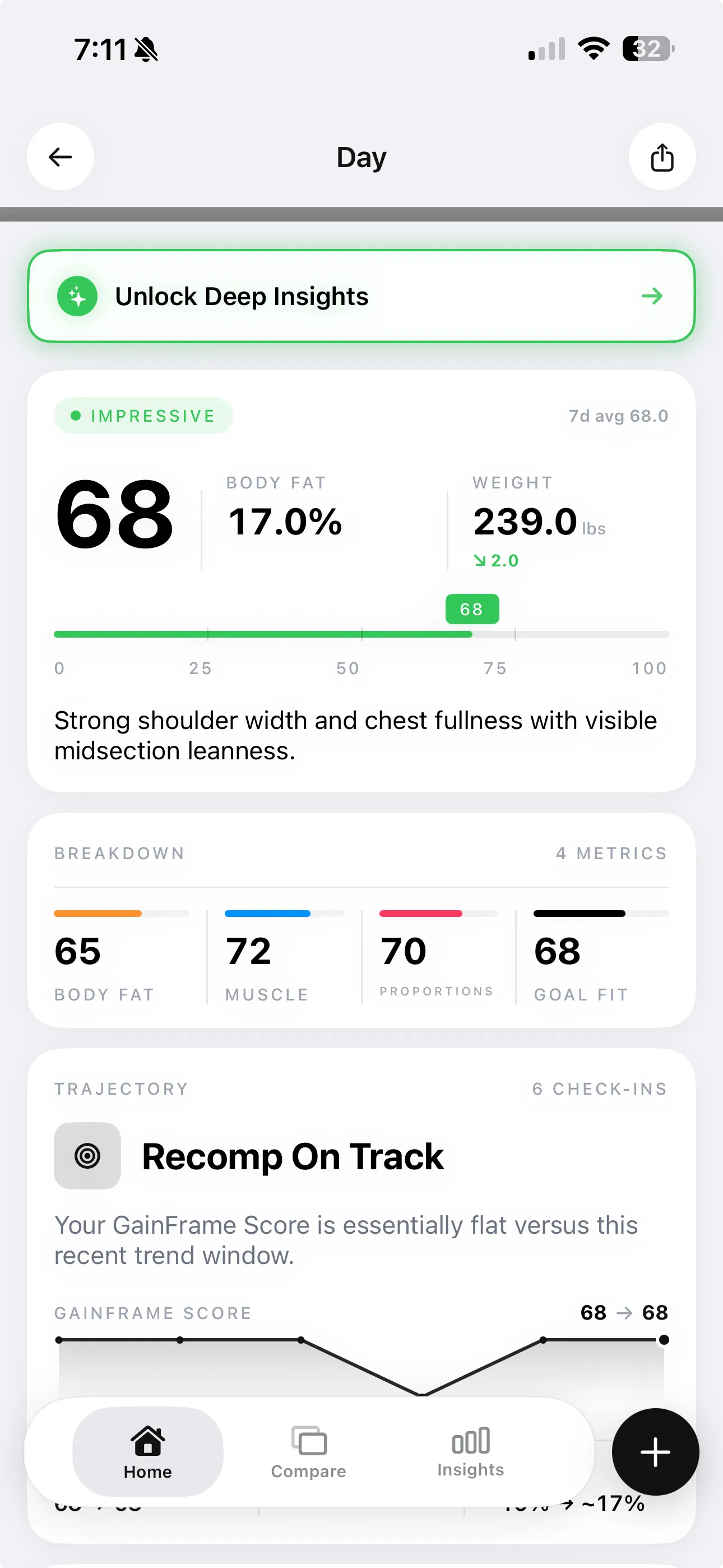
The Proportions metric in a body composition score card measures the shoulder-to-chest-to-waist visual ratio from your photo, the same relationship the SWR calculation captures, tracked automatically with each check-in.
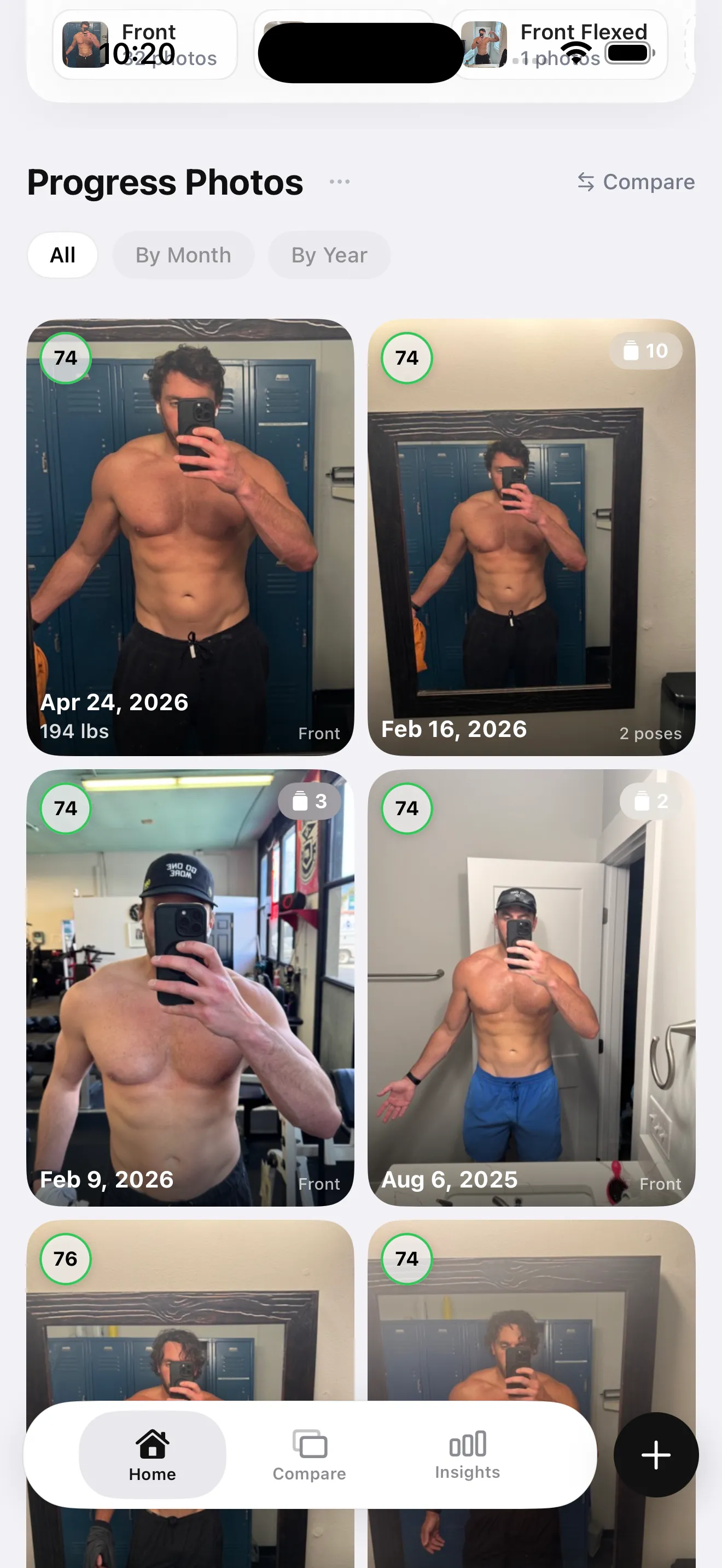
A consistent photo library organized by pose lets you compare the V-taper silhouette directly across months, the visual change that monthly ratio measurements confirm.
What else should you know?
What is the ideal shoulder to waist ratio for men?
The golden ratio ideal is 1.618, shoulders 61.8% wider than the waist. Research supports approximately 1.6 as the most attractive male proportion. A practical target range of 1.45 to 1.618 represents the aesthetic V-taper zone. Most natural lifters achieve 1.5+ at their best composition, which produces a clearly athletic silhouette.
What is the ideal shoulder to waist ratio for women?
Around 1.4, less extreme than the male standard. The hourglass figure involves hip-to-waist proportions alongside shoulder width, so women's aesthetics are less dominated by a single ratio. A shoulder-to-waist ratio of 1.3 to 1.4 is considered athletic and proportionate.
What is the Adonis Index?
The Adonis Index is the shoulder-to-waist ratio applied using the golden ratio (1.618). It calculates your ideal waist measurement from your shoulder width: ideal waist = shoulder circumference ÷ 1.618. Same math as shoulder-to-waist ratio, named after the Greek ideal of male beauty.
Can you improve your shoulder to waist ratio with training?
Yes, on both sides. Develop lateral deltoids, rear deltoids, and lats to widen the shoulder measurement. Reduce body fat, particularly abdominal fat, to narrow the waist measurement. Both respond to consistent training and nutrition.
How does body fat affect shoulder to waist ratio?
Body fat disproportionately accumulates around the midsection, directly increasing waist circumference without affecting shoulder width. Reducing body fat, even without adding shoulder muscle, improves the ratio by narrowing the denominator.
Does clavicle width limit your shoulder to waist ratio?
It sets a genetic floor, not a ceiling. Lateral deltoid and lat development adds meaningful apparent width beyond clavicle structure. Even average-framed men can achieve strong V-taper aesthetics through focused shoulder and back training.
How do you measure shoulder circumference correctly?
Wrap a soft tape at the level of the deltoid heads, roughly midway between collarbone and nipple line. Keep the tape horizontal. Measure relaxed, not flexed, to get a consistent baseline. Flexed measurements appear wider but don't reflect your resting silhouette.
What shoulder-to-waist ratio do pro bodybuilders have?
Classic Physique competitors like Chris Bumstead are commonly estimated by fans at ratios around 1.7 to 1.8 in stage condition, but note these are estimates from photos, not published measurements. That level combines three things most people don't have together: wide clavicles, years of specialized delt and lat development, and competition-lean waists. It's a useful ceiling reference, not a natural-lifter target.
Track your proportions, not just your weight
GainFrame tracks body fat percentage, per-muscle scores, and a Proportions metric from your check-in photos, showing the shoulder-to-waist visual relationship over time, not just a single tape measurement. See how your V-taper is actually developing.
Download GainFrame Free