
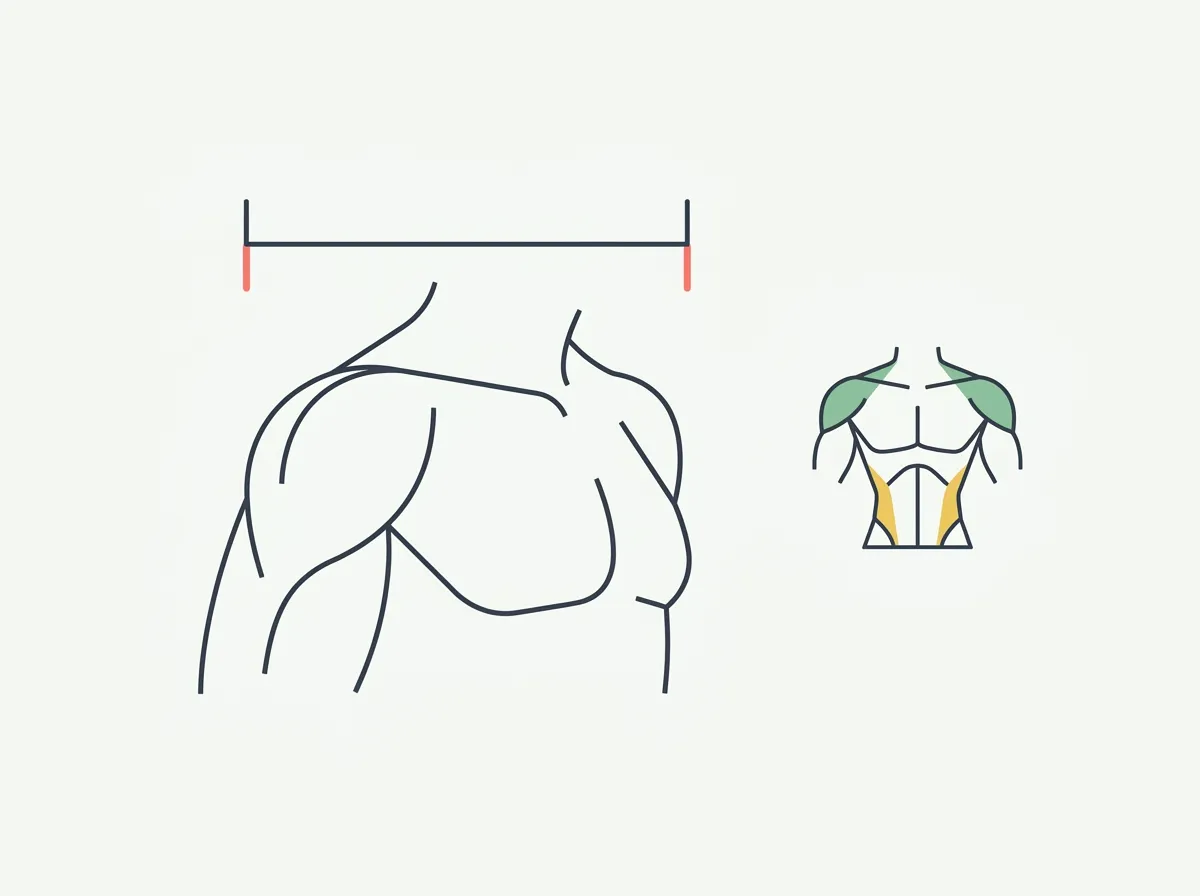
Quick answer: Average male shoulder width is often summarized as about 16 inches in older anthropometric references, but the exact figure depends on the sample and landmarks. That refers to breadth across the shoulders, not a tape loop around them. Keep biacromial breadth, outside width, garment width and shoulder circumference separate when comparing measurements.
Which shoulder measurement are you comparing?
| Measurement | How it is defined | What to avoid |
|---|---|---|
| Biacromial breadth | Straight-line distance between specified bony shoulder landmarks | Comparing it with a tape loop |
| Outside shoulder width | Outer shoulder outline, including soft tissue | Calling it an identical skeletal measurement |
| Shoulder circumference | A tape around the shoulders and upper torso | Treating the number as width |
| Garment shoulder width | A clothing maker's seam-to-seam dimension | Assuming it is a body measurement |
For a proportional comparison, the shoulder-to-hip ratio guide explains why width and circumference ratios need separate labels.
Search "average shoulder width" and you'll find two completely different numbers presented as the same thing: something around 16 inches, and something around 46 inches. Neither site tells you which one your tailor means, which one the survey measured, or which one you can actually train.
They're different measurements of different things , and the difference is exactly where the "can I get wider?" answer lives.
What is the average shoulder width for men?
There are two honest numbers, and they answer different questions.
Biacromial width , the straight-line distance between the bony points at the top of each shoulder , is the skeletal measurement. Commonly cited U.S. survey data puts the adult male average around 16 inches, with most men falling within roughly an inch and a half of that. This is the number your frame was dealt: it's set when growth plates close and no exercise moves it.
Shoulder circumference , a tape wrapped horizontally around the widest point of your shoulders and delts , is the trainable measurement. Untrained men commonly tape somewhere around 44-48 inches depending on height and body weight. This number responds to muscle, and it responds to fat, and the tape can't tell you which it's counting. A photo can: the free browser body fat estimator reads body fat from a single picture, one scan a day, no signup.
When a clothing chart says "shoulder: 18 inches," that's usually a seam-to-seam garment measurement , a third number, larger than biacromial width. Know which of the three you're holding before you compare yourself to anything.
What counts as broad shoulders?
A useful comparison needs the same measurement method and a relevant reference population. Shoulder circumference includes muscle and other soft tissue; biacromial breadth uses specified bony landmarks. A clothing measurement follows the garment maker's own definition.
Do not treat a circumference-by-height chart as evidence of how many years someone has trained. Training history and body composition cannot be read reliably from one tape measurement. Record your own dimension consistently and use comparable photos when reviewing appearance.
Can you make your shoulders wider?
Not the bones. Everything else , yes, and the effect is bigger than most lifters expect, because "broad" is a visual judgment, not a skeletal one.
The eye reads three things as width. First, side delts: they're the only muscle that adds literal horizontal inches to your silhouette, which makes lateral raise volume the most direct width investment in training. Second, upper back and traps: they fill the frame from behind, so the same bone width carries more visual mass. Third , and biggest , the waist below: a V-taper is a ratio, and shrinking the denominator widens the appearance of a numerator that never changed.
That third lever is brutally asymmetric. Adding an inch of shoulder circumference takes months of pressing and lateral work. Dropping an inch of waist happens in weeks of a modest cut. Our shoulder-to-waist ratio guide runs the exact math on what each inch is worth, and the average waist size numbers show how much room most men have on that side.
How do you measure your shoulder width correctly?
For the trainable number , circumference , the protocol:
- Stand relaxed, arms at your sides. No flare, no shrug, no breath-hold. A lat flare adds two-plus inches of fiction.
- Wrap the tape around the widest point , across the outermost curve of both delts, level with the top of your armpits.
- Keep the tape parallel to the floor. A drooping tape reads long. Use a mirror or a second person.
- Cold, not pumped. A shoulder day pump commonly adds an inch that's gone by morning.
- Monthly, alongside your waist. The ratio between the two numbers matters more than either alone.
For biacromial width, you need a second person and a rigid ruler , feel for the bony point at the top of each shoulder (the acromion) and measure the straight line between them. Do it once for curiosity; it will never change again.
How do you know your shoulders are actually growing?
The tape wraps delts, traps, chest thickness, and the fat over all of it into one number. Whether the trend is muscle takes a second signal.
GainFrame reads it from a photo: its AI rates 12 muscle groups individually , front delts and side/rear delts among them , alongside estimated body fat percentage, so you can see whether the circumference trend is delt-shaped or just bulk. Estimates from photos, not clinical measurement, but the per-muscle breakdown answers the exact question the tape leaves open.
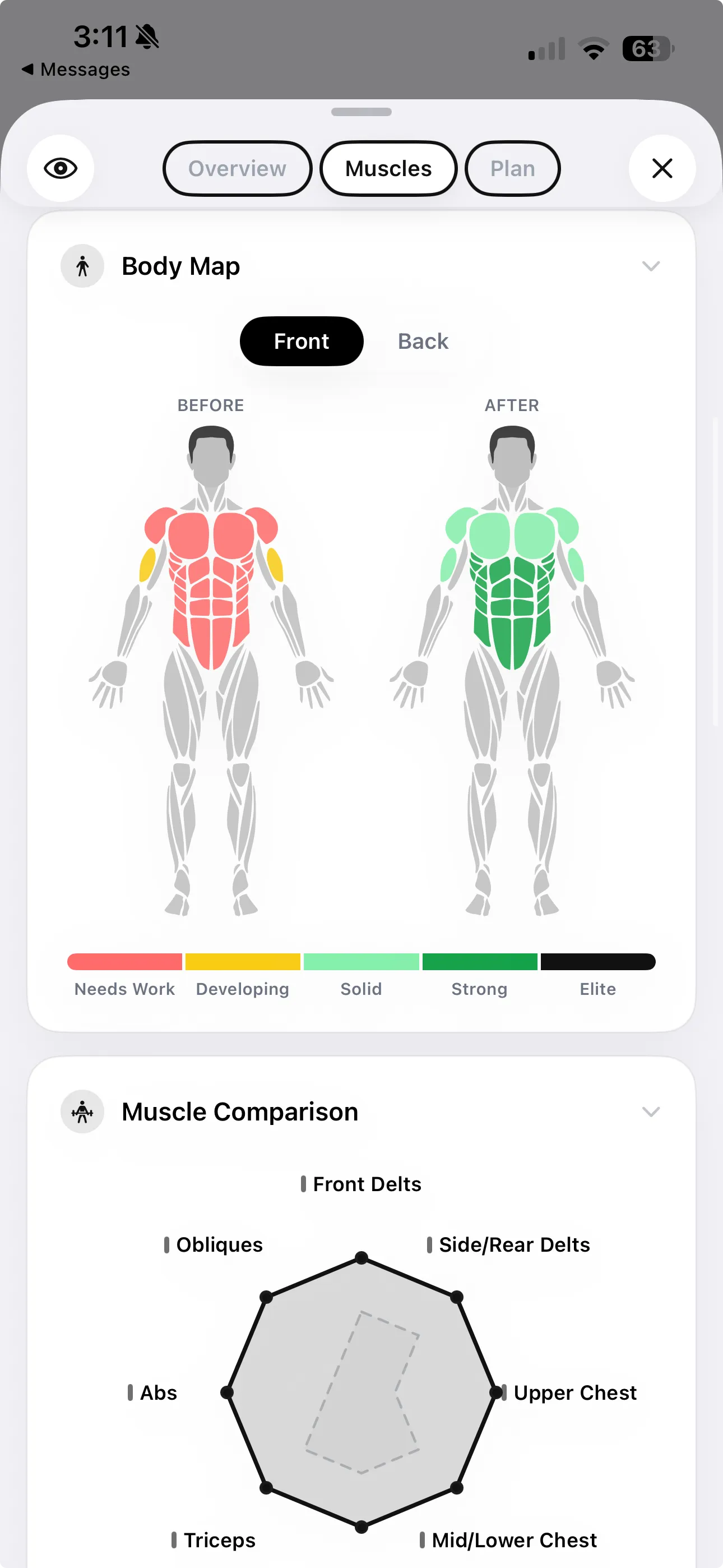
Baseline vs current per-muscle ratings: if the delt scores climb while body fat holds, the width is real.
Pair the photo signal with the tape and your pressing log, and the signs you're actually building muscle stop being guesswork.
What else should you know?
What is the average shoulder width for a man?
Measured bone-to-bone across the acromion processes, commonly cited survey data puts the average adult male around 16 inches. Measured as circumference around the shoulders at the widest point, untrained men commonly tape around 44-48 inches. The first number is skeleton; the second is skeleton plus muscle plus body fat.
Can you make your shoulders wider after puberty?
The bone width can't change , biacromial width is set once growth plates close. Everything layered on top can: side delts add visible width directly, upper back and traps add frame thickness, and losing waist circumference makes the same shoulders read dramatically broader. Trained physiques look wider through muscle and ratio, not bone.
Are 18 inch shoulders broad?
If that's a bone-to-bone measurement, yes , roughly two inches above the commonly cited male average, genuinely broad-framed. If it's a shirt-shoulder seam measurement it runs larger than skeletal width and reads closer to average-athletic. Be sure which number you have before comparing against charts.
What shoulder circumference is considered big?
Untrained men commonly tape around 44-48 inches around the widest point of the shoulders. Consistent training typically adds two to four inches, so a lean 50-inch shoulder circumference is solidly trained and 52-plus lean is genuinely big for a natural lifter. Body fat inflates the number without adding visual width.
What shoulder to waist ratio should I aim for?
Commonly cited ideals put the aesthetic target around 1.6 , shoulder circumference roughly 1.6 times waist circumference, the classic V-taper. Most lifters get there faster by shrinking the denominator: an inch off the waist moves the ratio about as much as months of delt work adds to the numerator.
See if the width is real
GainFrame rates your front, side, and rear delts , and 9 other muscle groups , from a photo, next to estimated body fat. See whether your shoulders are growing or your frame is just getting heavier. Free to start on iOS.
Download GainFrame Free