
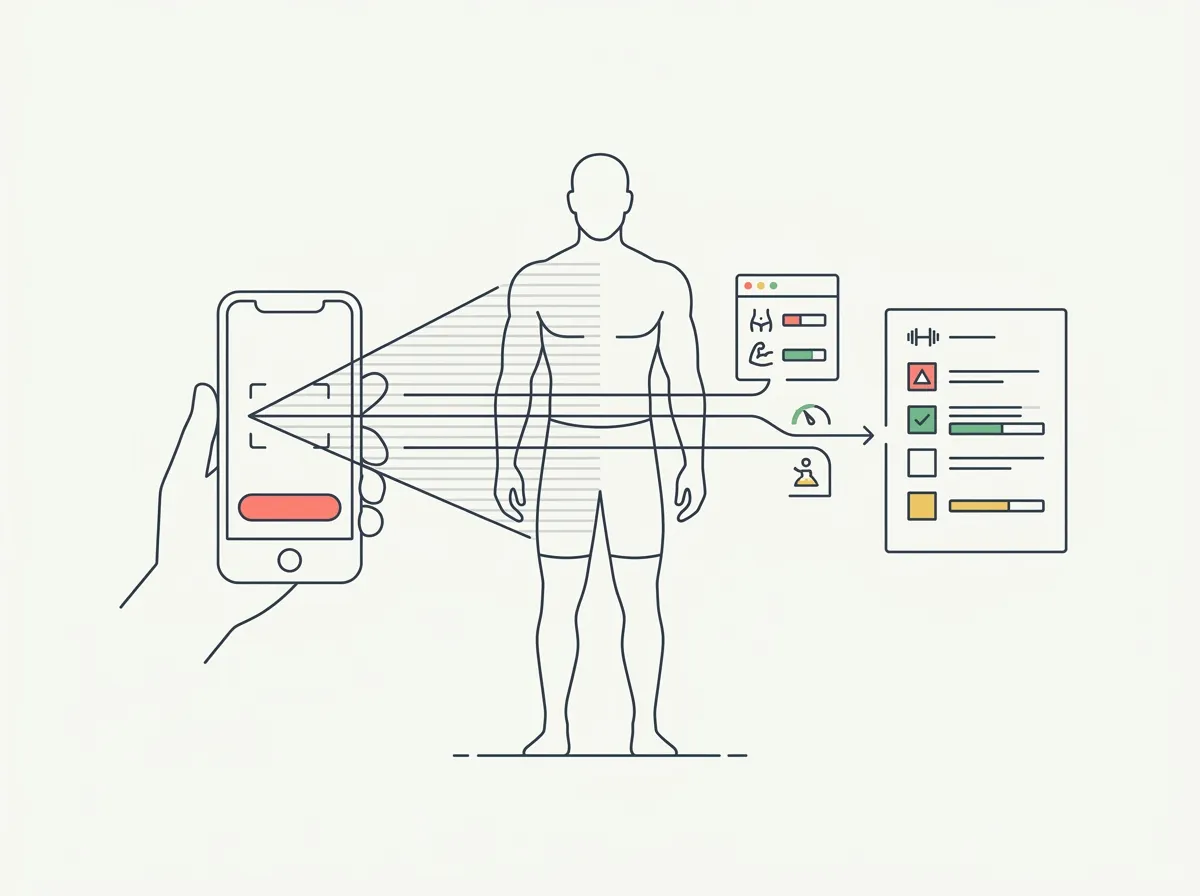
Quick answer: Thelo is an iOS AI personal trainer that builds adaptive workout plans from a phone-camera body scan. It rates 4.6 across roughly 1,300 App Store ratings, costs $9.99 weekly to $59.99 yearly after a free download, and publishes no accuracy validation for its scans. Best for lifters who want scanner and planner in one app.
Most fitness apps make you choose a camp: workout planners that know your sets and nothing about your body, or body trackers that know your body and nothing about your training. Thelo's bet is that the scan should drive the plan — point the camera at yourself, and the workouts reshape around what it sees.
That dual-camp design is why it took the #2 spot in our AI fitness apps that track your body roundup. This review goes deeper on Thelo itself: what the BioScan actually feeds into, what the subscription costs, and where the honest gaps are.
What does the Thelo app actually do?
Thelo (from One Labs LLC, launched January 2025) runs on a loop: scan, plan, train, rescan. The BioScan reads your body through the phone camera and, per the app's own description, identifies muscle imbalances and weak points, structure and proportions, and which muscles are recovered. The planner then builds sessions around your schedule, equipment, and training history, and keeps adjusting as new scans come in.
Three things it does genuinely well:
- Scan-to-plan integration. This is the feature that earns the download. Most stacks make you manually translate body data into routine changes; Thelo does the translation automatically. Cut too hard and lose lean mass, and the plan responds.
- Adaptive scheduling. Sessions adjust to available time and equipment rather than assuming a fixed gym week — a real advantage for people whose training windows move around.
- Active development. Version 2.2.4 shipped in late July 2026, and the 4.6 rating across ~1,300 App Store ratings is a solid signal for an app this young.
How much does Thelo cost?
Free to download, with the core value behind Thelo Pro. Pricing from the App Store listing at review time:
| Tier | Price |
|---|---|
| Thelo Pro Weekly | $9.99/week |
| Thelo Pro Monthly | $19.99/month |
| Thelo Pro Yearly | $59.99/year |
| Thelo Pro Unlimited | $149.99 |
| Individual AI scans | ~$5.99–9.99 each |
The yearly tier is the sane buy — the weekly price annualizes to over $500. The à-la-carte scan purchases are unusual for the category and worth noting: if you stop subscribing, the scans themselves are still metered.
Where is Thelo thin?
The biggest gap is verification. Thelo describes the BioScan as "proprietary body scan technology" and publishes no validation data — no DEXA comparison, no error range, no methodology beyond the marketing copy. The scan may well be consistent enough for trend tracking; there's simply no public evidence either way, which matters when the whole product is built on top of the scan's output.
The second gap is lock-in. The plan is Thelo's plan. If you already run Fitbod, follow a coach's program, or write your own training, the planner half of the app is redundant and you're paying for a scanner with a workout app attached. The scan output is also less granular than a per-muscle-group breakdown — you get directional insights rather than a scored report per body part.
Worth knowing as a buyer: the app has been renamed repeatedly — it launched as Swoosh, became "Thelo: Body Scan & Weights AI," and is now "Thelo: AI Personal Trainer." Legacy IAP names from the Swoosh era are still visible in the listing. None of that says anything about the product's quality; it does suggest the positioning is still settling.
What should you pair Thelo with — or use instead?
If Thelo's planner is the part you want, the open question is whether its scan is telling you the truth about results. An independent measure of body change closes that loop.
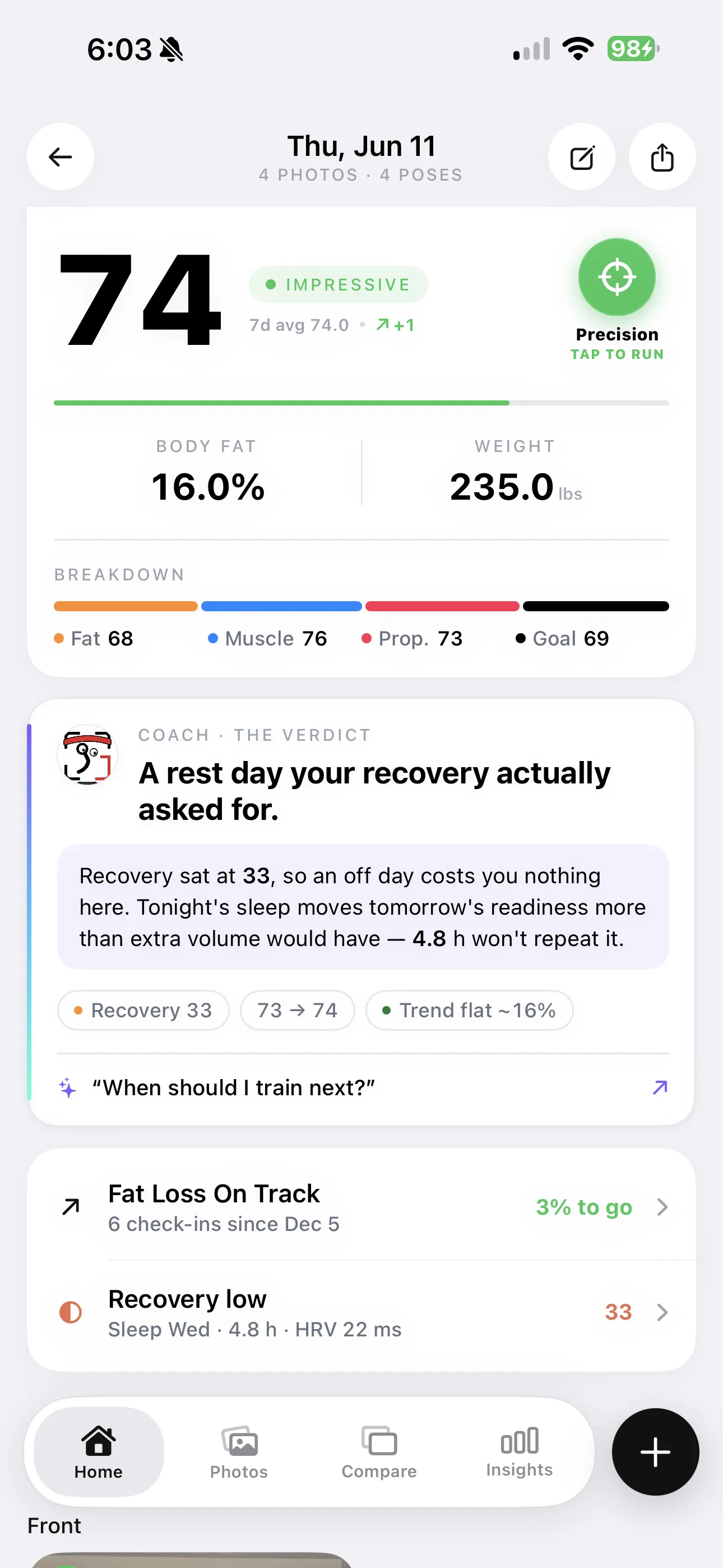
The results side of the loop: a weekly photo check-in scored for body fat, FFMI, and 12 muscle groups — independent of whatever app plans the training.
GainFrame sits on that results side: weekly photo check-ins scored for body fat, FFMI, physique score, and 12 muscle groups, with published DEXA validation (±0.4% in its accuracy study), and it works next to any planner — Thelo's included. If you want the scan without the planner commitment, that's the cleaner split.
Who should use Thelo?
Use Thelo if: you want one app for everything, you don't have a program you're attached to, and the idea of workouts that reshape around your scan results is the feature you'd pay for. Nothing else in the category integrates the two halves this directly.
Skip Thelo if: you already have programming you trust (the planner becomes dead weight), you need validated accuracy numbers before trusting a scan, or you want per-muscle scoring rather than directional insights. Our body scan app roundup covers the scanner-only alternatives.
Frequently asked questions
What is the Thelo app?
Thelo (by One Labs LLC) is an AI personal trainer for iOS built around a phone-camera body scan. The BioScan reads body fat, muscle balance, and structure, and the app turns that into a workout plan that adapts as your body changes. It launched in January 2025 and holds a 4.6 rating across roughly 1,300 App Store ratings as of August 2026.
Is the Thelo app worth it?
If you want a scanner and a workout planner in one app and don't already have programming you trust, Thelo is one of the few apps that genuinely does both, and users rate it well (4.6 across ~1,300 ratings). If you already train with Fitbod, a coach, or your own program, the planner side becomes redundant and the subscription is harder to justify.
How much does Thelo cost?
Thelo is free to download, with the core features behind Thelo Pro: $9.99 weekly, $19.99 monthly, or $59.99 yearly at the time of this review, plus a $149.99 unlimited tier. The App Store listing also sells individual AI scans à la carte for roughly $5.99–9.99. Prices can change — check the current listing before subscribing.
Is Thelo's body scan accurate?
Unverifiable from the outside. Thelo describes its BioScan as proprietary technology and has not published validation data comparing its estimates to a clinical method like DEXA, so there is no public accuracy figure to cite. Treat its numbers as trend data — useful for tracking direction over time rather than as clinical measurements.
Thelo vs GainFrame — which should you use?
Different centers of gravity. Thelo scans your body to feed its own workout planner — the scan exists to drive training. GainFrame is results-first: weekly photo check-ins scored for body fat, FFMI, and 12 muscle groups, with published DEXA validation, and it works alongside whatever training you already do. Pick Thelo for an all-in-one; pick GainFrame to measure progress independently of any planner.
Measure the results, whoever plans the training
GainFrame scores a weekly photo for body fat, FFMI, physique score, and 12 muscle ratings — DEXA-validated, planner-agnostic. Free to start on iOS.
Download GainFrame Free