
Quick answer: Weight gain in the first weeks of lifting is mostly glycogen and the water stored with it, plus fluid from muscle repair — not fat. A 2–5 lb jump in weeks one through four is commonly observed, and it usually levels off. Fat gain only enters the picture if you're eating in a large surplus.
Three weeks into your first real lifting program, you step on the scale and you're up 4 lbs. You've trained hard, eaten reasonably, done everything the plan said. And the number that was supposed to prove it's working just moved in the wrong direction.
This is the single most common reason beginners quit in month one. It's also almost never fat. Your body is doing something specific and predictable, and once you know what it is, the scale stops having power over you.
Why does the scale go up when you start lifting?
Because lifting changes what your body stores, not just what it burns. A new training stimulus tells your muscles to hold more fuel and more fluid — and both of those have weight. Fat requires a sustained calorie surplus to accumulate; the early jump doesn't.
Four things are stacking on the scale at once. Here's each one, roughly in order of size.
Glycogen and the water that comes with it
Muscles store carbohydrate as glycogen, and training tells them to store more of it. The commonly cited figure is that each gram of glycogen binds roughly 3 grams of water. So a modest increase in stored glycogen drags a multiple of its own weight in water along with it — several pounds of scale weight that contain zero fat.
This is the same mechanism that makes low-carb dieters "lose" 5 lbs in week one, running in reverse. You didn't gain tissue. You topped off the tank.
Fluid from muscle repair
Hard training — especially training your body isn't used to — creates micro-damage in the muscle, and the repair process involves localized inflammation and fluid retention. That's part of why you're sore. It's also part of why you're heavier, and why the scale can bounce a pound or two the morning after a brutal leg day.
This effect is biggest in your first weeks, when every session is novel. It fades as your body adapts.
More food and sodium in the system
Starting a program usually means eating more — more total food, more carbs, often more sodium. Food in transit through your gut has weight before a single calorie of it is stored as anything. Add the water that extra sodium holds, and your day-to-day readings can swing 2–3 lbs on intake alone.
If you also started creatine with the program, add another pound or two of intracellular water on top. All normal. None of it fat.
Actual muscle — real, but slower than the water
Newbie gains are real: muscle growth is fastest in your first year of training. But even then, commonly cited estimates put it around 1–2 lbs of muscle per month for men under good conditions, somewhat less for women. In week three, genuine new muscle is a fraction of a pound — the water got there first.
That's the punchline of the early scale jump: the muscle is coming, but the water shows up before it. The early signs you're building muscle are strength and reps, not scale weight.
How long does the early weight gain last?
The commonly observed pattern: the scale rises 2–5 lbs across weeks one through four, then flattens. The glycogen and fluid shift is a one-time recalibration of your baseline, not a trend — it stops when the tank is full and your body has adapted to the training stimulus.
| Timeline | What the scale does | What's actually happening |
|---|---|---|
| Week 1–2 | Up 1–4 lbs, jumpy day to day | Glycogen filling, repair fluid, more food in the system |
| Week 3–4 | Up 2–5 lbs total, still noisy | Storage adaptation peaking; first real muscle accruing slowly |
| Week 5–8 | Flattens; slow trend emerges | Water shift complete — the trend line now means something |
| Month 3+ | Follows your calories | Rising = surplus (muscle + some fat); falling = deficit |
Individual timing varies with body size, carb intake, and how new training is to you. But if you're panicking in week two, you're reading the noisiest possible data at the noisiest possible time. Visible change runs on a longer clock too — here's the realistic timeline for seeing lifting results.
When is the weight gain actually fat?
Honest answer: when your surplus is too big. Water explains a one-time 2–5 lb shift that levels off. It does not explain a scale that keeps climbing a pound or more every week from month two onward.
Run this check before you blame water:
- Is the trend still rising after week 6? The glycogen shift is done by then. A continuing climb is coming from your calories.
- Is your waist growing? Measure at the navel, weekly, same conditions. Glycogen lives in muscle; a waist trending up over 3–4 weeks is fat.
- How big is your surplus? "Eating big for gains" at +700–1,000 calories a day gains fat faster than muscle. A lean gaining phase runs closer to +200–400.
- Do photos show softening? Two weeks apart, same light and pose. Water makes you look fuller; fat makes you look softer, mostly at the midsection.
If the answer to those is yes, yes, big, and yes — that's not water weight, and the fix is trimming the surplus, not abandoning the program.
What should you track instead of daily weight?
Daily scale readings are the wrong instrument for the first two months. Three signals do the job properly:
Weekly average weight. Weigh daily if you like, but only compare week-to-week averages. Averaging strips out the water, sodium, and gut-content noise that makes single readings meaningless.
Waist measurement. The cheapest fat detector there is. Stable-or-shrinking waist while the scale rises is the signature of a good start — and how you measure muscle gain without a scale covers the full tape-measure protocol.
Photos under consistent conditions. Same spot, same light, same pose, every week or two. The mirror lies daily; a photo series doesn't. This is where an app earns its place: GainFrame tracks your weight trend and milestones alongside AI analysis of those photos — estimated body fat percent and muscle-group ratings — so the scale number sits next to evidence of what it's made of. It's iOS only, the estimates come from photos rather than clinical measurement, and the free tier covers 25 photos, which is months of weekly check-ins.
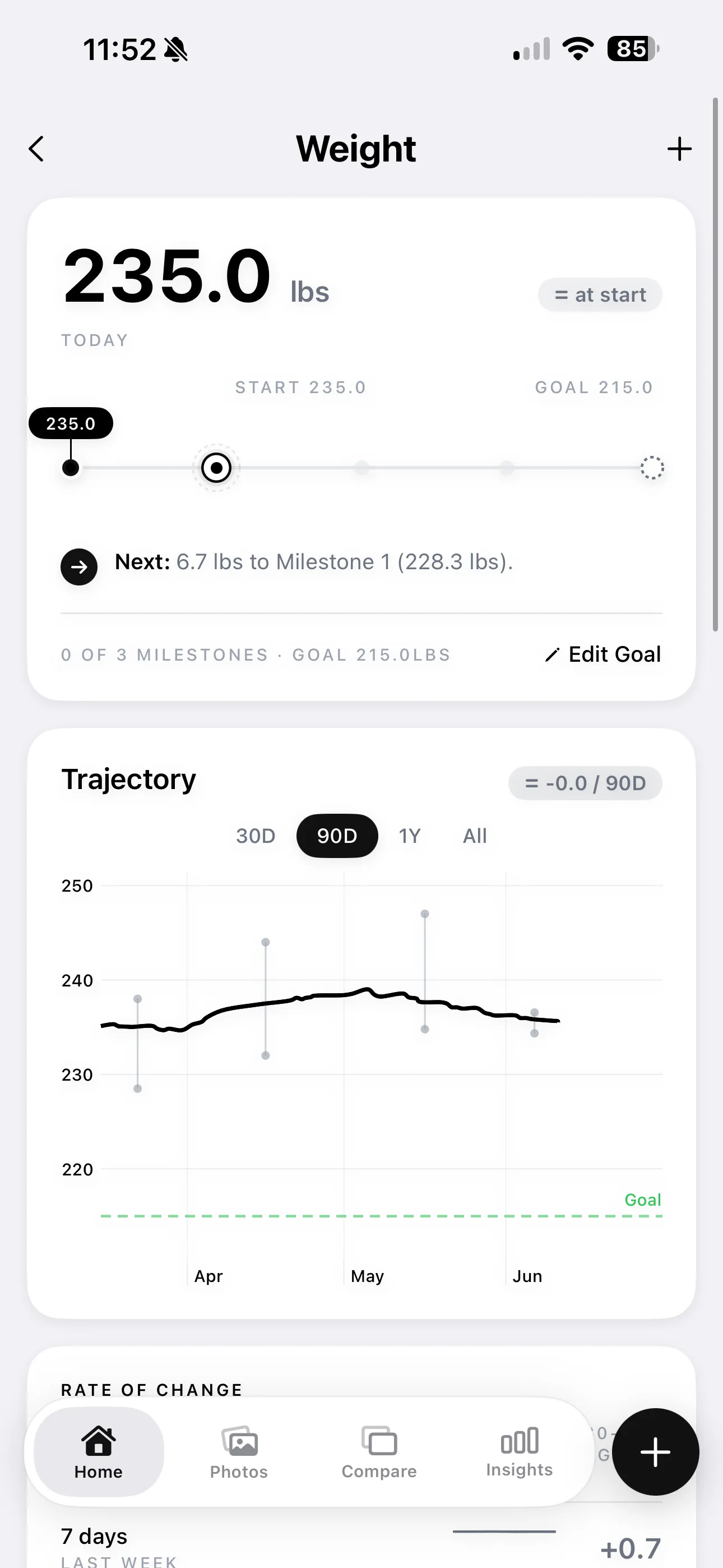
The scale number with context: trend, milestones, and photo evidence of what the gain is made of.
Scale weight is one input, not the verdict. Body fat percentage tells you far more than the raw number ever will.
Frequently asked questions
How much weight do you gain when you first start lifting?
A jump of roughly 2–5 lbs over the first two to four weeks is commonly observed in new lifters, mostly from extra muscle glycogen and the water stored with it, plus fluid involved in muscle repair. Heavier people and those eating more carbs tend to sit at the higher end. It typically levels off rather than climbing indefinitely.
How long does water weight from working out last?
The initial glycogen-and-water gain usually stabilizes within three to six weeks as your body adapts to the new training stimulus. It does not keep accumulating — it is a one-time upward shift in your baseline. Soreness-related fluid retention from any single hard session generally resolves within a few days, which is why day-to-day scale readings are so noisy.
Am I gaining muscle or fat when the scale goes up?
In the first month, most of the gain is neither — it is glycogen and water. Real muscle accrues slower: commonly cited estimates for new lifters run around 1–2 lbs per month under good conditions. Fat gain requires a sustained calorie surplus. Check your weekly average weight, waist measurement, and photos together; fat shows up as a rising waist, muscle does not.
Should I stop lifting because I am gaining weight?
No. The early scale jump is your body storing more fuel in the muscle you are now using — it is a sign training is working, not that it is backfiring. Quitting resets the adaptation and keeps you in the start-stop loop. Give any program at least eight to twelve weeks, judge it on measurements and photos, and only adjust calories if your waist trends up for several consecutive weeks.
Why am I gaining weight lifting but losing inches?
That is body recomposition, and it is the best-case scenario. Muscle is denser than fat, so you can add lean tissue and water while your waist shrinks — weight up, clothes looser. New lifters see this most often because muscle gain is fastest in the first year. Trust the tape measure and photos over the scale; they are measuring the thing you actually care about.
See what the scale can't tell you
GainFrame analyzes your weekly progress photos — estimated body fat, FFMI, and 12 muscle-group ratings — next to your weight trend, so a rising scale reads as progress instead of panic. Free to start on iOS.
Download GainFrame Free