
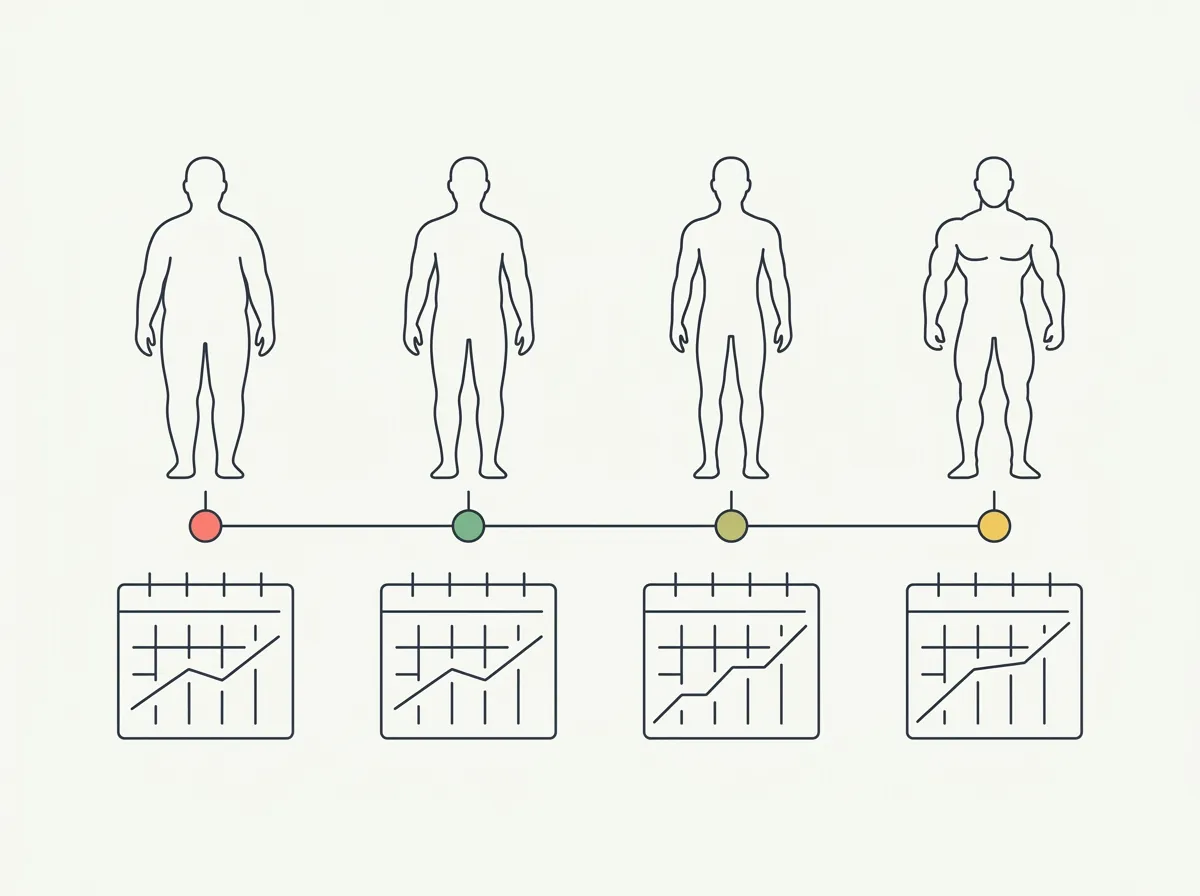
Quick answer: You'll feel results from lifting within 2 to 4 weeks, strength up, better energy, improved endurance. Progress photos start showing visible changes around weeks 6 to 8. Others notice at 3 to 4 months. Significant muscle definition takes 4 to 6 months of consistent training and adequate protein. The mirror is always last, body composition data and photos show progress 4 to 6 weeks earlier.
The most common reason people quit a lifting program is also the most preventable: they stop in week 8 because they can't see anything happening. What they don't know is that they're quitting during the phase where the real change is happening, they're just looking for it in the wrong place at the wrong time.
The mirror is not a progress tracker. It updates daily, which means your brain stops registering gradual change. It's the worst possible instrument for evaluating a 10-week training block. Understanding what actually shows results when, and where to look for them, is what gets you to the phase where the mirror finally confirms what your data already showed.
Why does the mirror lie to you about lifting progress?
The mirror updates every time you look at it. Your brain adapts to daily incremental changes the same way it adapts to the clock ticking, it stops noticing them.
This is called adaptation habituation. People who see you once a month notice dramatic changes. You see yourself every day and notice nothing. Both experiences are accurate, they're just sampling the same change at different frequencies.
Progress photos exploit this. A photo taken four weeks apart forces a direct comparison your daily mirror experience never allows. The 4 to 6 week gap captures accumulated change in one moment, bypassing the adaptation that makes daily change invisible.
The second reason the mirror lies: the earliest changes aren't visible. The first 2 to 4 weeks of lifting are primarily neurological adaptation, your nervous system learns to recruit more muscle fibers efficiently before the fibers themselves grow. You become genuinely stronger without looking significantly different.
What changes in the first month of lifting?
Weeks 1 to 2: Soreness is high. Movements feel awkward. Your nervous system is building coordination patterns for each exercise. Strength may not increase yet because technique is still being established. This is the hardest phase to stay consistent through, you're working hard and seeing nothing.
Weeks 2 to 4: Strength begins climbing quickly. Technique becomes more natural, and neural efficiency improves dramatically. You may add 10 to 15% to primary lift numbers within the first month simply from motor learning, before any actual muscle growth. Energy levels often improve as cardiovascular adaptation begins. Appetite typically increases.
What you can see vs. what you can measure: Almost nothing visible in the mirror yet. But strength numbers are up, soreness is diminishing, and the workouts feel less brutal. These are the early signs that the process is working, check this list of early muscle growth signals if you're unsure whether it's progressing.
What does lifting progress look like at 8 to 12 weeks?
This is when the first visible changes typically appear. Not dramatically, the transformation movies show isn't 8 weeks of work, it's 8 months, but measurably.
What's happening physiologically: Actual muscle hypertrophy, the growth of individual muscle fibers, is now producing structural changes. Muscle glycogen storage has increased, making trained muscles appear fuller. Subcutaneous fat may be thinning if nutrition is appropriate.
What you'll notice:
- Clothes fitting differently: sleeves tighter across the upper arm and shoulder, shirts tighter across the back
- Progress photos from week 8 showing clear changes compared to week 1 photos
- The pump after training more pronounced and lasting longer
- Others starting to notice, especially people who see you infrequently
What the scale shows: Often very little. Muscle gain and potential fat loss can offset each other, keeping the scale flat even as body composition improves meaningfully. This is why body fat percentage tracking matters more than scale weight at this stage.
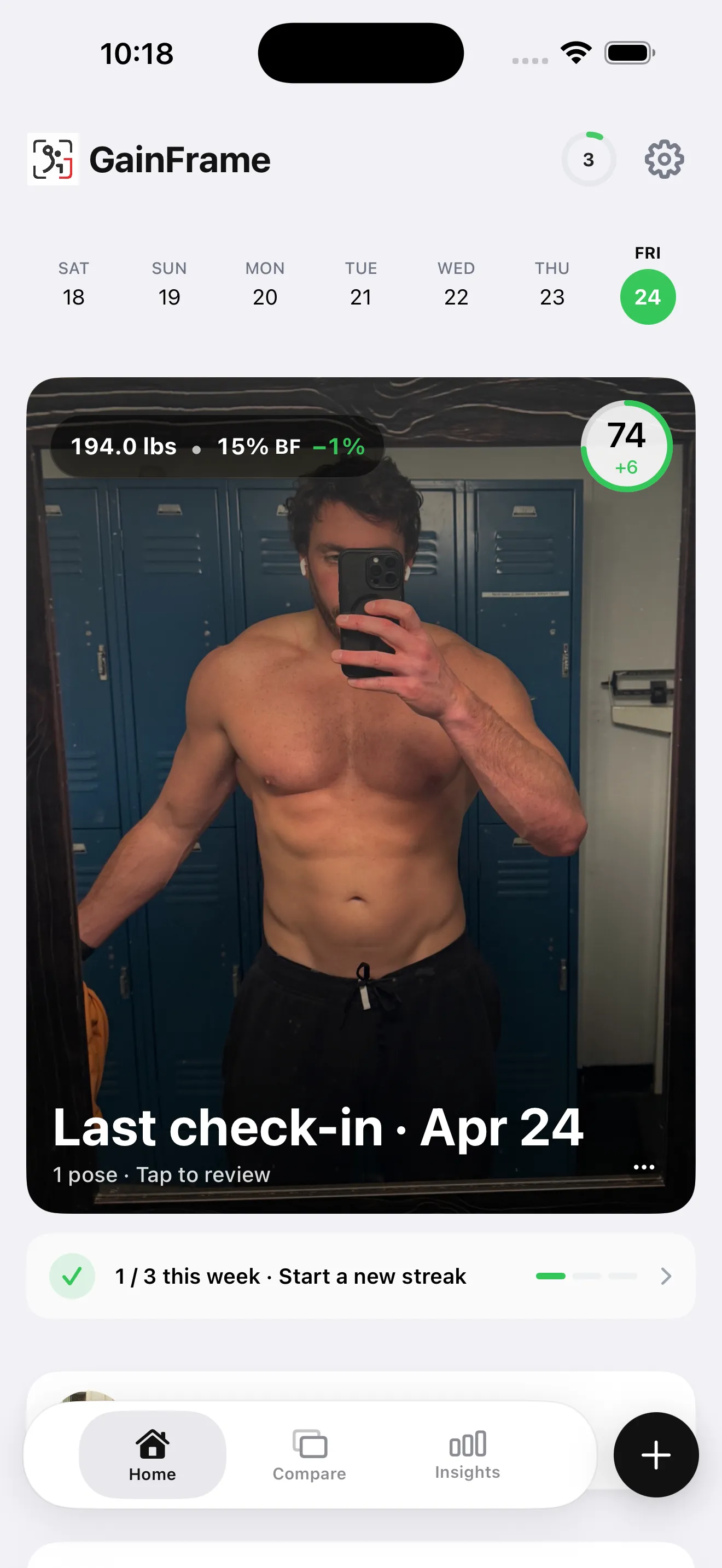
Eight consistent weekly check-ins is the minimum dataset to see a real trend emerging. Each check-in adds a data point, body fat %, muscle score, photo, that builds the picture the scale and mirror miss.
For a defined three-month block, plan a 90-day Winter Arc and set your photo check-ins before you start. Use consistent conditions so the comparison at the end has a useful baseline.
What does six months of consistent lifting actually produce?
Six months is the threshold where most people cross from "trying lifting" to "actually being a lifter." The results at this point are meaningful enough to notice in the mirror and obvious enough for others to remark on consistently.
Muscle development: For beginners, research suggests 1 to 2 lbs of actual muscle tissue per month is realistic in the first year, roughly 6 to 12 lbs over six months. This doesn't sound dramatic as a number, but distributed across the body it represents visible changes in shoulder width, arm size, back thickness, and leg development.
Body fat: If nutrition has been aligned with the goal, six months typically produces 15 to 25 lbs of fat loss (at a moderate deficit) or clear definition from body composition improvement. At 12 weeks, you look noticeably different to others. At six months, you look dramatically different in your own progress photos.
What longer-term comparisons reveal: A single training session photo vs. a six-month-later photo under the same conditions shows a transformation that daily mirror observations completely missed building.
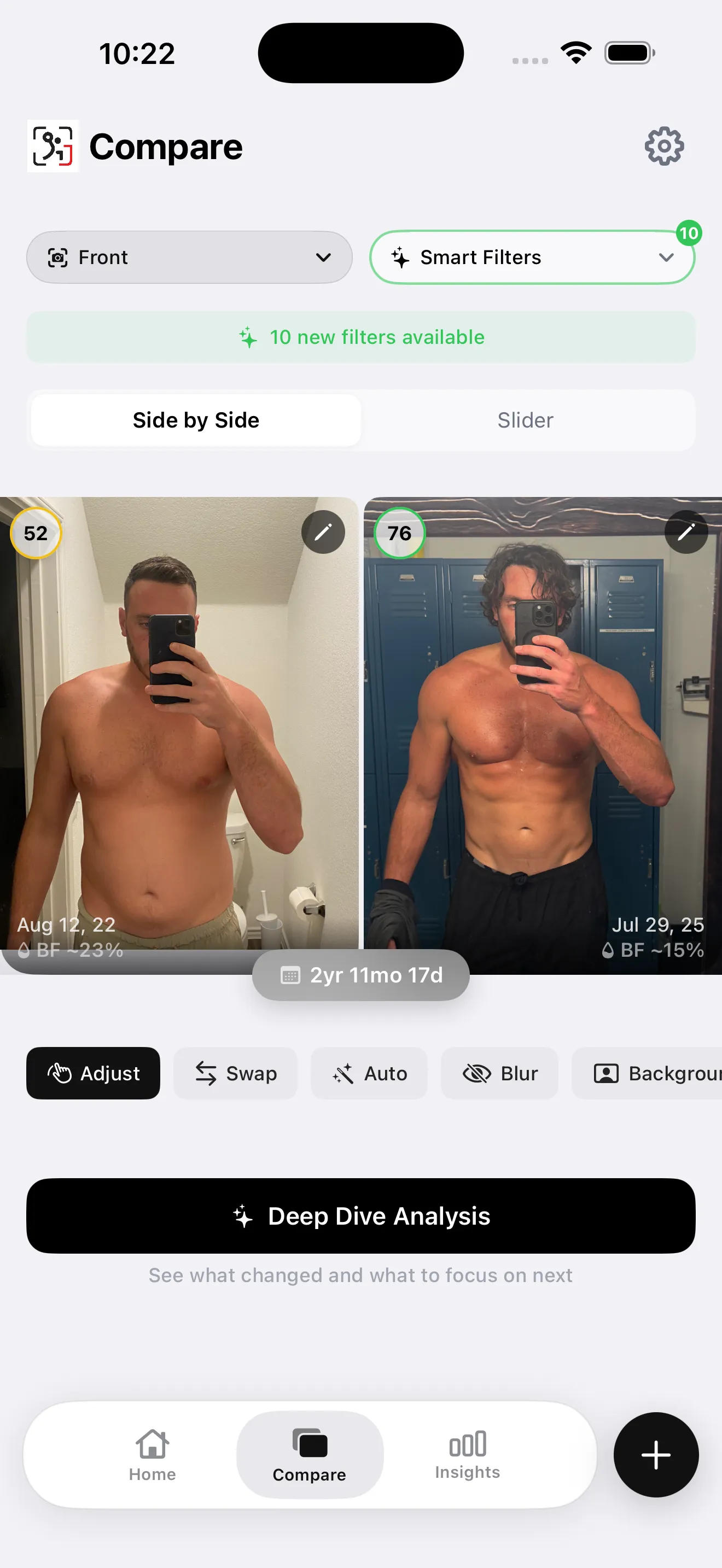
A 23% body fat reduction over nearly three years. The scale barely tells this story. The comparison photo tells it immediately, which is why consistent progress photo tracking is more valuable than any weight on a scale.
What factors most affect how quickly you see results?
Training age matters most. Beginners see results significantly faster than experienced lifters. The first 1 to 2 years of consistent lifting produce the most dramatic proportional gains. Advanced lifters need more volume, more programming precision, and longer blocks to produce proportionally similar results.
Starting body fat matters a lot. Someone starting at 25% body fat who lifts consistently and eats in a moderate deficit will often see dramatic visual changes within 8 to 12 weeks because fat loss reveals the muscle development underneath. Someone starting lean may take longer to see visible changes because there's less fat "hiding" the muscle that's being built.
Protein intake is make-or-break. Without 0.8 to 1g of protein per pound of bodyweight daily, muscle growth is significantly impaired regardless of training quality. This is consistently the variable most people underestimate.
Sleep is the third lever. Research shows reduced sleep significantly impairs muscle protein synthesis and increases cortisol. 7 to 9 hours is the range where muscle recovery is optimal. Consistently sleeping less is equivalent to doing half the training for half the result.
Consistency beats optimization. Three moderate sessions per week done consistently for 6 months beats five optimized sessions per week done for 6 weeks then abandoned. The compounding return of consistent training is what produces the dramatic comparisons, not any single week.
How to track the results that the mirror misses
Log your lifts every session. Weight and reps on your main compound movements. The upward trend in these numbers over 4 weeks is the most sensitive early indicator of muscle growth.
Take progress photos every 4 weeks. Same pose, same lighting, same time of day. Front and side views. Compare directly to four weeks prior, not yesterday.
Track body fat percentage monthly. Not just scale weight. Body fat trending down alongside flat scale weight means recomposition is working. This is invisible to the scale alone.
Measure key circumferences every 4 to 6 weeks. Arms, chest, shoulders, waist. Shoulder circumference up + waist circumference flat or down = the composition change the scale doesn't show.
Review the 12-week trend, not the weekly noise. At 12 weeks, compare your starting data to now. Strength numbers, photos, measurements, body fat percentage. This is when results become undeniable even if daily progress felt invisible.
Frequently Asked Questions
How long does it take to see results from lifting weights?
You'll feel results within 2 to 4 weeks (stronger, more energy). Progress photos show changes around weeks 6 to 8. Visible definition noticeable to others takes 12 to 16 weeks. Significant muscle development takes 4 to 6 months of consistent training and adequate protein.
Why don't I see results after 4 weeks of lifting?
Because the first four weeks are primarily neurological. Your nervous system becomes more efficient before muscle fibers grow. You're genuinely stronger, but the physical change is minimal. Compare progress photos, not daily mirror checks, to see what's actually happening around week 6 to 8.
How long until others notice your body transformation?
Typically 3 to 4 months. Others see you after a gap and register cumulative change all at once, the same change you've been watching daily and stopped noticing. Friends who haven't seen you in 8 to 12 weeks often notice dramatic changes. Their observations are accurate; your daily mirror checks are biased.
Do you see results faster if you lift more frequently?
Up to a point. Training each muscle group 2 to 3 times per week produces faster hypertrophy than once per week. Beyond that, recovery becomes the limiting factor. More total weekly volume also accelerates results until it exceeds your recovery capacity.
How quickly do beginners see results compared to advanced lifters?
Significantly faster. The first 1 to 2 years produce the most dramatic proportional gains, often 1.5 to 2× faster than experienced lifters. Untrained muscles respond strongly to any progressive stimulus. Beginner gains are the fastest window of change in lifting.
What is the fastest way to see results from lifting?
Consistent progressive overload, sufficient protein (0.8 to 1g per pound daily), adequate sleep (7 to 9 hours), and appropriate caloric target. None is optional. The combination produces faster results than maximizing any single variable.
How do progress photos show results before the mirror does?
The mirror updates daily, so your brain adapts to gradual changes and stops registering them. A photo taken 4 to 6 weeks apart forces a direct comparison that bypasses this bias, capturing accumulated change in one moment, the same way others see you after not seeing you for a while.
Track the results the mirror misses
GainFrame builds a progress photo timeline with body fat percentage, muscle scores, and composition trend at each weekly check-in, so the results the mirror isn't showing yet are visible in the data. Start your baseline today so the 12-week comparison tells the real story.
Download GainFrame Free