
Quick answer: The Withings Body Scan (commonly listed around $400) is the most polished consumer smart scale we've researched: segmental BIA via a retractable handle, plus ECG-style heart and nerve-health features. It's worth it for quantified-health enthusiasts consolidating devices. For composition alone, the Hume Body Pod does the core job at roughly half the price.
How this review was researched
Straight up: this review synthesizes Withings' published specifications, the BIA research literature, and aggregated user reviews, without months of hands-on daily testing by us. Where reviewer experiences differ, we flag the disagreement instead of picking a side. And a disclosure: we make GainFrame, a photo-based body tracking app that pairs with (rather than competes against) a scale like this.
Four hundred dollars is a strange price for a bathroom scale. It's 10 to 15 times what a Renpho-class smart scale costs, roughly double a Hume Body Pod, and within striking distance of two DEXA scans. So the question this review keeps returning to is the only one that matters at this price: what exactly are you buying that the cheap scale doesn't already do?
Withings' answer is that you're buying more than a scale. The Body Scan is pitched as a daily "health station": body composition, heart rhythm, nerve health, vascular age, all from one 90-second stand. Some of that pitch holds up structurally. Some of it runs into the same physics that governs every BIA device ever sold, at any price.
What is the Withings Body Scan?
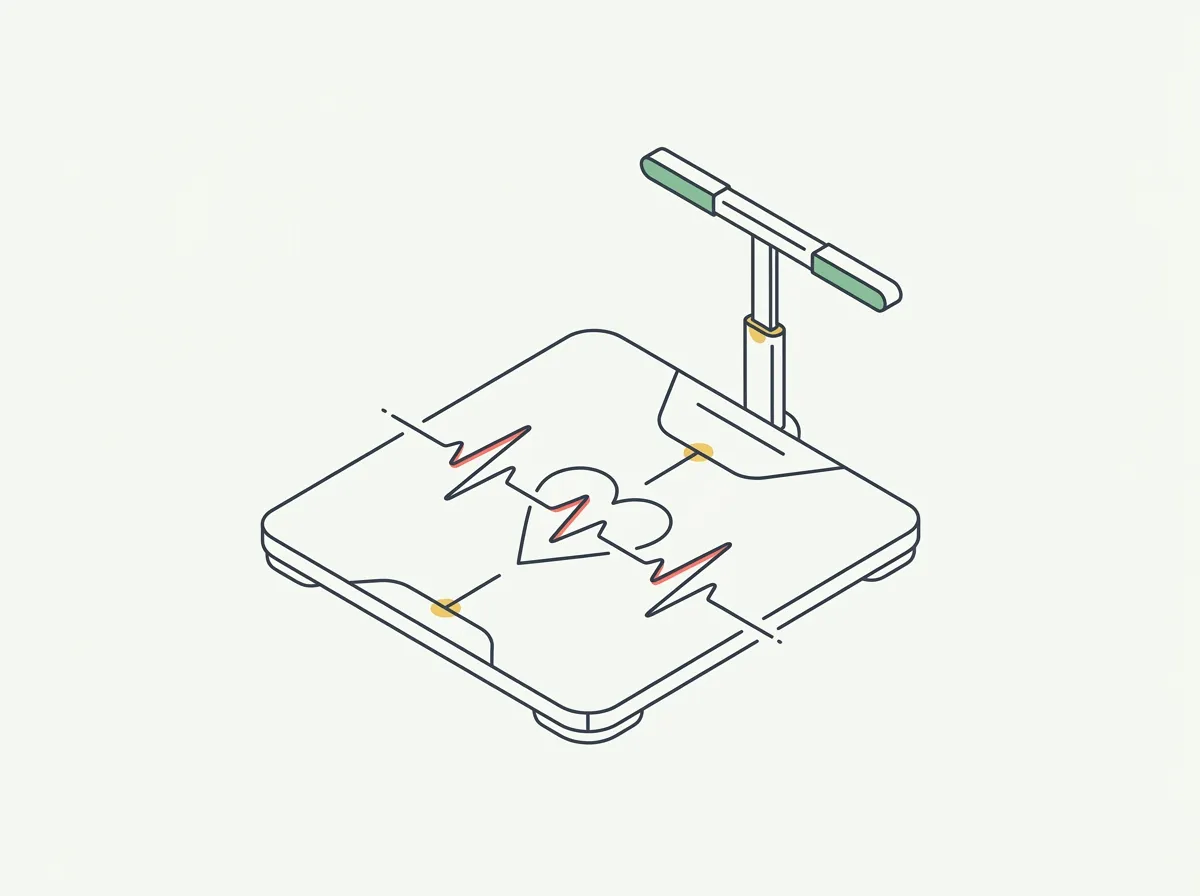
The Body Scan is Withings' flagship smart scale, commonly listed around $400 and at times closer to $500 depending on region and bundle; check current pricing, it has moved. The signature hardware is a retractable handle: a bar that pulls up from the platform on a cable, putting electrodes in your hands as well as under your feet.
That handle is the composition story. Foot-only scales run current up one leg and down the other, then model your entire upper body from a lower-body sample. Hand-plus-foot electrodes send current through arms and torso too, and the Body Scan uses multi-frequency segmental BIA to report each arm, each leg, and the trunk separately, the same electrode architecture family as the InBody machines gyms charge per scan for. We covered why this layout matters in our Hume Body Pod review; the Body Scan is the premium expression of the same idea.
On top of composition, Withings stacks the health-station extras: an ECG-style heart rhythm check taken through the handle, a "nerve health" score derived from sweat-gland activity in the feet, vascular-age estimation, and standing heart rate. These are manufacturer-marketed features, and the framing matters enormously; more on that below. Readings sync over Wi-Fi to the Health Mate app, which is widely regarded as one of the best companion apps in consumer health hardware, and Withings' Apple Health handoff is the most dependable in the category, as our Apple Health scale roundup details.
What does the Body Scan do well?
- The hardware is best-in-class, and reviewers largely agree on it. Tempered glass, a color screen, the motorized-feeling handle, weight readings praised for consistency. If a smart scale can feel premium, this is the one that does.
- Segmental readings beat foot-only modeling. Per-limb and trunk composition from real current paths through the upper body is a structural upgrade over any $30 scale's whole-body guess. For lifters, per-limb lean mass trends are a genuinely interesting signal at home.
- The app polish is commonly praised. Health Mate's trends, integrations, and multi-user handling show up positively across reviews with unusual consistency. Whatever the sensors capture, you'll actually be able to read it.
- It genuinely consolidates devices. A scale, an ECG-capable wearable's rhythm check, and a handful of wellness screens in one object and one morning habit. For the person who was going to buy three gadgets, one $400 device has a defensible logic.
Where does it fall short?
- It's still BIA, and no price tag changes that. Hydration, meal timing, alcohol, yesterday's training, and time of day move impedance readings on a $400 scale exactly as they do on a $30 one. The Body Scan narrows the noise with better electrode geometry; the physics underneath is unchanged, and weigh-in discipline is still mandatory. Our breakdown of every body fat measurement method puts BIA's error bars in context.
- The health extras are wellness features, and you should read them that way. The ECG-style check and nerve score are manufacturer-marketed screening aids. Whatever regulatory clearances apply in your region, a bathroom scale cannot diagnose heart or nerve disease, and a clean reading cannot rule problems out. Anything concerning belongs in front of a doctor; the feature's best case is prompting that visit earlier.
- The price buys polish and extras, and composition accuracy only partly. For the core body fat number, the gap between the Body Scan and a good cheap scale is real but smaller than the price gap implies, because hydration sensitivity is the dominant error source either way. If composition is the whole reason you're shopping, this is an expensive way to buy it.
- Subscription creep is a fair worry. Core readings have worked without a subscription, but Withings has marketed a paid tier with additional insights, and what sits behind it has shifted over time. Check the current listing before buying; at this price, renting features back stings.
| Basic Renpho-class scale | Hume Body Pod | Withings Body Scan | AI photo analysis (GainFrame) | |
|---|---|---|---|---|
| Price | ~$25 to 50 | ~$229 | ~$400+ (commonly) | Free tier; Pro $5.99/mo |
| Current paths | Feet only | Hands + feet | Hands + feet, segmental | None; photo-based estimate |
| Hydration sensitivity | High | Moderate; still BIA | Moderate; still BIA | None (lighting/pose matter instead) |
| Shows where change happens | No | No | Per-limb lean estimates | Yes: visual + 12 muscle ratings |
| Health extras | No | No | ECG-style check, nerve score, vascular age | No |
| Best for | Weight trend on a budget | Composition value pick | Quantified-health consolidation | Visible change and physique scoring |
Who should buy the Body Scan?
- Quantified-health enthusiasts consolidating devices. If you were already eyeing an ECG wearable, a premium scale, and a trends app, one device that does all of it well, with the best companion app in the category, is the honest use case for $400.
- Households that track together. Multi-user recognition plus app polish makes it a strong shared health station, amortizing the price across everyone standing on it.
- Committed daily weighers who want the ceiling of scale hardware. If the morning weigh-in is a permanent habit and you want the most information per stand, this is the most scale you can buy.
Who should skip it?
- Composition-only buyers. If body fat and lean mass trends are the entire mission, the Hume Body Pod runs the same hand-plus-foot BIA architecture at roughly half the price, and a Renpho-class scale plus discipline costs a tenth. Our Renpho alternatives roundup maps that whole ladder.
- Visual-change trackers. Honest disclosure again: GainFrame is our app, so weigh this pitch accordingly. If your real question is "do I look different than last month?", no impedance reading answers it at any price. A weekly progress photo does, and GainFrame turns those photos into estimated body fat %, FFMI, a 1 to 100 physique score, and 12 muscle-group ratings, with side-by-side compare between any two check-ins. Photo estimates carry their own error sources, lighting and pose consistency, but they're immune to the hydration noise that moves every BIA number, which makes photos the natural cross-check for any scale on this page. iOS only, on-device analysis, free tier covers 25 photos.
- Absolute-accuracy seekers. No consumer BIA device ends the "is this number even right?" doubt; a periodic DEXA scan does, and at ~$100 to 200 per scan, two of them cost about one Body Scan. Anchor with DEXA occasionally; track the in-between with cheaper tools.
If you mainly need a weight history, compare Withings and RENPHO before paying for a more complex scale. Within the Withings range, Body Smart vs Body Comp explains which additional features justify the upgrade.
Verdict: is the Withings Body Scan worth it?
Body Scan: the best scale, bought for the wrong reason by half its buyers
As hardware, the Body Scan earns its reputation: the finest consumer scale built, with segmental BIA that structurally beats foot-only devices and an app that reviewers consistently rank first in class. As a health station for someone consolidating gadgets, the $400 has a real case.
As a body composition upgrade, the case is thinner. The dominant error in home body fat readings is hydration-driven BIA noise, and that survives at every price point. Paying 10x for the composition number alone buys polish and a modest structural improvement; the physics comes along unchanged.
Buy it if: you're a quantified-health enthusiast who wants composition, heart-rhythm screening, and nerve-health checks in one polished daily station.
Skip it if: you only want body composition (Hume at half price), you track visually (photos are free), or you need clinical-grade numbers (periodic DEXA).
Frequently asked questions
Is the Withings Body Scan accurate?
Better positioned than foot-only scales: the retractable handle adds hand-to-foot current paths, and multi-frequency segmental BIA reads limbs and torso separately rather than modeling them. But it remains bioelectrical impedance, so readings still move with hydration, meals, and time of day. Treat single readings as estimates and the multi-week trend as the real signal.
Is the Withings Body Scan worth $400?
For a quantified-health enthusiast who wants composition, heart-rhythm checks, and nerve-health screening consolidated into one daily station, arguably yes; nothing else consumer-grade bundles all of it this cleanly. For body composition alone, no. The Hume Body Pod covers hand-plus-foot BIA at roughly half the price, and a basic scale plus progress photos costs a tenth.
Does the Withings Body Scan require a subscription?
Core readings have worked without one: you buy the hardware and the main metrics appear in the companion app. Withings has also marketed a paid subscription tier with extra insights and coaching features, and bundling details have shifted over time. Check the current listing for what's included before buying if subscription-free operation matters to you.
Can the Withings Body Scan detect heart problems?
Treat its heart features as screening tools, never diagnosis. Withings markets an ECG-style rhythm check and vascular-age estimate, and such features are commonly positioned as wellness aids that can flag things worth showing a doctor. A consumer scale cannot rule heart problems in or out. Any symptoms or concerning readings belong in front of a physician, full stop.
Should I buy the Withings Body Scan or the Hume Body Pod?
Decide based on whether the health-station extras are worth roughly double the price. Both use hand-plus-foot multi-frequency BIA for composition, so the core body fat trend should be comparable. The Body Scan adds ECG-style heart checks, a nerve score, and more polished hardware and software. If you only want composition numbers, the Body Pod is the value pick.
Add the layer no scale sees
GainFrame turns progress photos into scored check-ins (estimated body fat %, FFMI, 12 muscle ratings) with zero hydration noise. The visual cross-check for a $30 scale or a $400 one. Free to start on iOS.
Download GainFrame Free