
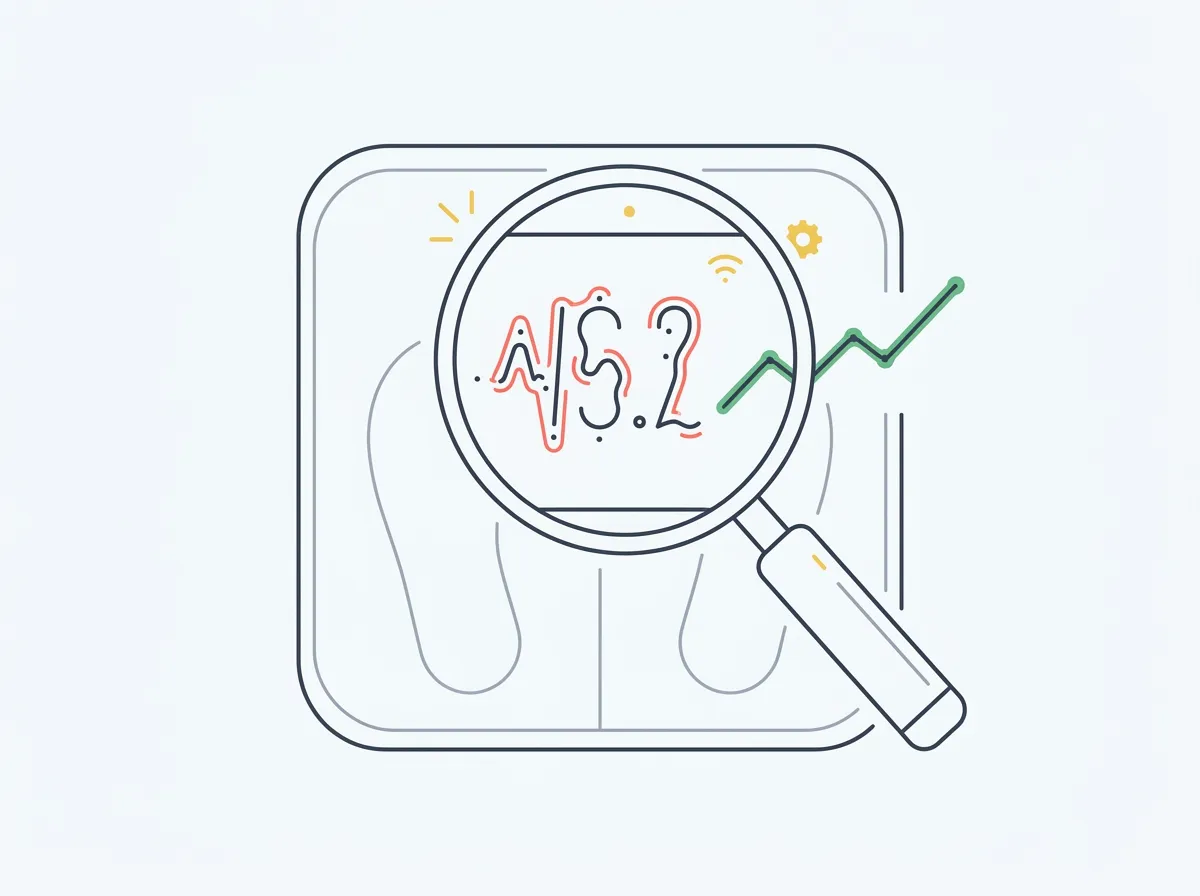
Quick answer: Smart scales are very accurate for weight, load cells are mature technology. The body fat number is a BIA estimate with commonly cited error ranges of several percentage points, and it swings with hydration. Trust the weight, treat composition numbers as a trend, and read weekly averages instead of single days.
A $30 smart scale hands you eight numbers every morning: weight, BMI, body fat, muscle mass, body water, bone mass, visceral fat, metabolic age. The marketing presents them as one product. They aren't. One of those numbers comes from a precision instrument, most come from a statistical model fed by a small electrical current, and one is basically a horoscope with units.
"Are smart scales accurate?" has no single answer because it's several questions wearing one trench coat. Split it by number and the answers get clear, and the scale gets genuinely useful.
Is the weight number on a smart scale accurate?
Yes, and it's worth saying plainly, because the skepticism aimed at smart scales shouldn't touch this number. Weight is measured by load cells, the same mature strain-gauge technology in shipping and lab scales, and consumer models commonly resolve changes of about 0.1 kg / 0.2 lb reliably. Put the scale on a hard, level floor (carpet genuinely degrades readings) and weigh at a consistent time, and the weight trend it produces is trustworthy data.
Everything else on the screen is a different technology answering a much harder question.
Is the body fat number on a smart scale accurate?
This is where the honest answer is: it's an estimate, and you should treat it like one. Smart scales use bioelectrical impedance analysis (BIA), a small current runs up one leg and down the other, the scale measures resistance, and a model converts that resistance into a full body composition report using your age, sex, and height.
Two problems follow from that design. First, validation studies commonly report individual errors of several percentage points against DEXA, a scale reading 22% can be measuring a body that's 17% or 27%. Second, the reading is hydration-sensitive: because the current mostly travels through body water, a salty meal, a hard workout, or alcohol commonly moves the estimate 2-4 points overnight while your actual composition sits still. We walk through the physics in our Renpho alternatives guide, the swings frustrate people enough to shop for replacements.
Neither problem makes the number useless. Both make it a trend signal, and only under consistent conditions.
Do hand electrodes make smart scales more accurate?
They improve the inputs, and it's the one hardware upgrade that addresses the actual weakness. Foot-only scales never measure your upper body, the current takes the leg-to-leg shortcut, and everything above your hips is modeled from assumptions. Devices with hand electrodes, like the Hume Body Pod (~$229) and the Withings Body Scan (~$400-500), route current through arms and torso too, which feeds the model better data and enables segmental readouts.
Better inputs, same method: these are still BIA devices, still hydration-sensitive, still estimates. The upgrade buys a tighter estimate, and the same weigh-in discipline applies.
What moves your smart scale reading day to day?
The practical list, since every item on it has convinced someone their cut stalled overnight:
- Water balance, the big one. Dehydration commonly reads as higher body fat; a rehydrated morning reads leaner.
- A salty or carb-heavy dinner, sodium and glycogen both hold water, shifting the current's path.
- Alcohol, dehydrating, commonly good for a next-morning body fat spike that isn't real.
- A hard workout, fluid shifts into muscle; readings taken right after training are commonly the least reliable of the day.
- Time of day, morning vs evening readings can differ by points; pick one and stay there.
- Foot placement and dry skin, the electrodes need consistent contact; calloused or very dry feet degrade the signal.
Your actual body fat changes by tenths of a percent per week. Anything the screen does faster than that is one of the items above.
How do you use a smart scale well despite the error?
The error is systematic, which means routine beats it:
- Same conditions, every time. Morning, after the bathroom, before food or water, dry feet, same floor spot. This turns hydration from random noise into a roughly constant offset.
- Read weekly averages, never single days. Seven readings averaged smooth most of the noise; a single Tuesday reading is a coin flip.
- Track direction, ignore the absolute. A scale that consistently reads 3 points high still shows a real downward trend correctly. The trend is the product.
- Never compare across devices or people. Different models produce different estimates from identical bodies; your number only means anything against your own history.
Do this and a cheap BIA scale becomes a genuinely useful trend instrument, which is the most any consumer composition tool can honestly claim to be.
When is a smart scale the wrong tool entirely?
Recomposition. If you're lifting and eating around maintenance, you can gain muscle and lose fat with the scale's headline number barely moving, and the BIA estimate is too noisy to resolve a shift that gradual. People in this exact situation write us convinced nothing is happening while their waist shrinks and their weight holds. The scale isn't lying about weight; it's answering a question you stopped asking.
Whether the scale is worth owning at all is a slightly different question from whether it is accurate, and we answer it separately in are smart scales worth it, which weighs the real pros and cons for lifters.
What are the alternatives when the scale isn't enough?
A spectrum, cheapest first, and note that each one measures a different signal, which is why they combine so well with a scale instead of replacing it:
- A tape measure (~$5). Waist and other circumferences track fat directly, immune to hydration. Our tape vs smart scale comparison breaks down when each wins.
- Progress photos + AI analysis. Your visible shape is the signal BIA can't see. GainFrame reads a weekly progress photo and returns an estimated body fat %, FFMI, a physique score, and 12 muscle-group ratings, no hydration noise, nothing to buy. Honest limits: it's iOS only, the numbers are estimates from photos rather than clinical measurements, and the free tier covers 25 photos.
- A periodic DEXA scan (~$100-200). The clinical anchor. Two to four scans a year pin down your absolute numbers; the daily tools track the trend between them. Full options in our DEXA alternatives guide.
If you'd rather replace the scale outright, our body scan app roundup ranks six options across 3D scanning, AI photo analysis, and manual measurement tracking.
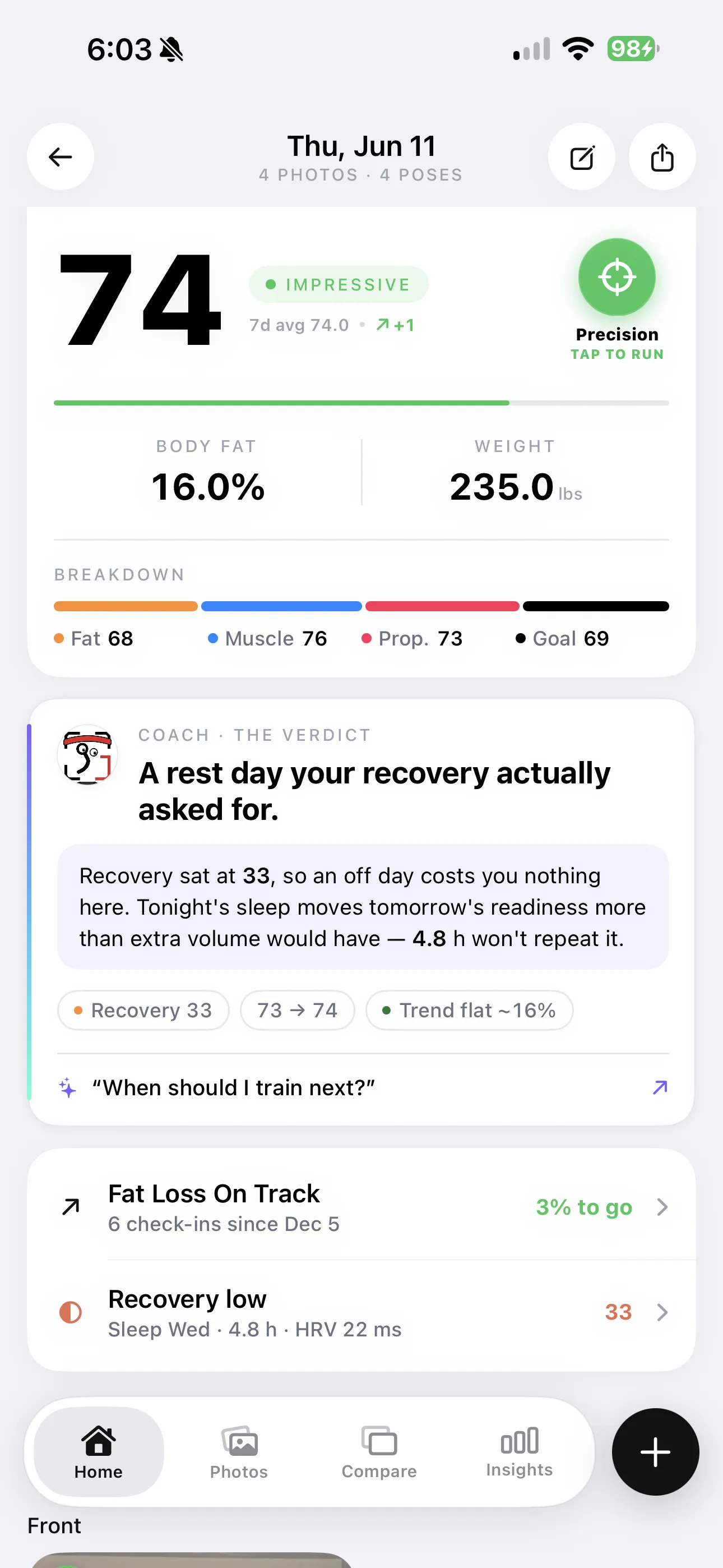
The photo-based route: composition estimated from what you look like, which last night's dinner can't move.
Which numbers on a smart scale can you trust?
The verdict, number by number:
| Number on screen | Trust level | How to use it |
|---|---|---|
| Weight | High | Trust it; weekly average smooths water swings |
| BMI | High (it's arithmetic) | Accurate math with BMI's usual blind spots, see our BMI vs body fat breakdown |
| Body fat % | Low absolute, fair trend | Same conditions, weekly averages, direction only |
| Muscle / lean mass | Low | Month-scale direction at best; verify with strength logs |
| Body water % | Very low | Mostly displays the same noise that corrupts the other estimates |
| Visceral fat rating | Rough flag | A persistent high rating is worth a real conversation; the digit itself isn't precise |
| Bone mass | Very low | Ignore for any decision; DEXA is the actual tool for bone |
| Metabolic age | Novelty | Marketing repackaging of the other estimates, entertainment only |
Frequently asked questions
Are smart scales accurate for weight?
Yes. The load cells that measure weight are mature, well-understood technology, and consumer scales commonly resolve changes of about 0.1 kg reliably. Weigh at the same time of day on a hard, level floor and the weight number is trustworthy. The accuracy questions around smart scales are almost entirely about the body composition estimates, which come from a different technology.
How accurate are body fat scales?
Body fat scales estimate composition with bioelectrical impedance (BIA), and validation studies commonly report errors of several percentage points against DEXA for individuals, with day-to-day readings swinging 2-4 points on hydration alone. The number is a model's estimate, useful for long-term trends under consistent conditions, unreliable as an absolute figure or for comparing against anyone else's reading.
Why does my smart scale body fat change overnight?
Because BIA reads electrical resistance, which mostly tracks body water. A salty dinner, alcohol, a hard workout, or a different weigh-in time shifts your water balance enough to move the estimate a couple of points while your body stays the same. Actual body fat changes by tenths of a percent per week, anything faster on the screen is measurement noise.
Are expensive smart scales more accurate?
Somewhat, for a specific reason: premium models like the Hume Body Pod and Withings Body Scan add hand electrodes, so the measuring current samples your whole body instead of just leg to leg. That improves the model's inputs and enables segmental estimates. They remain BIA devices, so hydration sensitivity persists, you're buying a better estimate, and consistent weigh-in conditions still matter.
Should I trust the muscle mass number on my smart scale?
Treat it as the least reliable number on the screen. Muscle mass is modeled from the same impedance reading as body fat, with extra assumptions layered on top, and month-scale direction is about all it can support. If muscle change is the thing you care about, a recomp, a lean bulk, strength logs, tape measurements, and progress photos are more direct signals.
Track the signal your scale can't see
GainFrame reads your weekly progress photo, estimated body fat, FFMI, physique score, and 12 muscle ratings, with no hydration noise and no hardware. Free to start on iOS.
Download GainFrame Free