
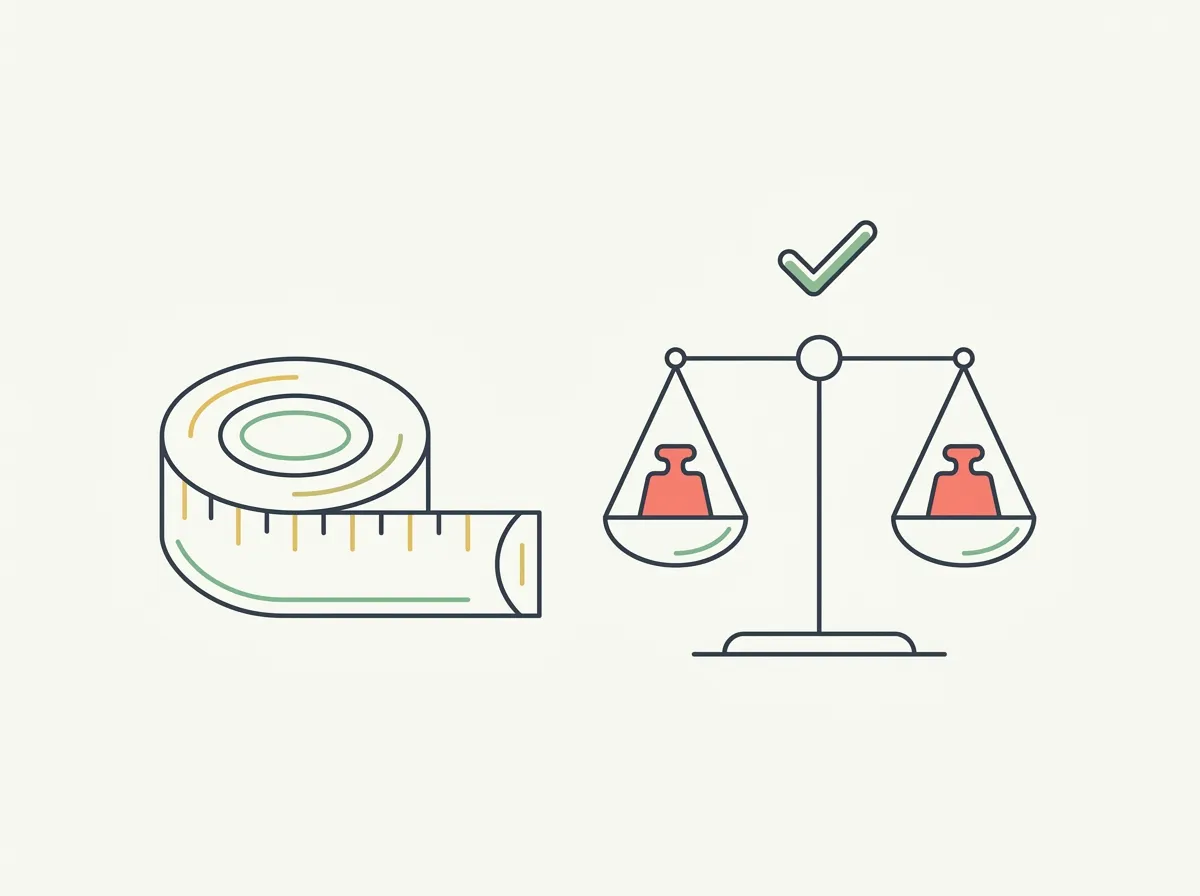
Quick answer: If your waist is shrinking while the scale holds still, the most common explanation for lifters is body recomposition: losing fat while gaining muscle. Muscle is denser than fat — roughly 15–20% by commonly cited figures — so trading one for the other makes you smaller at the same weight. Confirm it with waist trend, photos, and strength.
Your belt is on a new notch. The jeans that wouldn't button in March slide on. And the scale has read 176, give or take a pound, for ten straight weeks — so you're standing on it wondering why nothing is working.
Something is working. A smaller waist at a flat scale weight is the classic signature of body recomposition, and the scale is structurally incapable of showing it to you. This is the happy mirror image of two frustrations we've covered before: the waist that won't shrink and the scale that jumps when you start lifting. Same instrument, same blind spot, and this time the news is good.
Why are you losing inches but not weight?
Start with the density math. Commonly cited figures put fat tissue around 0.9 g/mL and muscle tissue around 1.06 g/mL — muscle is roughly 15–20% denser. A pound of muscle occupies noticeably less space than a pound of fat, and our 10 pounds of fat vs muscle breakdown shows just how dramatic that volume gap looks side by side.
Now run the trade. Suppose over three months you lose 6 pounds of fat and gain 6 pounds of muscle. Scale change: zero. Volume change: real and visible, because the 6 pounds that left took up more room than the 6 pounds that arrived — and fat tends to leave places like the waist while muscle arrives at the shoulders, back, and legs. You get smaller where you wanted to shrink and fuller where you wanted to grow, at the exact same body weight.
There's a name for this trade: body recomposition. A shrinking waist at stable weight is close to the textbook definition of a recomp succeeding — the before-and-after timelines show what this looks like at 3, 6, and 12 months, and the through-line is that the scale barely moves while the photos transform.
Why is the scale the worst instrument for this exact phase?
The scale reports one number: total mass. It has no opinion on what the mass is made of or where it sits. In a pure weight-loss phase that's a tolerable simplification, because total mass is actually falling. In a recomp, total mass holding still is the expected outcome — so the signal you're looking for is, by definition, absent from the instrument.
It gets worse. Day-to-day scale readings commonly swing 2–4 pounds on water, glycogen, sodium, and gut contents alone. During a recomp, the underlying trend is approximately flat, which means close to 100% of what your scale shows week to week is noise. You're reading static and calling it feedback.
The tape and the camera have no such blind spot. Circumference and silhouette respond directly to the volume trade the scale can't see — which is why they get promoted to primary instruments for this phase, and the scale gets demoted to a supporting role.
Could water be masking actual fat loss?
One honest wrinkle: sometimes the story is plain fat loss temporarily hidden under water, with less simultaneous muscle gain than you'd hope. A few common maskers, all hedged because individual responses vary widely:
- A new or harder training program. Muscle repair commonly brings temporary fluid retention — the same effect behind the beginner scale bump. It can sit on top of real fat loss for weeks.
- Sodium and carb swings. A salty restaurant week or a refeed commonly adds visible water weight that has nothing to do with fat.
- Creatine. Starting it commonly adds a couple of pounds of intramuscular water.
- Menstrual cycle. Cyclical water retention commonly moves the scale several pounds within a month, which is one reason week-over-week comparisons mislead — compare the same phase across months instead.
- Stress and poor sleep. Both are commonly associated with retention.
If water is the masker, the scale often catches up abruptly — people commonly describe a "whoosh" where several weeks of hidden loss shows up in a few days. Either way, the practical response is identical: stop reading the daily scale as a verdict and check the signals that can't be fooled by a glass of water.
How do you confirm it's real recomp?
Three signals, checked together. Any two agreeing beats the scale's opinion.
- Waist tape trending down. Measure weekly at the navel, same time of day, same conditions. A 4+ week downtrend is fat leaving — water noise doesn't sustain a month-long direction.
- Photos changing. Monthly progress photos, same pose, lighting, and distance. Recomp shows up as a tighter waist and rounder shoulders before the mirror admits anything — the early signs of muscle growth are easier to spot in a side-by-side than in daily reflection.
- Strength holding or climbing. Fat loss with muscle loss usually drags your lifts down. Flat weight, shrinking waist, and stable-or-rising strength together point squarely at fat out, muscle in.
The photo comparison is where this gets satisfying, because it's the one place the change is undeniable. GainFrame runs the check automatically: it estimates body fat percentage from progress photos and its Deep Dive Compare puts two dates side by side with the estimated change quantified. Estimates from photos rather than a lab measurement — but taken under consistent conditions, the trend is exactly the evidence the scale can't give you.
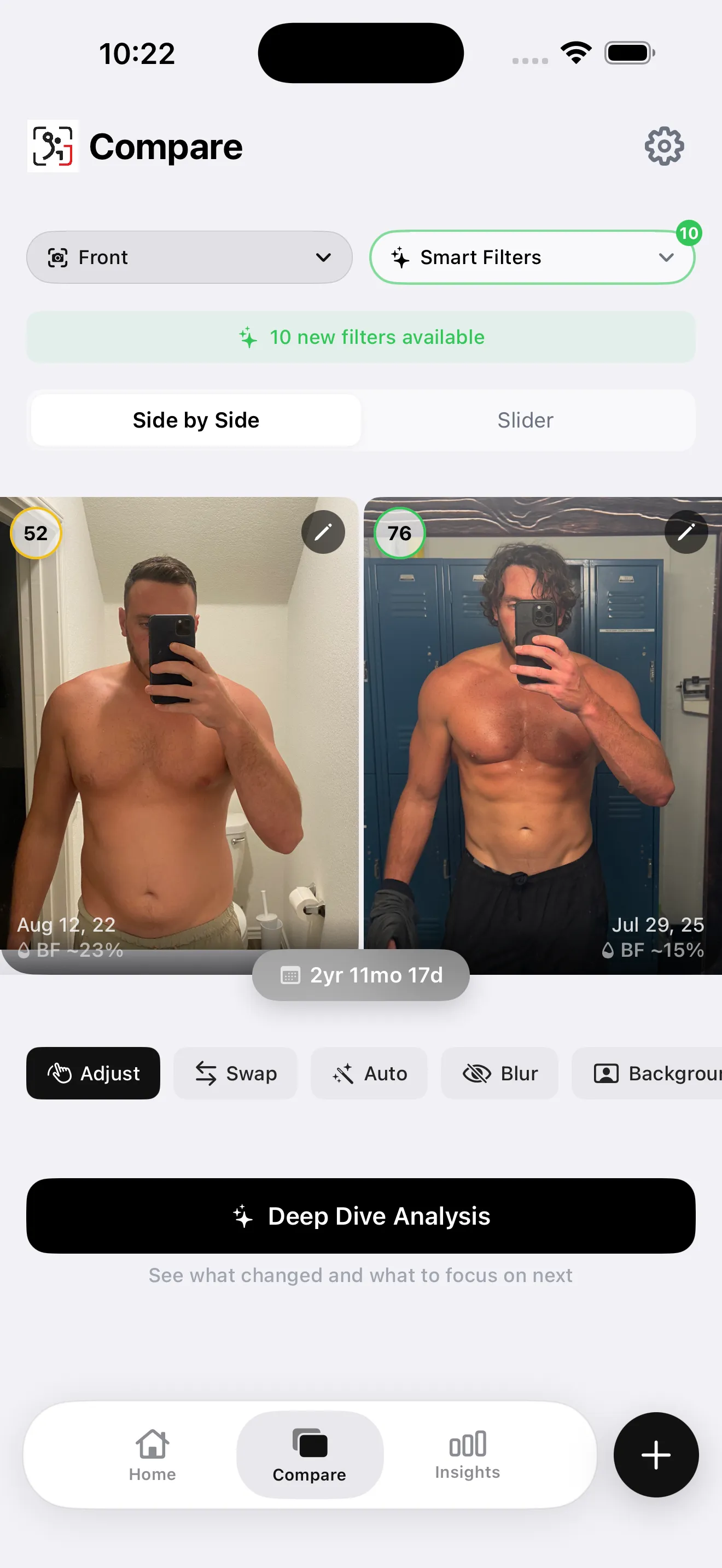
Deep Dive Compare: the same scale weight can hide a visible composition change — the photos and the estimated body fat delta surface it.
When is it NOT recomp?
A brief honesty check, because certainty needs to be earned:
Measurement error. A tape angled differently, pulled tighter, or placed an inch lower can manufacture a phantom inch. Measure at the navel, parallel to the floor, snug without denting skin, morning before food — the same protocol every time.
Clothes stretching. Denim relaxes half a size with wear; waistbands with elastane give even more. "My jeans fit better" is a lead worth investigating, and the tape is the follow-up that settles it.
Wishful reading. If the tape is genuinely flat over four weeks, the photos look identical, and strength hasn't moved, then the honest verdict is that composition is holding steady rather than recomping — which usually means calories or training need an adjustment, and our bulk, cut, or recomp guide covers which lever to pull.
Run the three-signal check for four weeks and you'll know which case you're in. Most people asking this question, though, land in the good one.
And if that's you — take the win properly. Losing inches at a flat weight means you spent weeks doing the two hardest things in fitness simultaneously, and your only instrument told you nothing was happening. You kept going anyway. The scale answers one narrow question — total mass — and that stopped being the interesting question weeks ago. Keep the program, keep the protein, and let the tape and photos keep score from here.
Frequently asked questions
Why am I losing inches but not losing weight?
The most common reason for people who lift: you're losing fat and gaining muscle at roughly the same rate. Muscle is denser than fat by commonly cited figures of around 15–20%, so a pound of it takes up less room. Your volume shrinks, your mass holds, and the tape catches what the scale physically cannot.
Is losing inches better than losing pounds?
For body composition, generally yes. Inches off the waist track fat loss specifically, while pounds off the scale can be fat, muscle, water, or glycogen in any mix. Someone who drops two waist inches at constant weight has almost certainly improved their composition; someone who drops ten pounds may have lost meaningful muscle along the way.
How long can body recomposition last?
Longest for beginners, returners after a layoff, and people with higher starting body fat — commonly discussed as months to a year or more of simultaneous progress. Advanced lean lifters see it slow to a crawl. If your waist has trended down for 8–12 weeks at stable weight, recomposition is working and there's no reason to interrupt it.
Why do my clothes fit better but the scale hasn't moved?
Clothes are a crude tape measure wrapped around your waist, hips, and thighs — the places fat commonly leaves first when training is working. If jeans button easier at the same scale weight, your circumference shrank, which points to fat down and muscle up. Verify with an actual tape and monthly photos before crediting the jeans alone, since denim stretches with wear.
Should I keep doing what I'm doing if I'm losing inches but not weight?
Yes. A shrinking waist with stable weight and holding strength is close to the ideal outcome for anyone lifting while eating near maintenance. Changing the plan because the scale is flat is how people abandon recomps that were working. Keep the program, keep protein high, and judge progress by the tape, photos, and your lifts for the next 8 weeks.
See the change the scale can't show
GainFrame estimates body fat percentage from your progress photos and compares any two dates side by side — so a recomp shows up as measured, visible progress instead of a flat number. Free to start on iOS.
Download GainFrame Free