
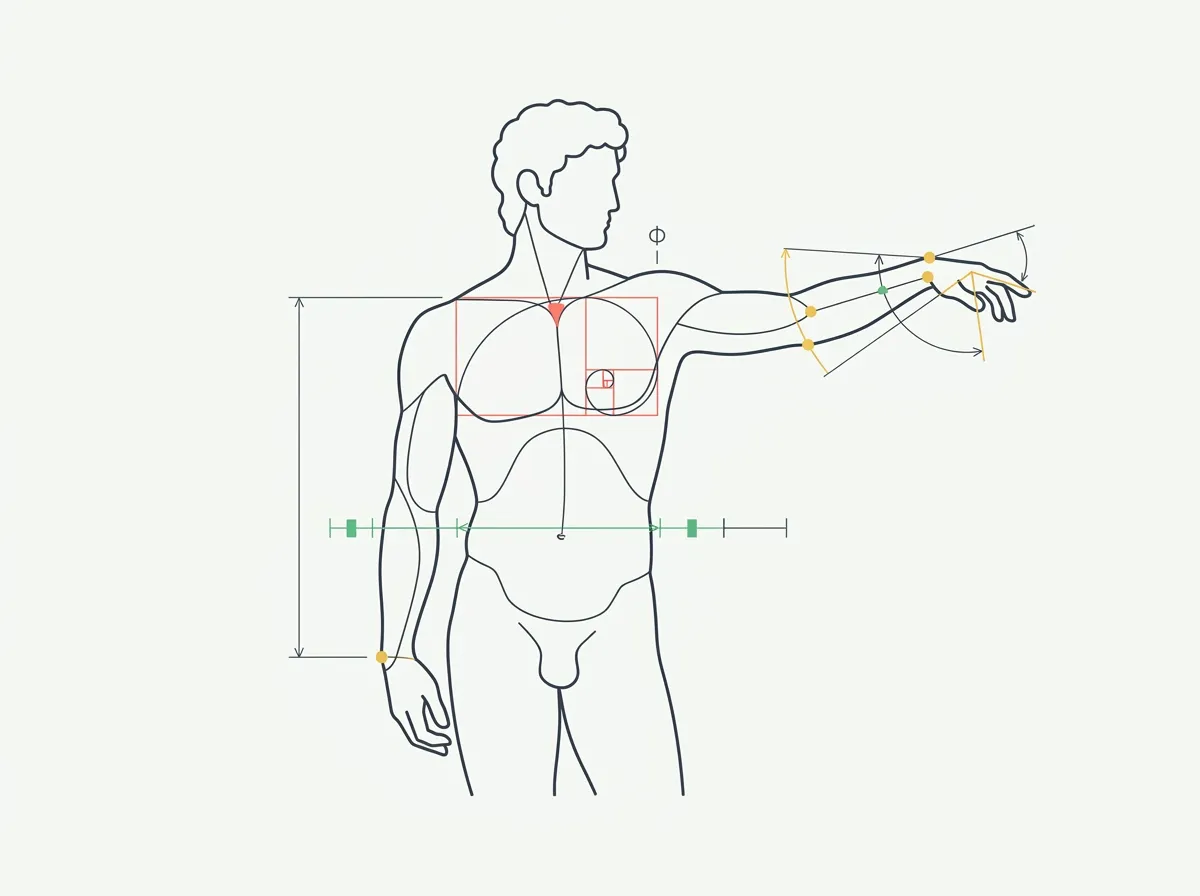
Quick answer: The classic "Grecian ideal" formulas, commonly cited from old-school bodybuilding, scale everything off your wrist: chest around 6.5 times wrist circumference, waist around 70 to 75 percent of chest, arms and neck each around 2.5 times wrist, and calves matching arms. For a 7-inch wrist that means roughly a 45.5-inch chest, a 32 to 34-inch waist, and 17.5-inch arms.
Your arms taped 16 inches this morning, and in a T-shirt they still read as ordinary. Meanwhile someone at your gym with visibly smaller arms looks built from across the room. The gap between those two impressions lives in ratios, how each measurement relates to the ones around it, and especially to the waist under all of it.
Old-school bodybuilding formalized those ratios into a set of formulas, commonly called the Grecian ideal, that describe a balanced physique using nothing except a tape measure and your wrist size. This page lays out the classic chart, works the numbers for real wrist sizes, and gives you the honest version of what the formulas can and can't tell you.
What are the ideal body measurements for men?
The classic system, commonly attributed to early and mid-century bodybuilding writing, and echoed by physique coaches ever since, treats your wrist as a proxy for skeleton size, then scales every other measurement from it. Small-boned and large-boned men get different targets from the same formulas, which is the whole appeal.
The commonly cited version of the formulas:
| Measurement | Classic formula |
|---|---|
| Chest | ~6.5 × wrist circumference |
| Waist | ~70-75% of chest |
| Arms (flexed) | ~2.5 × wrist |
| Neck | ≈ arms (~2.5 × wrist) |
| Calves | ≈ arms |
Different sources quote slightly different multipliers, some say 6.3 for chest, some anchor the waist to hips instead, so treat these as the center of a tradition rather than a precise spec. The internal logic is consistent everywhere: a wide chest and shoulder line, a markedly narrower waist, and matching arms, neck, and calves so no single body part dominates.
Notice what the system rewards. Every formula is about balance between parts, and the waist appears as the one measurement you're trying to keep small. That's the opposite of how most lifters chase numbers, and it's the reason physiques built to these ratios look athletic in clothes rather than merely large.
For lower-body context, see the average thigh and calf sizes. Those reference measurements describe observed size ranges, while the formulas above describe aesthetic conventions.
What do the classic numbers look like at your wrist size?
Measure your wrist just below the wrist bone, on the hand side, with the tape snug. Then find your column:
| Measurement | 6.5" wrist | 7" wrist | 7.5" wrist |
|---|---|---|---|
| Chest | ~42 in | ~45.5 in | ~49 in |
| Waist | ~29.5-31.5 in | ~32-34 in | ~34.5-36.5 in |
| Arms (flexed) | ~16.25 in | ~17.5 in | ~18.75 in |
| Neck | ~16.25 in | ~17.5 in | ~18.75 in |
| Calves | ~16.25 in | ~17.5 in | ~18.75 in |
Now put those against reality. Commonly cited survey data puts the average American male waist around 40 inches, every waist target on this chart sits 4 to 10 inches under that. The average untrained bicep tapes around 13 to 14 inches, so the arm targets represent years of training even for a beginner with good genetics. The chest targets are closer to reach on the tape, since the average chest already measures around 40 to 42 inches, but most of an untrained reading is ribcage and body fat rather than pecs.
Read as a package, the chart describes a physique that is simultaneously leaner than average at the waist and considerably more muscular than average everywhere else. That combination is the hard part, and it's why the chart is a multi-year project rather than a bulking season.
How does this compare to a bodybuilding measurement chart?
If you searched for a bodybuilding measurement chart, the tables above are the thing you were looking for under its older name. Nearly every bodybuilding measurements chart circulating online descends from one of two families. The first is the wrist-based system on this page, which scales targets from your frame so that small-boned and large-boned lifters get different numbers. The second scales targets from height instead; it produces similar destinations but ignores frame differences, which is why the wrist version has aged better.
Both families measure the same six or seven sites, and both treat the waist as the number to keep small while everything else grows. Two modern checks make the old charts more useful. The shoulder-to-waist ratio calculator turns the chart's core idea, taper, into a single trackable number. And a photo timeline shows whether chart progress is actually visible, since a tape cannot tell you whether an inch of chest went to pecs or posture.
Are these proportions realistic for a natural lifter?
Mostly yes, on the multi-year timescale, with two honest caveats.
First, these are aesthetic conventions, and health targets are a different list. The formulas come from an era of physique competition and describe what judges and audiences rewarded. Health guidance cares mainly about your waist, where the commonly cited rule is a waist-to-height ratio under 0.5. The classic waist targets happen to clear that rule easily, so chasing the chart won't hurt you, but missing the arm target has zero health meaning.
Second, genetics constrain some ratios harder than others. Clavicle length is fixed as an adult, so how wide your frame can look has a structural ceiling, our average shoulder width guide covers what's changeable there and what's skeleton. Ribcage circumference, hip width, and muscle insertion points are similarly dealt at birth. Two lifters can train identically for five years and land at the same wrist-multiple chest, and one will still show a sharper taper because his hips are narrower.
The useful mindset: the formulas describe a direction, and your skeleton decides exactly where the road ends. Almost every natural lifter can get dramatically closer to these ratios than they are today. Very few will hit all five on the nose, and the ones who do usually had the bone structure for it.
Why do proportions read clearest when you're lean?
The chart is circumference math, and a tape measure can't tell muscle from fat. A 45-inch chest at 30% body fat and a 45-inch chest at 13% are the same number and completely different physiques, fat adds inches at the waist faster than anywhere else, which wrecks the one ratio doing most of the visual work.
Here's what the classic proportions actually look like on a body. This is a standardized, photorealistic AI render from our body fat visualizer, same build, pose, and lighting across the whole render set, so the leanness is the variable on display.
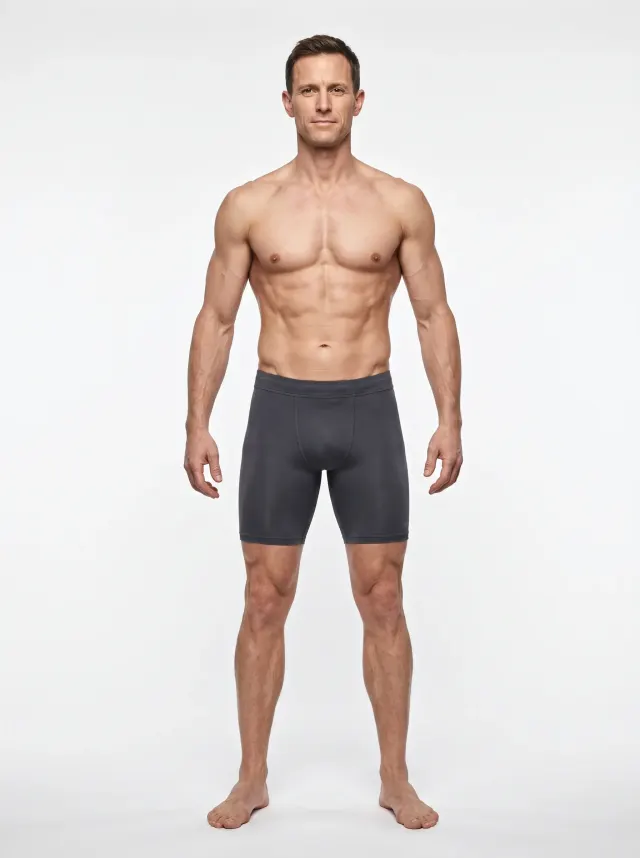
13% body fat on a trained frame. The chest-to-waist gap, shoulder line, and arm-to-torso balance are all legible, the same measurements carrying 10 more points of body fat would read as a bigger guy rather than a built one.
This is why coaches tell lifters chasing proportions to get lean before judging anything. At 13%, your real ratios are visible and you can see which body part actually lags. At 25%, the waist inflates, the shoulder-to-waist contrast flattens, and every ratio on the chart reads worse than your muscle deserves. The shoulder-to-waist ratio guide runs the math on exactly how much each inch of waist costs the taper.
How do you actually use the chart?
Treat it as a diagnostic, and let it pick your next training block. The procedure takes ten minutes:
- Measure everything under matched conditions, morning, cold, relaxed except the flexed arm. Wrist, chest, waist at the navel, neck, flexed upper arm, calf.
- Compute your target column from your wrist, using the table above.
- Express each measurement as a percentage of its target. A 15.5-inch arm against a 17.5-inch target is 89%; a 44-inch chest against 45.5 is 97%.
- The lowest percentage is your lag. That body part gets priority volume for the next few months, while everything else maintains.
- Remeasure every 8-12 weeks, under the same conditions. Monthly is too noisy for circumference changes this slow.
For most men the lag is predictable: the waist percentage is worst (fixed by cutting, and it's the fastest ratio to move), and among muscle groups the calves or the arms trail. Necks largely take care of themselves through heavy pulling and pressing.
The tape finds the lagging circumference, and photos find the lagging muscle inside it, an arm can be all triceps and no biceps at the same 16 inches. GainFrame rates 12 muscle groups individually from a progress photo, alongside body fat percentage and an overall physique score, so the balance the Grecian chart is chasing gets scored per muscle rather than per tape line. These are estimates from photos rather than clinical measurements, and it's iOS only, but the per-muscle read is exactly the level the proportion question lives at.
For tools that log the tape numbers or estimate them from a 3D scan, see the best body scanning and measurement apps. It compares manual trackers, 3D avatars, and photo analysis by the question each method can answer.
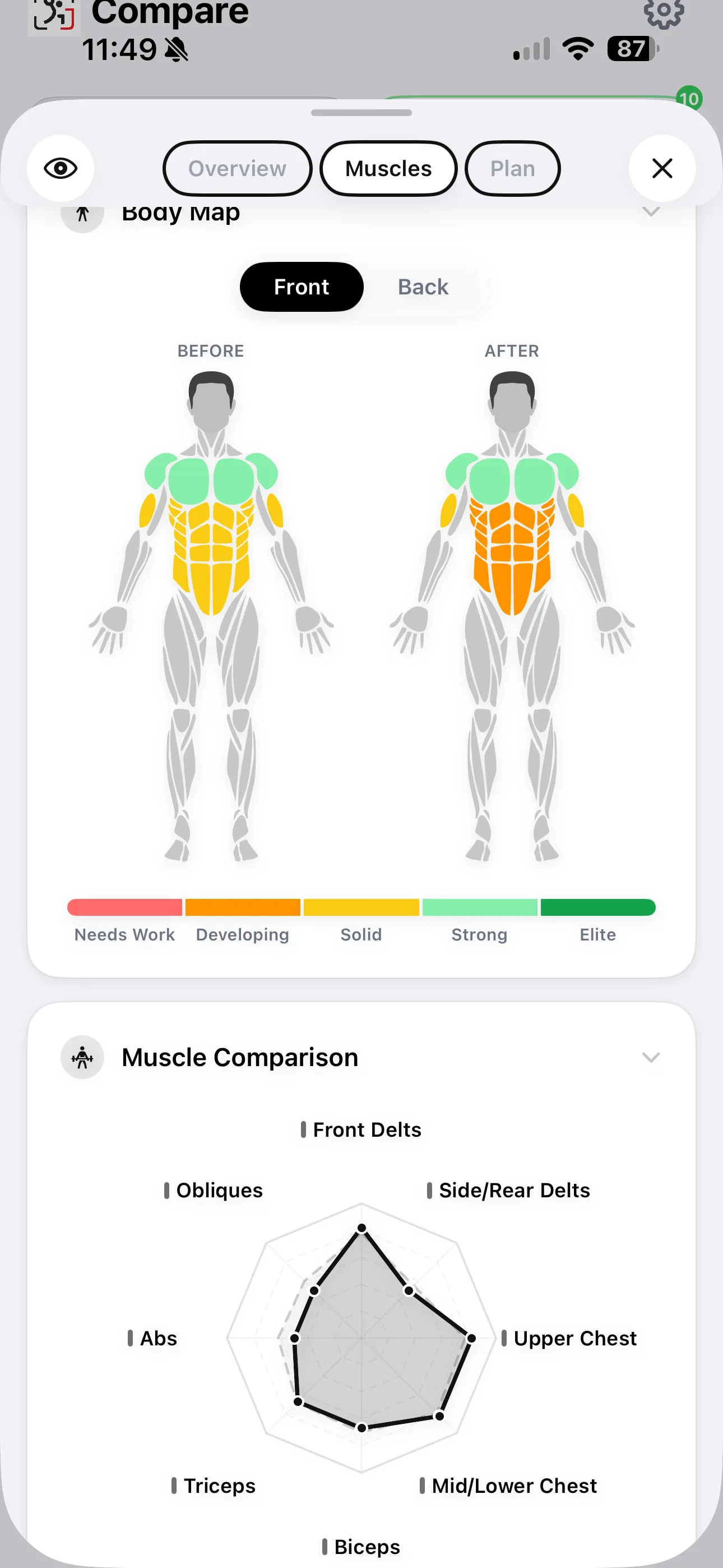
Per-muscle ratings on a body map: the modern version of the proportion audit the old chart does with a tape.
Frequently asked questions
What are the ideal body measurements for a 7-inch wrist?
Using the commonly cited classic formulas: chest around 45.5 inches (6.5 times wrist), waist around 32 to 34 inches (70 to 75 percent of chest), arms, neck, and calves each around 17.5 inches (2.5 times wrist). Treat those as aesthetic reference points from old-school bodybuilding tradition rather than requirements, ribcage size, clavicle width, and fat distribution all shift what your version looks like.
Is the Grecian ideal achievable naturally?
Mostly, with years of training and a lean body fat percentage, the formulas were popularized in eras before modern drug-built physiques and describe proportion rather than extreme mass. The hardest targets vary by individual: lifters with narrow clavicles fight for the shoulder line, and lifters with wide hips fight for the waist ratio. Genetics decide which ratio is your slow one.
What is the ideal chest-to-waist ratio?
The classic convention puts the waist around 70 to 75 percent of chest circumference, a 45-inch chest over a 32-inch waist lands near the middle of that band. Commonly cited aesthetics research points the same direction: a visibly narrower waist under a wider torso reads as fit at almost any size. Waist reduction usually moves this ratio faster than chest growth does.
Should my arms and neck really be the same size?
That's the classic convention, flexed upper arm, neck, and calves all matching, each around 2.5 times wrist circumference. It survives because it reads as balance: a thick neck with small arms looks blocky, and big arms over thin calves look top-heavy. Necks respond to heavy compound lifting with little direct work, so for most lifters the arms and calves lag behind.
What is a good bodybuilding measurement chart?
The most durable bodybuilding measurement chart is the wrist-based classic system: chest around 6.5 times wrist circumference, waist around 70 to 75 percent of chest, and arms, neck, and calves each around 2.5 times wrist. It scales with your frame, which height-based charts ignore, and it encodes the balance-first logic that makes a physique read athletic rather than merely big.
Are ideal body measurements the same as healthy measurements?
No. The Grecian formulas are aesthetic conventions from bodybuilding tradition, and health guidance cares about a much shorter list, mainly waist. A waist under half your height is the commonly cited health target, and the classic waist numbers happen to sit comfortably under it. You can be perfectly healthy while missing every other ratio on the chart.
Find your lagging ratio from a photo
GainFrame rates 12 muscle groups, estimates body fat percentage, and scores your physique from progress photos, so the balance the classic chart measures with a tape shows up per muscle. Free to start on iOS.
Download GainFrame Free