
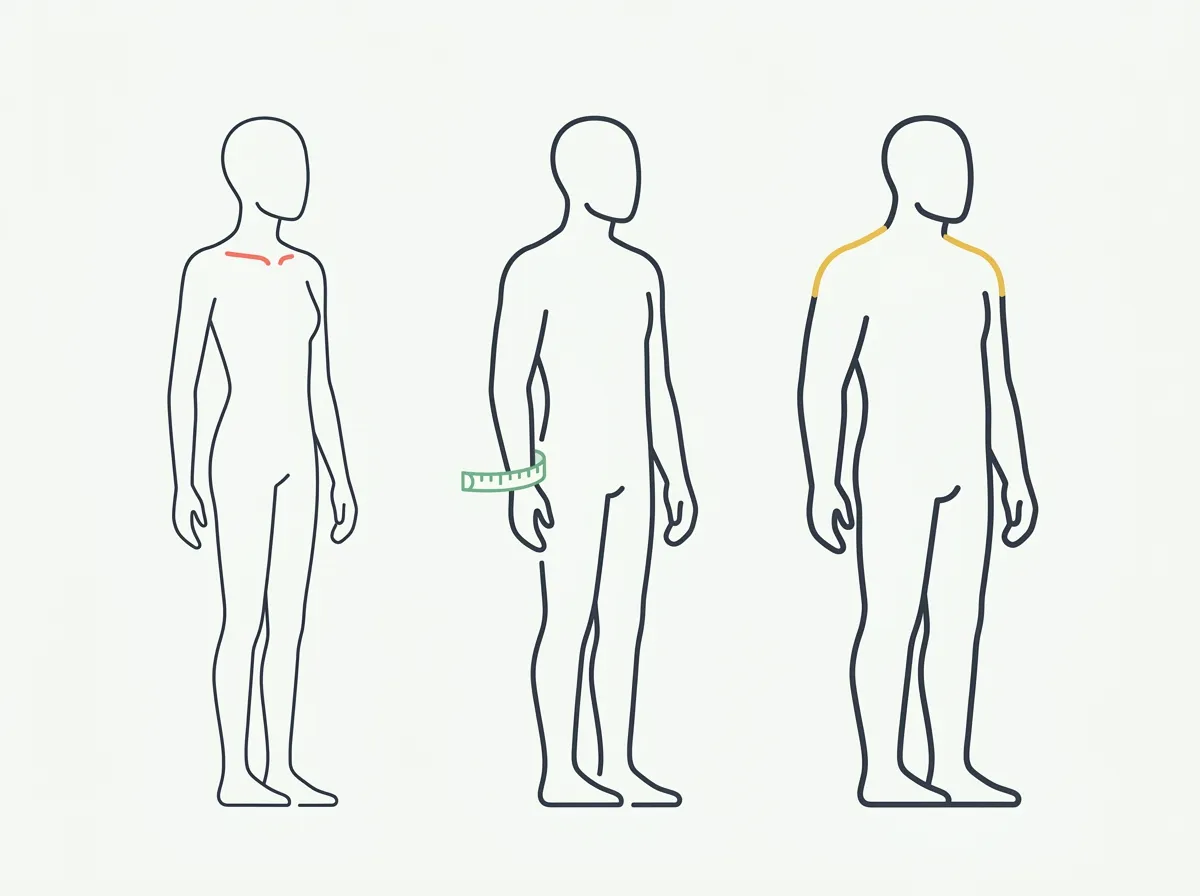
Quick answer: Frame size is your skeleton's build class, small, medium, or large. The classic check: wrist circumference relative to height. Men over 5'5" commonly class as small under 6.5 inches, medium from 6.5 to 7.5, and large above 7.5. Frame shifts measurement baselines a few percent; it doesn't explain body fat.
Two men, both 5'10", both 175 pounds. One looks lean and fills out a medium shirt; the other looks slight and swims in it. Same height, same scale weight, and the difference between them was set in their bones years before either touched a barbell.
That's frame size, and it's simultaneously one of the most real and most abused concepts in fitness. Real, because skeletons genuinely vary and the variation shifts what every measurement means for you. Abused, because "big boned" has become a fifty-pound excuse for what is commonly a few-percent effect. This page covers the two classic ways to class your frame, the charts, what frame size actually changes, and where the excuse ends.
What is body frame size?
Frame size describes the build of your skeleton, the breadth of your shoulders and hips, the thickness of your joints, the general chassis everything else is bolted to. Convention sorts it into three classes: small, medium, and large. Two people of identical height can sit a full class apart, which is why height alone predicts so little about how a body looks or what it should tape.
You can't measure a skeleton directly with a tape, so the classic methods use proxies, body sites that are nearly all bone and tendon, where fat and muscle barely intrude. The standard one is the wrist. It's mostly bone, it changes very little with training or weight gain, and it correlates reasonably with overall skeletal build. Our average wrist size guide is the deep dive on that measurement, averages, what it says about muscle potential, how to tape it correctly. This page uses the wrist for its classic job: classing your frame.
How do you tell your frame size from your wrist?
Wrap a tape around your wrist just below the wrist bone, on the hand side, snug against the skin. Then read your band off the commonly used charts. For men taller than 5'5":
| Wrist (men over 5'5") | Frame class |
|---|---|
| Under 6.5 in | Small |
| 6.5 to 7.5 in | Medium |
| Over 7.5 in | Large |
For women, the commonly used bands shift with height:
| Height (women) | Small | Medium | Large |
|---|---|---|---|
| Under 5'2" | Under 5.5 in | 5.5 to 5.75 in | Over 5.75 in |
| 5'2" to 5'5" | Under 6 in | 6 to 6.25 in | Over 6.25 in |
| Over 5'5" | Under 6.25 in | 6.25 to 6.5 in | Over 6.5 in |
Treat the boundaries as soft. These charts date back decades, different sources draw the lines slightly differently, and a wrist a tenth of an inch over a boundary means nothing. What the check gives you is a class, and most people land exactly where they'd guess, medium, which is itself useful information: it means the standard charts and averages apply to you roughly as written.
What is the elbow breadth method?
The second classic method skips circumference entirely and measures bone width directly. Raise your arm to shoulder height, bend the elbow to 90 degrees with your palm facing you, and measure the distance between the two bony knobs on either side of the elbow, calipers or a careful ruler work. Compare against tables banded by height and sex; for a man around 5'10", roughly 2.75 to 3.25 inches commonly reads as a medium frame, with small and large falling either side.
Elbow breadth is commonly considered the slightly more rigorous proxy because almost no fat accumulates over those bony points, so the reading stays honest at any body weight, a heavier person's wrist can tape marginally up, but their elbow bones don't widen. In practice the two methods agree for most people, and the wrist check wins on convenience. Use elbow breadth as the tiebreaker if your wrist lands on a boundary.
Is "big boned" real?
Yes, and it's doing far less work than it gets credit for. Both things deserve saying plainly.
The real part: skeletons vary, and if the charts above put you in the large class, the variation is measurably yours. A large frame means broader joints, a naturally bigger ribcage, wider hips, and baseline measurements that run higher than a small-framed person's at the same leanness. Your shirt size, your watch strap, the way medium jackets pinch your shoulders: genuinely skeletal.
The honest part: the size of the effect is small. Commonly cited framings put the frame's contribution to body measurements and healthy-weight ranges at a few percent, roughly the 10 percent adjustment classic ideal-weight tables apply. A large frame might explain 10 or 15 pounds relative to the medium chart. It cannot explain 50. Bone is dense, thin stuff; the difference between a large and small skeleton is a handful of pounds of it, and a waistline that keeps growing is soft tissue, every inch of it. If you've been carrying "big boned" as the explanation, the kind move, and this page is trying to be kind, is to take the 10 percent it's genuinely owed and stop paying it the rest.
What does frame size actually change?
Three practical things, all worth knowing before you compare yourself to any chart on this site.
Your measurement baselines. Averages for waists, necks, and chests are built on mostly-medium populations. A large-framed man runs naturally above several of those averages at the same body fat; a small-framed man runs below them. Read every average with your class in mind.
Your ideal-weight math. Commonly used ideal-weight formulas adjust roughly 10 percent down for small frames and up for large ones, which is why two equally healthy people at 5'10" can sit 20 pounds apart and both be exactly where they should be.
Your proportion targets. The classic aesthetic formulas are frame-relative by design, old-school proportion math builds the whole physique outward from the wrist, so a small-framed lifter's target arm and chest numbers are genuinely smaller than a large-framed lifter's. Our bodybuilding measurements chart runs those numbers, and frame size similarly nudges muscle-mass ceilings like FFMI up or down a point or so.
This is also why raw numbers benefit from a frame-aware second opinion. GainFrame sidesteps the chart problem by scoring the physique it actually sees: its AI reads a progress photo and returns an estimated body fat percentage, FFMI, and a 1 to 100 physique score based on your build as it stands, proportions included, no assumption that you're chart-medium. Estimates from photos rather than clinical measurement, but the score tracks your frame's trend rather than a population average.
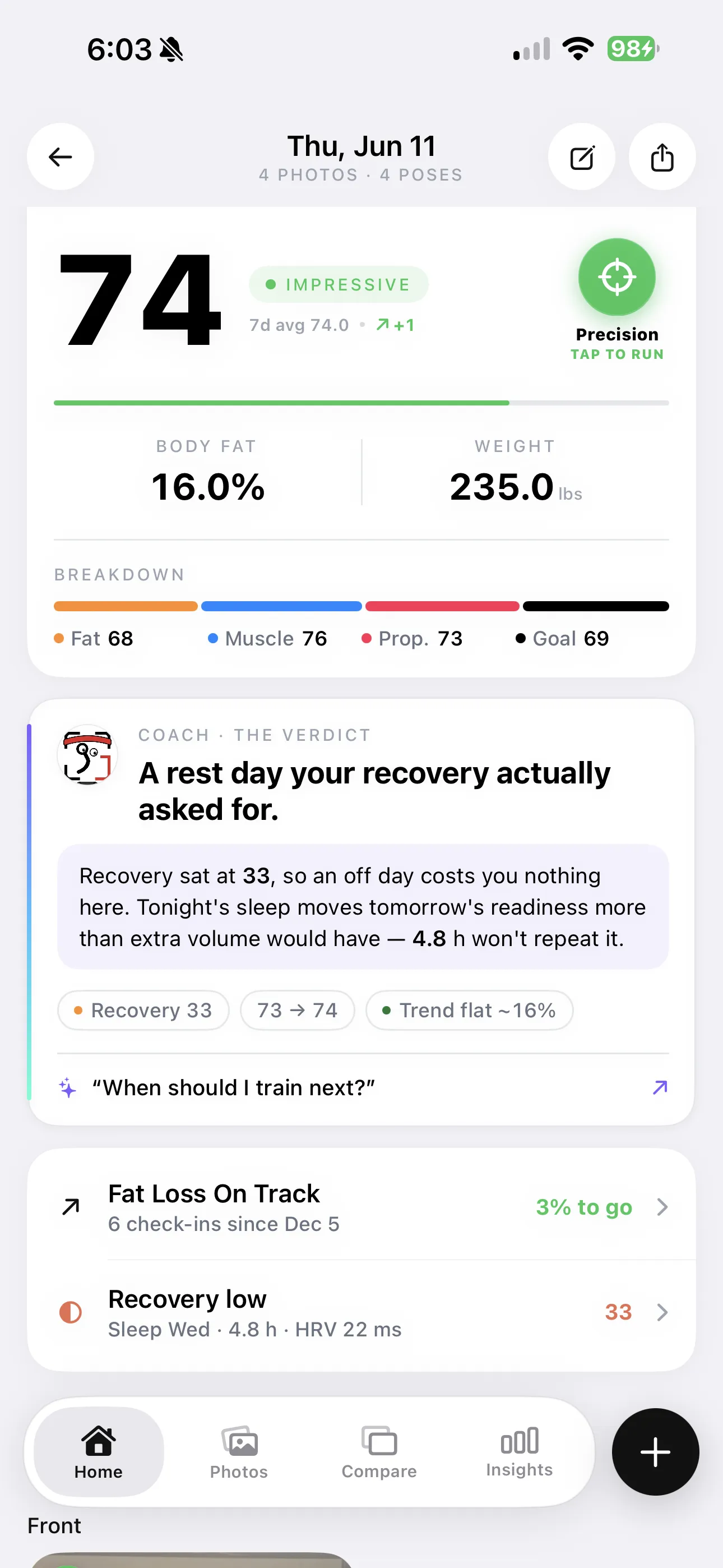
A physique score built from your photo scores the body you have, frame and all, instead of grading you against a medium-frame chart.
What does frame size not change?
Everything that actually builds a body. This is the part the excuse-hunters and the doom-scrollers both get wrong, from opposite directions.
Training fundamentals are identical across frames: progressive overload grows muscle on a 6-inch wrist and an 8-inch wrist by exactly the same mechanism. Nutrition math is identical: a calorie deficit strips fat off a large frame precisely as it does off a small one, and protein needs scale with body weight, not wrist bones. Recovery, sleep, consistency, none of it checks your elbow breadth first.
And the outcomes overlap almost completely. A small-framed lifter who trains for three years will out-muscle, out-perform, and typically out-look a large-framed person who doesn't train at all, the classes are maybe 10 percent apart while the trained-versus-untrained gap is enormous. Frame size tells you which chart column to read. What ends up in the column is still entirely yours to build.
Frequently asked questions
How do I know if I have a small, medium, or large frame?
The quickest commonly used check is wrist circumference. For men over 5'5", under 6.5 inches commonly classes as a small frame, 6.5 to 7.5 as medium, and over 7.5 as large. Women's bands shift with height, roughly, under 6 inches reads small and over 6.5 reads large. Elbow breadth is the other classic method.
Is being big boned a real thing?
Frame size is real, skeletons genuinely vary in breadth and joint size. What it can't do is explain much body weight: commonly cited estimates put the frame's effect on measurements and ideal-weight ranges at a few percent, roughly 10 percent on classic tables. Frame explains your shirt fit and watch strap. It doesn't explain body fat.
Does frame size change your ideal weight?
Modestly. Commonly used ideal-weight tables adjust roughly 10 percent down for a small frame and 10 percent up for a large one, which is why two healthy bodies at the same height can sit 20 pounds apart. Frame also shifts measurement baselines, a large-framed man tapes a bigger natural waist, neck, and chest before body fat enters the picture.
Can you change your frame size?
No, once you finish growing, bone structure is essentially fixed. Wrists commonly add only about a quarter inch even after years of heavy lifting, which is exactly why they work as a frame proxy. What training changes is everything attached to the frame: muscle can dramatically reshape how a small or large skeleton looks.
Do large-framed people build more muscle?
Loosely, yes, a broader skeleton generally supports somewhat more muscle mass, and frame size commonly nudges natural ceilings like FFMI up or down. But the correlation leaves enormous room: plenty of impressive natural physiques were built on small frames, and thin joints make the muscle over them look bigger. Frame is context rather than a verdict.
Get scored on the frame you actually have
GainFrame reads a progress photo and returns estimated body fat, FFMI, and a 1 to 100 physique score built on your proportions, no medium-frame chart assumptions. Free to start on iOS.
Download GainFrame Free