
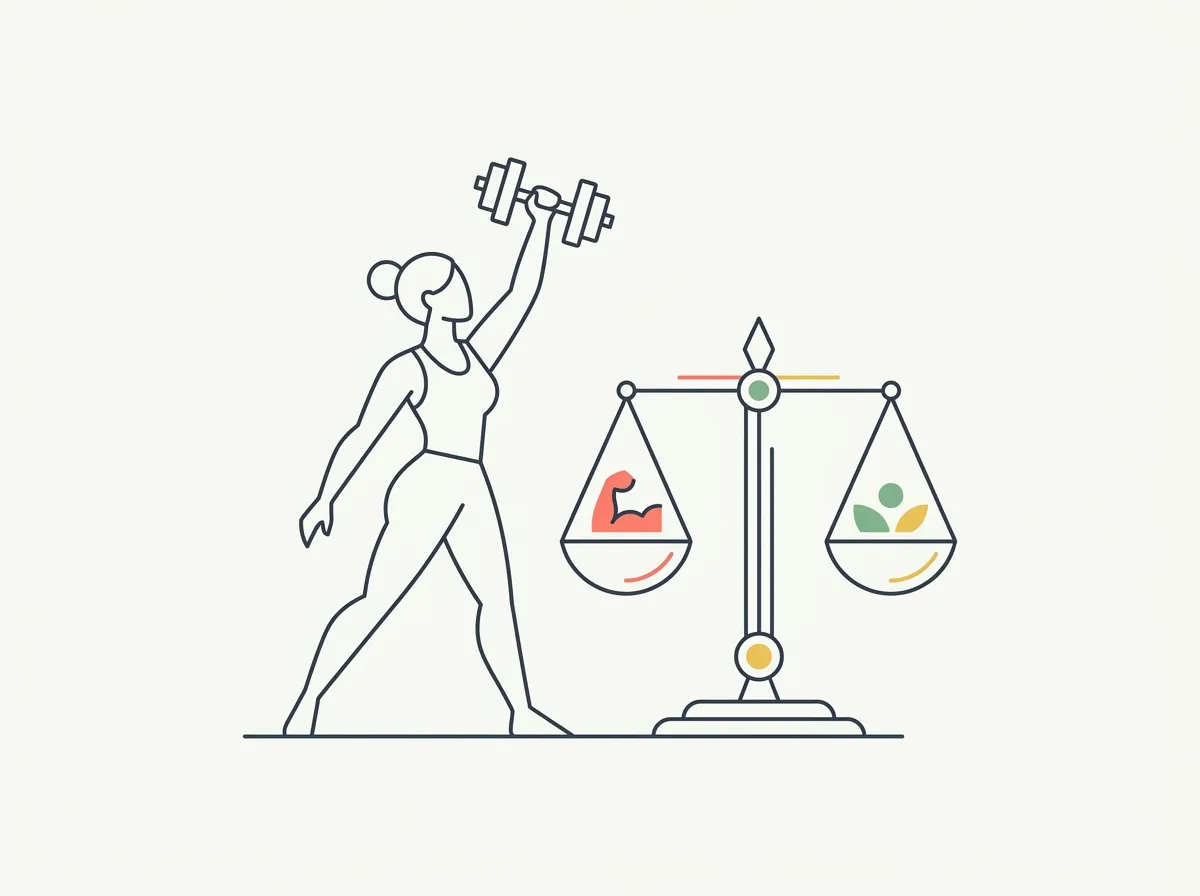
Quick answer: Body recomposition — building muscle while losing fat — is arguably the best default approach for most women. The "toned" look is muscle plus moderate leanness, and women's naturally lower testosterone makes accidental bulk essentially impossible. Eat plenty of protein, lift progressively heavier, and track with photos instead of the scale.
You've done the cardio. You've done the calorie deficits. Maybe you've lost 10 pounds more than once — and each time, the mirror showed a slightly smaller version of the same shape, not the "toned" look you were actually chasing.
That's not a willpower failure. It's a strategy mismatch. The look most women describe as toned is a body composition outcome — some muscle, moderate leanness — and dieting alone can't produce it, because dieting alone doesn't build anything. Body recomposition can. Here's the complete guide.
What is body recomposition and why does it suit women so well?
Body recomposition means losing fat and building muscle during the same period, instead of alternating dedicated bulking and cutting phases. You eat around maintenance calories (or a slight deficit), prioritize protein, and lift with progressive overload. The scale barely moves. The mirror changes anyway.
Recomp suits women especially well for one simple reason: the goal most women actually have is recomp. "Toned arms," "a flat, athletic stomach," "shape without bulk" — every one of those describes muscle showing through a moderate layer of body fat. Not less body. Different body.
There's a practical advantage too. Most women have never trained seriously for muscle, and untrained or lightly-trained lifters get the strongest recomp response — the window where building muscle in a calorie deficit works best. If you've spent years dieting but never progressively lifting, you're positioned for the fastest visible change of your training life. (Not sure recomp is your phase? Our bulk, cut, or recomp guide walks the decision.)
Will lifting weights make you bulky?
This fear has probably cost women more results than any training mistake ever has. So let's deal with it directly.
Women naturally produce a fraction of the testosterone men do — commonly cited figures put it around 10–20 times lower. Testosterone is the primary driver of rapid muscle growth. With naturally lower levels, gaining muscle fast enough to accidentally become bulky is essentially impossible for the overwhelming majority of women. Building even a few visible pounds of muscle typically takes months of deliberate work.
The physiques that read as "bulky" — figure competitors, elite CrossFit athletes — are built on purpose, over years, with training volumes and nutrition precision most people never approach. You cannot stumble into that body by adding three lifting sessions a week. What three sessions a week actually produces is the toned look: shoulders with shape, arms with a visible line, a tighter waist.
The reframe that matters: "toning" and "building muscle" are the same physiological process. There is no separate tone tissue. Light weights don't sculpt and heavy weights don't bulk — both stimulate muscle, and the visible result depends on how much muscle you build and how lean you are. Chasing tone while avoiding muscle is chasing a thing while avoiding the thing.
What body fat percentage should women aim for?
The numbers are different for women than men, and knowing them prevents both undershooting and chasing something unsustainable. Women carry 10–13% essential fat — the minimum needed for hormonal and reproductive health — versus 2–5% for men. Every range shifts up accordingly.
For most women, the fitness range of 21–24% body fat is where the classic toned look lives: flat stomach, visible arm and shoulder definition, curves retained. The athletic range of 14–20% brings sharper definition and visible abs, though many women find the lower end of it hard to sustain without energy and hormonal costs. Our body fat percentage chart shows standardized reference photos at every level if you want to see the ranges rather than read them.
The honest takeaway: a woman at 22% body fat with a year of lifting behind her looks fit — noticeably more so than a woman at the same 22% without the muscle. The percentage is only half the equation. The muscle underneath is the other half.
What does a recomp plan for women actually require?
Two levers move everything. Neither is complicated. Both are non-negotiable.
Protein. Common evidence-based guidance for recomp lands around 0.7–1 gram per pound of body weight daily — roughly 105–150 grams for a 150-pound woman. That's substantially more than most women eat by default, and under-eating protein is the most common reason recomps stall. Spread it across 3–4 meals. You don't need supplements, but a protein shake makes the math easier.
Progressive overload. Lift 2–4 times a week, and make the work gradually harder over time — more weight, more reps, or more sets. This is the signal that tells your body to keep muscle and build more, even in a deficit. The specific program matters far less than the progression. If you're lifting the same dumbbells at the same reps in month four as month one, you're maintaining, not building.
Calories sit at maintenance or a slight deficit — recomp is not a starvation project. Aggressive cutting kills the muscle-building side of the equation, and that side is the one that produces the look you're after.
Why is the scale extra misleading for women?
The scale misleads everyone during recomp — losing 5 pounds of fat while gaining 4 pounds of muscle reads as one pound of "progress" despite being a significant transformation. But for women there's a second layer of noise on top.
Menstrual-cycle water fluctuation of several pounds is normal, commonly peaking in the days before a period. That means a Tuesday weigh-in can sit 3–5 pounds above the previous Tuesday with zero change in fat or muscle. Stack that on recomp's near-flat weight trend and the scale becomes close to useless for judging whether the plan is working — it's mostly measuring hydration and hormones week to week.
If you weigh at all, weigh daily and read only the multi-week trend, comparing the same phase of your cycle to itself. Better: demote the scale to a supporting metric and judge progress visually.
What does female recomp actually look like?
Here's the honest version — the same woman, rendered at 27% and 22% body fat. This is roughly what a well-run recomp produces over 6–12 months, and it's worth staring at because the scale might report almost none of it.
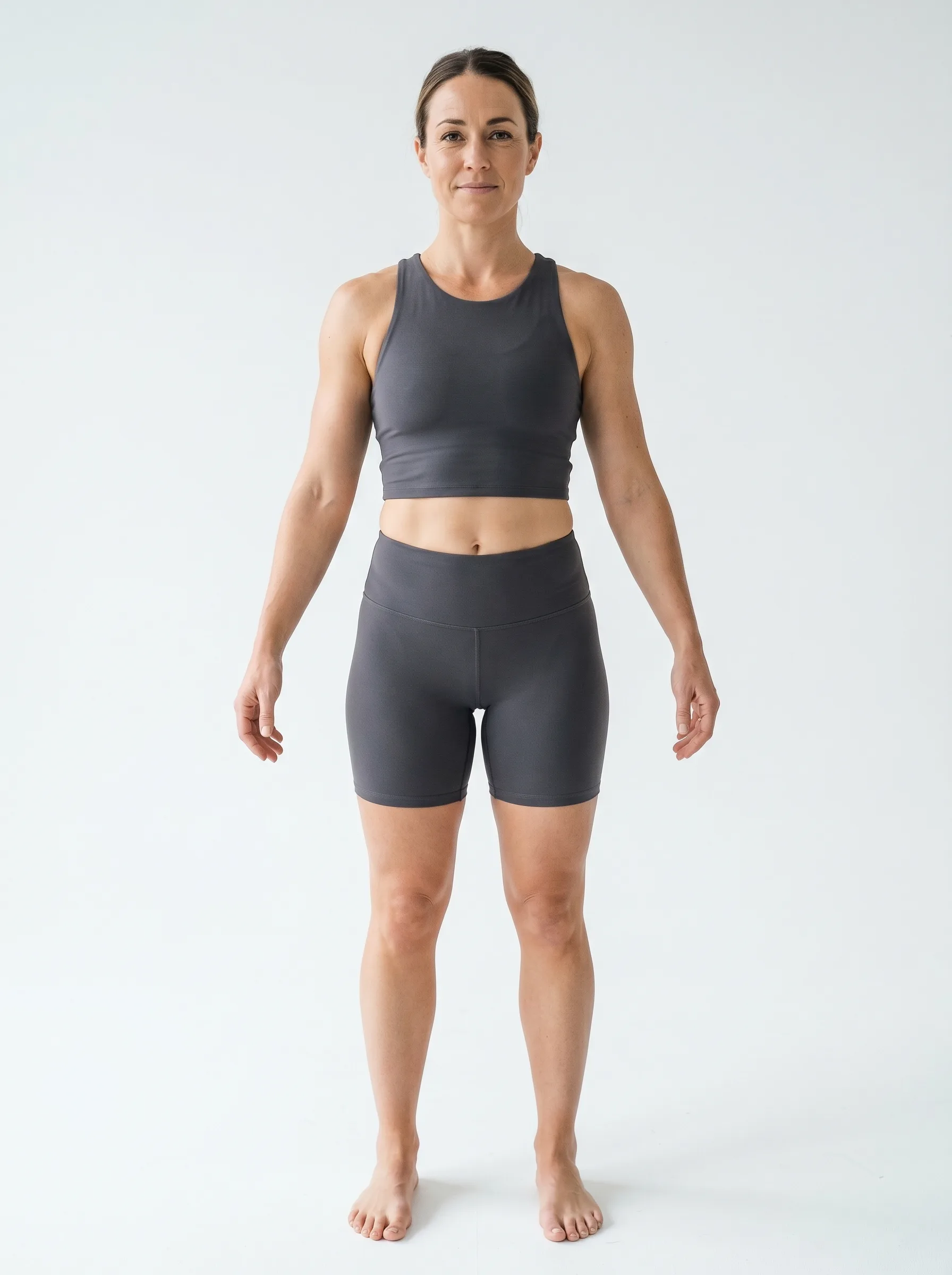
The typical starting point — around 27% body fat, squarely in the healthy average range. Muscle exists here; it just isn't visible yet.
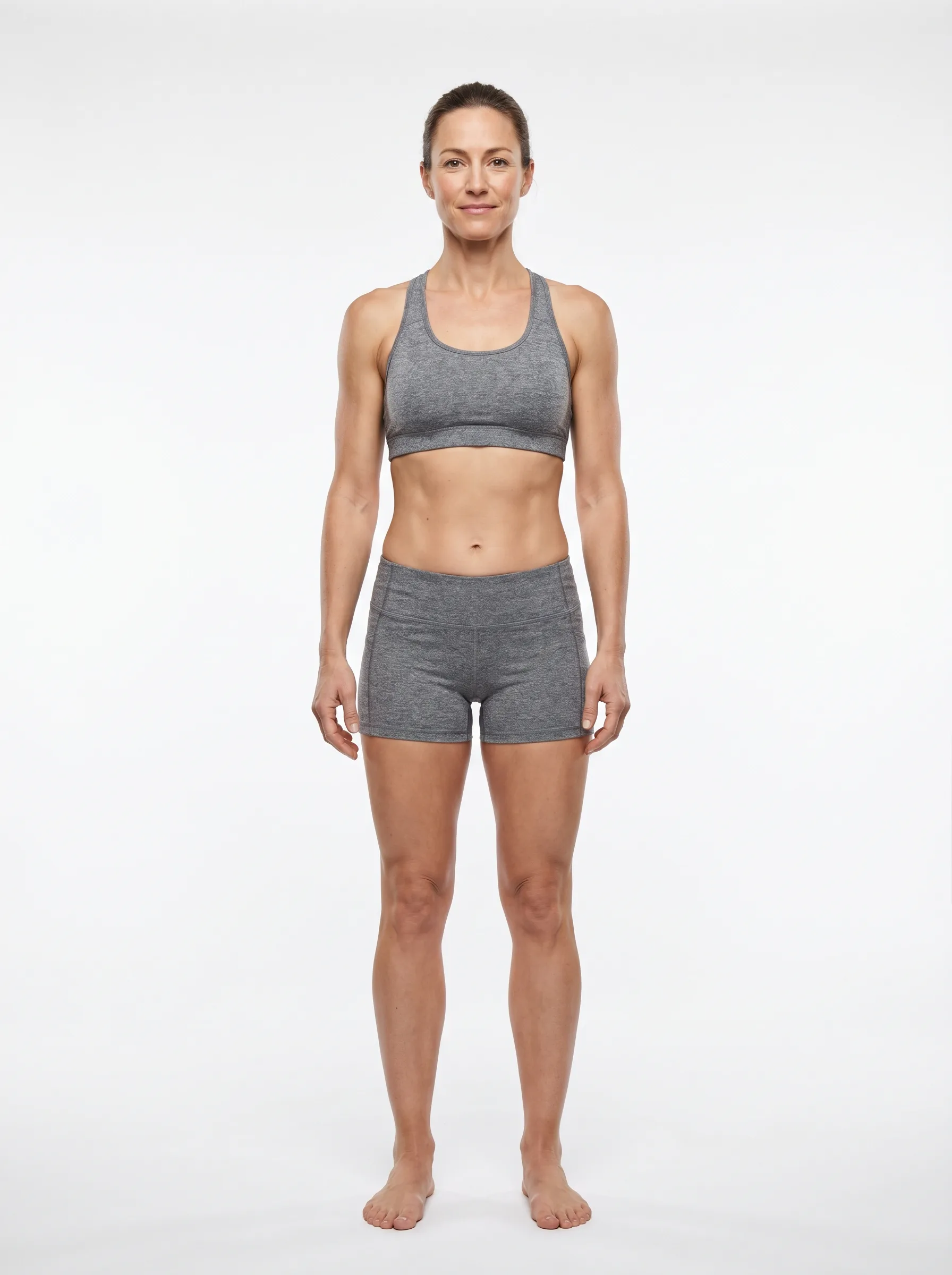
Around 22% — the fitness range. Flatter stomach, visible shoulder and arm shape, curves intact. This is what "toned" is made of.
Notice what didn't happen: no dramatic shrinking, no bulk. A five-point body fat drop with muscle underneath reads as a completely different physique — and on the scale, this change might total single-digit pounds. For a realistic month-by-month version of this arc, see what recomp before-and-afters really look like and our honest recomp timeline.
How should you track recomp progress instead?
If the scale can't see recomp, something else has to. Three signals, in order of usefulness:
- Progress photos — same pose, same lighting, same distance, weekly or biweekly. This is the metric that actually matches your goal, because your goal is visual.
- Strength numbers — if your lifts are climbing, you're almost certainly holding or building muscle. A rising row and a shrinking waist is recomp confirmed.
- Waist and hip measurements — a tape measure catches fat loss the scale obscures, and it's immune to water noise in a way weight isn't.
The failure mode with photos is consistency — different lighting or a slightly different angle can fake or hide weeks of progress. This is the specific problem GainFrame was built for: weekly photo check-ins with auto-alignment, an estimated body fat percentage per photo, and side-by-side comparisons that put the composition change on screen next to the (useless) scale number. The AI estimates are approximations, not clinical measurements — but for tracking relative change over months, consistent photos beat the bathroom scale decisively.
Your recomp starting framework
- Set protein first. Aim for roughly 0.7–1 g per pound of body weight daily. Build meals around it.
- Lift 2–4 times a week with progression. Any sane full-body or upper/lower program works — the progression is the ingredient, not the program name.
- Eat at maintenance or a slight deficit. Recomp is not a crash diet. Feed the muscle side of the equation.
- Take a baseline photo this week. Relaxed, front-on, consistent light. Add waist measurement and your starting lifts.
- Reassess every 4–8 weeks, visually. Compare photos to photos and lifts to lifts — not Tuesday's scale to Wednesday's.
The scale measures mass. Your goal is shape. Recomp changes shape while barely touching mass — so judge it with the tools that see shape: photos, measurements, and strength.
Frequently asked questions
Will lifting weights make a woman bulky?
For the overwhelming majority of women, no. Women naturally produce far less testosterone than men, which makes rapid, accidental muscle gain essentially impossible. Building visible muscle takes most women months to years of deliberate training and eating. The physiques that read as "bulky" are built on purpose over long timelines — you cannot stumble into one by adding two lifting sessions a week.
What is the difference between toning and building muscle?
Physiologically, nothing. "Toned" is not a separate tissue type — it's the appearance of muscle under a moderate layer of body fat. Light weights for high reps don't create tone and heavy weights don't create bulk; both stimulate the same muscle. The toned look comes from building some muscle and being lean enough for it to show.
What body fat percentage should a woman aim for during recomp?
For most women, the fitness range of 21–24% body fat delivers the classic toned look — flat stomach, visible arm and shoulder shape, curves retained. Athletic definition shows in the 14–20% range, though many women find the low end hard to sustain. Going below the 10–13% essential fat minimum is dangerous and disrupts hormonal health.
How long does body recomposition take for women?
Visible change commonly takes 8–12 weeks, and a transformation you'd notice across a room typically takes 6–12 months of consistent training and adequate protein. Recomp is slower than a pure cut because two things are changing at once. Newer lifters and women returning after a break generally see faster results than experienced trainees.
Why does the scale not move during body recomposition?
Because recomp trades fat for muscle at roughly similar weight — losing 5 pounds of fat while gaining 4 of muscle nets out to almost nothing on the scale despite a visible change. For women, normal menstrual-cycle water retention can add several pounds of noise on top. Photos, measurements, and strength numbers show what the scale hides.
How much protein do women need for body recomposition?
Common evidence-based guidance lands around 0.7–1 gram of protein per pound of body weight per day for people trying to build muscle while losing fat. For a 150-pound woman that's roughly 105–150 grams daily — more than most women eat by default. Spreading it across 3–4 meals makes the target far more achievable.
See the change the scale can't
GainFrame turns weekly photos into a body composition trend — estimated body fat, muscle-group scores, and auto-aligned before/after comparisons. Track your recomp visually, free to start on iOS.
Download GainFrame Free