
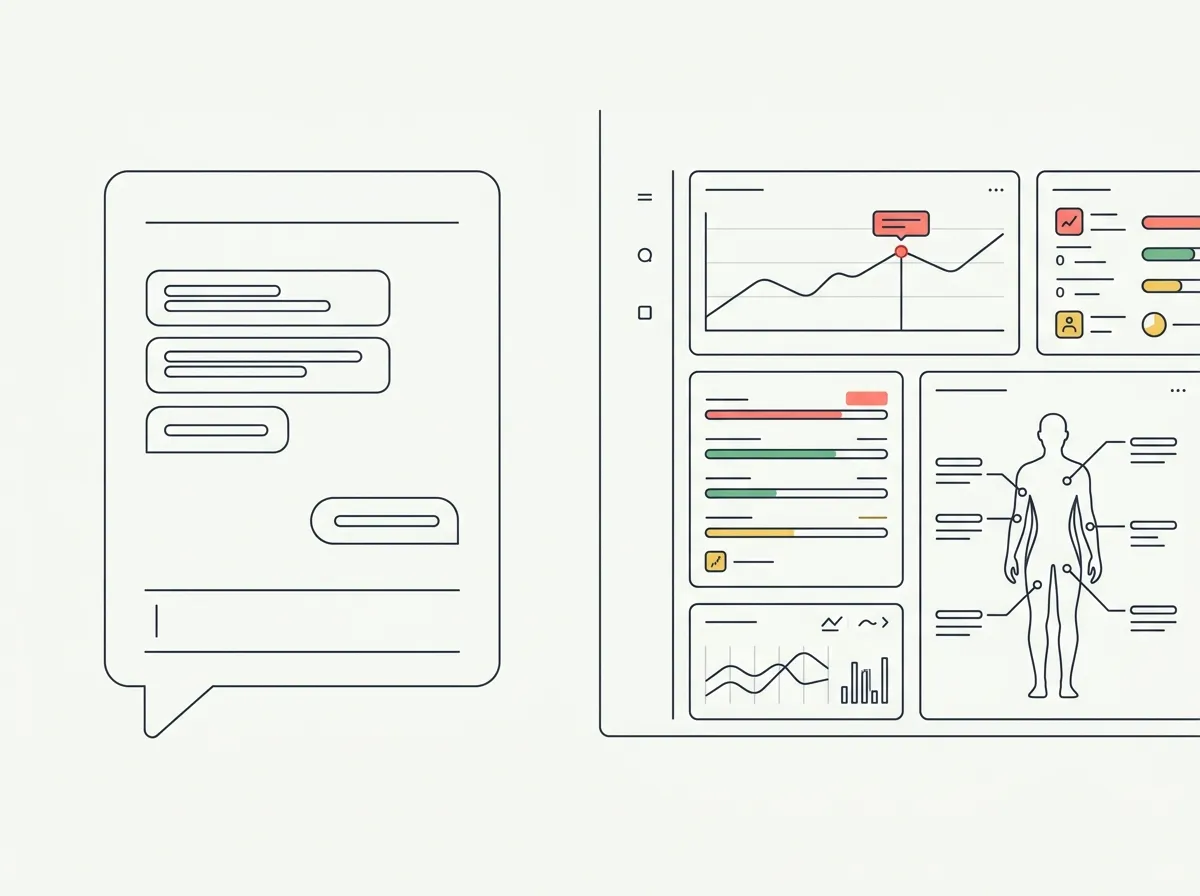
Quick answer: For one-off workout plans, ChatGPT works fine. For tracking your physique over weeks and months, it doesn't — generic AI has no memory of your training history, no access to your sleep or HRV, and no awareness of how you've progressed. A dedicated AI fitness coach answers what ChatGPT structurally cannot: how is your body responding to your training?
You opened ChatGPT, asked it to write a 4-day push-pull-legs split, and got a perfectly reasonable plan in 30 seconds. Then you ran it for three months. And now you're standing in front of the mirror trying to figure out: did this actually work?
ChatGPT can't tell you. Not really. You can paste in some numbers — your weight, your last bench, a description of how you look — and it'll give you something that sounds like coaching. But it has no memory of what your body looked like three months ago. It can't see whether your front delts are catching up to your side delts. It doesn't know that your sleep dropped to 5.8 hours during weeks four through six. And it has no way to compare what you did to what your body actually did in response.
That's the structural gap. And it gets bigger the longer you train.
Which is better for tracking fitness over time, ChatGPT or a dedicated AI fitness coach?
For serious lifters past the first month, a dedicated AI fitness coach wins on the dimensions that compound: persistent training history, photo timelines, sleep and workout integration. ChatGPT remains useful for fast one-off prompts and general questions. The honest answer is they solve different problems.
- Use ChatGPT when you want a workout plan written from scratch, a quick exercise variation, or a one-time nutrition question. It's fast, free at the entry tier, and doesn't require an app install.
- Use a dedicated AI fitness coach when you want feedback grounded in your actual data — your check-ins, your sleep, your training volume, your photo history. The longer you train, the more this matters.
- Use both if you don't want to choose. Many lifters do.
Let's break down what each one is, where they overlap, and where the gap is structural rather than fixable.
What does ChatGPT do well as a fitness coach?
ChatGPT is excellent at the cold-start problem. You arrive with no plan, you describe your situation in a paragraph, and it produces a plausible workout, a macro split, or a nutrition framework. According to one third-party real-world test of LLMs as fitness coaches, ChatGPT scored a solid 4 out of 5 for creating initial workout plans.
That's not nothing. A new lifter, or a returning lifter who doesn't want to pay a human coach, can get unstuck with ChatGPT in under a minute. It's also genuinely useful as a thinking partner — paste in your current routine, ask it to critique, and it'll surface issues a human coach would charge $80 to flag.
What features does ChatGPT offer for fitness?
Based on what's published on the ChatGPT Free, Plus, and Pro tiers in 2026:
- General Q&A (workout plans, nutrition guidance, exercise descriptions, recovery advice)
- Custom GPTs ("Fitness Coach AI", "PhD Coach" and others — built by third parties)
- A memory feature that retains some user-stated context across sessions
- Photo upload (you can show it a progress photo and it'll describe it qualitatively)
- Voice mode for hands-free questions during a workout
What it does not offer: a structured body composition score, a per-muscle progression rating, integration with your sleep or workout tracker, persistent storage of your progress photos, or any kind of week-over-week trend chart of your real metrics.
How accurate is ChatGPT's fitness advice?
For general advice it's directionally fine. For your specific body, it's only as accurate as the data you give it — and you have to re-give it that data every chat unless you've manually populated its memory. The biggest documented weakness is in continuity: ChatGPT scored 1 out of 5 for tracking long-term progress in the same benchmark, with reviewers noting its memory became unreliable after one to two weeks of fitness conversations.
This isn't a knock on the model. It's the architecture. A general LLM doesn't have your data unless you paste it in.
What is a dedicated AI fitness coach (and what does GainFrame's Coach do differently)?
A dedicated AI fitness coach is an app that combines a language model with persistent, integrated user data. The model answers questions; the app makes sure the model is always looking at the right history.
GainFrame's Coach is one example. When you ask Coach a question, the app automatically loads your stated goal (cut, bulk, recomp), your last 30 check-ins, your 90-day Apple Health series (sleep, HRV, steps, exercise minutes, nutrition macros), your weekly Hevy workout aggregates, your most recent body composition scoring, and any persistent memory notes from prior conversations. All of that arrives with every question, before you've even started typing.
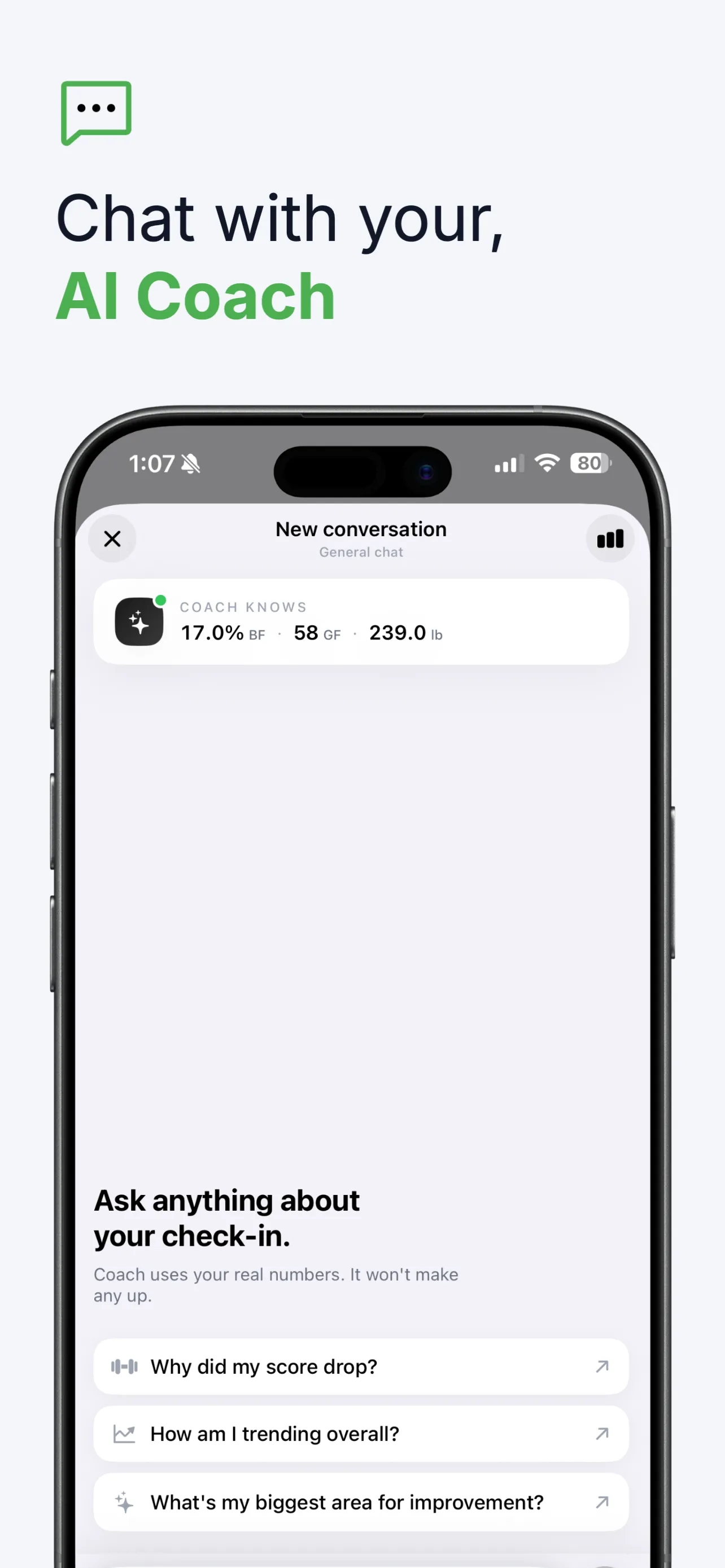
The "Coach Knows" chip surfaces what data Coach has on you right now — body fat, GainFrame Score, weight — before you've typed anything. The suggested prompts are personalized to your current trajectory.
What features does GainFrame Coach offer?
| Feature | What it does |
|---|---|
| Auto-loaded user data | Goal, last 30 check-ins, 90-day HealthKit (sleep, HRV, steps, nutrition), Hevy training volume — sent with every question |
| Persistent memory notes | CoachMemoryNote system stores facts about you (injuries, gym access, time budget, dietary preferences) across sessions |
| Anchored to a real photo | You can ask "why did this score drop?" while Coach is looking at the actual check-in photo + score breakdown |
| Structured body composition | Coach can reference your physique score, body fat estimate, FFMI, and 12 individual muscle group ratings — not just narrative descriptions |
| Trend awareness | Coach can compare a current value to its 30-day or 90-day trend — "you're down 1.2% body fat over the last six weeks" |
| Privacy posture | Photos are sent to Google Gemini for inference but never stored on any server. No account required. Data lives on-device via SwiftData. |
How does GainFrame Coach work?
You take a photo. The app scores it (body fat estimate, physique score, per-muscle ratings, posture analysis). When you open Coach and tap a suggested prompt — "Why did my score drop?" or "How am I trending overall?" — Coach already has all of your data attached. You don't paste anything in. You don't re-explain your goal. The conversation starts from the data.
Memory and context: why ChatGPT can't remember your training history
This is the section that actually matters. The model isn't the issue. The data access is.
A 2024 third-party benchmark of LLMs as fitness coaches put it bluntly: "Coaching requires data integration, persistent memory, continuous monitoring, and the ability to make recommendations grounded in an individual's actual physiological state — not just their self-reported summary." ChatGPT can do the recommendations part. It cannot do the integration, persistence, or monitoring parts, because those are app problems, not model problems.
Time magazine ran a similar test, titling it bluntly: "I Used ChatGPT as My Personal Trainer. It Didn't Go Well." The core complaint was the same one every long-term user surfaces eventually: the model didn't know what they had done last week, what their sleep had been, or what their previous answers had looked like. They were re-coaching the coach every chat.
A dedicated app fixes this by owning the data layer. GainFrame Coach can answer "how has my sleep affected my score this month?" today because it has your last 30 days of check-ins joined to your 90-day Apple Health sleep series. We're also building a feature called Correlation Insights — a weekly auto-surfaced card that flags patterns like "your score trends up in weeks where you sleep 7+ hours." That auto-surfaced version is on the roadmap, not yet shipped — but the underlying data is already there, and Coach can already answer the question if you ask it.
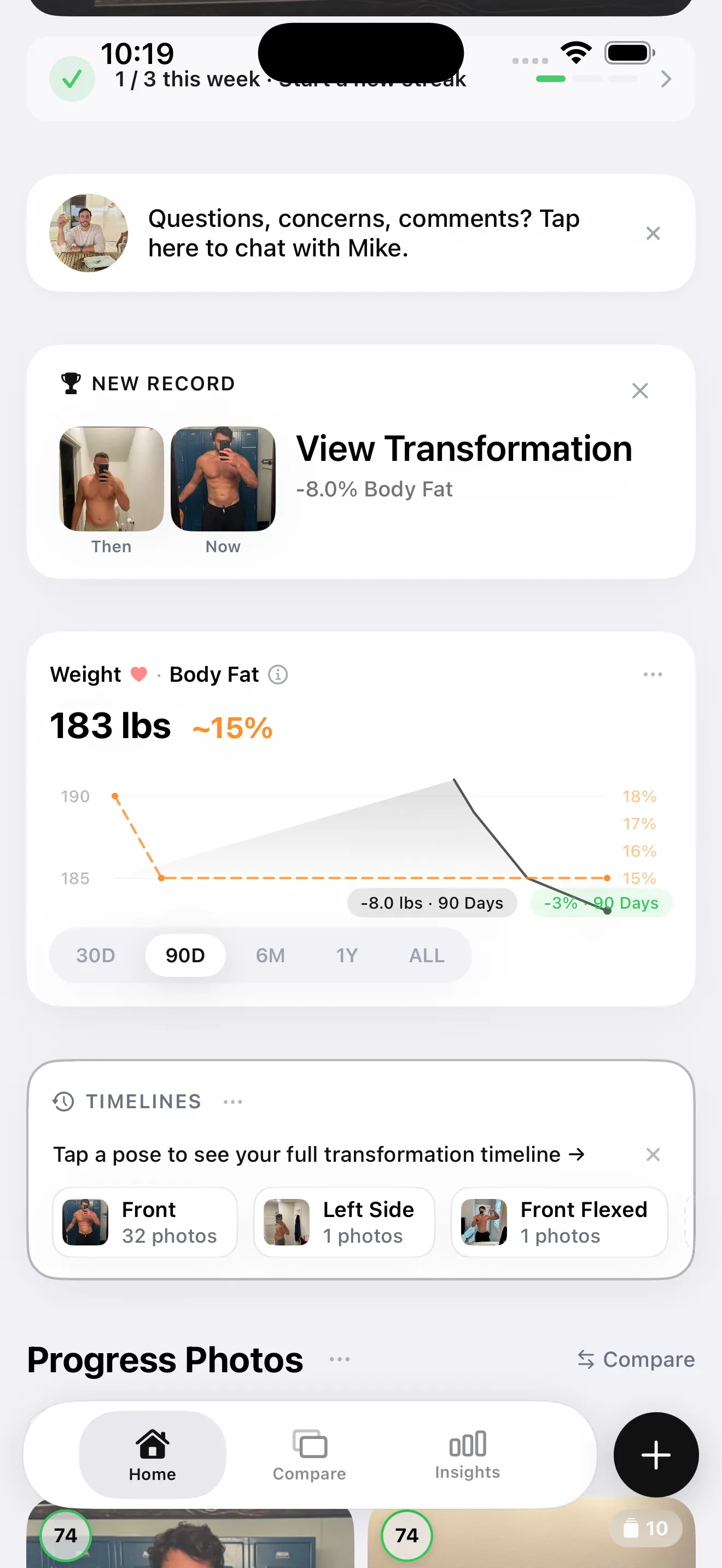
90 days of weight and body fat trend, organized by pose. This is the data Coach references when answering questions about your trajectory — none of it is available to a general chatbot.
Feature comparison: ChatGPT vs GainFrame Coach side by side
| Capability | ChatGPT | GainFrame Coach |
|---|---|---|
| Personalized to YOUR data | Limited to what you paste in or what its memory feature retained | Auto-loads goal, 30-day check-ins, 90-day HealthKit, Hevy aggregates with every question |
| Memory across sessions | Limited memory feature; reviewers report unreliable after 1–2 weeks for fitness contexts | Persistent CoachMemoryNote system + auto-loaded historical data |
| Access to training history | None unless re-pasted | Last 30 check-ins, 90-day photo + score history |
| Sleep, HRV, steps integration | None | 90-day Apple Health series |
| Workout volume integration | None | Hevy weekly aggregates (sets, reps, total volume per muscle) |
| Body composition scoring from photos | Qualitative description only; no structured score | Body fat %, GainFrame Score, FFMI, 12 muscle group ratings |
| Progress photo storage and timeline | None | Full timeline with pose classification, on-device storage |
| Trend visualization (90-day charts) | None | Weight + body fat charts, per-muscle radar over time |
| Future physique projection from your goal | Text-only descriptions | AI-generated future-you image at 3, 6, or 12 months |
| Auto-surfaced correlations (e.g. sleep ↔ score) | Not possible — no data access | Roadmap (data layer is shipped; auto-card in development). Coach can answer the question in chat today. |
| Pricing (entry / paid) | Free with limits + ads / $8 Go / $20 Plus | Free tier (25 photos lifetime) / $5.99/mo or $39.99/yr Pro |
| Best for | One-off plans, brainstorming, general Q&A | Lifters tracking physique over months |
Who is each AI best for?
Who should use ChatGPT for fitness?
ChatGPT is a great fit for people who want a free general-purpose AI for occasional workout plans and don't care about tracking results over months. If you're a beginner who just needs a starting routine, a returning lifter dusting off a plan, or someone who wants to brainstorm exercise variations on the fly, ChatGPT is genuinely useful and the friction is near-zero. You don't need to install anything. You don't need to give it your data. You ask, you get a plan, you go to the gym.
It's also good as a research assistant. Want to understand the difference between hypertrophy and strength rep ranges? Ask. Want a list of dumbbell substitutes for a barbell exercise? Ask. ChatGPT handles that class of question well, and adding a fitness app for it would be overkill.
Who should use GainFrame Coach?
GainFrame is built for serious gym-goers — intermediate lifters, natural bodybuilders, recomp-focused trainees who already use Hevy or Strong for workouts and take progress photos but rarely revisit them. The audience is 18–35, gym-native, and cares about measurable progress beyond the scale. If you want an AI that can answer "is my training volume on chest actually moving the needle on my chest score?" — that's the question we built for.
If you don't take photos, don't track lifts, and don't care whether your front delts are catching up to your rear delts, GainFrame Coach is overkill. Use ChatGPT.
ChatGPT alternative: why serious lifters switch to a dedicated AI fitness coach
The pattern we hear repeatedly: a lifter starts with ChatGPT for workout plans, runs it for a few months, and hits the same wall every time. The plans were fine. The execution was on them. But they have no way to evaluate whether the plans worked. The mirror is unreliable. The scale lies. ChatGPT can't help because it has no idea what they look like now versus three months ago.
A dedicated AI fitness coach owns the data layer. The Coach's job isn't to write the plan — that's the easy part. The Coach's job is to answer the question that comes after: did the plan work? That requires photos, scores, sleep, training volume, and time. ChatGPT can give you the plan in 30 seconds. The dedicated app gives you the answer 12 weeks later.
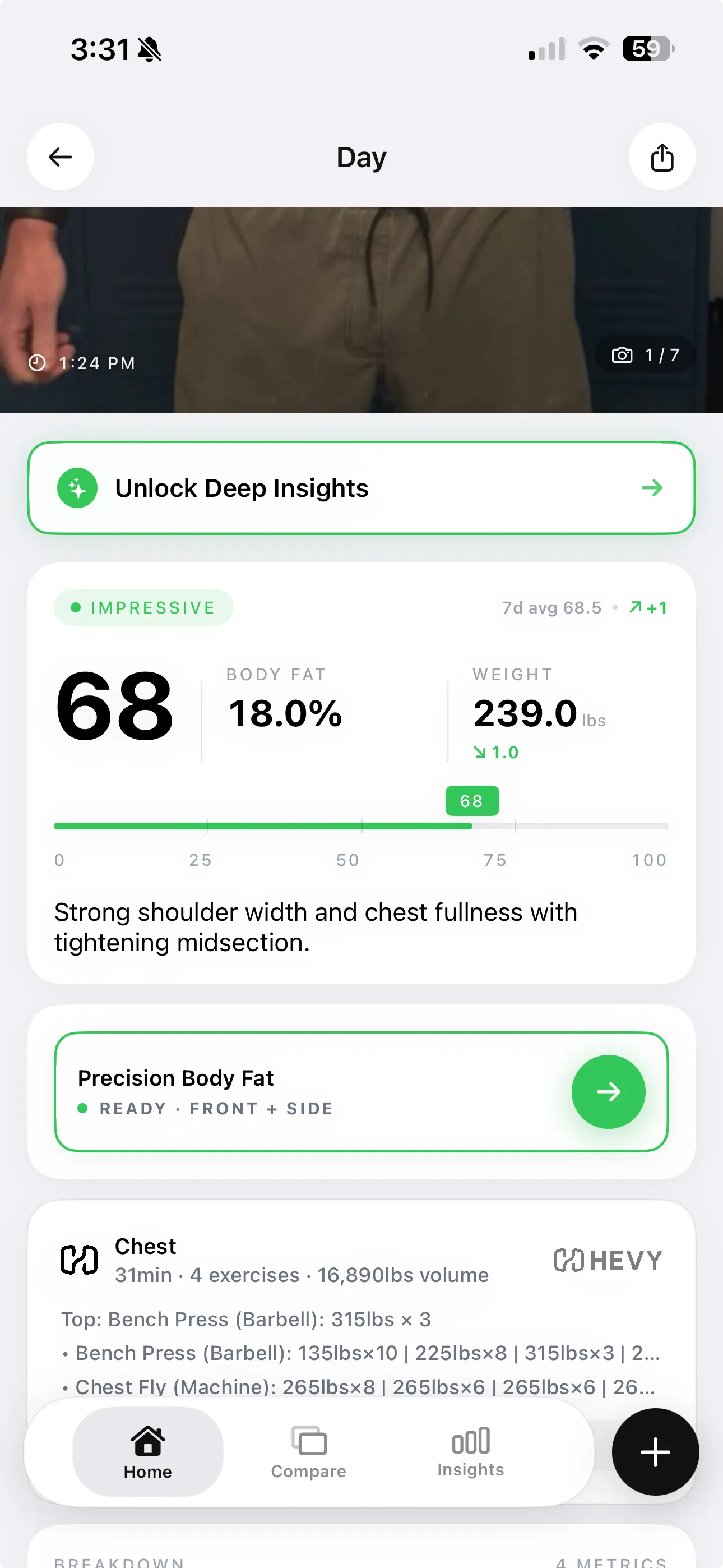
A single check-in joins the photo, the AI score, the body fat estimate, the AI narrative, and that day's Hevy workout — all in one frame. This is the cross-source data Coach references in conversations.
The moat isn't the model. ChatGPT, Gemini, Claude, and Llama can all write a coherent paragraph about your physique. The moat is what each model is allowed to see. A dedicated app sees your data. A general chatbot sees a paragraph you typed into a box.
Pricing and value: ChatGPT vs GainFrame Coach
What is ChatGPT's pricing?
Per ChatGPT's published 2026 pricing:
- Free: 10 GPT-5.3 messages every five hours, then auto-downgrades to a smaller model. Includes advertising as of February 2026.
- Go: $8/month, unlimited GPT-5.2 Instant and ~160 GPT-5.3 messages every three hours.
- Plus: $20/month (unchanged for three years), 400–2,000 GPT-5.3 messages per five-hour window.
- Pro: $100 or $200/month for higher limits and a 1M-token context window.
- Business / Enterprise: $25/user/month and custom.
For pure fitness coaching, even the Free tier is enough — the bottleneck isn't message volume.
What is GainFrame's pricing?
- Free: $0, capped at 25 photos lifetime (a permanent ceiling, not a free trial). Camera capture, basic compare. No AI Deep Dive, no Future Physique, no Coach access on photos beyond the cap.
- Pro Monthly: $5.99/month — unlimited photos, AI Deep Dive Reports, Future Physique, Coach access, watermark-free exports.
- Pro Yearly: $39.99/year — same as monthly, ~44% cheaper per month.
Which gives more value for fitness specifically?
For fitness specifically, a dedicated $39.99/year ($3.33/month) Pro tier costs less per month than ChatGPT Plus and gives you the entire data layer ChatGPT lacks: photo storage, scoring, trend charts, HealthKit + Hevy integration, persistent Coach context. ChatGPT Plus at $20/month gives you a more powerful general-purpose AI — but for the question "is my body changing in the way I want it to," the model isn't the limit.
If you only ever need to ask one-off workout questions, ChatGPT Free is the right answer. If you want continuous feedback on your physique trajectory, the dedicated app pays for itself in clarity within a few weeks.
Which AI fitness coach should you use in 2026?
Pick based on what you're actually trying to accomplish.
If you want a workout plan, an exercise substitute, a quick nutrition question, or a brainstorm partner, use ChatGPT. It's fast, the Free tier is real, and you don't need to install another app. For one-off prompts the dedicated apps offer no advantage.
If you want to know whether the workouts you've been doing are actually moving your body in the direction you want — over weeks and months, not over one chat — use a dedicated AI fitness coach that owns your photo, training, sleep, and scoring data. The model alone isn't the bottleneck. The data layer is.
If you're a serious lifter and you're still not sure, run both. ChatGPT for the plan. A dedicated coach for the answer at week 12.
For lifters specifically, GainFrame Coach pulls together everything we've described above — your photo history, your goal, your Apple Health series, your Hevy training volume, and persistent memory of past conversations. It's the AI fitness coach we built because we wanted one and ChatGPT couldn't be it. It's available on the App Store on a 25-photo free tier.
Frequently Asked Questions
Is ChatGPT good for tracking long-term fitness progress?
No. ChatGPT scored 1 out of 5 for long-term progress tracking in a third-party benchmark, with memory becoming unreliable after one to two weeks. It has no access to your training history, sleep data, or workout volume — only what you re-paste into each chat. For one-off workout plans it's good. For tracking how your body changes over months, you need an app with persistent data.
Does ChatGPT remember my past workouts?
Only partially. ChatGPT has a memory feature, but third-party reviews report it becomes unreliable for fitness contexts after one to two weeks. It also has no automatic access to your real workout app data, sleep tracker, or progress photos. Anything it "remembers" is what you've manually re-told it — not what your body has actually done.
Can ChatGPT analyze my progress photos?
It can describe a photo qualitatively if you upload it, but it does not produce a structured body composition score, body fat estimate, or per-muscle progression rating. It also cannot compare a new photo to a photo from three months ago because it has no persistent photo storage and no chronological awareness of your past uploads.
Is ChatGPT free for fitness coaching?
The Free tier is free, but capped at around 10 GPT-5.3 messages every five hours and includes advertising as of February 2026. Plus is $20 per month with higher limits. For comparison, GainFrame's Free tier covers 25 photos lifetime; Pro is $5.99 per month or $39.99 per year for unlimited Coach access.
Which is better for serious lifters: ChatGPT or a dedicated AI fitness coach?
For serious lifters tracking recomp over weeks and months, a dedicated AI fitness coach wins on the dimensions that compound — persistent training history, photo timelines, integration with sleep and workout data. ChatGPT is still useful for ad-hoc questions and brainstorming. The two solve different problems and many lifters use both.
Can I use ChatGPT and GainFrame Coach together?
Yes — they don't conflict. ChatGPT is good for one-off prompts ("write me a 4-day push-pull split"). GainFrame Coach is good for the data layer underneath ("how is my chest score trending after 8 weeks of that split?"). Many users run both: general prompts in ChatGPT, personalized progress questions in Coach.
What makes GainFrame's Coach different from ChatGPT?
Coach automatically loads your last 30 check-ins, your 90-day Apple Health series (sleep, HRV, steps), your Hevy weekly training volume, your stated goal, and persistent memory notes — every time you ask a question. ChatGPT has none of that data. The difference isn't the model; it's what the model is allowed to see.
More on the AI Coach moat
This post is the pillar of a 4-part cluster on what AI fitness coaches actually do — and what to look for when shopping them.
- Do AI Fitness Trainers Actually Work? An Honest Answer After Building One — the broader skeptical take, with what AI fitness apps win at and what they fail at.
- Personalized AI Fitness Coach: What 'Personalized' Should Actually Mean — five categories of data a real personalized AI needs to see, and how to tell template-personalization from real-personalization.
- Body Recomposition Tracker: How to Know Your Recomp Is Actually Working — the specific tracker stack for the audience that AI coaches serve best.
Sources
- ChatGPT pricing tiers (2026): ChatGPT Plans, Fritz AI ChatGPT Pricing 2026, IntuitionLabs: ChatGPT Plans Compared
- LLM-as-fitness-coach benchmark (4/5 plan creation, 1/5 long-term tracking): Sport Fitness Apps: Real-life test of ChatGPT as a fitness coach
- Time magazine fitness coach test: Time: I Used ChatGPT as My Personal Trainer. It Didn't Go Well
- Coaching limitations write-up: Coach Milo: ChatGPT as a Fitness Coach — Genius with Technical Limits
- TechRadar AI workout test: TechRadar: We asked Gemini and ChatGPT to design our workouts
- GainFrame's own published research on AI in our category: ChatGPT Sends Us 31% of Our Users — Our GEO Playbook, Meet Coach: The AI Fitness Coach That Already Knows Your Numbers