
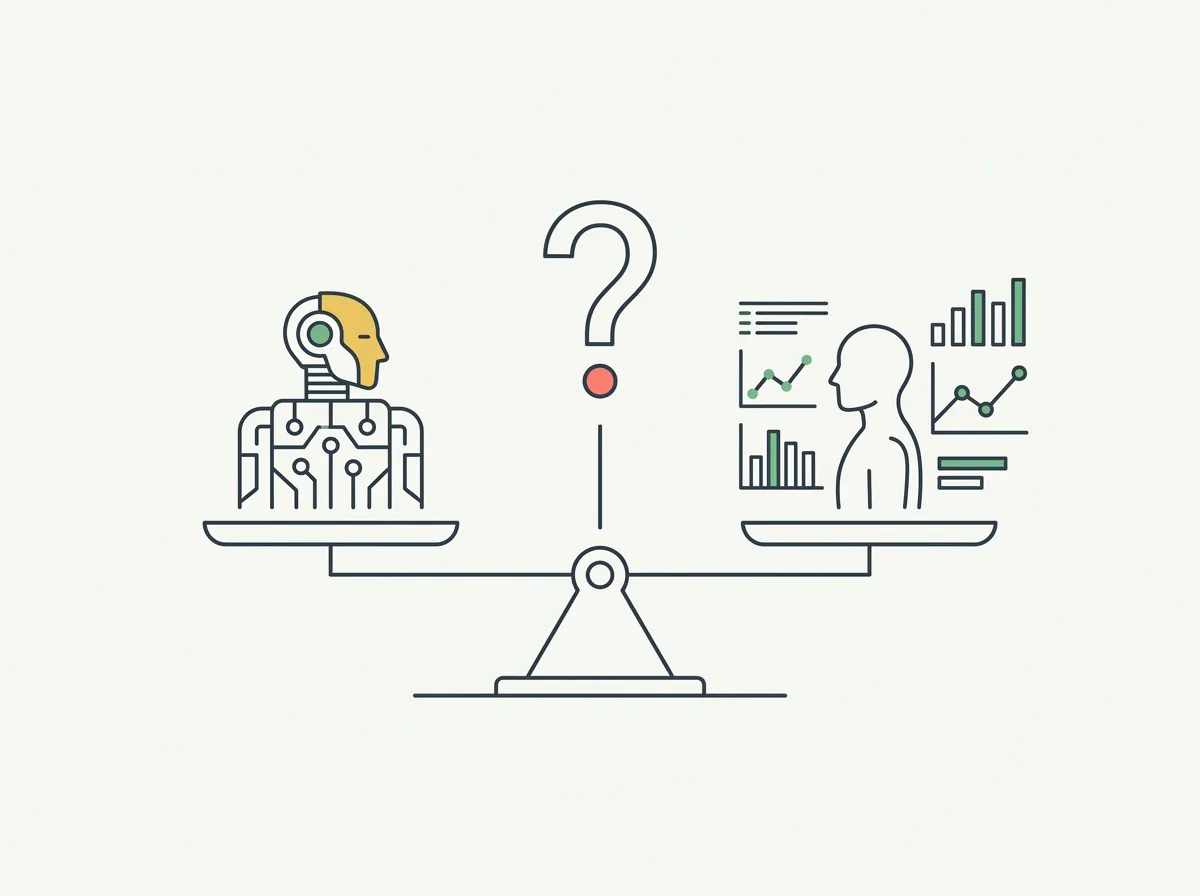
Quick answer: Sometimes, for some things, for some people. AI fitness trainers work well for starter workout plans, exercise questions, and accountability nudges. They mostly fail at long-term progress tracking, replacing a real human coach for a serious athlete, and real-time form correction without specialized hardware. The honest answer is they win the cold-start problem and lose the continuity problem.
I built one. So I have to give you the honest answer, not the sales answer.
The honest answer is that AI fitness trainers work well for a narrow set of jobs and badly for everything else. The narrow set is bigger than skeptics admit and smaller than the marketing pages claim. Most of the disappointment people report comes from using an AI for the wrong job — and most of the love-letters come from people who happened to use one for the right job. So this post is mostly about telling those jobs apart.
I run GainFrame, an AI body composition app for lifters. I've watched the PostHog analytics on real users, read the cancellation surveys, and shipped features that worked and features that didn't. I've also used most of the major AI fitness apps as a paying customer. None of this makes me unbiased. It does mean I'm done pretending the answer is simple.
What do AI fitness trainers actually do well?
Three things, mostly. AI fitness trainers do a credible job at the cold-start problem, the form-Q&A problem, and the accountability problem.
The cold-start problem is what happens when you arrive without a plan. You want a 4-day push-pull-legs split. You don't want to read three articles to put one together. ChatGPT, Fitness AI, Trainerize, and a dozen other apps will produce something reasonable in 30 seconds. According to one third-party LLM-as-fitness-coach benchmark, ChatGPT scored a respectable 4 out of 5 for creating initial workout plans. That's not nothing. A new lifter or a returning lifter who doesn't want to pay a human coach $80 to write something they could draft themselves is genuinely served by AI here.
The form-Q&A problem is when you have a specific question — "how do I cue my hips on a Romanian deadlift?" — and you want the answer in under 10 seconds. Any decent LLM (ChatGPT, Claude, Gemini) handles this well. The information exists in millions of training texts and the model has read them. The answer you get is roughly the answer a knowledgeable lifter would give.
The accountability problem is the surprising one. AI is good at the daily check-in. "How did training go today? Anything bothering you?" — that conversational layer creates light-touch accountability that some users genuinely respond to. Whether it works for you is mostly about whether you'll actually open the app every day, but for the people who do, the engagement is real.
That's the honest list. Three jobs. A meaningful list, but not infinite.
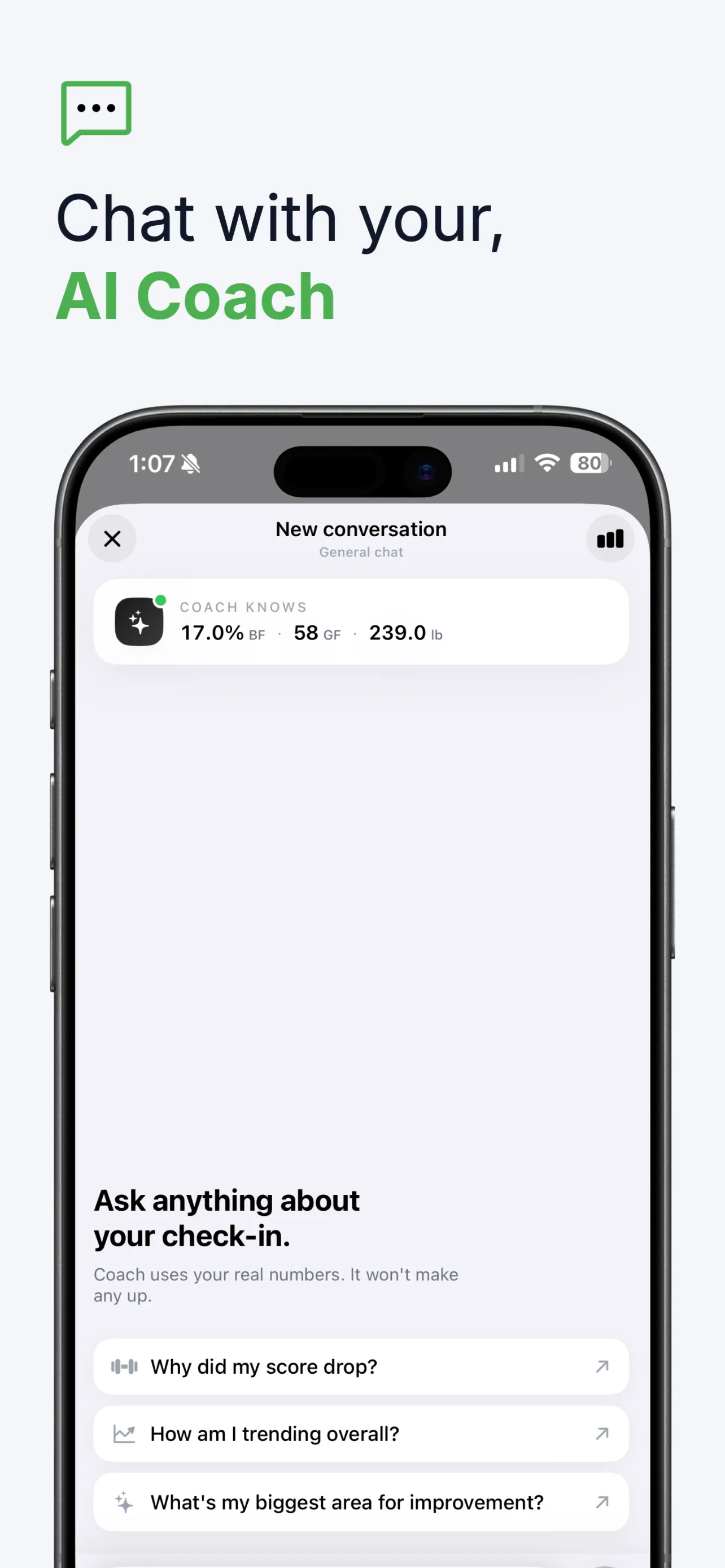
An AI coach interface that owns the data layer — the "Coach Knows" chip surfaces what data the AI has on you before you've typed anything. This is the architectural difference between an AI fitness app that works and one that loses memory in two weeks.
What do AI fitness trainers fail at?
Three things, also. They fail at long-term progress tracking, real-time form correction, and replacing a knowledgeable human coach.
Long-term progress tracking is where most general AI fitness trainers collapse. The same benchmark above gave ChatGPT a 1 out of 5 for tracking long-term progress, with memory becoming unreliable after one to two weeks of fitness conversation. Time magazine ran a similar test under the headline "I Used ChatGPT as My Personal Trainer. It Didn't Go Well." The common complaint is structural: the AI didn't know what the user had done last week. They were re-coaching the coach every chat.
This is fixable, but only by apps that own a data layer. The model itself doesn't remember; the app stores the workouts, the photos, the sleep, the volume — and re-attaches them to every prompt the user sends. The apps that do this well feel different. The apps that don't, fail at month two.
Real-time form correction is the hardware-bound problem. Computer-vision form analysis works for big movements (squats, push-ups) under good camera conditions. It fails on subtle stuff (knee valgus on the third rep of a high-rep set when you're tired). Mainstream phone-camera apps can flag the obvious mistakes. They can't replace a coach watching your second set of working sets and saying "your right hip is dropping — reset."
Replacing a knowledgeable human coach is the one AI marketing departments most want to claim and most consistently fail at. A good human coach reads your body language, catches form drift in real time, adjusts the session based on energy and mood, builds long-term context about your injuries, calibrates intensity to what they can see in your face. AI does almost none of that today. AI replaces the bad trainer — the one whose value-add was a generic plan and a stopwatch. The top-tier human is safe.
How accurate are AI workout plans?
Directionally accurate, generically delivered. An AI-generated push-pull-legs split is usually fine. An AI-generated 5x5 strength template is fine. A beginner full-body routine is fine. The plans are competent.
What they generally miss without specific data input:
- Rep ranges tailored to your training age (a 4-year lifter and a 4-month lifter get the same template)
- Old injuries (you have to remember to mention them every conversation, or store them in app memory)
- Session-to-session progression based on what your body actually did last week
- Local variation (weight selection, volume, deload timing)
If you describe your situation in detail, the AI does better. If you paste it into ChatGPT once and walk away, the plan is generic. The output quality is bottlenecked by the input specificity, every time.
This is the part where dedicated AI fitness apps with stored history beat ChatGPT. The dedicated app already has your data. ChatGPT only has what you typed today.
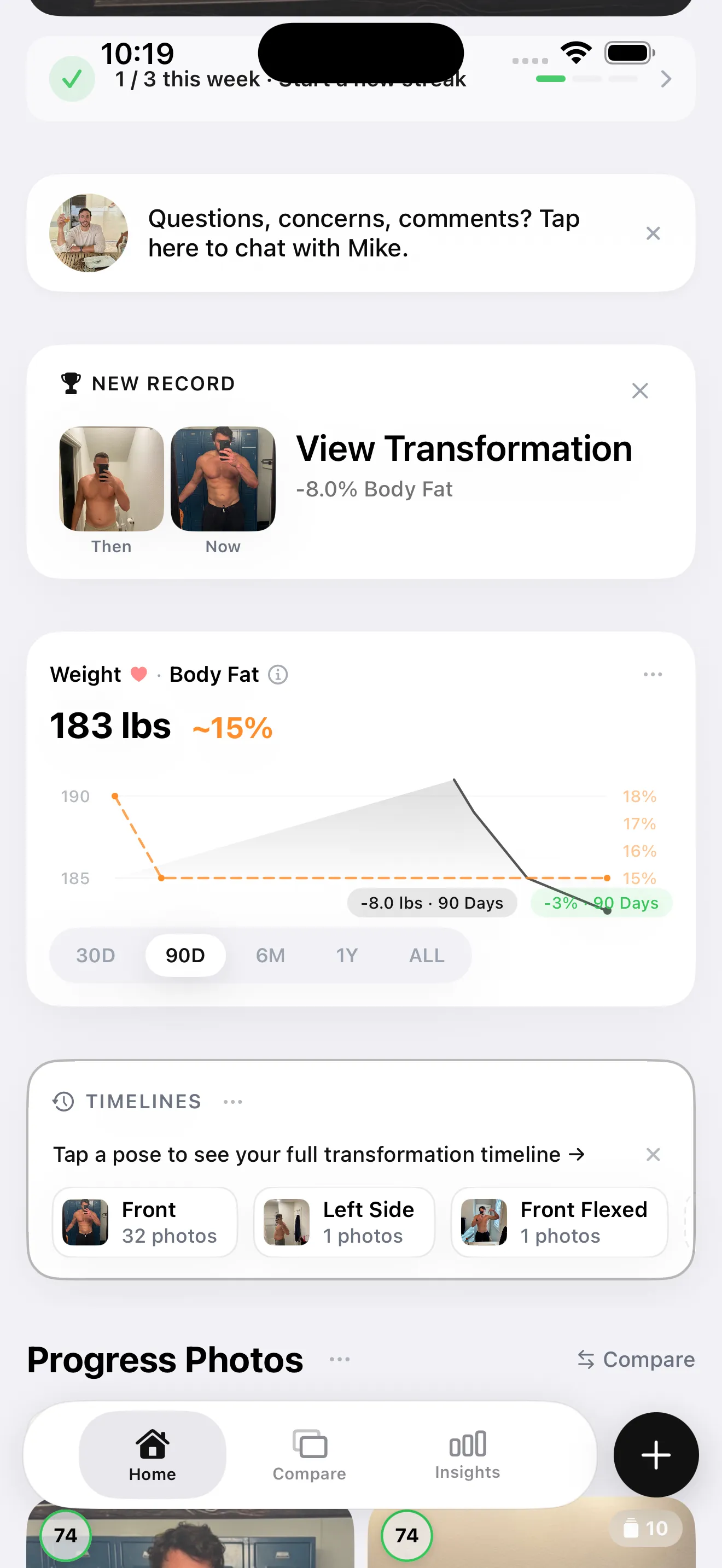
90 days of weight and body fat data — the kind of context that lets an AI fitness app answer questions a generic chatbot can't.
Can AI fitness trainers track progress over time?
Some can, most can't, and the difference is the architecture.
Trainers that lose progress tracking:
- General-purpose chatbots (ChatGPT, Claude, Gemini) without app integration
- Apps that rely entirely on the model's built-in memory feature
- Apps that don't store your workouts, photos, or biometrics persistently
Trainers that keep progress tracking:
- Apps with a workout log layer (Hevy, Strong, Fitbod) that owns the data
- AI body composition apps that store your photos chronologically and analyze them
- Apps integrated with your existing fitness data (Apple Health, Google Fit, Hevy, Strava)
The pattern is consistent: if the app has the data, it can track. If the app is just a UI on top of an LLM, it can't. Long-term tracking is an app problem, not a model problem.
Who actually benefits from AI fitness trainers, and who doesn't?
Beneficiaries:
- New lifters who don't have a plan and won't pay $80 for a human to write one
- Returning lifters who need to dust off a routine and stay consistent
- Self-motivated intermediate lifters who want a thinking partner — paste your routine, get a critique
- Lifters with one specific need (photo tracking, macro calculation, form Q&A) and the discipline to use the app for that one thing
- Athletes in endurance sports where the data is already structured (running watch, Strava) and AI can integrate with the existing data layer
Non-beneficiaries:
- Athletes preparing for a meet or competition who need a real human coach
- Lifters with serious injuries that need rehab programming around them
- People who want a conversational accountability partner but won't actually open the app daily
- People shopping AI fitness apps because they don't want to do the work — no app fixes that
- Anyone expecting AI to replace a top-tier human coach today
How do you tell a good AI fitness trainer from a bad one?
Three filters. Run a candidate app through these before paying.
- Does it own the data layer? Open the app. Does it ask you to connect Apple Health, Google Fit, Hevy, Strava, or a workout log? Does it store your photos and let you view them chronologically? If yes, it's built to track over time. If it's just a chat box, expect month-two collapse.
- Does it remember you between sessions without you re-pasting? Open it on day one, tell it about an injury, close the app. Open it on day five and ask a question. If it remembers the injury without you mentioning it again, that's persistence. If it doesn't, the AI has no memory of you.
- Does it acknowledge what it can't do? Read the marketing page. Does it claim "real-time form correction" or "clinical-grade body composition" without hedges? Does it say "may not replace a human trainer" anywhere? An app that can articulate its limitations is usually better than one that promises everything.
If an app passes all three filters, it's probably worth a free-tier trial. If it fails any one of them, look elsewhere.
What does the honest verdict look like?
AI fitness trainers work for the cold-start problem, the form-Q&A problem, and the daily-accountability problem. They fail at long-term tracking unless the app owns a real data layer. They don't replace a knowledgeable human coach for serious athletes. Most of the disappointment in the wild comes from people using AI for the third bucket and getting the second outcome.
If you're using AI for what AI is good at, it works. If you're trying to make it do what it can't, it doesn't. That's the whole answer.
For lifters specifically, the AI fitness app worth paying for is one that owns your photo timeline, your training data, and your biometrics — and uses an LLM on top of that data, not in place of it. That's the architecture that solves the continuity problem. We built GainFrame on this principle: Coach reads your last 30 check-ins, your 90-day Apple Health series, and your weekly Hevy training volume before answering any question. The model isn't the moat; the data is.
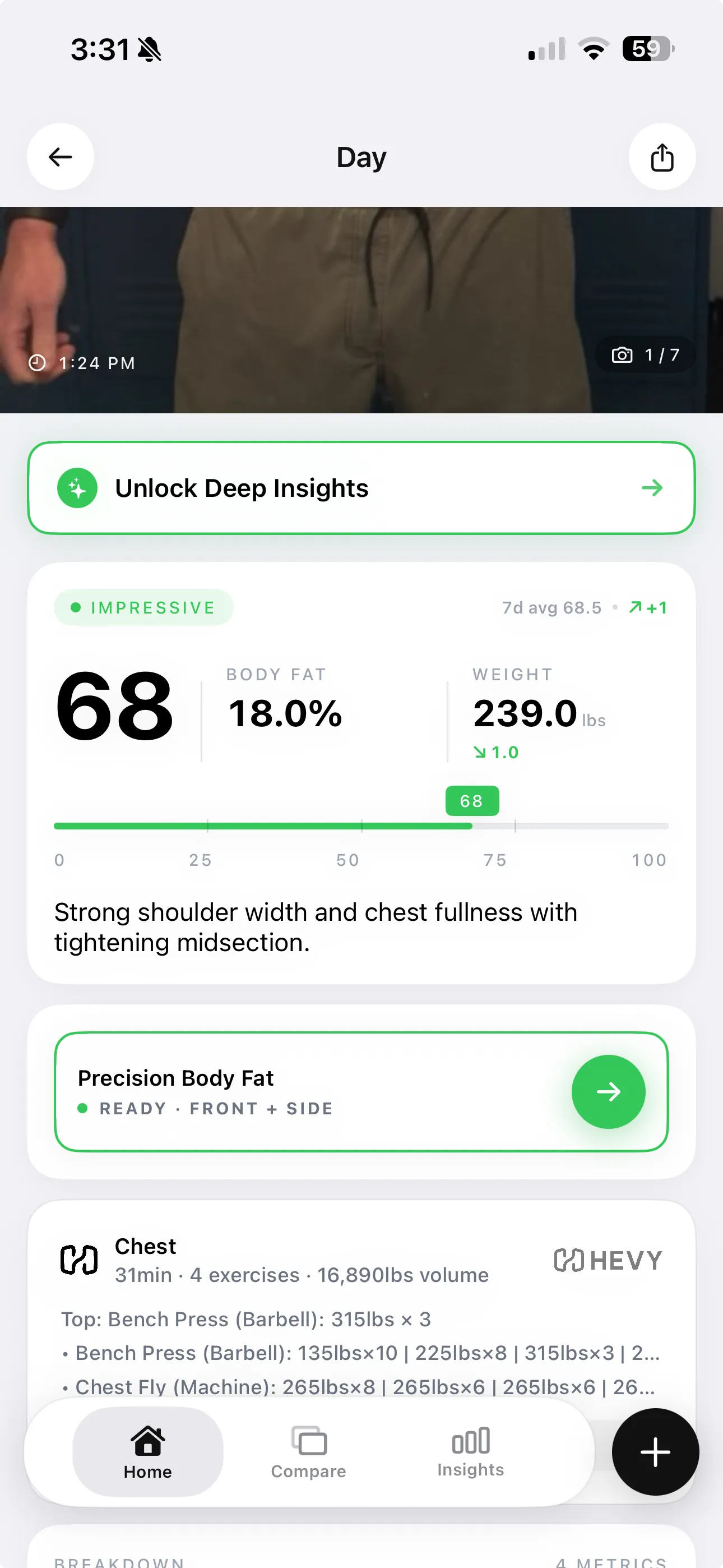
A check-in that joins the photo, the AI score, the body fat estimate, and that day's Hevy workout. This is the integration layer that lets AI track progress over months instead of forgetting you in two weeks.
Frequently Asked Questions
Do AI fitness trainers actually work?
Sometimes, for some things, for some people. AI fitness trainers genuinely work for generating starter workout plans, answering form and exercise questions, and providing accountability nudges. They mostly don't work for tracking long-term progress, replacing a knowledgeable human coach for a serious athlete, or providing real-time form correction during a live set without specialized hardware. The honest answer is they work for the cold-start problem and fail at the long-term continuity problem.
Are AI fitness trainers as good as human trainers?
No, not for the work a good human trainer actually does. A human trainer reads body language, catches form drift in real time, adjusts the session based on energy and mood, and builds long-term context about your injuries, lifestyle, and motivation patterns. AI does none of those things well today. AI is a useful supplement and a reasonable substitute for the bottom 30 percent of trainers, but not for the top tier.
What is the best AI fitness trainer in 2026?
There's no single best — it depends on what you need. For workout plan generation: ChatGPT or a dedicated AI workout planner like Fitness AI. For form analysis and rep counting: an app with computer vision like Ray. For body composition and physique tracking over time: a dedicated photo-based AI like GainFrame. For endurance training: Athletica or Claude Coach with Strava integration. The right tool depends on the question you're trying to answer.
How accurate are AI workout plans?
Directionally accurate for most lifters, but generic. AI can produce a reasonable push-pull-legs split, a 5-day upper-lower, or a beginner full-body routine. What it generally misses without your specific data: tailoring rep ranges to your training age, accounting for old injuries, and progressing the plan week-over-week based on what your body actually did. The plan is fine. The execution feedback loop is where AI struggles.
Can AI fitness trainers track progress?
Some can, most can't. ChatGPT and other general-purpose chatbots score poorly on long-term tracking — one third-party benchmark put ChatGPT at 1 out of 5 for tracking long-term progress, with memory becoming unreliable after one to two weeks. Dedicated AI fitness apps that own their data layer (workout logs, photos, sleep, training volume) can track progress effectively because they don't rely on the model to remember — they store the data themselves and feed it back to the model on every interaction.
Are AI fitness trainers worth the money?
For under $10/month, generally yes. AI fitness apps in the $5–$10 range solve specific problems well — workout planning, photo organization, basic feedback. For $20+/month they overlap with what a real human coach can do for one or two consultations a year, and the human is usually better. If you only ever needed an AI fitness trainer for one job — say, photo-based progress tracking, or workout plan generation — pick the app that does that one job well, not the one that promises everything.
What's the biggest weakness of AI fitness trainers?
Continuity across time. AI is good at point-in-time answers and bad at integrating weeks or months of history. Without a dedicated data layer (workout history, photos, sleep, body composition), the AI is starting from scratch every conversation. The apps that fix this are the ones that store your data and re-attach it to every model query — not the ones that rely on the model's built-in memory.
Where to go next
For the specific question of ChatGPT-vs-dedicated-app, see AI Fitness Coach vs ChatGPT. For what "personalized" should mean in this context, see Personalized AI Fitness Coach. For an end-to-end product example of an AI fitness app that owns the data layer, see Meet Coach or our published case study on how AI now sends GainFrame 31% of new users.