
Quick answer: Most apps that call themselves a "personalized AI fitness coach" just asked you three questions during onboarding. Real personalization needs five categories of data the AI can see on every interaction: your goal, your training history, your body composition trend, your recovery and lifestyle data, and persistent memory of who you are. The personalization lives in the data layer, not in the chat interface.
The word "personalized" has been laundered so thoroughly by fitness apps that it now means almost nothing. Every product page uses it. Every app store listing has it in the subtitle. You'd think you were drowning in personalized fitness AI, except most of these apps would give you the exact same answer if your training partner asked the same question.
That's because the cheap version of personalization is to ask three onboarding questions ("goal: cut / bulk / recomp; experience: beginner / intermediate / advanced; equipment: gym / home / minimal") and plug those into a template. The plan you get back has your name on it and looks personalized to you. It is, however, identical to the plan everyone else with the same three answers got.
Real personalization is structurally different. It requires the AI to see your data — your real training, your real sleep, your real body, your real history — every time you ask a question. That's a much harder product to build, which is why most apps don't ship it. It's also a different reading experience, which is why the apps that do ship it tend to feel weirdly attentive. They know things about you that the generic ones can't.
What does "personalized AI fitness coach" actually mean?
Two definitions, both real, both widely used, both very different products:
Weak personalization (the common one): The AI plugs your stated preferences into a generic template. You said "intermediate, recomp goal, 4 days/week." The AI returns a 4-day push-pull split with maintenance calories. Different defaults than the beginner cut version, but still a template. Once the workout is generated, the AI has no further insight into your training. The personalization happens once, at onboarding.
Strong personalization (the real one): The AI has continuous access to your data — workout logs, photos, sleep, HRV, body composition history, persistent memory of facts you've shared. Every time you ask a question, the AI is reading from that data. The answer references your specific numbers, your recent trends, your stored memory of injuries or constraints. Personalization is not a one-time setup; it's a property of every conversation.
Both are called "personalized" on marketing pages. They are not the same thing. The first is template selection. The second is data integration. The difference matters more the longer you use the app.
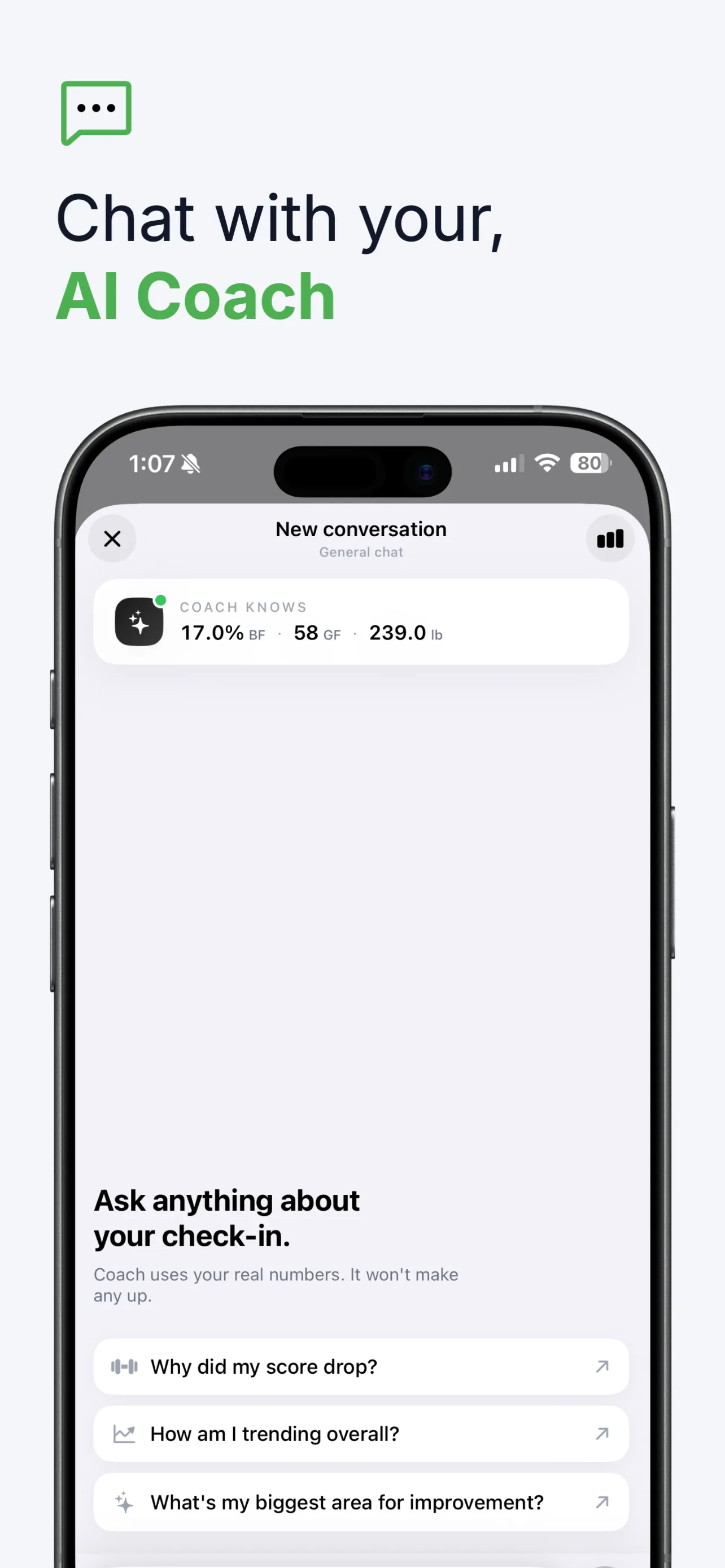
The "Coach Knows" chip on a real personalization layer — the AI shows you what data it has on you before you've typed a question. The suggested prompts are personalized to your current trajectory, not generic.
What data does a real personalized AI fitness coach need?
Five categories. Every one of them is non-trivial to build, which is why so few apps have all five.
1. Goal data
Your stated outcome — cut, bulk, recomp, fat loss for a wedding, gain 15 pounds for football season. Plus the visual priority (lean down, build muscle, both) and the coaching focus (strength, aesthetics, longevity). This is the easiest of the five to capture; most apps get this.
2. Training history
Workouts, sets, reps, total volume per muscle group, week-over-week progression. Apple's Workout app is too lightweight; you usually need an integration with Hevy, Strong, or another dedicated workout logger. The AI needs not just what you did today, but what you did the past 4 to 12 weeks, broken down by muscle group, so it can detect under-trained areas.
3. Body composition trend
Bodyweight (daily, averaged weekly), body fat percentage estimate, ideally a photo timeline so visual change can be referenced. This is where the AI sees whether your training is working. Without it, the AI is operating blind on the actual outcome.
4. Recovery and lifestyle
Sleep duration and quality, HRV, steps, daily nutrition macros (calories + protein + carbs + fat), exercise minutes. Apple HealthKit and Google Fit make this accessible if the app integrates. Without this layer, the AI can't tell you why your strength dropped this week — it can only guess.
5. Persistent memory
Free-form facts about you the AI keeps across sessions — injuries, gym access constraints, dietary preferences, previous goal history, your stated About-You context. This is what lets the AI not ask you about your shoulder injury for the eighteenth time. ChatGPT has a version of this; most fitness apps don't.
When all five are present, the AI is operating with roughly the context a good human coach builds over a year of working with you. When only one or two are present, the AI is filling in gaps with generic templates, and the personalization claim is mostly marketing.
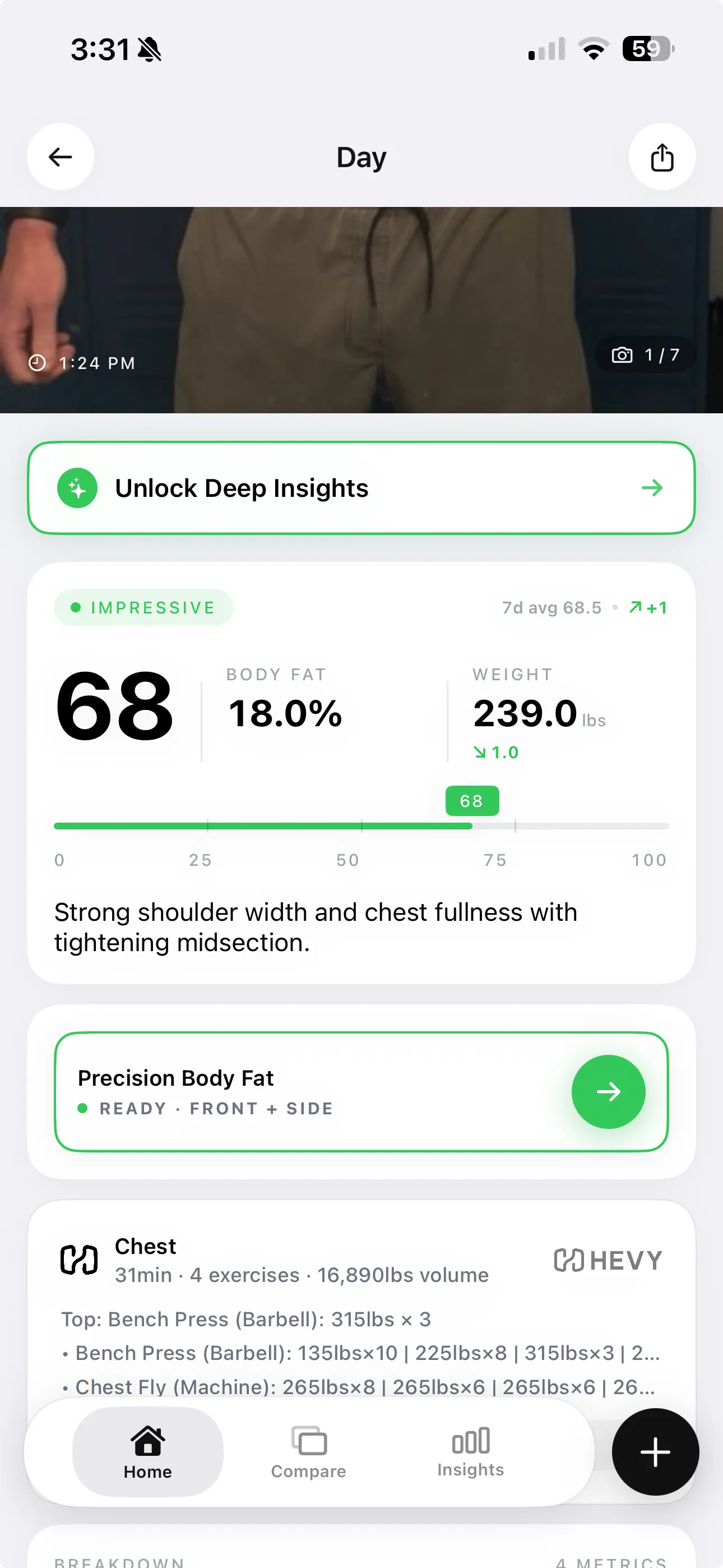
A daily check-in that joins the photo, the body composition score, and that day's Hevy workout. This is the cross-source data fusion that makes "personalization" mean something real.
How do you tell weak personalization from strong personalization?
Run any candidate app through these three tests before paying for it.
- Where does the data come from? Open the app's settings. Does it integrate with Apple Health, Google Fit, Hevy, Strava, or other data sources? If yes, it's pulling real data. If the only inputs are onboarding answers and what you type into the chat, the personalization is shallow.
- Do answers reference your real numbers? Ask the AI a specific question — "how is my chest training going?" — and read the response. Does it cite your actual lifts, your actual volume, your actual sleep? Or does it give generic advice that could apply to anyone? Real personalization sounds different. It's specific. It uses your data.
- Does it remember between sessions? Tell the app something specific in a conversation today (e.g. "I have a tweaked shoulder, avoid pressing"). Open it again in a week and ask for a workout. Does it remember the shoulder? If yes, the persistent memory layer is real. If not, you'll be re-coaching the coach forever.
If an app passes all three: real personalization. If it passes one or two: shallow personalization with marketing-speak attached. If it passes none: it's a generic template engine with onboarding questions.
Why don't more AI fitness apps offer real personalization?
Because the work required to ship strong personalization is significantly harder than what marketing pages imply.
- HealthKit / Google Fit integrations take weeks of engineering each, plus app review cycles. Most teams ship the chat layer and skip the integration.
- Workout app integrations (Hevy, Strong, Strava) require API agreements, rate-limit management, and ongoing maintenance.
- Photo timelines with chronological pose classification require on-device ML, image storage infrastructure, and privacy review. Cheaper to skip and tell users to "describe your physique" in chat.
- Persistent memory requires database schema, retrieval logic, and a way to expose memory to the user (so they can edit or delete it). Most apps just rely on the model's built-in memory, which doesn't survive long conversations.
- The privacy story for all of the above is non-trivial. Honest apps spend real time on disclosures. Apps in a hurry skip this and accept liability risk.
The end result is most apps ship the cheapest version of personalization that lets them put the word on the marketing page. The apps that ship the real version are usually built by people who needed it themselves and refused to compromise on the data layer.
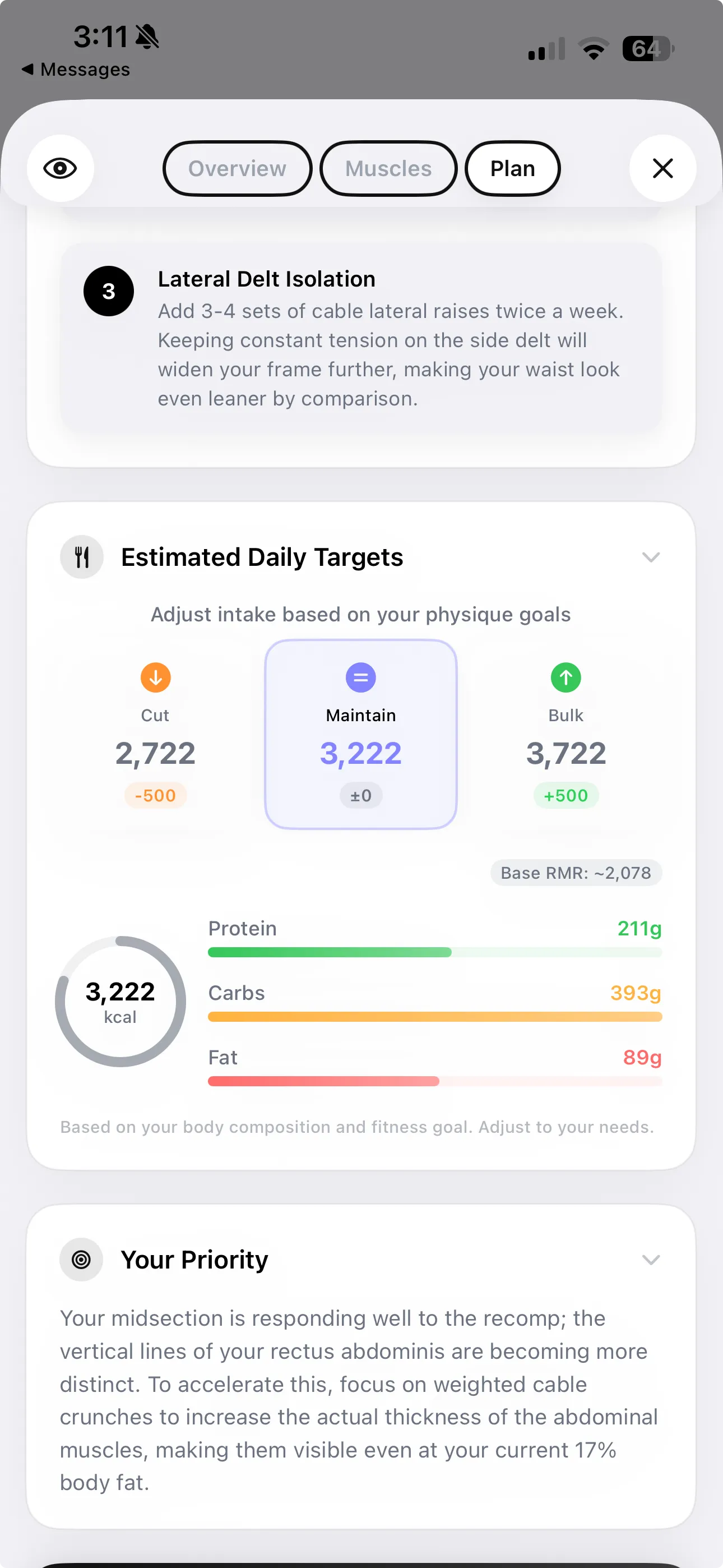
Personalized macro targets and an AI training recommendation calculated against the user's actual goal, body composition, and recent training history. The numbers shown change when the data changes — that's the test.
What does real personalization look like in a working product?
GainFrame's Coach is one example, since I built it. When you ask Coach a question — "why did my score drop this week?" — the app loads, before the model sees the message: your goal (cut/bulk/recomp + visual priority + coaching focus), your last 30 check-ins, your 90-day Apple Health series (sleep average, HRV trend, steps, exercise minutes, full daily nutrition), your Hevy weekly aggregates (sets, reps, total volume per muscle), your most recent body composition score with all four sub-dimensions, your photo for the anchored check-in, and any persistent memory notes from prior conversations.
The model isn't doing more work than ChatGPT. It's reading more context. The answer it gives has your numbers in it because the numbers were attached to the question.
Because it holds your history, the Coach can also compare points in time, not just read the present. Ask it to look at two check-ins six weeks apart and it surfaces your biggest movers — which muscle groups climbed, which softened — and reads the change against your goal. A general chatbot can't do this. It never saw last month's check-in.
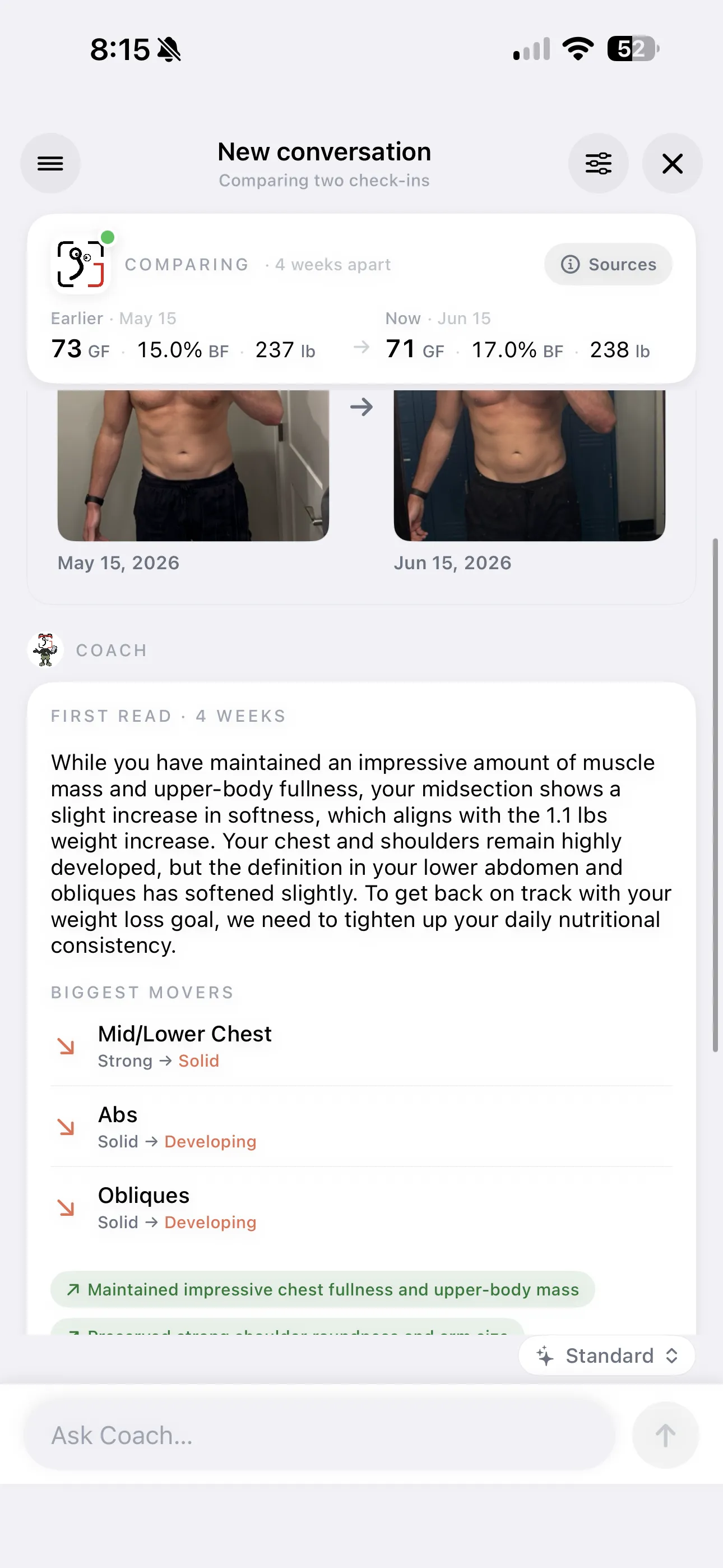
Coach comparing two check-ins six weeks apart — narrative plus the biggest movers by muscle group.
This isn't unique to GainFrame. Other apps that own this layer (Trainerize for the coaching-platform side, Fitbod for the workout-only side, Athletica for endurance) all do the same thing in their respective domains. The architecture is what makes the personalization real, not the brand. If you're shopping AI fitness apps, look for the architecture before you look at the marketing.
Quick checklist: Is your AI fitness coach actually personalized?
- Connects to at least one external data source (Apple Health, Google Fit, Hevy, Strong, Strava, MyFitnessPal). If it only knows what you typed during onboarding, it's not personalized.
- References your specific numbers (your weight, your last bench, your sleep average) in answers — not generic ranges.
- Remembers between sessions without you re-pasting context. Test by sharing a fact in one session and checking next session.
- Has a stored history layer (workouts, photos, biometrics) that you can browse independently of the chat — meaning the data is real, not just narrative.
- Tells you what data it's using to generate an answer — transparency is the proof.
A coach that passes 5 of 5 is genuinely personalized. 3 of 5 is partial. Below 3 of 5 is template selection with a chat skin on top.
Frequently Asked Questions
What does "personalized AI fitness coach" actually mean?
It depends on the app. The weak version is "we asked you three onboarding questions and the AI plugs them into a generic template" — most apps that claim personalization mean this. The strong version is "the AI has access to your real training history, your sleep and HRV, your body composition trend, and your stated goals, and uses all of that on every question." These are very different products despite the same word.
How do I know if an AI fitness coach is actually personalized?
Three quick tests. First, does the app pull data from Apple Health, Google Fit, Hevy, Strava, or another data source — or does it only know what you typed during onboarding? Second, does the AI's answers reference your specific numbers (your last bench, your sleep average, your body fat trend) or does it give generic advice? Third, if you ask "what are you using to answer this?" does it cite real data sources or just say "based on your goals"?
What data does a real personalized AI fitness coach need?
Five categories. (1) Goal — cut, bulk, recomp, and the visual priority. (2) Training history — workouts, sets, reps, volume by muscle. (3) Body composition — weight, body fat estimate, and ideally photos over time. (4) Recovery and lifestyle — sleep, HRV, steps, nutrition macros. (5) Persistent memory — facts about you (injuries, gym access, time constraints) that the AI keeps across sessions. Apps that have all five can be genuinely personalized. Apps that have one or two are mostly decorating a generic plan.
Is ChatGPT a personalized AI fitness coach?
Only as personalized as you make it in each conversation. ChatGPT has a memory feature that retains some user-stated facts, but it has no automatic access to your workout app, sleep tracker, or body composition data. The personalization is entirely on you to provide and re-provide. For one-off questions this is fine. For continuous personalized coaching across months, ChatGPT is structurally not built for it.
How is GainFrame's Coach personalized differently?
GainFrame's Coach automatically loads — on every question — your stated goal, your last 30 check-ins, your 90-day Apple Health series (sleep, HRV, steps, exercise minutes, daily nutrition macros), your Hevy weekly training volume, your most recent body composition scoring, and any persistent memory notes from prior conversations. None of this requires you to re-paste anything. The personalization is built into the data layer, not the conversation.
Why don't more AI fitness apps offer real personalization?
Because real personalization is hard work. Building integrations with HealthKit, Google Fit, Hevy, and Strava takes months. Storing photo histories with on-device pose classification takes infrastructure. Maintaining a privacy-friendly memory system takes legal review. Most apps ship the cheap version (a few onboarding questions plugged into a template) because it's faster to market. The apps that ship the real version are usually built by lifters who needed it themselves.
Is more personalization always better?
No. More personalization is better only when the data is high-quality and the user actually wants the depth. For someone who lifts twice a week and asks the AI for a split, generic advice is sufficient and easier to follow. For a recomp-focused intermediate lifter who wants to know whether their training is moving the right metrics, deep personalization is the difference between useful coaching and noise. Match the depth to the goal.
Where to go next
For the broader question of when AI coaches genuinely work and when they don't, see Do AI Fitness Trainers Actually Work. For the specific ChatGPT comparison, see AI Fitness Coach vs ChatGPT. For an end-to-end product example of an AI fitness coach with real data integration, see Meet Coach and our case study on smart Hevy integration — the workout-data side of the personalization layer.