
Quick answer: Weight regain after stopping GLP-1 medications is commonly reported in research — appetite returns as the drug's effect fades. What the regain is made of depends on what you kept: if you maintained muscle through training and protein, regain skews less toward fat. Plan any transition off medication with your prescriber.
Say you lost 45 lb on semaglutide, stopped in the spring, and by mid-summer the scale is up 8 lb. That number tells you almost nothing. Eight pounds could be water and glycogen returning as you eat more normally, muscle rebuilding because you kept training, fat coming back as appetite does — or, most likely, some mix the scale has no way to separate.
One thing up front: none of this is medical advice, and nothing here is a reason to start, stop, or change a medication. Those decisions belong to you and your prescriber. What this post covers is the part an app roundup writer can actually speak to — the measurement problem. The composition of regain is where the story gets more useful than the headlines, and it's the part you can watch.
What commonly happens after you stop a GLP-1?
The mechanism runs in reverse. GLP-1 medications suppress appetite and slow gastric emptying while you take them; when you stop, those effects fade, and hunger signaling commonly returns toward where it was before treatment. Research on discontinuation generally reports that some regain follows for many people — the magnitudes vary widely by study, dose history, and follow-up length, so treat any specific percentage you've seen quoted with caution.
That's the expected biology of the medication wearing off, and clinicians commonly frame it exactly that way. The regain question that gets far less attention is the one the scale can't answer: what is the returning weight made of?
Why does the composition of regain matter more than the amount?
During rapid weight loss — GLP-1-assisted or otherwise — some of what's lost is commonly lean mass, especially without resistance training and adequate protein. We covered that side in depth in our GLP-1 muscle loss guide. Discontinuation is where that detail comes due.
The pattern commonly described in body composition research: when weight lost as a mix of fat and muscle comes back without training and protein in place, it tends to return as proportionally more fat than what left. Lose 40 lb of mixed mass, regain 20 lb of mostly fat, and you can land at a heavier body fat percentage than the scale math suggests — sometimes with less muscle than you started with.
Which flips the priority. The muscle you kept during treatment is the asset that matters after it. Muscle holds your strength, your metabolic rate contribution, and your shape — and it's the reason two people who regain the same 10 lb can look and feel completely different. Protecting it while losing was step one (our GLP-1 muscle tracking apps roundup covers that stack). Keeping it through the transition is step two.
What does a transition plan commonly look like?
None of this is a prescription — it's the set of themes that come up again and again when people plan discontinuation with their clinicians:
- A maintenance-calorie transition. Appetite returning into a total vacuum of structure is the commonly cited failure mode. People often work out a maintenance intake target with their clinician or a dietitian before stopping, so "eat when hungry" has a reference point.
- Resistance training that doesn't pause. Training protected muscle during the loss; it's commonly described as the single biggest lever for keeping regain lean-tilted rather than fat-tilted. Two to three sessions a week, continued straight through the switch.
- Protein held at treatment levels. The intake that protected muscle on the way down — commonly discussed in the 1.2–1.6 g/kg range, personalized by a clinician — doesn't stop being useful the day the medication does.
- Scheduled follow-up. Clinicians commonly want to see how the first months off medication go. The tracking below gives you something concrete to bring.
What should you track in the first months after stopping?
The transition is exactly the situation where weight is at its least informative — water, glycogen, muscle, and fat can all be moving at once. Three signals separate them:
- A weekly progress photo, same pose and lighting. Fat regain shows up visually at the waist first; muscle rebound shows up as shape returning to shoulders and arms. Photos are the cheapest composition signal that exists.
- A waist measurement. The tape tracks the fat-specific trend the scale muddles — a stable waist during a small weight rise is a very different story from a growing one. Recomp readers know this signal from losing inches without losing weight; it works in reverse too.
- Strength numbers. Lifts holding or climbing at stable effort suggest your lean mass is intact. It's the earliest warning system available, months ahead of any scan.
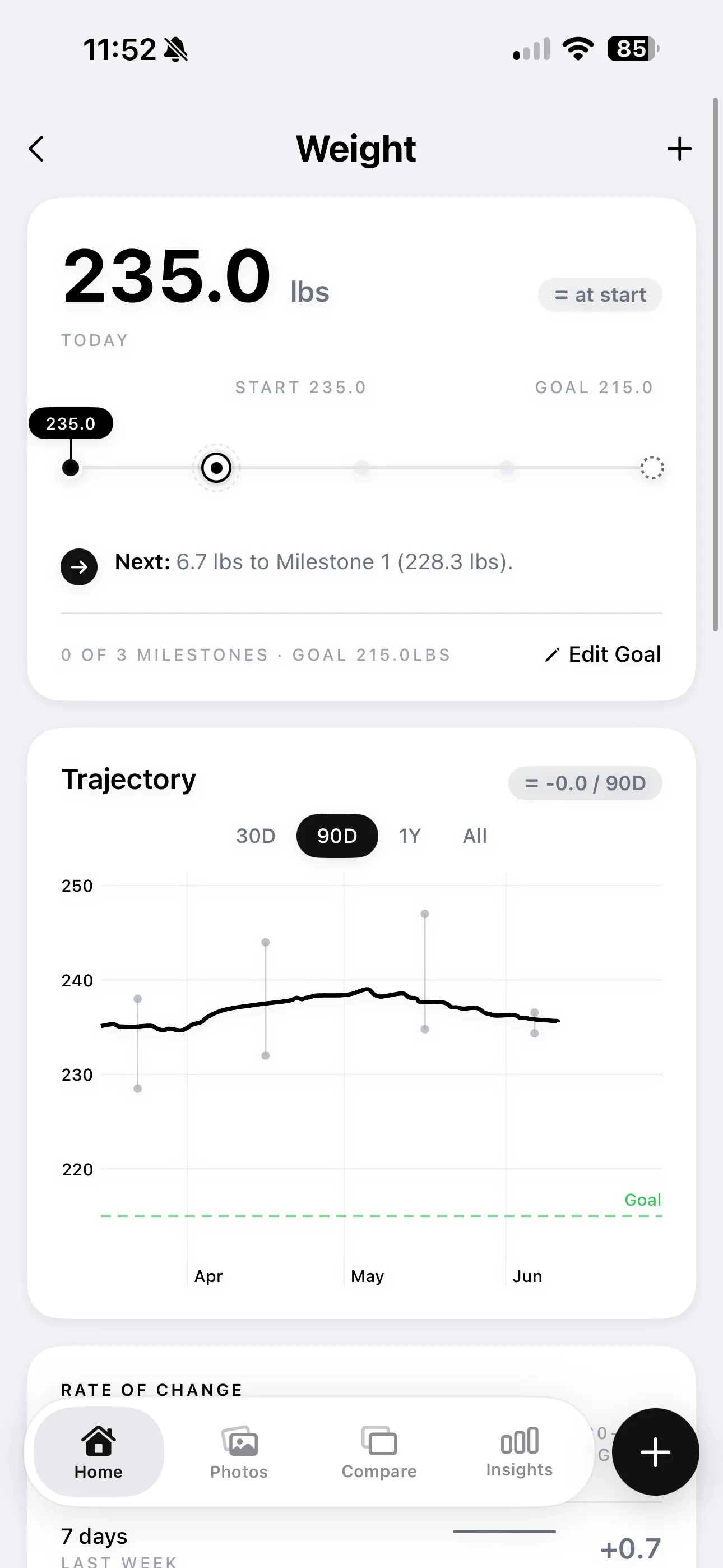
The trend view matters more than any single weigh-in — a two-pound drift is a data point, a six-week slope is a signal.
The point of weekly tracking is catching drift while it's small. A 3 lb fat regain spotted in week four is a conversation with your prescriber and a food-log review. The same trend discovered six months later is a much bigger project. GainFrame automates the photo side of this — estimated body fat %, FFMI, and 12 muscle-group scores from each weekly check-in, with weight and milestones tracked alongside — and our Ozempic tracking guide covers the full method with or without an app.
Is needing ongoing treatment a failure?
The framing worth stealing from clinicians: obesity is commonly described in medicine as a chronic condition, and chronic conditions are managed, the same way blood pressure or asthma are. Nobody describes a person whose blood pressure rises after stopping medication as lacking discipline. The biology of appetite regulation works the same way — regain after stopping reflects a mechanism reversing, far more than a character flaw.
So if the trend data you collect leads you and your prescriber to resume treatment, that's the system working: you measured, you saw the signal early, you acted on information. The muscle you protected and the tracking habit you built carry forward either way — those are yours regardless of what the prescription says.
Frequently asked questions
Do you regain weight after stopping Ozempic or other GLP-1s?
Research on GLP-1 discontinuation commonly reports that some weight returns after stopping, because the appetite suppression that drove the loss fades as the medication leaves your system. How much varies widely by person, dose history, and which habits carry forward. Whether and how to stop is a decision to make with your prescriber, along with a plan for the transition.
Why does regained weight after a GLP-1 tend to be more fat?
It doesn't have to be, and the commonly described pattern explains why: if lean mass was lost during rapid weight loss and regain happens without resistance training and adequate protein, the weight that returns tends to be proportionally more fat than what was lost. Training and protein — during treatment and after — are the levers commonly credited with changing that outcome.
How can you keep weight off after stopping semaglutide?
The approaches people commonly discuss with their clinicians: a gradual transition to maintenance calories instead of an abrupt jump, resistance training that continues uninterrupted through the switch, protein intake held at the level that protected muscle during treatment, and tracking that catches drift early. None of this is a guarantee — regain has biological drivers — which is why prescriber follow-up matters.
What should you track after coming off a GLP-1 medication?
Three signals cover it: a weekly progress photo, which shows whether any regain is fat, muscle, or water; a waist measurement, which tracks the fat-specific trend; and your strength numbers in the gym, which confirm muscle is holding. Weight alone can't tell a five-pound muscle rebound from a five-pound fat regain — the composition signals can.
Is needing to go back on a GLP-1 a personal failure?
Clinicians commonly describe obesity as a chronic condition, and ongoing medication for a chronic condition is management — the same way it is for blood pressure. Regain after stopping reflects biology, appetite signaling returning as the medication fades, far more than willpower. If weight comes back after stopping, that's information to bring to your prescriber, and it carries no verdict on you.
See what your weight change is made of
GainFrame scores your weekly photos — body fat, FFMI, and 12 muscle-group ratings — so a shifting scale number comes with a composition verdict attached. Free to start on iOS.
Download GainFrame Free