
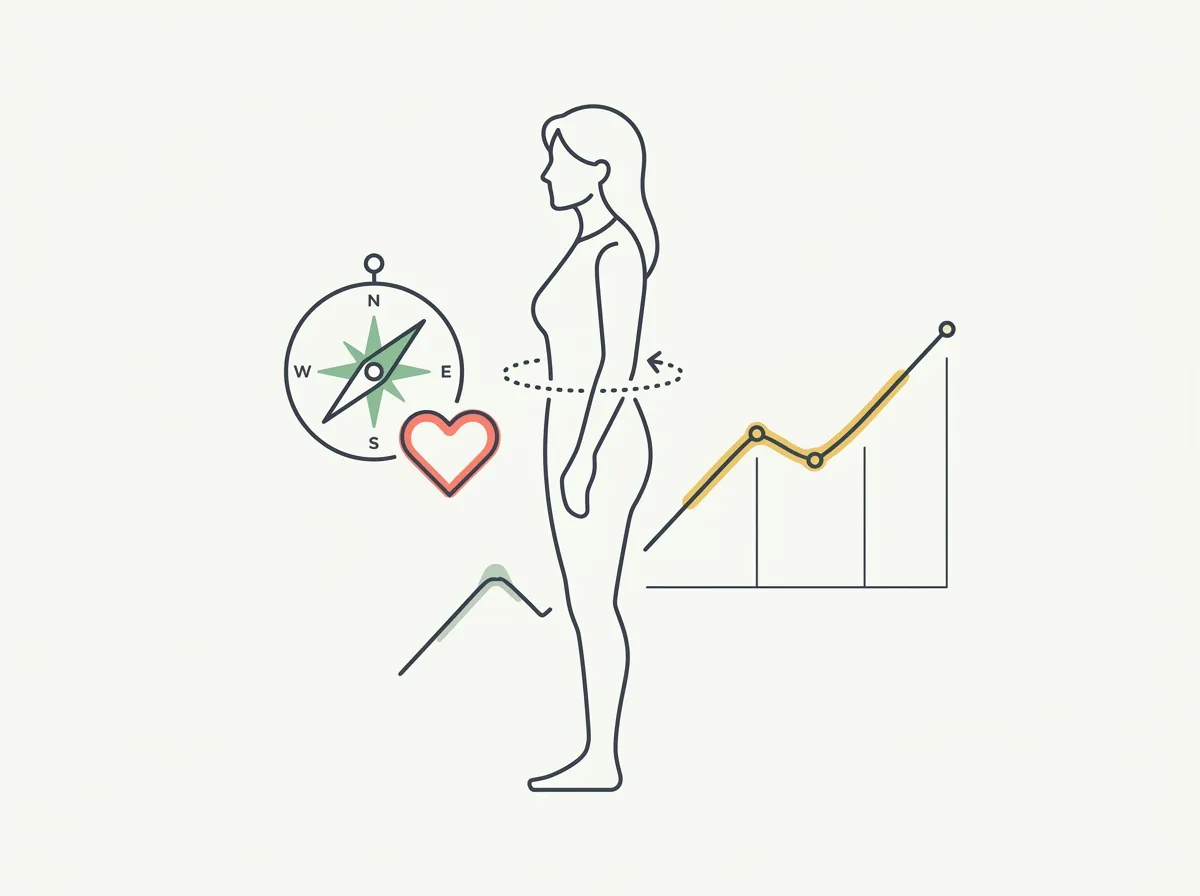
Quick answer: Menopause commonly shifts fat storage toward the abdomen and accelerates age-related muscle loss, even when scale weight barely changes — research links both to declining estrogen. Resistance training and adequate protein are the most consistently supported counters. Track composition with photos, waist measurements, a strength log, and periodic DEXA, and discuss changes with your clinician.
Your weight is within a few pounds of where it's been for a decade. But your waistbands disagree, your arms feel different, and the mirror is reporting something the scale refuses to acknowledge.
You're not imagining it, and nothing is wrong with your tracking. Menopause changes body composition more than it changes body weight — which makes this one of the few life stages where the bathroom scale is close to the worst available instrument. This guide covers what research commonly reports, what's consistently supported as a response, and what's actually worth measuring.
Not medical advice. This article is about measurement and general findings from published research — it is not a substitute for professional care. Menopause is individual, magnitudes vary widely between women, and decisions about hormones, medication, training, or diet during this transition belong in a conversation with your clinician.
What happens to body composition during menopause?
Two changes show up repeatedly in the research, and both can happen with little or no movement on the scale.
Fat storage shifts toward the abdomen. Before menopause, estrogen appears to direct fat preferentially to the hips, thighs, and buttocks. As estrogen declines through the transition, research commonly reports that storage shifts toward the midsection — including visceral fat, the kind stored around the organs. Total body fat may rise somewhat, but the redistribution is often the more noticeable change: similar weight, different shape.
Age-related muscle loss accelerates. Everyone loses muscle gradually with age — the process is called sarcopenia. Studies of the menopausal transition commonly report an acceleration around this window, plausibly connected to the same hormonal changes. The reported magnitudes vary considerably between studies and individuals, so treat any specific number you read skeptically. The direction, though, is consistent.
Neither change is a personal failing, and neither is destiny. Both respond to training. But both are nearly invisible to a bathroom scale — losing a pound of muscle while gaining a pound of abdominal fat reads as zero change on the only instrument most people use.
Why does the scale hide what's actually changing?
The scale measures total mass. It cannot tell you what that mass is made of or where it sits — and during menopause, "what it's made of" and "where it sits" are precisely the things changing.
Consider what the commonly reported pattern looks like in practice. A woman's weight drifts up perhaps a few pounds over several years — unremarkable, easy to dismiss. Underneath that flat trend: some muscle lost, somewhat more fat gained, and a meaningful share of that fat relocated to the abdomen. The scale saw almost none of it. Her clothes saw all of it.
This is exactly the situation where visual and strength tracking beat weight. Composition change is visible in photos and measurable at the waist long before it moves the scale meaningfully — and muscle, the thing most worth protecting, shows up in strength numbers, which the scale can't see at all.
The two renders below make the point. Both are the same woman in her 50s, standardized pose and lighting, at roughly 27% and 37% body fat.
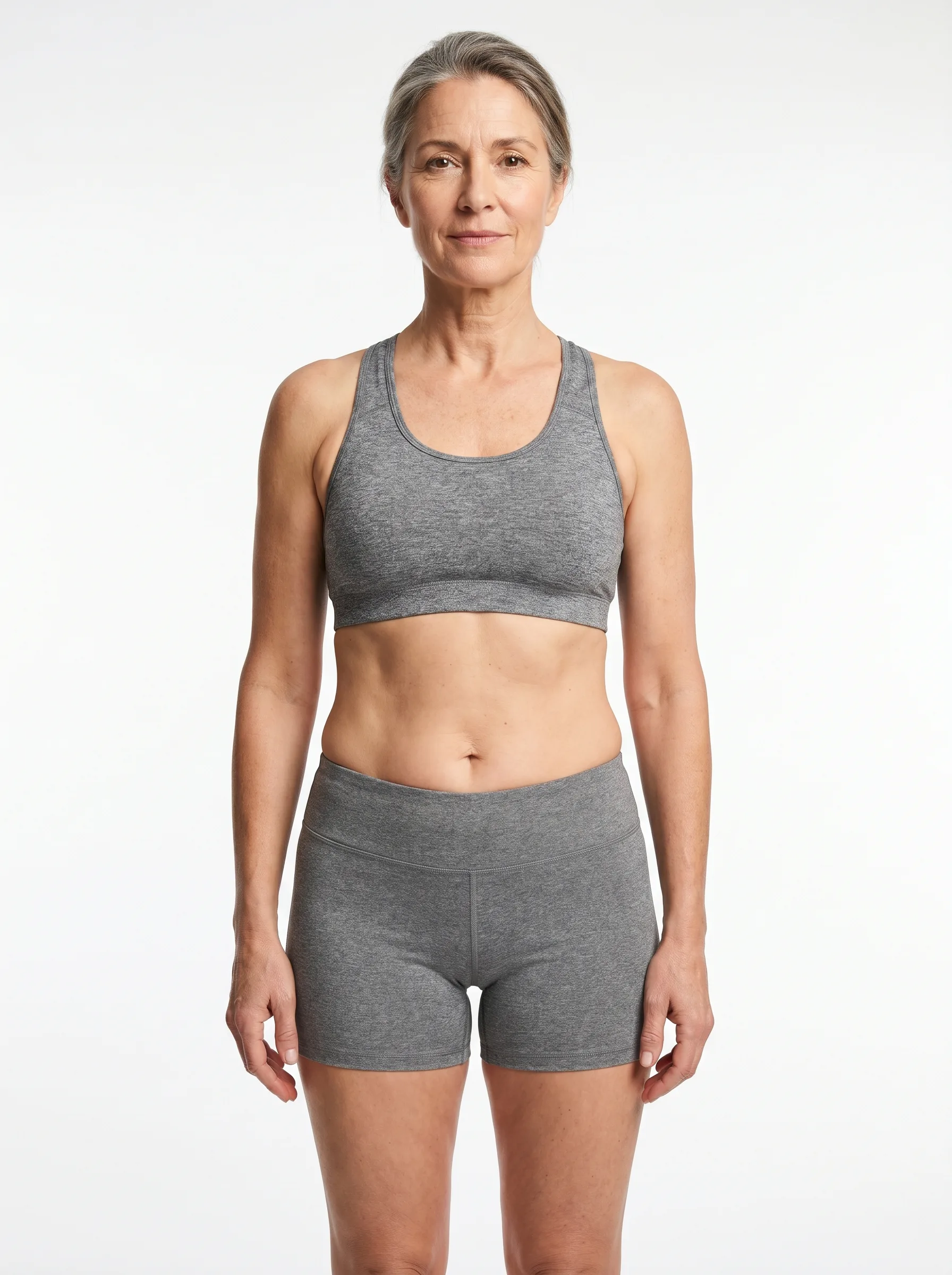
Around 27% body fat — a healthy, common range. Fat sits mostly in the hips and thighs, the premenopausal storage pattern.
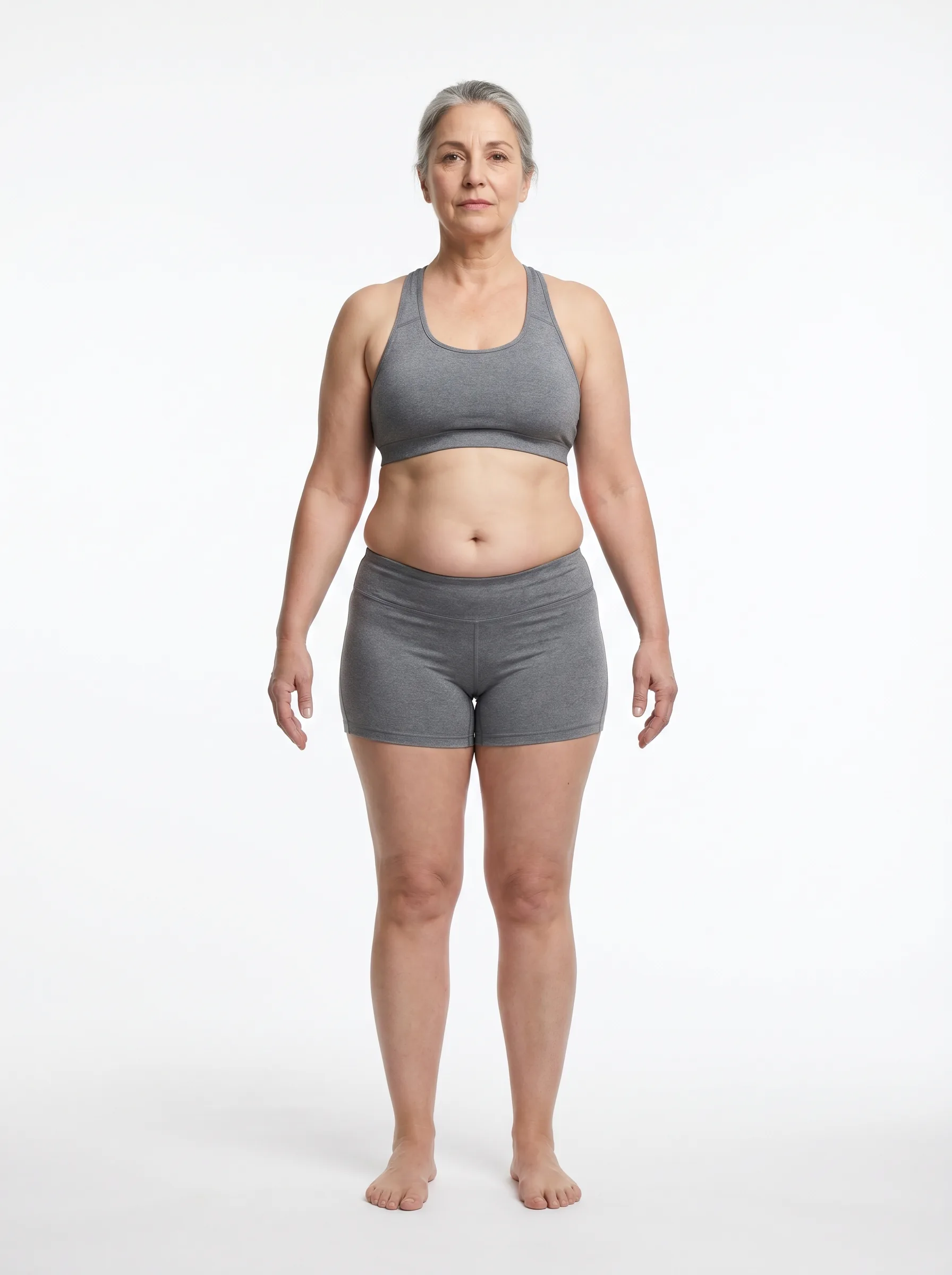
Around 37% — note where the change concentrates: the midsection and trunk, the storage pattern research commonly associates with declining estrogen. This is distribution, not a character flaw.
Ten percentage points of body fat is a large difference — and yet on a scale, depending on muscle changes underneath, it could present as a surprisingly modest number. Where you sit relative to peers is context too: our average body fat percentage by age breaks down the typical ranges by decade.
What actually helps, according to research?
Amid a lot of contested menopause advice, two interventions are supported with unusual consistency — and they work at every age, including well past menopause.
Resistance training. Study after study reports that postmenopausal women who lift build muscle and strength meaningfully. The response may be somewhat slower than at 25, but it is real, and for women who never trained before, the early gains are often striking. Two to three sessions a week of progressively harder lifting is the pattern most programs in the research resemble. This is the same engine behind body recomposition for women at any age — the fundamentals don't expire.
Adequate protein. Protein needs appear to matter more with age, not less — commonly cited guidance for older adults preserving muscle runs higher per pound than for the general population, and intake tends to drift down exactly when it should drift up. There's no single magic number; a clinician or dietitian can set a personal target.
Beyond those two, evidence quality drops off quickly. Hormone therapy is a legitimate clinical option with individual trade-offs — squarely a clinician conversation, not a fitness-blog one. Sleep and stress plausibly matter for abdominal fat specifically, though magnitudes are hard to pin down. Supplements marketed at "menopause belly" are, as a category, well ahead of their evidence.
What should you track during menopause?
If the scale can't see the changes that matter, the fix is a small set of measurements that can. None takes more than minutes.
- Monthly progress photos. Same pose, same distance, same lighting, front and side. Composition and distribution changes are visible in consistent photos months before they're obvious any other way — and a photo record gives you objectivity on days the mirror is unkind.
- Waist measurement. A tape at the navel, monthly, tracks the abdominal shift directly. Research commonly treats waist circumference as a more useful health signal than weight in this life stage.
- A strength log. Whatever you lift, write it down. Rising or stable numbers are the clearest practical evidence you're keeping muscle. Falling numbers at equal effort are an early flag worth acting on.
- Periodic DEXA (optional). A DEXA scan gives clinical-grade fat mass, lean mass, and regional distribution — genuinely useful once or twice a year as an anchor, and worth bringing to your clinician. If cost or access is a barrier, our DEXA alternatives guide ranks the options honestly.
For the photo side, this is the problem GainFrame is built around: weekly or monthly photo check-ins, auto-aligned comparisons, and an estimated body fat trend over time — estimates, not clinical measurements, but consistent ones, which is what trend-tracking needs. The same logic applies to anyone tracking composition through a body change the scale misreads — it's why we recommend photo tracking on GLP-1 medications too, where the scale is equally blind to what the loss is made of.
A simple starting framework
- Take a baseline this week. One front photo, one side photo, consistent conditions. Waist measurement at the navel. Whatever weights you currently lift, logged.
- Start or continue resistance training, 2–3 times a week. Progressive, full-body, any sane program. If you're new to lifting, a session or two with a qualified trainer is money well spent.
- Get protein at most meals. Discuss a personal daily target with your clinician or a dietitian, especially if you have kidney or other health considerations.
- Re-measure monthly, not daily. Photos, waist, strength. Judge trends over months — this transition plays out over years, and single data points mislead.
- Bring the data to your clinician. A photo timeline, a waist trend, and a strength log make for a far more productive appointment than "my weight's the same but I feel different."
The scale's verdict through menopause is mostly noise. The signal is in composition — and composition shows up in photos, at the waist, and under the bar long before it shows up anywhere else.
Frequently asked questions
Why does menopause cause belly fat?
Research commonly links the shift to declining estrogen, which appears to change where the body preferentially stores fat — away from the hips and thighs and toward the abdomen. Total weight may not change much; the distribution does. The magnitude varies substantially between individuals, and factors like sleep, stress, activity, and genetics all contribute. A clinician can help interpret your specific situation.
Does menopause cause muscle loss?
Age-related muscle loss (sarcopenia) happens gradually in everyone, and research commonly reports it accelerates around the menopausal transition, likely related in part to declining estrogen. It is not inevitable in any fixed amount: resistance training and adequate protein are the two counters most consistently supported by research at every age, including during and after menopause.
Can you do body recomposition after menopause?
Research consistently supports that postmenopausal women can build muscle and lose fat with resistance training and adequate protein — the response may be somewhat slower than at younger ages, but it is real and meaningful. Many women see their most visible strength and composition improvements after 50 precisely because they had never trained for muscle before.
Why is my weight the same but my body looks different after menopause?
Because composition can shift while mass stays stable — commonly reported as gradual muscle loss alongside fat gain and a redistribution of fat toward the abdomen. The scale measures total mass only, so it can read "no change" through a meaningful change in what that mass is made of. Photos, waist measurement, and strength numbers catch what the scale misses.
What should I track during menopause instead of weight?
Four signals cover the picture: monthly progress photos in consistent conditions, a waist measurement (which tracks the abdominal shift directly), a simple strength log (which reflects muscle), and an optional periodic DEXA scan for clinical-grade numbers. Together they show composition change the scale can't — and give your clinician far better information than weight alone.
Is weight gain during menopause dangerous?
Not automatically — modest changes through the transition are common and widely reported. Health risk appears tied less to total weight and more to abdominal (especially visceral) fat and to muscle loss, which is why composition tracking matters more than the scale here. If your waist measurement is climbing steadily or you have health concerns, that's a conversation for your clinician.
Track composition, not just weight
GainFrame turns consistent photos into a body composition trend — estimated body fat, auto-aligned comparisons, and a visual timeline you can actually bring to your clinician. Free to start on iOS.
Download GainFrame Free