
Quick answer: Researchers haven’t established a day when everyone starts losing muscle after they stop lifting. A small bench press study found no significant change in chest or triceps size after three weeks off. Another study measured smaller muscles and lower strength after ten weeks off. Neither study identifies the day loss begins.
Your last arm photo was a Friday night shot after curls. Ten days into a trip, you take another one in a hotel bathroom. Your sleeves look looser. Even if those ten days included plenty of walking and no lifting, you still need a fair comparison. What did your arm look like on Friday before the curls?
What happens if you miss one, two or three weeks of lifting?
For a week or two away, there is little you can conclude from the calendar alone. One useful comparison comes from 15 young men who were new to lifting. Some trained the bench press continuously. The others trained for six weeks, took three weeks off, then resumed. Researchers used MRI to measure a cross section of the chest and triceps and tested the heaviest bench press each man could complete for one rep. Ogasawara and colleagues' bench press study.
The researchers detected no significant decline in those measurements over the three-week break. With only part of a small group taking the break, modest changes could have gone undetected. The finding applies to those muscles and that lift. It gives you no reason to treat the first day of week four as a deadline.
How much changed during ten weeks off?
In a longer trial by Eeli Halonen and colleagues, 42 adults with little previous lifting experience completed the comparison. Twenty trained for ten weeks, took ten weeks off and then trained for another ten weeks. The other 22 trained for twenty consecutive weeks. During the break, participants went about daily life and were asked to avoid resistance training, endurance training and unfamiliar exercise. Halonen and colleagues, study design and Table 3.
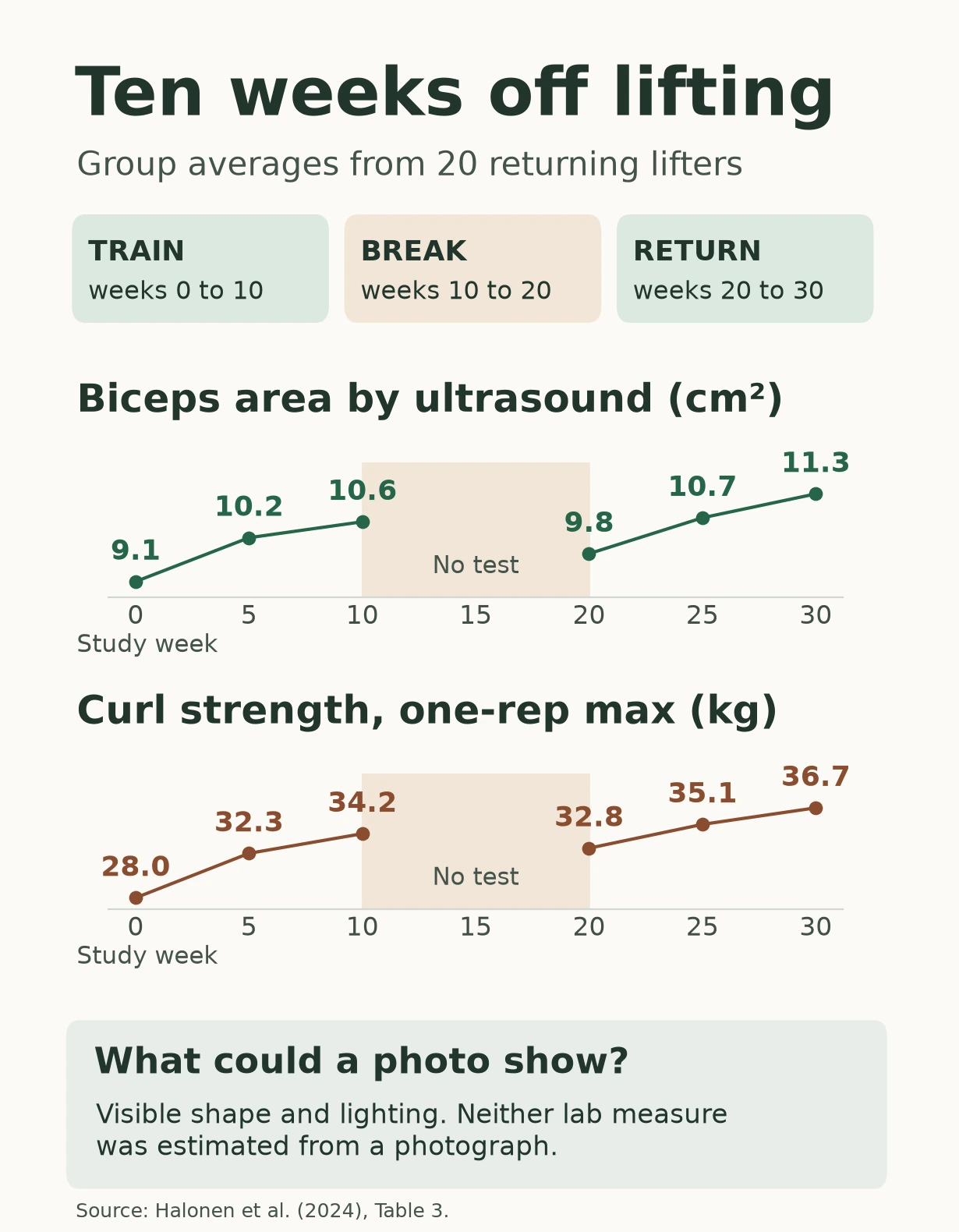
Each dot is a test in the group that took a break. The gap between weeks 10 and 20 shows where there were no tests.
Size. Ultrasound measured the area of a slice through the biceps. The group averaged 10.6 cm² before the break, 9.8 cm² at the end of it and 10.7 cm² after five weeks back. That measurement describes one slice of one muscle. You cannot convert it into pounds of muscle lost across the body.
Strength. The same group's average one-rep curl went from 34.2 kg before the break to 32.8 kg afterward, then to 35.1 kg five weeks into retraining. Their starting average before any training was 28.0 kg. They came back able to lift more than when they first started, even after the dip.
Five weeks back was the first scheduled return test. The pre-break and five-week return measurements did not differ significantly at the group level. Your own return could take a different amount of time. Experienced lifters, people recovering from illness and people with an immobilized limb had different circumstances from these volunteers.
Why do your muscles sometimes look smaller before your lifts change?
A post-workout pump can change the comparison before you've missed a single session. In an experiment with trained adults, researchers used ultrasound before and immediately after four sets of curls. The exercising group had thicker arm muscles after the sets. The group that rested showed no corresponding increase. Yitzchaki and colleagues' acute swelling experiment.
Check the timestamps in your camera roll. If the earlier shot came after training, label it and find a pre-workout shot to use as your reference. For the next picture, use the same room, camera height, distance and relaxed pose.
You can line up the two photos using your shoulders as a landmark. Compare the outline you can see. Even a well-matched pair cannot tell you how much muscle tissue you have lost.
What should you write down when you return?
Find the last ordinary working set you recorded before the break. Choose a familiar lift with a setup you can repeat. On your return, select a manageable load, record how many clean reps you complete and estimate how many more you could do with the same form. There is no need to test a maximum to start a log.
Here is a fictional return log for one person using the same seated row machine, seat setting and handle each time. These numbers illustrate how to compare sessions.
| Session | Working set | What the lifter wrote |
|---|---|---|
| Before the trip | 40 kg × 9 | About 3 reps left |
| First day back | 35 kg × 9 | About 3 reps left. Chose a lighter load. |
| Next visit | 40 kg × 8 | About 2 reps left |
| Following visit | 40 kg × 9 | About 3 reps left, same range of motion |
The first return set answered “What feels manageable today?” The lifter chose 35 kg, so the entry alone tells you nothing about whether 40 kg was possible. The last row is a better comparison. It matches the old load, reps, range and reported effort. That is evidence of recovering performance on the row. It still leaves the amount of muscle gained or lost open.
A line in your own log can be as simple as date / exercise and setup / load / reps / reps left / anything different today. If you want a visual record, take a relaxed photo before your first session back. Match it at a later check-in and read it alongside your sets. Our muscle-gain tracking guide covers how to add a consistent tape measurement when that would help.
What else should you know about a lifting break?
Will I lose muscle after two weeks off lifting?
Two weeks away from your usual routine gives you little evidence on its own. A small three-week break study in new lifters found no significant decline in the chest and triceps measurements it tracked. If you feel smaller, check whether your reference photo was taken after a workout and how a familiar lift feels when you return.
Does a weaker first workout mean I lost muscle?
A first workout tells you what you did that day. A different machine, a shorter rest or a more cautious effort can change the numbers. Write down the setup and repeat a manageable working set on another visit. Several comparable entries make it easier to judge whether performance on that lift has actually changed.
Can I use a progress photo to measure muscle loss?
You can compare how your shape looks in two photos. Take both before training with similar lighting, camera position and posture. Even with those controls, a picture cannot isolate muscle tissue from everything else in the frame or measure its cross-sectional area. Keep your photo dates alongside your training log so you can review both.
How long does it take to regain muscle after a break?
In the ten-week break trial, the first test five weeks into retraining found average size and strength back around their pre-break levels. Each participant had been relatively new to lifting at the outset. How long your own return takes depends in part on what you were doing before the break and what you can consistently do afterward.
Is recovering from an injury the same as taking a holiday from lifting?
The volunteers in the longer study could go about daily life during their break. A cast, bed rest or surgery can change how much you can move or load a limb. The holiday comparison gives no return date for that situation. If you have activity restrictions, follow your care team’s guidance about when and how to reload it.
Compare your return photos
Choose the last comparable photo before your break and one from a later check-in. Line up the shoulders and check the pose before judging the difference.
Open Progress Photo Compare