
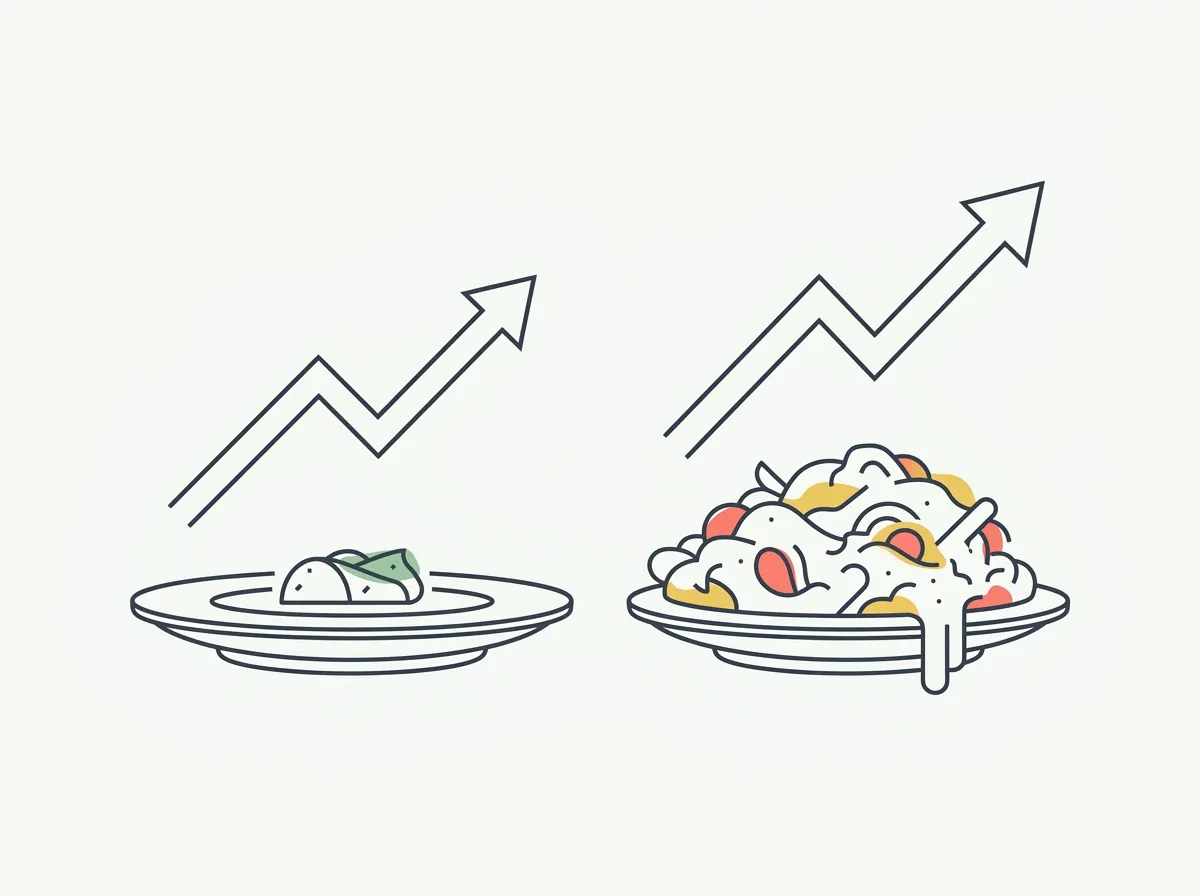
Quick answer: A lean bulk runs a modest surplus (~200–400 calories) for slow, mostly-muscle gain; a dirty bulk eats big and gains fast — but muscle growth has a rate ceiling, so the extra speed is mostly fat. For most lifters the lean bulk wins on total cost. The honest exception: true hardgainers who otherwise can't gain at all.
Every bulking thread eventually splits into the same two camps. One side says a surplus is a surplus, eat everything, cut later — that's dirty bulking. The other side treats every gram of fat gain as a personal failure and bulks so cautiously they're functionally maintaining.
The argument stays alive because both sides are describing something real. The dirty bulker really does gain weight faster and lift more in the short run. The lean bulker really does spend less of the year fat and less of it dieting. What settles the debate isn't preference — it's the arithmetic of how fast muscle can actually be built, and what happens to every calorie past that line.
What is a lean bulk?
A lean bulk (or clean bulk — the terms are used interchangeably) is a deliberately small calorie surplus, commonly around 200–400 calories over maintenance, aimed at a gain rate commonly cited around 0.25–0.5% of body weight per month for trained lifters — roughly half a pound to a pound a month at 180 lbs. Novices can run the top of that range or above, because untrained muscle grows fastest.
The logic: muscle growth is slow no matter what you eat, so the surplus only needs to be big enough to support the maximum rate your body can build at. Everything above that is padding. The trade-off is patience — the scale crawls, progress is invisible week to week, and you have to trust the process for months. The full setup — calories, protein, meal structure — is in our lean bulk setup guide; this post stays on the comparison.
What is a dirty bulk?
A dirty bulk drops the precision entirely: eat big, eat often, don't count too hard, and let the scale run. Surpluses commonly land north of 700–1,000 calories — sometimes far north, since nobody's counting — with weight gain of a pound or more per week. The food quality usually slides too; when the target is "more," the path of least resistance is calorie-dense everything.
The pitch is seductive: strength jumps fast (heavier bodies lift more), the scale rewards you weekly, you always feel full and recovered, and there's a certain freedom in not weighing rice. The pitch leaves two things out — where most of those calories actually go, and what it costs to undo them. That's the next two sections.
The physics both camps have to obey
Here's the part that isn't a matter of opinion. Muscle protein synthesis has a rate ceiling — your body can only build muscle so fast, commonly estimated at roughly 0.25–0.5% of body weight per month for lifters past the novice window, somewhat higher for beginners, and slower the more advanced you get. Training drives that rate; calories merely permit it.
That single fact decides most of the debate. Once your surplus is big enough to fund the maximum building rate, every additional calorie has nowhere productive to go and is stored predominantly as fat. A 1,000-calorie surplus doesn't build muscle at triple the speed of a 300-calorie surplus — it builds muscle at roughly the same speed and banks the difference around your waist. Estimates vary and individual response is real, but no commonly cited estimate puts the trained-lifter ceiling anywhere near what a hard dirty bulk feeds it.
So when a dirty bulker gains 4 pounds in a month against a lean bulker's 1 pound, the extra 3 pounds weren't bonus muscle. They were the invoice.
The hidden cost of a dirty bulk
The fat itself is only half the bill. The other half is time, and it gets paid twice.
You pay it during the bulk. A hard dirty bulk parks you at a body fat level most lifters actively dislike — softer face, no definition, clothes tightening — for months. You're training as hard as you've ever trained while looking progressively less like someone who trains. There's also a commonly discussed (though debated) concern that gaining well past the mid-20s in body fat percentage makes future fat gain easier and the eventual diet harder; the hedged version is simply that nothing good happens past that point that wasn't already happening at 15%.
You pay it again after. Fat doesn't convert to muscle — it has to be dieted off. At the commonly recommended cutting pace of 0.5–1% of body weight per week, 15–20 pounds of surplus fat is three to five months of deficit, during which you build little or nothing and work mainly to keep what the bulk added. Run the full-year accounting and the dirty bulk's speed advantage usually inverts: more months cutting, more months soft, roughly the same muscle. If you're deciding what your next phase should even be, our bulk, cut, or recomp guide walks that decision.
When dirty bulking actually has a case
Steel-manning the other side, because it has a real constituency:
True hardgainers. Some lifters — genuinely, not "I forget lunch sometimes" — struggle to eat enough to gain at all. Small appetite, high activity, fast metabolism, food gets boring. For this lifter, the precision of a lean bulk is solving a problem he doesn't have while ignoring the one he does. If tracking honestly for a month shows the scale flat despite an intended surplus, eating aggressively and imprecisely beats eating precisely and insufficiently. Any bulk beats no bulk.
Novices who can't make the scale move. A beginner's muscle-building ceiling is the highest it will ever be, which makes a generous surplus less wasteful for him than for anyone else. A skinny 19-year-old who has never gained a pound gets more from "eat big, lift, sleep" than from a 250-calorie surplus he'll undershoot half the time.
The honest middle path for both: a generous-but-not-unlimited surplus built mostly on calorie-dense whole food — the "relaxed bulk" — captures most of the dirty bulk's practical advantages while capping the fat bill. The dirty bulk's real virtue was never the junk food; it was the permission to stop under-eating.
What each approach looks like
Abstract percentages, made concrete. These are standardized, photorealistic AI renders from our body fat visualizer — same man, same build, pose, and lighting, so the only variable is body fat. Treat them as illustrative endpoints, not guarantees: where any individual bulk lands depends on the surplus, the training, and the months spent running it.

~13% body fat — the neighborhood a well-run lean bulk keeps you in. Visible definition holds while the scale creeps up; you look like you lift for the entire bulk.
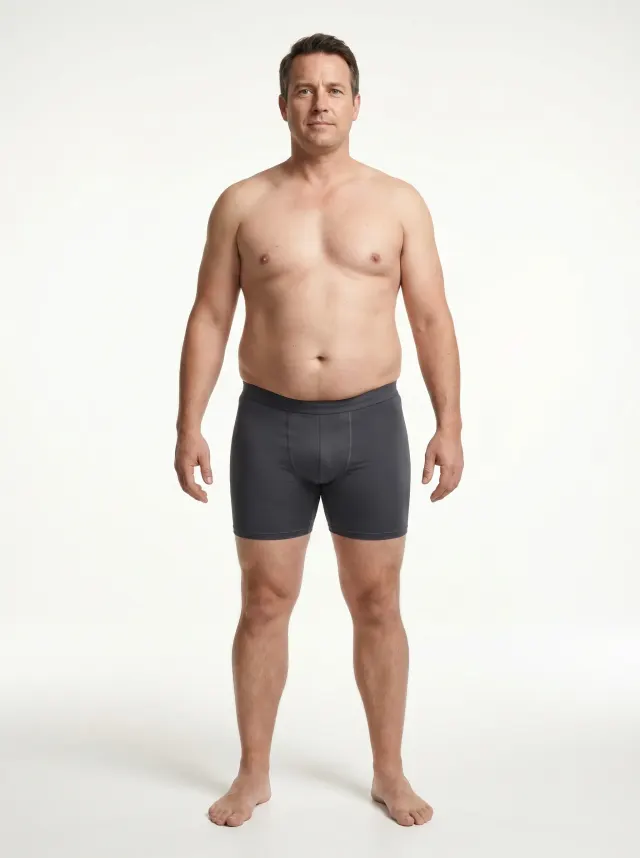
~28% — where a hard, months-long dirty bulk can land. The muscle underneath is real, but nothing about the outline says so, and the cut back from here is measured in months.
Both bodies may be carrying similar amounts of new muscle. Only one of them can see it — and only one of them is months of dieting away from showing it.
Lean bulk vs dirty bulk: the verdict table
| Lean bulk | Dirty bulk | |
|---|---|---|
| Surplus | ~200–400 calories, tracked | 700–1,000+, loosely tracked or untracked |
| Scale gain | ~0.25–0.5% BW/month (more for novices) | 1%+ BW/month, often much more |
| Muscle gained | Near your rate ceiling | Near your rate ceiling — the ceiling doesn't move |
| Fat gained | Small, manageable | Most of the extra weight |
| Look during the bulk | Lean-ish throughout | Progressively softer for months |
| Cut afterward | Short or optional | Commonly 3–5 months |
| Effort profile | Discipline daily (tracking, patience) | Discipline deferred (the cut collects it) |
| Best for | Most lifters past the novice stage | True hardgainers; novices who can't gain |
| Verdict | Default choice | Situational tool |
How to actually run whichever you pick
This post is the comparison; the execution lives elsewhere. If the lean bulk won you over, the lean bulk setup guide covers calories, protein, and meal structure, and is your lean bulk working? covers how to tell muscle from fat once the scale starts moving. Still torn on whether to bulk at all? The 2-minute bulk-or-cut self-assessment settles it faster than another forum thread.
Whichever you run, the failure mode is the same: the scale goes up and you have no idea what the weight is made of. That's the question that decides whether a bulk worked, and it's a visual one. GainFrame estimates body fat percentage and physique scores from progress photos, so you can watch whether the new weight is landing on your shoulders or your waistline — estimates, not a DEXA scan, but consistent week to week, which is exactly what a bulk needs.
Frequently asked questions
Is dirty bulking faster than lean bulking?
Faster on the scale, not meaningfully faster in muscle. Muscle protein synthesis has a rate ceiling — commonly estimated at roughly 0.25–0.5% of body weight per month for trained lifters, more for novices — and calories beyond what supports that rate are stored predominantly as fat. A dirty bulk mostly accelerates the fat, not the muscle.
How much weight should you gain per month on a bulk?
Commonly cited lean-bulk targets are around 0.25–0.5% of body weight per month for experienced lifters and up to roughly 1–2% for novices, driven by a modest surplus of about 200–400 calories. Gaining much faster than that almost guarantees the extra weight is disproportionately fat.
Does dirty bulk fat turn into muscle later?
No. Fat and muscle are different tissues, and one doesn't convert into the other. Fat gained on a dirty bulk has to be dieted off in a cut, during which you'll be working to keep the muscle you built. The fat was never an investment — it's just fat.
How long does it take to cut after a dirty bulk?
At a commonly recommended loss rate of roughly 0.5–1% of body weight per week, every 10 pounds of surplus fat costs roughly 5–10 weeks of cutting. A hard dirty bulk that adds 15–20 pounds of fat can demand three to five months of dieting — often longer than the bulk itself.
Should skinny guys dirty bulk?
This is the one population with a real case. A genuine hardgainer who has tracked honestly and still can't gain weight benefits more from eating aggressively than from optimizing surplus size — for him, any bulk beats no bulk. Even then, a generous surplus with mostly whole foods usually beats a see-food free-for-all.
Know what your bulk weight is made of
GainFrame estimates body fat percentage and physique scores from your progress photos — so you can see whether the scale gain is muscle or padding while there's still time to adjust. Free to start on iOS.
Download GainFrame Free