
Quick answer: Your lean bulk is working if body fat percentage has risen less than roughly one-third of total weight gained, strength on compound lifts trends up week over week, and per-muscle scores show genuine development. The scale going up only tells you you're in a surplus — not what that surplus is building.
You've been eating in a surplus for eight weeks. The scale is up nine pounds. Your bench has gone up ten pounds. You look... maybe a little thicker? Possibly puffier around the midsection? You genuinely can't tell if you've added muscle or if you've just been eating more.
Both explanations fit the data you have — which is the problem.
A scale going up is only evidence that you're in a caloric surplus. It tells you the experiment is running. It does not tell you what the experiment is building. Nine pounds of scale weight could be seven pounds of muscle and two of fat — an excellent bulk. Or it could be two pounds of muscle and seven of fat — a bulk that needs to be cut. The number is the same. The outcomes are completely different.
Knowing which one you're looking at requires measuring something the scale doesn't: body composition.
Why doesn't the scale going up mean your lean bulk is working?
When you eat in a surplus, your body gains both muscle and fat. The ratio between those two things is what determines whether your bulk is efficient or wasteful. A well-run lean bulk might add one pound of fat for every two pounds of muscle — a fat fraction around 33%. A poorly calibrated bulk adds two pounds of fat for every one pound of muscle — a 67% fat fraction. The scale sees nine pounds either way.
The fat fraction depends on three things: the size of your caloric surplus, your protein intake, and the quality of your training. Too large a surplus overwhelms your muscle-building capacity and the excess goes to fat. Too little protein means the building blocks aren't there. Poor progressive overload means the muscle signal isn't being sent. Any of the three being wrong and the scale goes up for the wrong reasons.
This is why the question "is my bulk working?" cannot be answered by the scale alone. You need body composition data — specifically, how much of the weight gained is fat versus lean tissue.
What is an acceptable rate of fat gain during a lean bulk?
Research and practical experience generally align around a few benchmarks for intermediate lifters:
- Weight gain rate: 0.25–0.5 lbs per week (roughly 1–2 lbs per month). Beginners can often sustain slightly higher without excessive fat gain due to accelerated early muscle response. Advanced lifters often need to go slower.
- Fat fraction: roughly 30–50% of total weight gained. If fat makes up more than 60–70% of your weight gain, the surplus is likely too large or protein is too low.
- Body fat ceiling: ending the bulk before body fat exceeds roughly 18–20% for men or 28–30% for women. Above those levels, the calorie-to-muscle conversion becomes less efficient and fat storage accelerates.
Faster is not better. A 500-calorie daily surplus feels productive because the scale moves. But for most intermediate lifters, the rate of muscle protein synthesis is already capped at a level that a 200–300 calorie surplus can fully fuel. The extra 200 calories above that ceiling goes somewhere — and that somewhere is fat.
What are the real signs your lean bulk is actually adding muscle?
Scale weight is a lagging and noisy indicator. These are the signals that muscle is actually being added:
Progressive strength on compound lifts. If your squat, bench, deadlift, and row numbers are trending upward week over week, your muscles are responding. Strength gain is the most reliable real-time signal of muscle growth available without a DEXA scanner. Stalled strength without body fat reduction means neither is happening — something is off.
Visible muscle development in progress photos. Shoulder caps gaining shape. Chest showing separation at higher weights. Arms with more density when flexed. These changes are invisible on a weekly timescale but clear on a four-week comparison.
Body fat percentage rising slowly. If your body fat percentage is up two percentage points after gaining nine pounds, the math suggests the majority of that gain was lean mass. If it's up five points, the opposite is true.
Waist staying relatively contained. A bulk that's adding mostly muscle tends to add girth in the right places — chest, shoulders, arms, legs — rather than primarily the midsection. A waist expanding faster than your shoulders and chest is a fat accumulation signal.
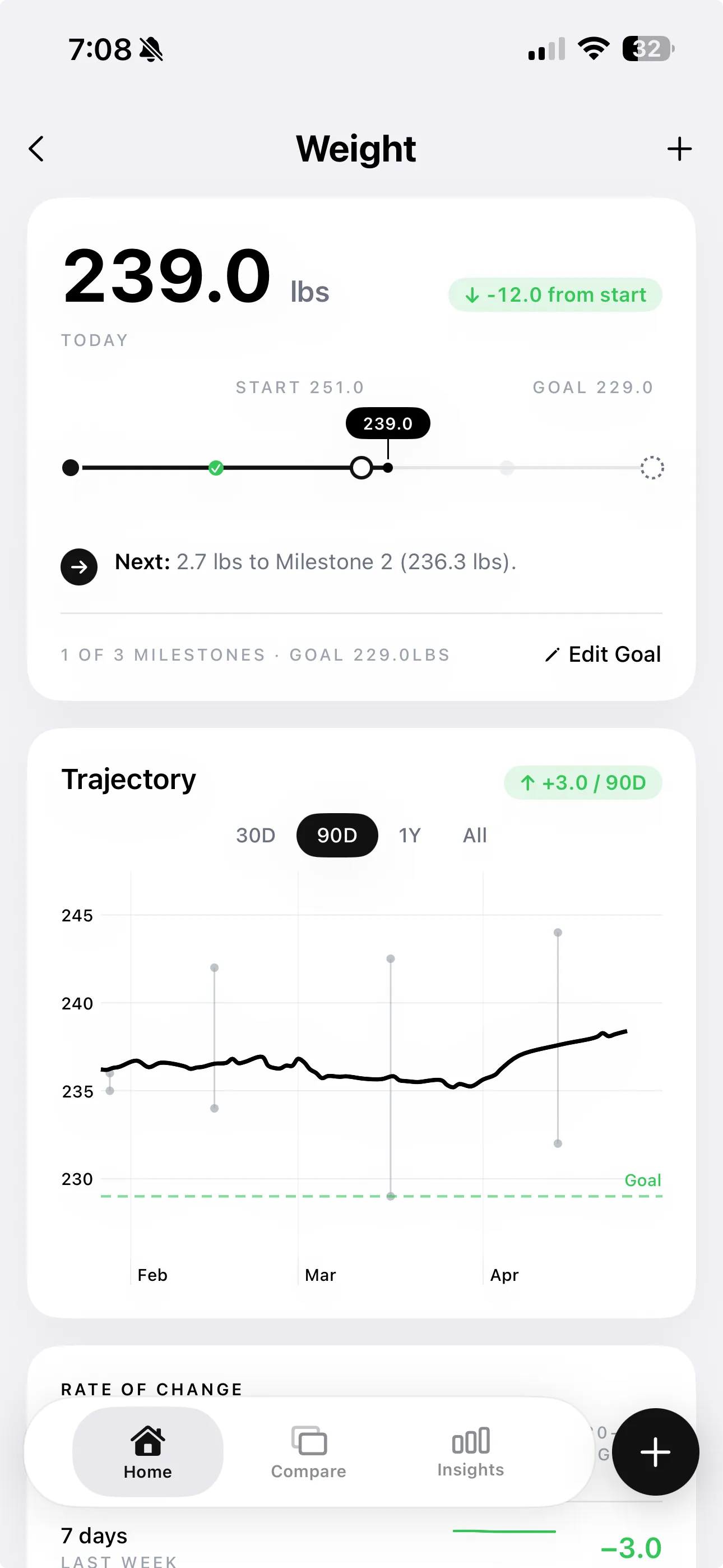
The scale going up during a bulk is expected — but the trajectory rate matters. Gaining faster than roughly 0.5 lbs per week as an intermediate lifter means more of that gain is fat than muscle.
What should you track to know if your bulk is working?
Track these four things together. None of them alone is enough; together they give you a complete picture.
1. Scale weight (7-day rolling average). Weigh daily, first thing in the morning after using the bathroom. Use the average across the week — daily weights swing two to four pounds based on water, food, and glycogen. The trend over three to four weeks is the signal.
2. Body fat percentage (every four weeks). DEXA is the most accurate option — it's also the most expensive, and there are reliable alternatives. AI body composition apps estimate from photos within roughly 2–4% of DEXA for most users and work for consistent trend tracking even if absolute accuracy varies. The four-week delta is what matters, not the absolute number.
3. Compound lift strength (every session). Log your working sets. Note the weight and reps. If the numbers aren't trending up over a four-to-eight week window, muscle isn't accumulating. Strength is the real-time signal body composition tools can only confirm in arrears.
4. Progress photos (every four weeks). Same pose, same time of day, same lighting. Compare four weeks apart. You're looking for muscle definition changes — not weight changes, not "do I look bigger."
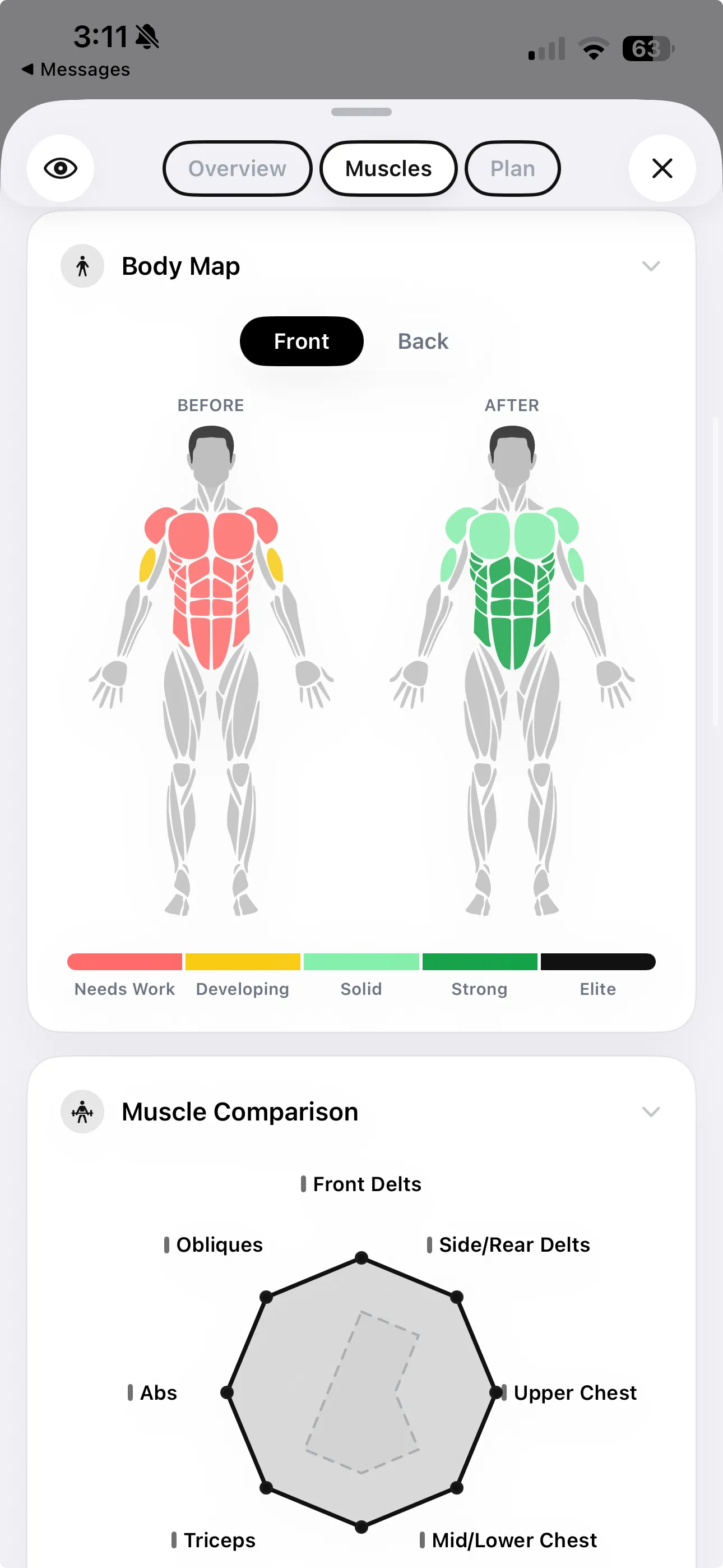
Per-muscle development tracked across a bulk. The dotted baseline versus solid current shows where muscle has been added — and where the surplus isn't going. If shoulders gained and chest didn't, that's a training signal, not a nutrition one.
The multi-week trend across all four signals together is what tells you whether the bulk is working. The dashboard view shows this over time:
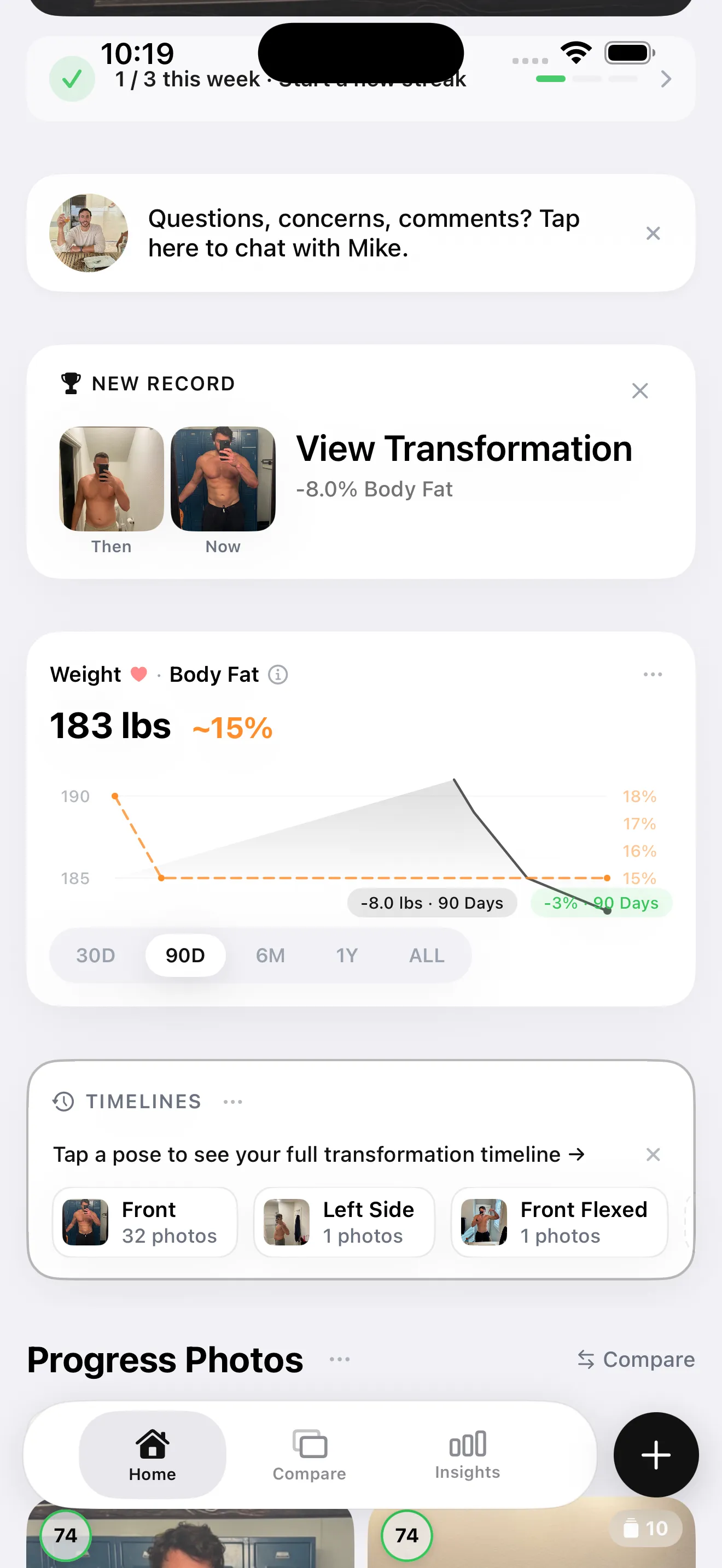
The transformation record and trend chart together — body fat direction over time, weight trajectory, total check-ins. This is the multi-week view a single weigh-in can't give you.
What are the warning signs your bulk is adding too much fat?
These are the signals to cut the surplus or reassess before the bulk runs away:
- Scale gaining faster than 1 lb per week consistently — the surplus exceeds what muscle-building can use
- Body fat percentage up by more than half your total weight gain — more than half the weight is fat mass
- Waist expanding faster than chest, shoulders, or arms — fat is leading the gain, not muscle
- Strength stalling while weight continues to rise — you're gaining weight without gaining strength, which almost always means fat
- Midsection losing definition visibly in photos even though the bulk just started — starting body fat was already higher than optimal for bulking
Any two of these together is a strong signal the current surplus is too large. The fix is not to panic-cut — it's to reduce surplus by 100–200 calories and reassess in four weeks.
What should you do when the fat-gain ratio gets too high?
Three levers, in order of how often the problem actually comes from each one:
1. Reduce surplus by 100–200 calories. Most people overshoot their surplus. The muscle-building ceiling for most intermediate lifters is fully fueled by a 200–300 calorie surplus. If the surplus is larger, the extra calories don't build more muscle — they build more fat.
2. Increase protein. If fat fraction is high but the surplus size looks right, inadequate protein is often the culprit. Increase protein by 20–30g per day before cutting calories. More amino acids available means more of the surplus can be directed toward muscle protein synthesis.
3. Audit progressive overload. If strength isn't moving, the training signal for muscle growth isn't being sent. No training signal means the surplus has nowhere to go except fat storage. Check whether you're progressing on your main lifts and adjust training intensity or volume if not.
GainFrame tracks body fat percentage and per-muscle scores across every check-in so the fat fraction of your bulk is visible as it accumulates — not just at the end when you're already deeper into fat territory than you wanted. The AI Coach has the full context of your check-in history and current composition, so you can ask it directly: "Am I gaining too much fat right now?" and get an answer grounded in your actual trend, not a generic response.

The AI Coach has your current body fat, check-in history, and goal in context. Mid-bulk questions like "am I gaining too much fat?" get answered from your real composition trend rather than generic advice.
Frequently Asked Questions
How fast should the scale go up on a lean bulk?
For intermediate lifters, 0.25–0.5 lbs per week — roughly 1–2 lbs per month — is a well-supported target. Beginners can sometimes sustain slightly higher rates without excessive fat gain. Gaining more than 1 lb per week consistently tends to mean fat is accumulating faster than muscle can be synthesized — the surplus is too large.
What fat-to-muscle ratio should you expect on a lean bulk?
A reasonable lean bulk adds roughly one pound of fat for every one to two pounds of muscle — a fat fraction around 33–50% of total weight gained. If more than 60–70% of your weight gain is fat mass, the surplus is likely too large or protein is too low. Body composition testing every four to eight weeks is the most reliable way to track this.
Can you gain muscle with zero fat gain on a lean bulk?
Rarely, and only in specific circumstances — beginners, returning lifters after a long break, or those at higher body fat percentages. For most intermediate lifters eating above maintenance, some fat gain is unavoidable. The goal of a lean bulk is to minimize the fat fraction, not to eliminate fat gain entirely.
How do you know when to end a lean bulk?
End a lean bulk when body fat approaches the upper end of your acceptable range — roughly 18–20% for men or 28–30% for women. At higher body fat, muscle-building efficiency decreases. An 8–12 week cut from that point returns you to a leaner, more metabolically efficient starting point for the next bulk phase.
How is a lean bulk different from body recomposition?
A lean bulk uses a deliberate caloric surplus — you eat more than you burn to maximize muscle growth, accepting some fat gain in the process. Recomposition uses a slight deficit or maintenance, aiming to gain muscle and lose fat simultaneously. Lean bulk is generally faster for muscle building; recomp is better suited for people with elevated body fat or as a long-term maintenance phase.
What body fat percentage is too high to start bulking?
Above roughly 18–20% for men or 28–30% for women. At elevated body fat, insulin sensitivity decreases and a higher proportion of surplus calories tend to be stored as fat rather than directed toward muscle synthesis. A short cut first brings you to a more metabolically efficient starting point — this is the core of the bulk vs. cut vs. recomp decision.
How long should a lean bulk last?
Most lean bulk phases run 12–20 weeks before transitioning to a cut or maintenance. Shorter than 12 weeks often doesn't allow enough muscle accumulation to justify the effort. Longer than 20–24 weeks risks reaching body fat levels where fat storage efficiency increases and the subsequent cut becomes lengthy and muscle-threatening.
The Lean Bulk Audit Checklist
Run this every four weeks while you're bulking. Not every week — four-week intervals filter out the noise.
Calculate your four-week weight gain rate. Take this week's 7-day average weight minus four weeks ago. Divide by four. Is it 0.25–0.5 lbs per week? Good. Over 1 lb per week consistently? Reduce surplus by 150–200 calories.
Estimate the fat fraction of your gain. Measure body fat percentage now versus four weeks ago. Calculate fat mass gained (body weight × body fat fraction, then subtract the same from four weeks ago). Divide fat gained by total weight gained. Over 60%? Tighten the surplus or increase protein.
Check strength trends on your main lifts. Are your squat, bench, deadlift, and row numbers higher than four weeks ago? Yes = muscle is accumulating. Flat with weight still rising = fat is leading, reassess the program.
Compare progress photos. Same pose, same lighting. Not looking for dramatic transformation — looking for muscle shape changes. Shoulder caps more defined? Chest wider? Arms denser when flexed? These confirm the weight gain is going to the right places.
Decide: continue, adjust, or cut. All signals positive → continue unchanged. Fat fraction high or strength stalling → reduce surplus 150–200 cal and reassess in four more weeks. Body fat above ceiling → end the bulk, start a cut phase.
Track what your bulk is actually building
GainFrame tracks body fat percentage and per-muscle scores across every check-in, so the fat fraction of your bulk is visible as it accumulates — not just when you're already deeper than you wanted. AI estimates run within roughly 2–4% of DEXA for most users. Not a clinical measurement, but a consistent four-week signal the scale alone can't give you.
Download GainFrame Free