
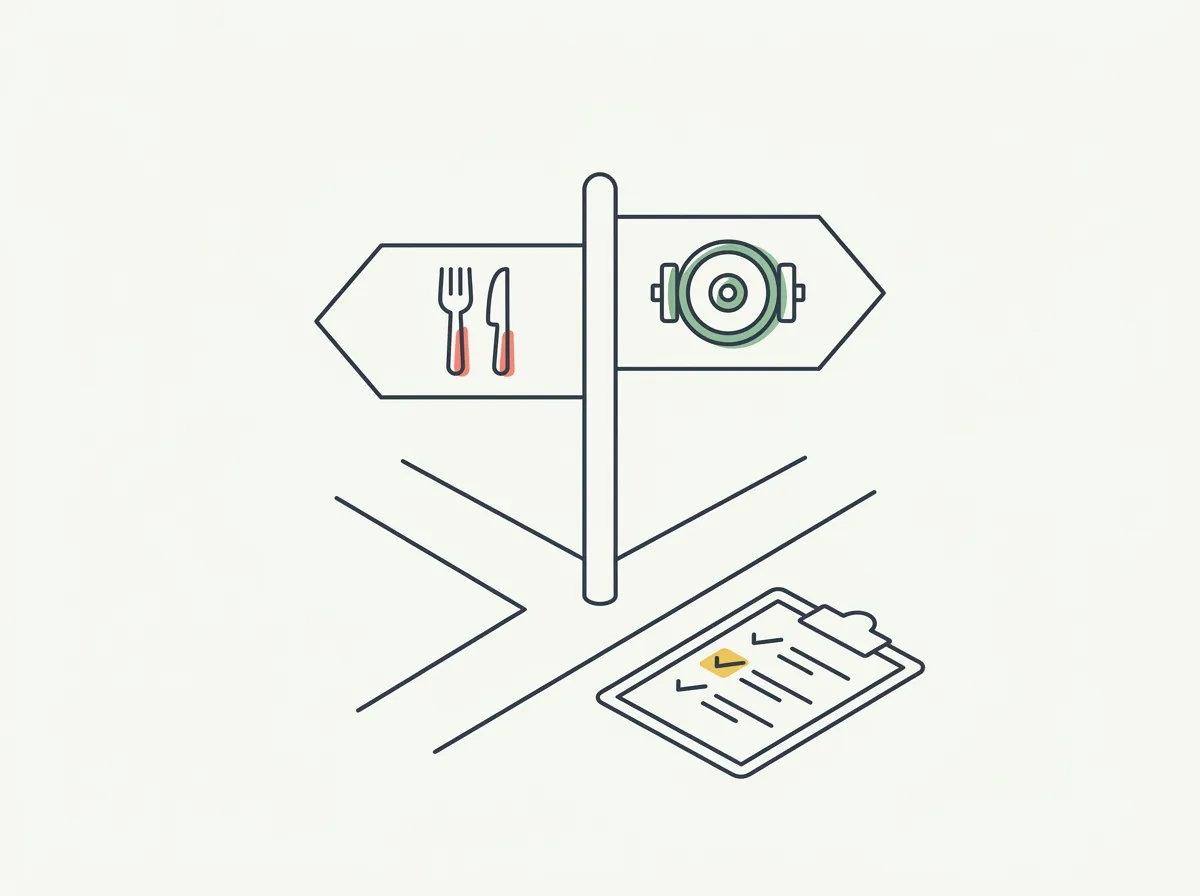
Quick answer: Answer six yes/no questions about your body fat, waist, training age, and appetite for a surplus. Mostly A answers point to cutting first; mostly B answers point to a lean bulk; a split points to recomp at maintenance. Above roughly 20% body fat (men) or 30% (women), cut first.
It's 11pm and you're on your fourth Reddit thread about this. One commenter says bulk, you're skinny. Another says cut, you can't see your abs. A third says it doesn't matter, just train. You close the phone no closer to an answer than you were three weeks ago — and three weeks of training in no particular direction is the actual cost.
This page is the two-minute version of the decision. Six questions, count your answers, get a verdict. If you want the full reasoning behind every threshold — the why, the hormone arguments, the recomp mechanics — that lives in our complete guide to choosing between a bulk, cut, or recomp. This is the fast pass.
How does this self-assessment work?
Answer each question honestly — A or B, no maybes. Tally your letters at the end. That's it. No JavaScript, no email gate, no "results are ready, enter your phone number."
One rule before you start: answer from evidence, not self-image. "Can you see your abs" means in a photo you took, not how you feel on a good day. If a question asks about body fat and you genuinely don't know, skip ahead to the body fat section below, get an estimate, then come back.
The six questions
| Question | A | B | |
|---|---|---|---|
| 1 | Can you see your top abs in good lighting, relaxed? | No | Yes |
| 2 | Is your waist (at the navel) under half your height? | No | Yes |
| 3 | Have you trained consistently — 3+ sessions a week — for at least 6 months? | No | Yes |
| 4 | Is your body fat above roughly 18–20% (men) or 28–30% (women)? | Yes | No |
| 5 | Are your main lifts still trending up week to week? | No, stalled | Yes |
| 6 | Are you comfortable getting a little softer for the next 4+ months? | No | Yes |
Count your A's and B's. Then read your verdict.
What do your answers mean?
5–6 A's: cut first. You're carrying enough body fat that a surplus works against you — extra calories from here add mostly fat, and the eventual cut gets longer and worse. Run a moderate deficit (300–600 kcal/day) with high protein and heavy lifting until you're around 15% (men) or 25% (women), then reassess. The payoff: everything you build afterward actually shows.
5–6 B's: lean bulk. You're lean, you've put in consistent training time, and you've accepted that building muscle means the scale goes up. A small surplus — 200–400 kcal/day, not a dirty bulk — is your fastest route to more muscle. Our lean bulk setup guide has the exact numbers.
A split (anything else): recomp. Mixed answers usually mean one of two profiles: a newer lifter who hasn't banked newbie gains yet, or someone in the middle body-fat range — including the classic skinny fat pattern. Eat at maintenance, lift hard, keep protein high, and let both problems fix each other slowly. It works best precisely for the people who score a split.
One honest caveat: six questions can't see everything. If a single answer feels like it's carrying your whole verdict — say, you scored mostly B but question 4 was a hard A — trust the body fat answer over the tally. Body fat percentage is the strongest single input in this decision, which is why the full framework leans on it.
Where do you land on the decision matrix?
The tally above compresses this table, which follows the same ranges as the full bulk/cut/recomp framework. Find your row and column:
| Body fat (men / women) | Under 1 year training | 1–4 years training | 5+ years training |
|---|---|---|---|
| Below 10% / below 18% | Lean bulk | Lean bulk | Lean bulk |
| 10–14% / 18–24% | Recomp (often automatic for beginners) | Recomp or lean bulk | Lean bulk |
| 15–19% / 25–30% | Recomp | Cut or aggressive recomp | Cut first |
| Above 20% / above 30% | Cut first | Cut first | Cut first |
Two patterns worth noticing. Beginners get recomp as the default in the middle ranges because the first year of training builds muscle almost regardless of diet phase. And every column converges on "cut first" at the top — no amount of training age makes a large surplus a good idea from high body fat.
What if you don't know your body fat percentage?
Half the questions above lean on it, and most people's guess is off by a meaningful margin — self-estimates commonly skew low. Three ways to get a workable number, none requiring a clinic:
- Compare against reference photos. Our body fat percentage chart shows standardized physiques at each level for men and women — find the one that matches your relaxed photo.
- Get a photo-based estimate. Our free body fat from photo tool gives you an AI estimate in about a minute, no account needed. For a read on which direction to go, the free AI physique rater scores the same photo 1–100 with a goal-fit sub-score that directly reflects whether you should bulk or cut.
- Tape measure + Navy formula. Waist and neck measurements into any Navy-method calculator. Crude but consistent.
You don't need a lab-grade number. This decision only needs the right bracket — above or below roughly 15% (men) or 25% (women) — and any of these gets you that.
What if you're still torn after scoring it?
A tie usually means the inputs are fuzzy, not that you're a special case. Sharpen the inputs. This is the one place an app genuinely helps: GainFrame analyzes a check-in photo and returns the numbers this quiz runs on — estimated body fat percent, FFMI, and a physique score broken into sub-scores, including how your current composition fits the goal you've picked. The same 16% body fat reads differently against a "get lean" goal than a "build muscle" one, and seeing that gap quantified tends to end the deliberation. It's iOS only and the numbers are photo-based estimates rather than clinical measurements — but the decision doesn't need clinical, it needs consistent.
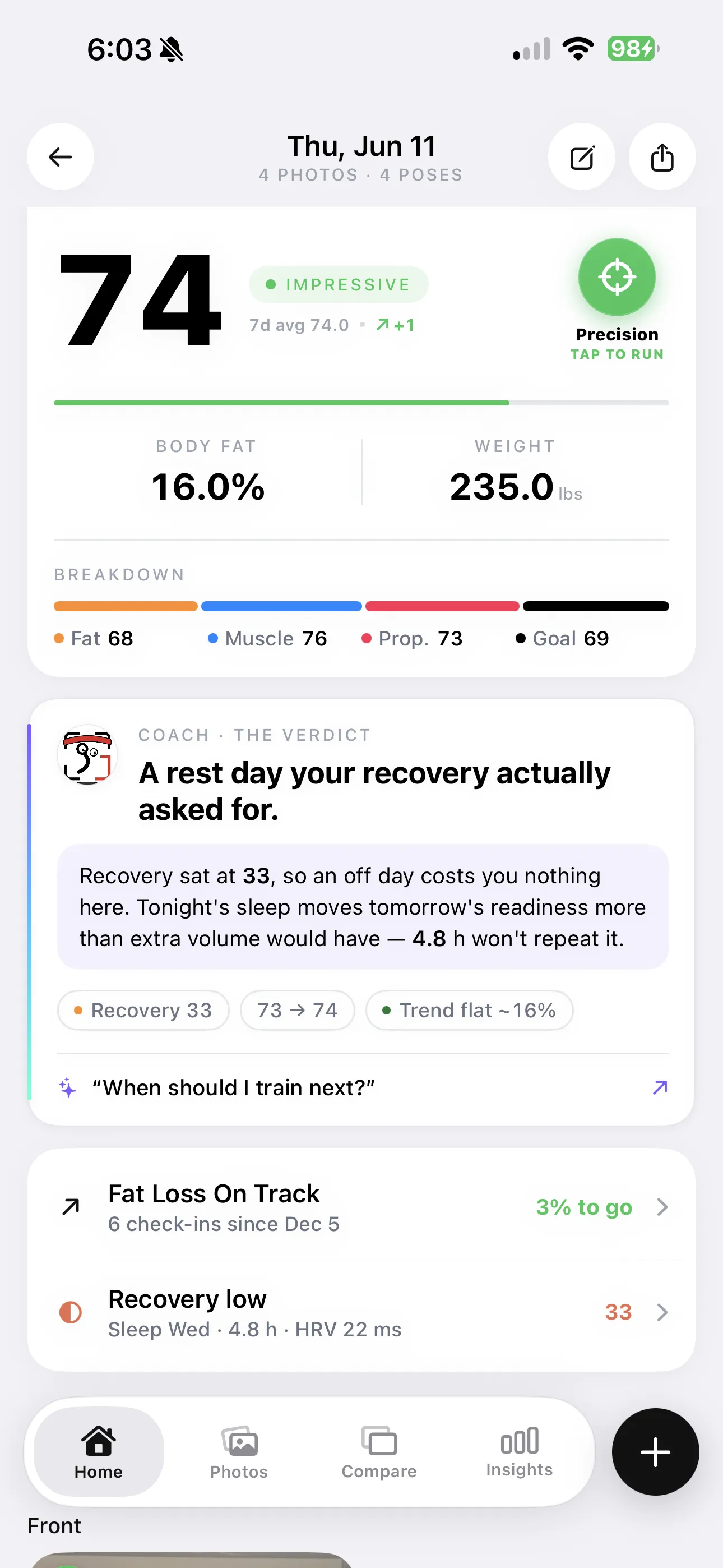
The quiz inputs as numbers: body fat estimate plus a goal-fit sub-score that shows which direction closes the gap.
Whichever verdict you got: commit to it for a minimum of 12 weeks. Phase-hopping every time the scale twitches is how people spend a year going nowhere. Pick the lane, track photos and measurements, reassess at week 12.
Frequently asked questions
Should I bulk or cut first as a beginner?
If you are visibly soft — no ab outline, waist over half your height — cut first, because starting a surplus from higher body fat digs a deeper hole. If you are lean or average, just train and eat at rough maintenance: beginners commonly gain muscle and lose fat simultaneously in the first year, so a dedicated phase matters less than consistency.
Should I bulk or cut if I am skinny fat?
Skinny fat usually means little muscle and a soft midsection at a normal scale weight — which is why the quiz tends to return a split verdict. Recomp at maintenance calories with serious lifting and high protein is generally the best first move: you get newbie muscle gains while slowly leaning out, without committing to a phase that fights half the problem.
At what body fat percentage should I stop bulking?
Common practice is to end a bulk around 17–20% body fat for men and roughly 28–30% for women. Past that range, additional surplus adds mostly fat, the eventual cut gets longer and more miserable, and commonly cited reasoning holds that a leaner state is a more favorable environment for muscle gain. Bulk in the lean range, cut before you leave it.
How do I find out my body fat percentage without a DEXA scan?
Three practical options: compare yourself against reference photos at known levels, use a photo-based AI estimate, or take waist and neck tape measurements with a Navy-method calculator. None is clinically exact, but this decision only needs the right bracket — above or below roughly 15% for men or 25% for women — not a lab-grade number. Any consistent method gets you that.
Can I bulk and cut at the same time?
Effectively yes — that is body recomposition: eating at or near maintenance while training hard, gaining muscle and losing fat simultaneously. It works best for beginners, people returning from a layoff, and lifters in the middle body fat ranges. It is slower than dedicated phases and the scale barely moves, so you need photos and measurements to see it happening.
Get the numbers this quiz runs on
GainFrame estimates your body fat, FFMI, and physique score from a single check-in photo — including how your current composition fits your goal — so the bulk-or-cut call stops being a guess. Free to start on iOS.
Download GainFrame Free