
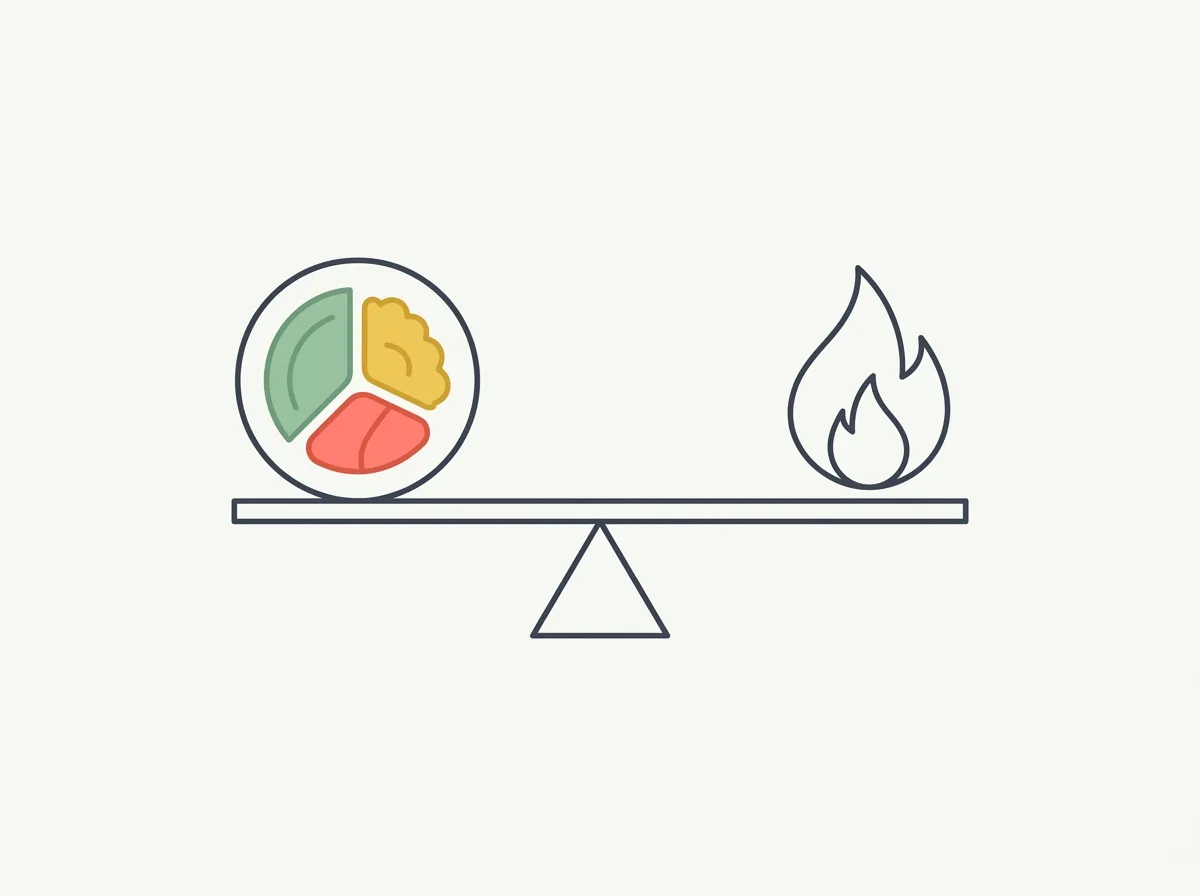
Quick answer: Maintenance calories are the daily intake at which your weight holds steady — your TDEE at your current size. Estimate a starting point with a formula, then verify it: track intake and weight for two to three weeks at stable weight. The observed number is yours; the formula is a guess.
You plugged your stats into a calculator, it said 2,800, so you ate 2,300 for a "500-calorie deficit" — and lost nothing for a month. The calculator wasn't broken. Its estimate was a few hundred calories high for your body, which quietly shrank your deficit to almost zero, and you spent four weeks white-knuckling a diet that wasn't one.
This is the most common failure mode in all of nutrition planning: building a precise plan on top of an imprecise number. The fix is knowing what maintenance actually is, what a formula can and can't tell you, and how to measure your real number in two to three weeks.
What are maintenance calories?
Maintenance calories are the intake at which your weight stays stable — the break-even point where what you eat matches what you burn. The burn side is your total daily energy expenditure (TDEE): basal metabolism, daily movement, exercise, and the energy cost of digestion, summed. Eat at TDEE and weight holds. Below it, you lose; above it, you gain.
TDEE and maintenance are effectively the same number seen from opposite sides — one describes output, the other the input that matches it. Every phase you'll ever run is defined relative to it: a cut is maintenance minus something, a bulk is maintenance plus something, and a recomp is eating at maintenance itself while training hard. Which means an error in this one number propagates into everything built on it.
How do you estimate maintenance with a formula?
The fast way is a calculator: our free TDEE calculator takes your age, height, weight, and activity level and returns an estimate in about thirty seconds. That's the right starting point, and for a first-ever cut or bulk it's genuinely enough to begin.
Just hold the number loosely. Formula estimates are commonly cited as accurate within roughly 10–15% for most people — and at a 2,600-calorie maintenance, 15% is nearly 400 calories. The error concentrates in the activity multiplier: people routinely overrate how active "moderately active" is, and two people with identical stats can differ substantially in daily non-exercise movement. The formula can't see any of that. It sees a demographic average wearing your height and weight.
So treat the calculator output the way you'd treat a weather forecast: plan with it, and update the moment real observations disagree.
How do you find your actual maintenance?
The observed method — the one most evidence-based coaches recommend as the gold standard — replaces the formula with your own data. It costs two to three weeks of tracking:
- Track everything you eat, weighed and logged, for 14–21 days. Accuracy matters more than perfection — the goal is a consistent honest number.
- Weigh yourself daily, same conditions (morning, after the bathroom, before food), and average each week.
- Live normally. Same training, same job, same weekend habits. You're measuring your life, so don't stage it.
- Compare weekly averages. Flat weight means your average intake over the stretch is your maintenance. Drifting weight means adjusting: roughly 400–500 calories per pound of weekly change.
A worked example, using the daily-average intake and average scale weight per week:
| Week | Avg daily intake | Avg weight | Read |
|---|---|---|---|
| 1 | 2,610 kcal | 181.4 lb | baseline |
| 2 | 2,590 kcal | 181.6 lb | flat (noise) |
| 3 | 2,620 kcal | 181.3 lb | flat |
| Result | ~2,605 kcal | stable | your maintenance ≈ 2,600 |
If this person's calculator had said 2,850, they now know their real number sits about 250 below the estimate — exactly the kind of gap that erases half an intended deficit. Note the week-to-week weight wiggle of a few tenths of a pound: that's water and gut-content noise, which is why you compare weekly averages instead of single weigh-ins.
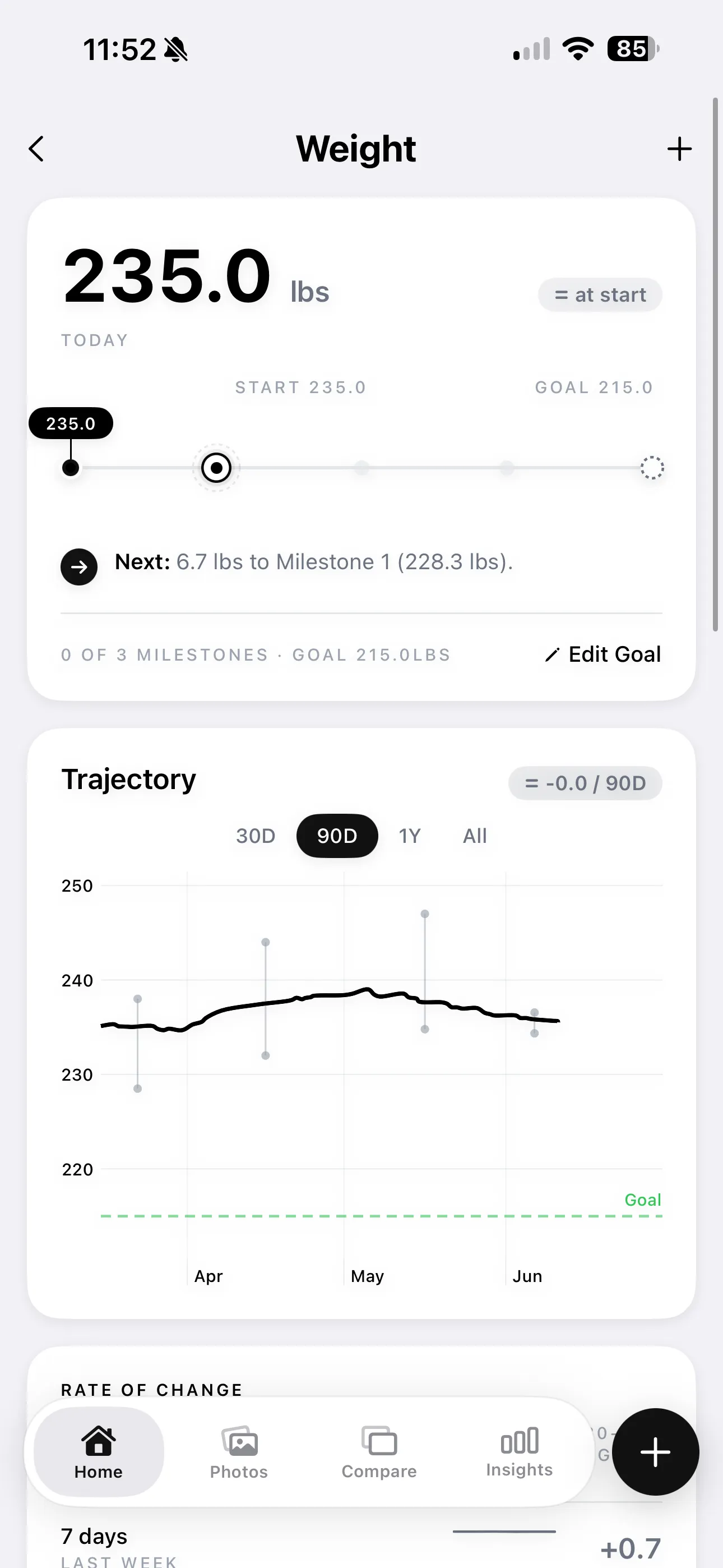
A smoothed weight trend is half of the observed method — flat trend at a known intake means you've found maintenance.
Why does your maintenance change over time?
Maintenance is a moving target, for three main reasons.
It tracks your body weight. A lighter body burns fewer calories at rest and moves less mass around all day. Lose 20 pounds and the maintenance you measured at the start of the cut no longer applies — commonly a couple hundred calories lower by the end.
It tracks your activity. A new job, a lifting program with more volume, an injury, a step-count collapse in winter — all of these move the burn side while the formula's "activity level" dropdown stays frozen where you set it.
It adapts somewhat during dieting. Prolonged deficits are commonly reported to nudge expenditure down beyond what weight loss alone predicts — reduced fidgeting and general movement do much of the work. The effect size is debated and varies by person, but the direction is consistent: late in a long cut, your maintenance is probably lower than any formula says.
The practical rule: re-verify after any weight change of ten-plus pounds or any real lifestyle shift, and expect the number to drift a little every few months.
What do you actually use maintenance for?
Exiting a cut. The end of a diet is where a known maintenance number earns its keep — you need a defined landing zone, whether you return to it quickly or ramp up gradually via a reverse diet. The mini cut formalizes this: a hard 4–6 week deficit with a pre-planned exit back to a maintenance number you actually trust.
Running a recomp. Body recomposition means eating at or near maintenance while training drives the fat-to-muscle swap. If your "maintenance" is 300 calories high, your recomp is a slow bulk; 300 low and it's a slow cut. The whole strategy lives or dies on the accuracy of this number — our bulk, cut, or recomp guide covers when it's the right call.
Setting honest deficits and surpluses. A first cut at "maintenance minus 500" only means anything if the maintenance is real. Same for a lean bulk's "plus 200".
The two mistakes to avoid mirror everything above: treating the calculator's output as gospel instead of a starting guess, and treating maintenance as a constant instead of re-checking it as your body and life change.
Weight tracking is half the observed method, and it's worth making frictionless. GainFrame logs weight with milestones and a projected trajectory, and pairs it with AI analysis of your progress photos — body fat percentage and physique score estimates from the same weekly check-in — so you can see whether time spent at maintenance is actually recomping you. Estimates from photos rather than clinical measurement, but the trend is the point. iOS, free tier covers 25 photos.
Frequently asked questions
What are maintenance calories?
Maintenance calories are the daily intake at which your body weight stays stable — the point where calories in match your total daily energy expenditure (TDEE). Eat below it and you lose weight; above it and you gain. Every deficit and surplus is defined relative to this number, which is why finding it accurately matters so much.
What is the difference between TDEE and maintenance calories?
In practice they're the same number viewed from two sides. TDEE is the energy your body burns per day — basal metabolism plus activity, exercise, and digestion. Maintenance calories are the intake that matches that burn, holding weight stable. Calculators estimate TDEE from formulas; your true maintenance is whatever intake actually keeps your weight flat.
How do I find my maintenance calories without a calculator?
Track everything you eat and weigh yourself daily for two to three weeks while living normally. If your average weekly weight held steady, your average daily intake over that stretch is your maintenance. If weight drifted up or down, adjust the estimate by roughly 400–500 calories per pound of weekly change. This observed number beats any formula.
How accurate are TDEE calculators?
Commonly cited figures put formula estimates within roughly 10–15% for most people — which at 2,600 calories is a window of 300–400 calories, wide enough to turn an intended deficit into accidental maintenance. Calculators are a legitimate starting point, but treat the output as a first guess to verify against your own tracked data.
Do maintenance calories change over time?
Yes. Maintenance moves with body weight — a smaller body burns fewer calories, so losing 20 pounds meaningfully lowers it. It also shifts with activity level, daily movement, and some degree of metabolic adaptation during prolonged dieting. Treat your maintenance as a number to re-verify after any major weight change or lifestyle shift, roughly every few months.
See what eating at maintenance is doing to your body
GainFrame tracks your weight trend and reads body fat percentage and physique scores from your progress photos — so time at maintenance shows up as visible recomp, or tells you it isn't. Free to start on iOS.
Download GainFrame Free