
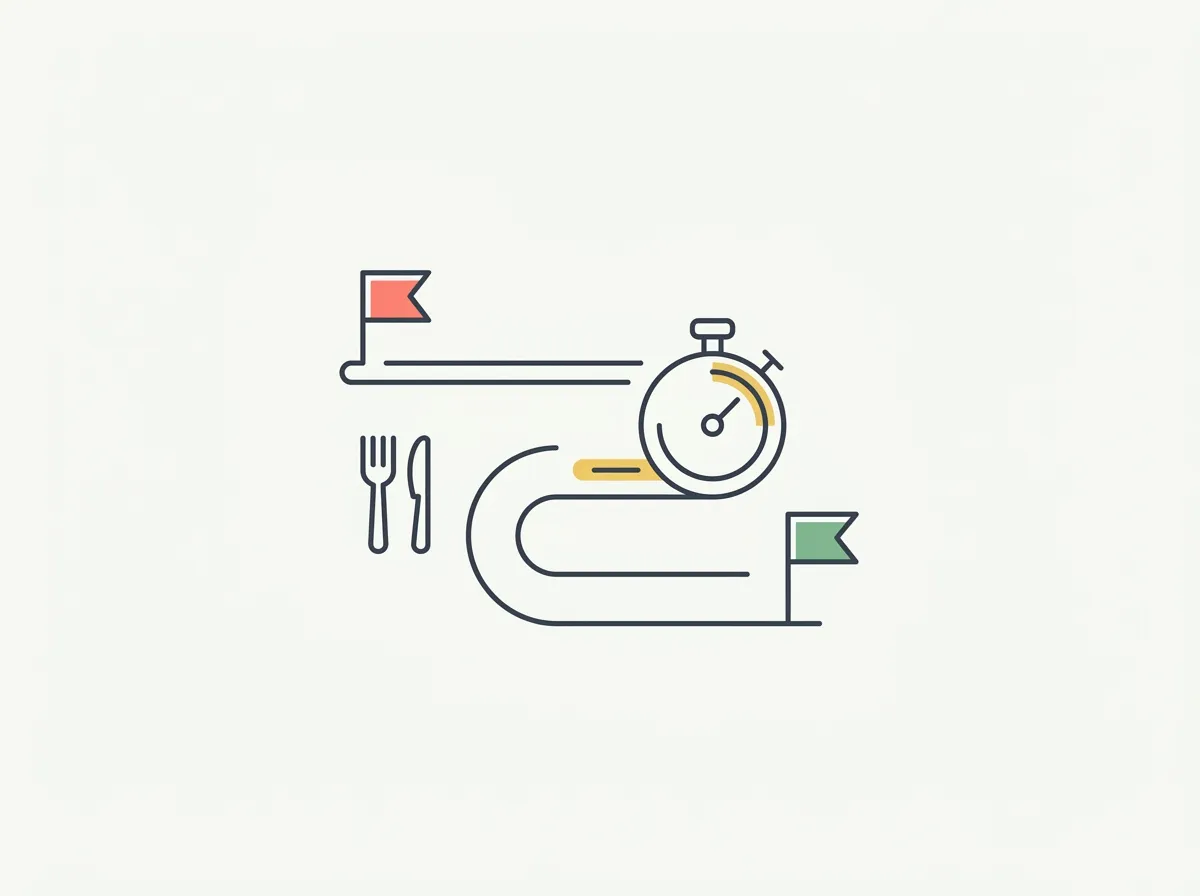
Quick answer: A mini cut is a short, aggressive fat loss phase — commonly 4–6 weeks — used mid-bulk to strip recent fat gain without derailing momentum. Rates up to roughly 1% of body weight per week are commonly cited as the ceiling. It works because it ends before adherence and adaptation become problems.
You're 16 weeks into a lean bulk. The scale is up 11 pounds, your bench is up 25, and the log says everything is working. Then you catch a mirror angle you didn't plan and the verdict is different: the waistband is tighter by two inches, the jawline is softer, and the abs you had in March are a rumor.
Nothing is broken. This is what a surplus does eventually, even a careful one. The question is what to do about it — and the standard answers both cost you something. Keep bulking and the fat keeps compounding. Switch to a full 12-week cut and you abandon a training phase that's producing PRs. The mini cut is the third option, commonly practiced in physique training exactly for this moment: a short, hard deficit that resets body fat and hands you back to the bulk within a month or so.
One guardrail before anything else: if this would be your first cut ever, this is the wrong article. A mini cut assumes skills a first diet is supposed to teach. Start with our beginner's cutting guide instead — it runs slower on purpose.
What is a mini cut?
A mini cut is a deliberately short fat loss phase — commonly defined as 4–6 weeks, occasionally stretched to 8 — run at a more aggressive deficit than a standard cut. The term comes from physique and bodybuilding practice rather than clinical literature, so treat the definitions as convention, hedges included.
The logic is a trade. A regular cut runs a modest deficit for a long time; a mini cut runs a steep deficit for a short time. Total fat lost can be similar per week of dieting, but the mini cut compresses the unpleasant part into a window small enough that motivation, gym performance, and social life don't have time to erode.
Its usual home is the middle of a lean bulk. Surpluses add fat alongside muscle — even good ones — and after four to six months most lifters drift a few body fat percent past where they started. The mini cut strips that drift, then returns you to building. It's a pit stop, and pit stops are judged on how fast you're back on track.
When does a mini cut actually make sense?
The mini cut has a narrow job description. It fits when most of these are true:
- You're mid-bulk and body fat has crept past your comfort zone. Commonly this means drifting from the athletic range into the high teens — say 13% to 18% — and disliking the trend. If you're unsure whether your bulk is adding muscle or mostly fat, diagnose that first.
- You intend to keep bulking afterward. The whole point is preserving momentum. If you're done gaining for the year, a regular cut is the honest choice.
- You have a date. A beach trip, a wedding, a photoshoot 5 weeks out — short deadlines are the mini cut's native habitat.
- You've dieted before and know your numbers. Maintenance calories, a protein habit, a tracking method you trust. A mini cut has no runway for learning these mid-flight.
And it does not fit in three common cases. Beginners — your first deficit should be a teaching diet, and the first cut guide covers that pace. The already lean — below roughly 10–12% body fat, aggressive deficits carry more muscle-loss risk and less visible payoff; what feels like stubborn fat is often a bulk-cut-recomp decision wearing a disguise. Anyone with a history of restrictive or disordered eating — a deliberately aggressive short diet is the wrong pattern to rehearse, full stop. Talk to a professional before any structured deficit.
How aggressive should a mini cut be?
Aggressive but bounded. The figure commonly cited in physique circles as the ceiling is around 1% of body weight per week — roughly double the pace usually recommended for a standard cut. For a 180-pound lifter, that's about 1.5–2 pounds per week, which back-of-napkin math puts near a 750–1,000 calorie daily deficit. These are conventions, and individual results scatter around them.
Three rules keep the aggression from becoming self-sabotage:
- Protein stays high. Commonly cited targets sit around 1 gram per pound of body weight during a deficit, sometimes higher. In a steep deficit, protein is the margin between losing fat and losing the muscle you bulked for.
- Training stays heavy. Lifting is the signal that tells your body the muscle is still needed. Volume can come down slightly if recovery demands it; intensity — the load on the bar — should not.
- The end date is scheduled in advance. Pick the final day before the first day. An open-ended aggressive deficit is a regular cut with worse macros and no plan.
Expect the first week's scale drop to flatter you. Steep deficits empty glycogen and shed water fast, so 3–4 pounds can vanish in week one with only a fraction of it being fat. It's the mirror image of the water-weight spike when you start lifting — the same mechanism, running in reverse.
Why does keeping it short protect muscle?
Two reasons come up consistently in physique practice, and both are about time rather than willpower.
Adherence has a half-life. Nearly anyone can execute a hard deficit for four weeks. Very few can do it for sixteen. Hunger, gym flatness, and diet fatigue compound weekly, and the classic failure of a long aggressive diet is the blowout that erases it. The mini cut simply ends before that curve catches up.
Adaptation needs a longer runway. The downshifts that make extended dieting harder — reduced daily energy expenditure, rising hunger signals, training quality erosion — are commonly described as building progressively over weeks and months of sustained deficit. A 4–6 week window limits how much of that snowball forms. This is a hedge-worthy claim: the research picture on short versus long deficits is genuinely mixed, and "limited adaptation window" is the practitioner's rationale rather than settled science. But the direction of the logic is sound: less time in a hole means less digging out afterward.
There's a muscle-preservation argument layered on top: a short window with high protein and heavy training gives your body a limited opportunity to break down tissue it's actively being told to keep. Lifters coming off a productive bulk are arguably in the best position possible to hold muscle through a brief deficit — newly gained tissue plus a strong training stimulus is decent insurance.
Why does the exit plan matter more than the cut?
Because the exit is where mini cuts actually fail. The deficit part is simple — eat less, lift heavy, wait five weeks. The dangerous 72 hours start the morning the cut ends, when appetite is peaked, restraint is spent, and "I earned this" is doing the meal planning.
The rebound binge is the classic ending: a week of unrestrained eating that restores a large share of the fat at ten times the speed it left. The physiology is stacked toward it — post-diet hunger runs hot, and depleted glycogen means early overfeeding pulls in water weight that reads as instant regain and demoralizes you into worse choices.
The fix is boring and it works: script the exit before you start.
- Return to calculated maintenance the day after the cut ends — a real number, planned in advance, at your new slightly-lower body weight.
- Hold maintenance for 1–2 weeks. Let hunger normalize, let glycogen refill, let the scale find its new baseline. The 2–4 pound bounce in this window is water and food volume; expect it so it can't scare you.
- Resume the lean bulk at a controlled surplus — commonly a few hundred calories over maintenance. You now have several months of clean gaining room before body fat approaches the line that triggered the cut.
A mini cut that ends in a scripted return to bulking bought you months of runway. One that ends in a two-week food riot bought you nothing but a hard five weeks.
Mini cut vs regular cut: which one do you need?
| Mini cut | Regular cut | |
|---|---|---|
| Length | ~4–6 weeks (commonly) | ~8–16+ weeks |
| Weekly loss rate | Up to ~1% body weight (commonly cited ceiling) | ~0.5–0.75% body weight |
| Deficit size | Steep (~750–1,000 kcal/day, ballpark) | Moderate (~300–500 kcal/day) |
| Typical goal | Strip recent bulk fat, resume bulking | Reach a meaningfully leaner set point |
| Best candidate | Intermediate mid-bulk, a few % over comfort zone | Anyone with 15+ pounds of fat to lose |
| Muscle-loss risk | Low if short, protein high, training heavy | Low at moderate pace |
| Diet fatigue | Minimal — ends before it compounds | Real — deloads and diet breaks commonly used |
| Ends with | Planned return to surplus | Transition to long-term maintenance |
| Wrong for | Beginners, the already-lean, restriction history | Nobody in particular — it's the default |
The decision rule compresses to one question: how big is the gap between current you and target you? A few body fat percent of bulk drift is mini cut territory. Anything that needs more than 8 weeks at a sane pace is a regular cut, and pretending otherwise just chains mini cuts together — which is a regular cut with extra whiplash. Still unsure which phase you're even in? The bulk, cut, or recomp breakdown sorts it out.
What does a mini cut's result actually look like?
Numbers undersell it, so here's the territory visually. These are standardized, photorealistic AI renders from our body fat visualizer — same build, pose, and lighting, so only body fat changes between images. The pair below spans 18% to 13% body fat. Treat it as illustrative of the direction a mini cut travels: a single 4–6 week cut commonly covers a solid chunk of a gap like this rather than all of it, depending on starting point and pace.

18% — the classic mini cut trigger point. Strong under the surface, soft over it; the bulk's work is there but blurred.

13% on the same frame — the direction of travel. Waist tighter, definition back, and every pound of the bulk suddenly visible.
Note what the pair demonstrates: the muscle is identical in both images. A mini cut doesn't build anything — it un-hides what the bulk already built.
How should you track a mini cut?
Differently than a long diet, because the timeline is too short for your usual signals to settle.
The scale is at its least trustworthy on a 5-week clock. Steep deficits move glycogen and water hard — a flattering crash in week one, random one-day spikes after a high-carb or high-sodium meal, and a rebound bounce at the exit. Over 16 weeks those swings average out; over 5 weeks they can hide the entire real trend for days at a stretch. Weigh daily if you like, but only trust the weekly average, and expect the same water mechanics that mask early lifting progress to mask fast fat loss here.
Weekly photos and a weekly waist measurement are the ground truth. Same pose, same lighting, same morning conditions; tape at the navel. Fat leaving the midsection shows up in both within two to three weeks even when the scale is having a tantrum. On a sprint this short, the visual and the tape are the difference between "it's working" and guessing.
This is the one place I'll mention the thing we build: GainFrame scores each weekly check-in photo — estimated body fat %, a physique score, 12 muscle-group ratings — and its Deep Dive Compare puts week 1 next to week 5 with the deltas quantified, which is precisely the question a mini cut needs answered. Estimates from photos rather than clinical measurement, iOS only, free tier covers 25 photos — but photo estimates don't care about water weight, and on a mini cut that's the superpower.
Frequently asked questions
How long should a mini cut last?
Commonly 4–6 weeks, with some practitioners stretching to 8. The short window is the defining feature — long enough to strip a meaningful amount of recent fat gain, short enough that adherence stays high and the adaptations that make long diets miserable have limited time to build. If it needs more than 8 weeks, it's a regular cut.
How much fat can you lose on a mini cut?
Figures commonly cited in physique circles cap the pace around 1% of body weight per week. For a 180-pound lifter that's roughly 1.5–2 pounds weekly, or about 6–10 pounds across 4–6 weeks — with early scale drops inflated by water and glycogen rather than fat. Expect the honest fat loss to be somewhat less than the scale suggests.
Can beginners do a mini cut?
It's the wrong tool for a first diet. Mini cuts assume you already know your maintenance calories, can hit a protein target on autopilot, and have a bulk to return to. A beginner's first cut should run at a moderate pace with room to learn the skills. A slower, structured first cut teaches habits a 5-week sprint never will.
Should I do a mini cut or a regular cut?
It depends on how much fat you need to lose. A mini cut suits someone mid-bulk who drifted a few percent past their comfort zone and wants to keep building afterward. A regular cut suits someone with a larger gap to close — commonly 8–16+ weeks at a gentler pace. Trying to solve a 20-pound problem with a 5-week sprint fails both ways.
What should I do after a mini cut ends?
Return to maintenance calories deliberately for one to two weeks, then resume your lean bulk at a controlled surplus. The end date should be scheduled before the cut starts. The common failure is an unplanned rebound — days of unrestrained eating that put back a large share of the fat you just paid five weeks to remove.
Five weeks is too short to guess
GainFrame turns weekly check-in photos into scored progress — estimated body fat %, physique score, muscle ratings — so a mini cut's real trend shows through the water-weight noise. Free to start on iOS.
Download GainFrame Free