
Quick answer: For a first cut, eat roughly 300–500 calories below maintenance (about 0.5–1% of body weight lost per week), keep protein around 0.7–1 g per pound, and keep lifting heavy — training is what tells your body to hold muscle. Most first cuts run 8–16 weeks. Track with weekly photos and weekly-average weight, not the daily scale.
You've been lifting for a year, maybe two. The scale went up, your sleeves got tighter, and somewhere under the layer you added along the way there's a chest and a set of abs you've never actually seen. Every "cutting guide" you find assumes you've done this before — meal timing protocols, refeed schedules, stage-prep water tricks.
You haven't done this before. That's the whole point of this post. A first cut is a different animal from a bodybuilder's eighth cut: the physical part is simpler than the internet makes it, and the mental part is harder than anyone warns you. Here's both.
How do you know you're ready for your first cut?
One condition: there has to be muscle to reveal. A cut doesn't build anything — it removes the layer covering what you've already built. Cut with a year-plus of consistent lifting behind you and the result looks athletic. Cut with three months of sporadic training and you mostly end up a smaller version of the same shape, which is the single most common first-cut disappointment.
The rough readiness checklist: you've trained consistently for at least 6–12 months, your main lifts have climbed meaningfully, and clothes fit differently in the shoulders and chest — not just the waist. If you're genuinely unsure whether cutting is even the right move, take the two-minute bulk-or-cut self-assessment, or read the longer bulk, cut, or recomp breakdown. Skinny-fat beginners in particular are often better served by recomp than by a dedicated cut.
One more calibration: if you've recently started lifting and your weight has been climbing, that's not automatically fat to cut. Weight commonly goes up when you start lifting — glycogen, water, and new muscle all weigh something.
How big should your calorie deficit be?
Smaller than your enthusiasm wants. The commonly recommended starting point is roughly 300–500 calories below maintenance, which for most people produces around 0.5–1% of body weight lost per week. For a 190 lb lifter, that's roughly 1–2 lb a week on the weekly average.
Beginners reliably want to go harder — cut 1,000 calories, be done in a month. The problem is that the bigger the deficit, the more of the loss tends to come from places you don't want: training energy first, then muscle. A moderate deficit you can hold for twelve weeks beats an aggressive one you abandon in three. Start at the small end. If the weekly average hasn't moved in two to three weeks, trim another 100–200 calories.
You don't need a perfect maintenance number to start — a TDEE estimate gets you close, and the scale trend tells you the truth within a few weeks. Adjust off results, not formulas.
How much protein do you need on a cut?
The commonly cited range is 0.7–1 g of protein per pound of body weight per day — so roughly 130–190 g for a 190 lb lifter. In a deficit, protein is doing two jobs: giving your body the raw material to hold onto muscle, and keeping you full enough that the deficit is livable.
Don't overcomplicate the rest. Protein target daily, calories roughly on target weekly, and food you'll actually keep eating for three months. Meal timing, fasting windows, and carb cycling are all optional details that matter far less than those two numbers.
Should you keep lifting heavy while cutting?
Yes — and this is the part beginners get exactly backwards. The instinct is to switch to light weights and high reps "for definition," add cardio everywhere, and treat the gym as a calorie furnace. But cardio doesn't preserve muscle. Training does.
Muscle is expensive tissue, and in a deficit your body is looking for expenses to cut. Heavy lifting is the ongoing signal that the muscle is still being used and needs to stay. Take the signal away and the body economizes. So keep your program, keep the weights heavy, and accept that some sessions will feel flatter than usual — holding your strength roughly steady while the scale drops is a winning cut.
Cardio's honest role: it's a tool for making the deficit bigger without eating less. A couple of easy sessions or a daily step target is plenty. What you never do is replace lifting sessions with cardio — that trades away the one thing protecting the muscle you're trying to reveal.
What does a realistic first cut actually look like?
A typical first cut runs 8–16 weeks. Here's roughly the transformation most first-timers are attempting — these are standardized renders from our body fat visualizer, same build and lighting, so only the body fat level changes:
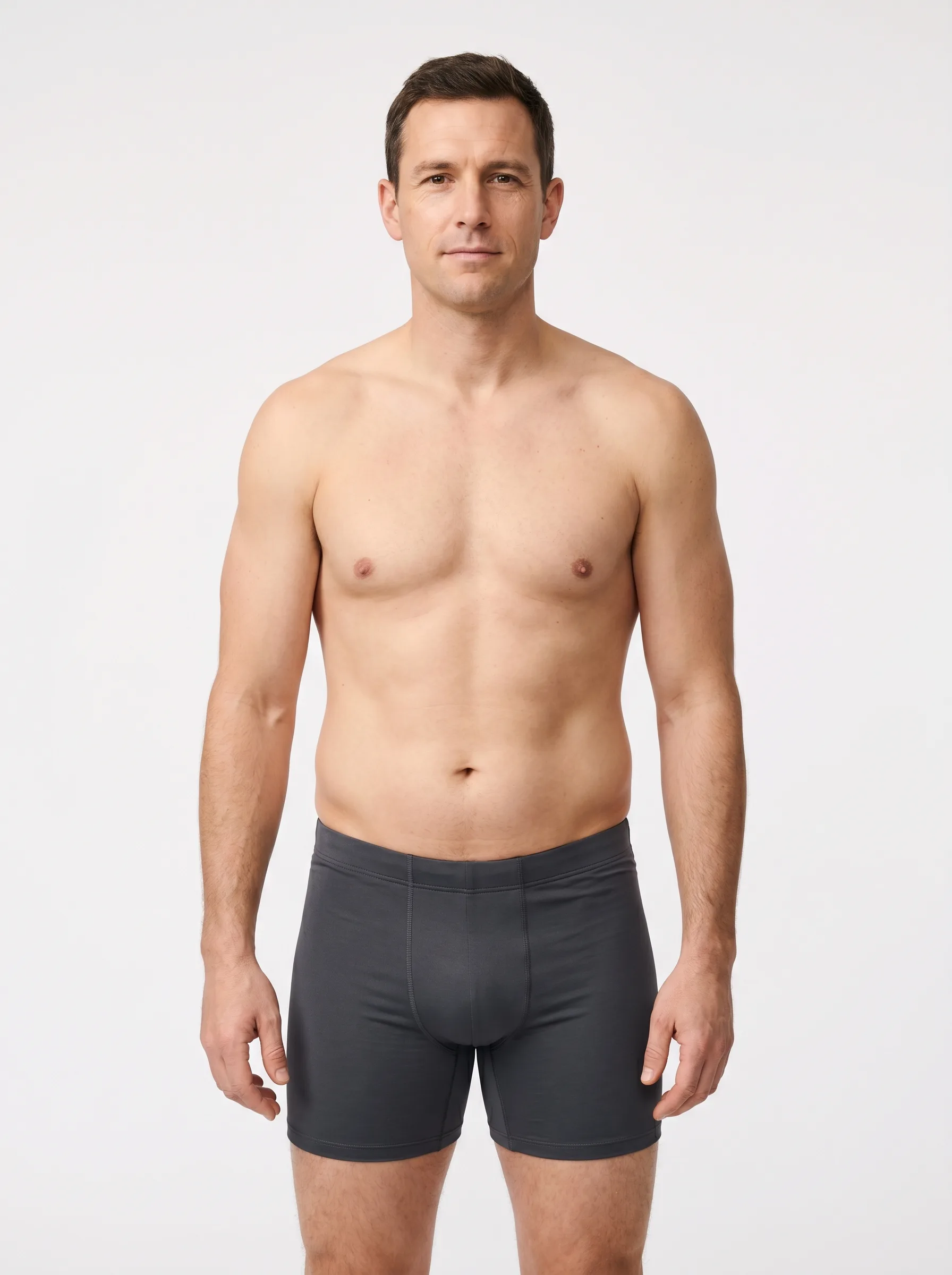
Around 23% body fat — a typical starting point for a first cut. There's clearly muscle under there; it's just not visible yet.
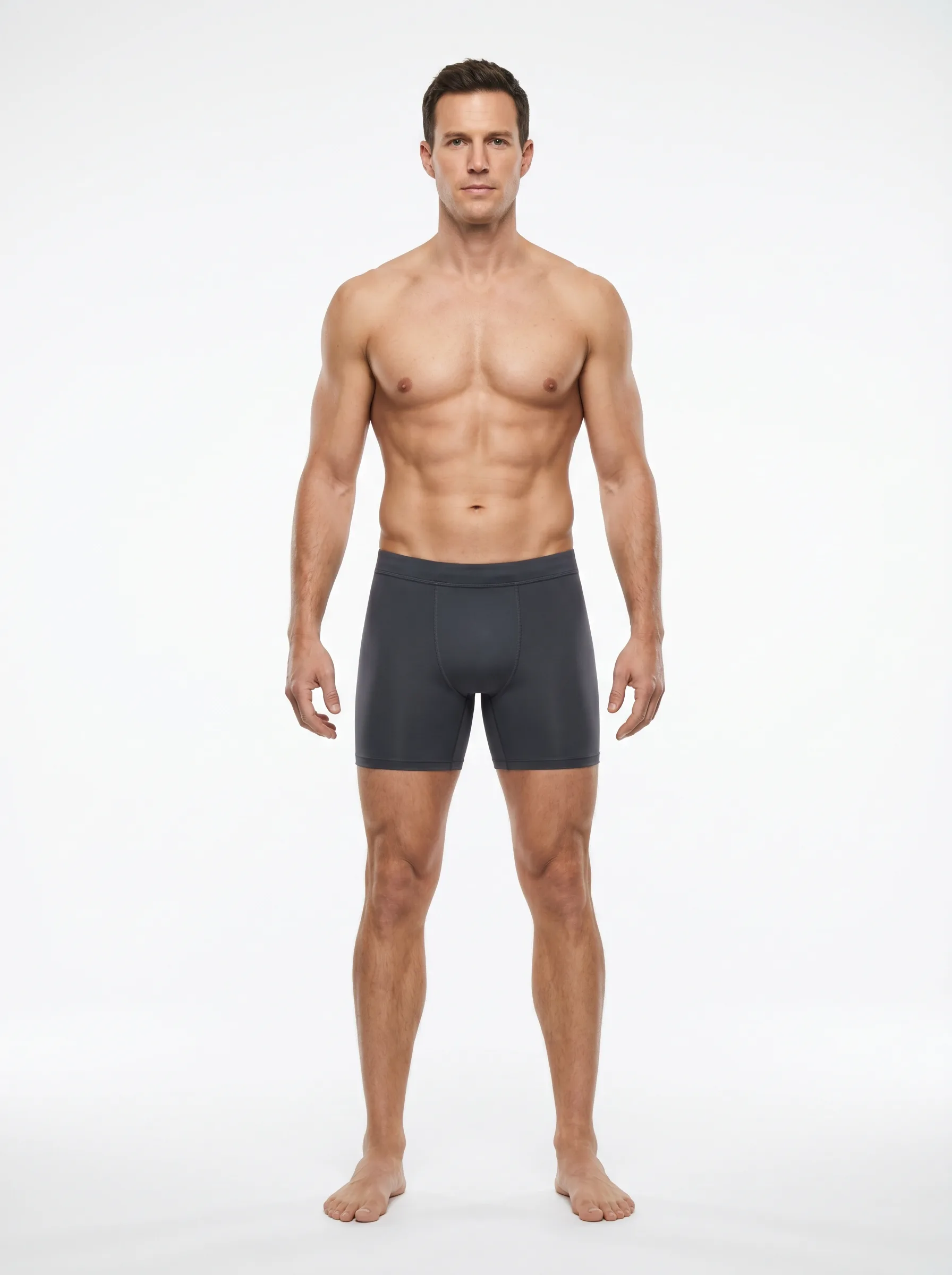
Around 18% — a realistic first-cut result for many people. Not shredded, but visibly fit: flatter stomach, sharper jaw, clothes fit differently. Individual results vary with genetics, adherence, and starting point.
That roughly five-point drop is an honest 10–14 week project at the rates above. Note what the "after" is not: it's not 10% with veins. Ab-outline lean is usually a second or third cut, not a first one — and chasing it on attempt one is how first cuts turn into six-month grinds that end in a rebound. If you want to see where different levels land visually, the body fat percentage chart covers the full range.
What are the mental parts nobody warns you about?
The arithmetic of cutting is easy. These four experiences are what actually end first cuts, so know them in advance:
- The stall. Somewhere around week 4–7, the scale will stop moving for one to two weeks while you do everything right. It's almost always water retention masking fat loss — stress, hard training, sodium, and poor sleep all hold water. The mistake is slashing calories in a panic. Hold steady and judge the three-week trend.
- The whoosh. Often the stall ends with a sudden 2–3 lb drop over a couple of days, commonly reported after a good night's sleep. Water lets go all at once. This is why single weigh-ins are meaningless in both directions.
- Looking flat. Mid-cut, with less glycogen in the muscle, you can look smaller in the mirror — softer and deflated rather than leaner. Beginners read this as losing muscle. It's mostly fullness, not tissue, and it's temporary; muscles fill back out at maintenance.
- The last-two-weeks panic. Near the end, progress feels invisible because you see yourself daily and adaptation eats the change. This is when people either quit two weeks early or vow to extend forever. Your week-1 photo is the antidote — compare against it, not against yesterday.
How should you track progress during a cut?
Two instruments, both weekly: a check-in photo in consistent conditions (same spot, same light, same relaxed pose) and your weekly-average weight. The daily scale is noise — water swings of 1–3 lb are normal, and a salty dinner can erase a week of fat loss on paper overnight. The weekly average smooths it; the photo catches what the scale can't see at all.
This is the one place an app genuinely earns its spot. GainFrame scores each weekly check-in photo — an estimated body fat %, a physique score — and lines up any two dates side by side with the deltas, while tracking your weight trend against milestones. iOS only, and photo-based estimates aren't clinical measurement, but for the week-6 "is this even working?" moment, a trend line beats a mirror read every time.
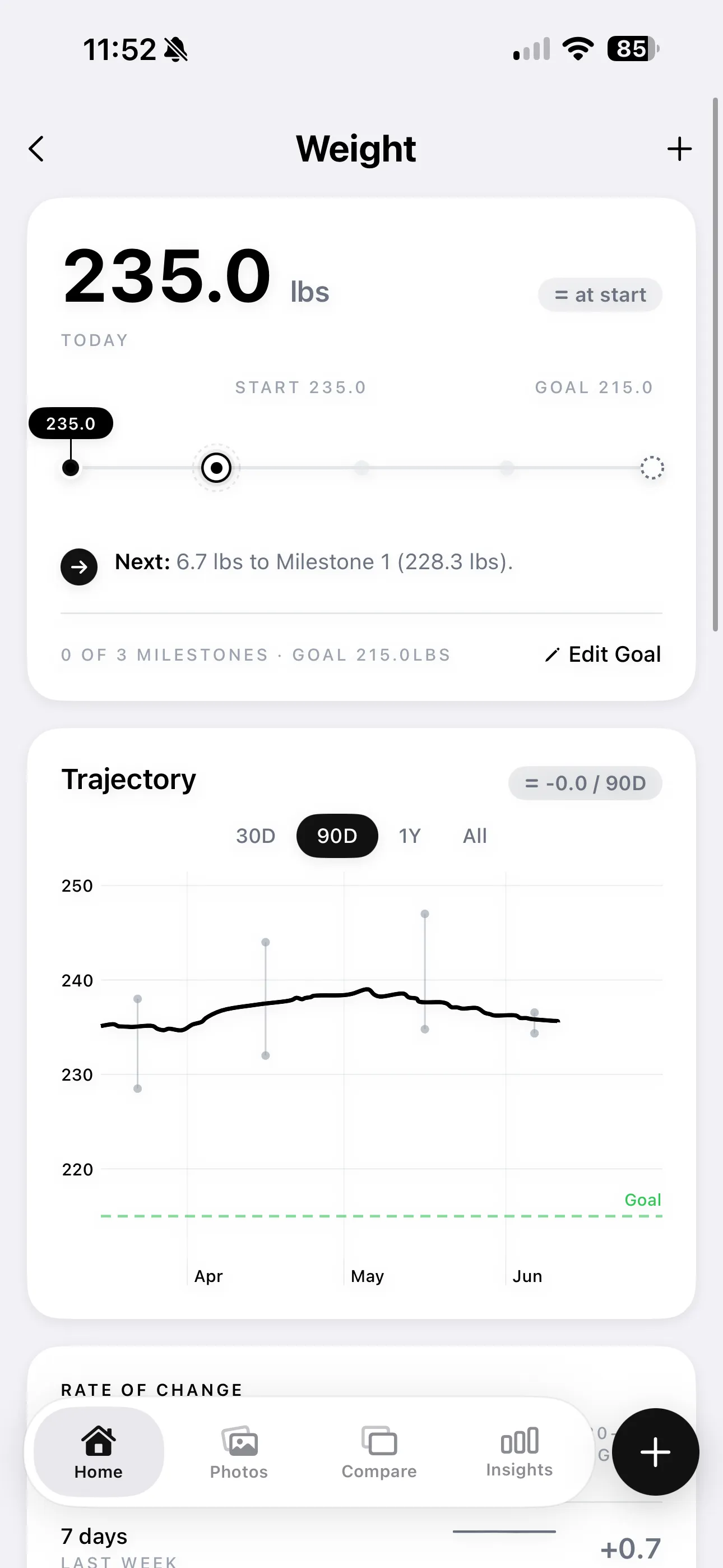
Weekly-average trend, milestones, and a trajectory — the honest answer to a noisy scale.
When should you stop cutting?
Decide the finish line before you start, because mid-cut you is not a reliable narrator. There are exactly two good reasons to stop:
- You hit the target. The look you wanted, or the number you set. Done means done — take the win, move to maintenance for 2–4 weeks, and let strength and fullness come back before deciding what's next.
- The cut stops being worth it. Strength dropping across multiple sessions, sleep falling apart, constant hunger, a fuse two inches long. Those are real signals, not weakness. Ending a cut at week 11 of a planned 14 because the cost curve turned isn't failure — it's the correct read.
The trap to name in advance is the "just two more weeks" loop — leaner keeps looking better, so the finish line keeps moving, and the cut quietly becomes a five-month grind that ends in burnout and a rebound. Two more weeks is fine once. When you catch yourself saying it the second time, that's the signal to stop. The leaner physique you're chasing will still be reachable after a maintenance break — from a stronger, saner starting point.
Your first cut in six steps
- Confirm you're ready. Several months of consistent lifting minimum — there must be muscle to reveal. Unsure? Take the bulk-or-cut quiz.
- Set the deficit. Roughly 300–500 calories below maintenance, targeting about 0.5–1% of body weight per week on the weekly average.
- Set protein. Around 0.7–1 g per pound of body weight daily — the commonly cited range for muscle retention in a deficit.
- Keep lifting heavy. Same program, heavy weights. Cardio is optional deficit help, never a replacement for training.
- Track weekly. One photo in consistent conditions plus the weekly-average weight. Ignore daily readings.
- Stop on purpose. Target reached, or strength and mood tanking for weeks — either one ends the cut. Then 2–4 weeks at maintenance.
Frequently asked questions
How long should your first cut last?
Most first cuts run 8–16 weeks. Shorter than 8 weeks rarely produces a visible change at a sustainable rate; longer than 16 weeks, adherence and training quality usually degrade. If you reach week 16 without hitting your target, common practice is to take 2–4 weeks at maintenance and then run a second, shorter cut.
How many calories should I cut for my first cut?
A deficit of roughly 300–500 calories below maintenance is the commonly recommended starting point, which typically produces around 0.5–1% of body weight lost per week. Beginners often want to go harder, but bigger deficits cost energy, training quality, and muscle. Start at the small end — you can always trim another 100–200 calories if the weekly average stops moving.
Will I lose muscle on my first cut?
Some muscle loss is possible, but it's largely preventable with three levers: a moderate deficit (not a crash), protein around 0.7–1 g per pound of body weight (a commonly cited range), and continuing to lift heavy. Training is the signal that tells your body to keep the muscle. Beginners who keep lifting hard often hold — or even gain — muscle during a first cut.
Should I do cardio while cutting?
Cardio is optional — it's a tool for increasing your deficit, not a requirement and not what preserves muscle. Lifting preserves muscle; cardio just burns calories. If you enjoy it, a couple of easy sessions or a daily step target works well. What you shouldn't do is swap lifting sessions for cardio sessions, which trades away the one thing protecting your muscle.
Why has my weight stalled in the middle of my cut?
Usually water retention masking fat loss, not an actual stall. Stress, hard training, sodium changes, and poor sleep all hold water, and many people report flat scale weeks followed by a sudden multi-pound drop — often called a whoosh. Judge progress on your weekly average weight and weekly photos over 2–3 weeks, not on any single reading.
When should I stop cutting?
Stop when you hit the look or number you set at the start — or when the cut stops being worth it: strength dropping across multiple sessions, constant hunger, bad sleep, and misery are signals to end it. Don't fall into the "just two more weeks" loop. Take 2–4 weeks at maintenance; you can always cut again later from a better position.
Twelve weeks of "is this working?" — answered weekly.
GainFrame scores your weekly check-in photos, estimates body fat, and lines up week 1 against today with the deltas — so the mid-cut panic gets a trend line instead of a mirror read. Free to start on iOS.
Download GainFrame Free