
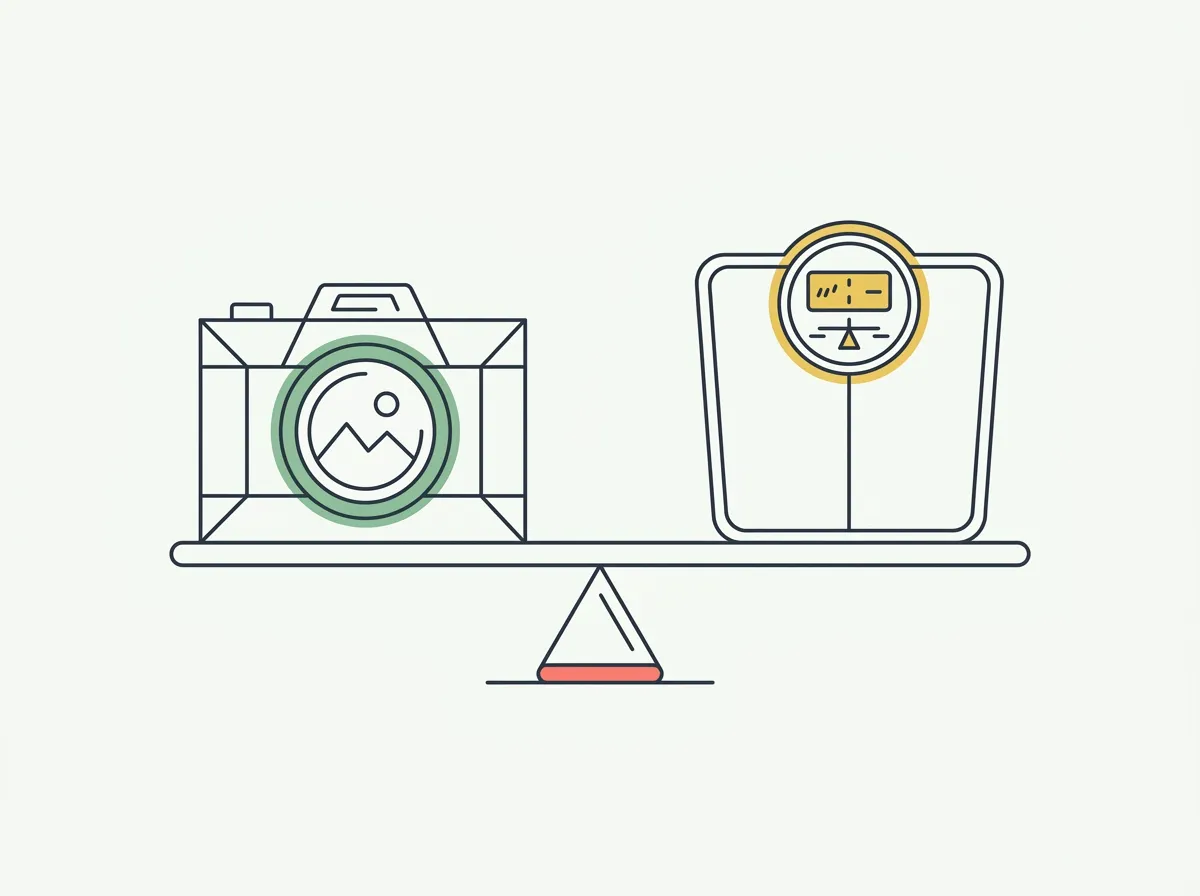
Quick answer: Trust the scale for energy balance and the photos for the actual goal. A weekly weight average tells you which direction your body is moving; regular photos tell you whether you like where it's going. On a cut, use both. On a recomp, photos lead and the scale gets demoted.
Six weeks into your cut, the scale has moved two pounds and you're ready to call the whole thing a failure. Then you open the photo you took on day one next to the one from this morning, and your waist is visibly smaller, your jaw is sharper, and your shoulders look wider against it. Two pounds on the scale; an obviously different body in the pictures.
Both records are honest. They're just answering different questions, and most people track the fast, loud one while ignoring the one that actually describes their goal. This page sorts out what each tool is good at, where each one lies to you, and which should lead depending on whether you're cutting, bulking, or recomping.
What does each one actually measure?
The scale measures total mass - you, plus everything you've eaten and drunk recently, plus every gram of water your body happens to be holding. It has no opinion on what that mass is made of. Muscle, fat, glycogen, and Saturday's pizza all weigh the same to a load cell.
Photos measure appearance: composition, proportion, where fat sits, where muscle shows. That's a fuzzier signal, and it's also the literal goal for most people who train. Almost nobody's actual objective is a smaller number on a device; the objective is looking leaner or more muscular, and photos are the only tool on this list that measures that directly.
So the honest framing is a trade. The scale gives you a precise, frequent number about something adjacent to your goal. Photos give you an imprecise, slower record of the goal itself.
What is the scale good at?
Frequency and objectivity. You can weigh yourself every morning in ten seconds, and the reading doesn't care how you feel about it. No other progress signal is this cheap to collect, which is why a long weight record is so valuable - trends need data points.
The weekly average is a real energy-balance signal. Any single weigh-in is noisy, but the average of a week of them, compared to last week's average, is a solid read on whether you're in a deficit, at maintenance, or in a surplus. That's the number that tells a cut it's working or a bulk it's on pace.
It catches drift early. A slow creep of a pound a month is nearly invisible in a mirror and unambiguous on a six-month weight chart.
The blindness is just as structural. The scale can't distinguish fat from water - daily swings of two to four pounds are commonly just hydration, salt, glycogen, and gut contents, which is why your weight fluctuates so much day to day. And it can't see composition: gain three pounds of muscle while losing three of fat and the scale reports that nothing happened, the exact pattern behind losing inches but not weight. If you weigh in daily and treat each reading as a verdict, the noise will wreck your motivation before the fat loss even stalls.
What are progress photos good at?
They measure the actual goal. How you look is the outcome most training is aimed at, and photos record it directly. When the photo says leaner, you are visibly leaner - there's no model or proxy in between.
They catch what the scale hides. Recomp is invisible to the scale by definition: weight holds while fat leaves and muscle arrives. In photos, that same period shows a smaller waist and rounder shoulders. Photos also localize change - the scale says minus four pounds, the photo says minus four pounds mostly from your midsection, which is a much more useful sentence.
They compound into a motivating archive. A year of consistent photos is proof of progress that no spreadsheet matches. On the bad weeks, the day-one photo is often the thing that keeps the whole project alive.
The weaknesses are real. Photos are subjective without standardization - different lighting, pump, posture, or camera angle can fake a transformation or erase a real one, which is why the protocol matters: same pose, same spot, same light, same time of day. And the feedback loop is slow. Visible change accumulates over weeks, so photos can't tell you whether the last ten days of dieting worked. The scale can.
Which should you trust for your goal?
Neither wins outright. The right lead instrument depends on the phase you're running:
| Goal | Lead instrument | Supporting | Demoted |
|---|---|---|---|
| Cut | Weekly weight average | Weekly photos, waist tape | Single daily weigh-ins |
| Recomp | Photos, weekly | Waist tape | The scale, almost entirely |
| Bulk | Weekly weight average | Photos every 1-2 weeks (watching the waist) | Day-to-day readings |
The logic per row is short. On a cut, energy balance is the mechanism and the weekly weight average is its cleanest cheap measure - photos confirm the weight is coming from the right places. On a recomp, the scale is structurally blind to the thing you're doing, so photos and the tape carry the entire signal; expect weight to sit still and stop checking it for reassurance. On a bulk, the scale trend controls the rate - commonly cited targets sit around a quarter to half a percent of body weight per month of gain - while photos are the audit that the surplus is building shoulders and quads rather than just waist.
If you're weighing the tape measure as a third option, we've run the same comparison for tape vs smart scales - the short version is that the tape slots into every row above as cheap supporting evidence.
Can photos become a number too?
The classic objection to photos is that you can't chart them. A weight log makes a graph; a camera roll makes a scrolling session and a shrug. Comparing photos by eye is genuinely hard - two weeks apart, honest lighting, and you still second-guess whether anything changed. The free Progress Photo Compare tool at least removes the camera-roll friction by placing two photos together in your browser.
This is the gap AI photo analysis closes. GainFrame reads each progress photo and estimates body fat percentage, FFMI, and per-muscle-group ratings, then trends them over time - so the same photos that show the change also produce a chartable line. Estimates from photos, not clinical measurement, but consistent shot to shot, which is what a trend needs. It's the scale's best property, frequency-friendly objective numbers, grafted onto the tool that was already measuring the right thing.
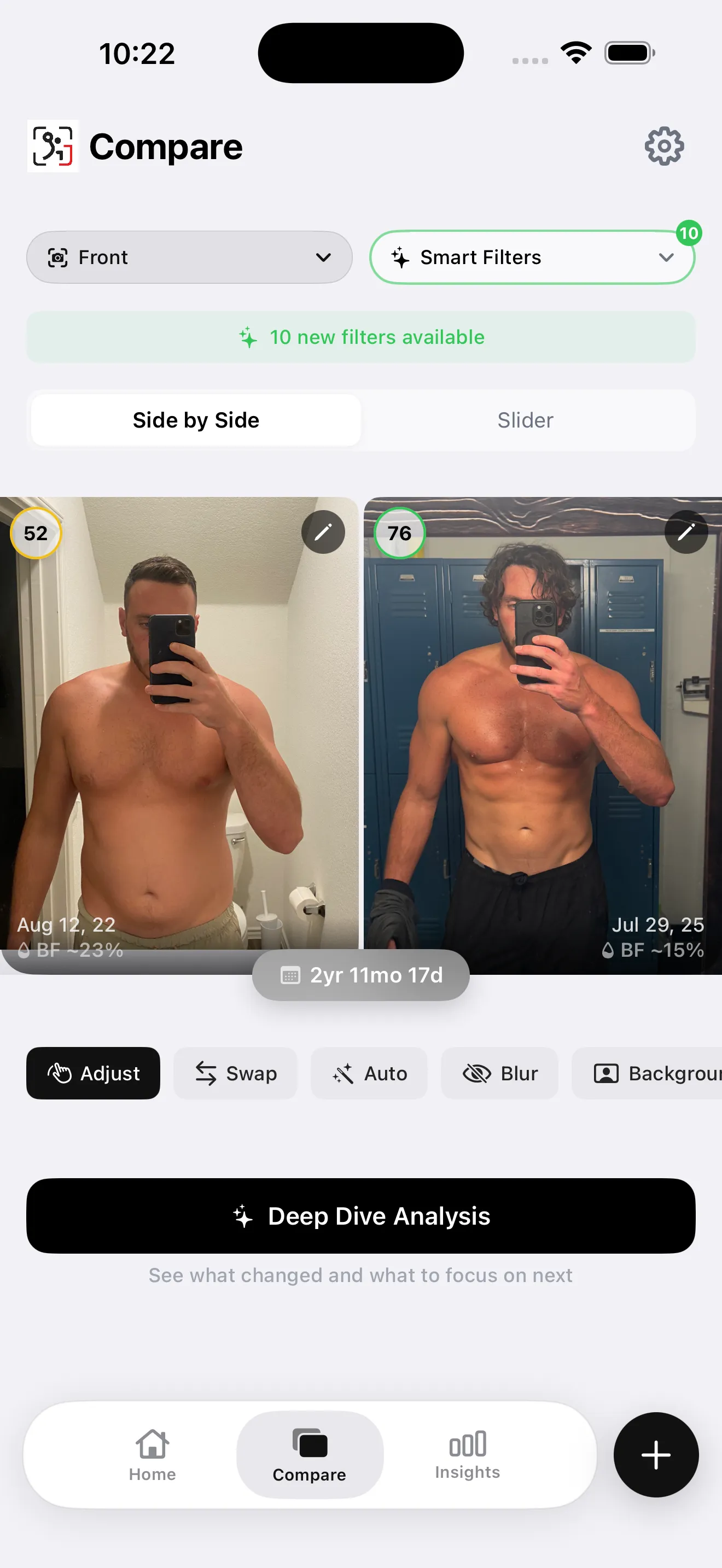
Side-by-side compare with the body fat delta on screen - the photo record and the number in one place.
The practical stack: weigh most mornings and read only the weekly average, shoot photos weekly under standardized conditions, and let each tool answer its own question. The scale reports the direction. The photos report whether it's the direction you wanted.
Frequently asked questions
Should I trust progress photos or the scale?
Trust each for what it measures. The scale is an objective daily signal of total mass and, averaged weekly, a solid read on energy balance. Photos show composition and shape - the thing you're actually training for. On a cut, lead with the weekly weight average and confirm with photos. On a recomp, photos lead and the scale gets demoted.
Why do I look better in photos but weigh the same?
That's body recomposition - gaining muscle while losing fat, which can hold total weight roughly still while your shape changes. The scale reads total mass and can't see the swap happening underneath it. Photos, waist measurements, and how clothes fit catch recomp; the scale is close to blind to it by design.
How often should I take progress photos vs weigh myself?
Weigh daily or most days, but only read the weekly average - single weigh-ins swing with water and food timing. Photos work best weekly or every two weeks: often enough to build a trend, spaced enough that visible change accumulates. Comparing photos a month apart is where the difference usually gets obvious.
Can the scale miss fat loss?
Yes, for stretches of weeks. Water retention from new training, extra salt, stress, or hormonal cycles can mask a real fat deficit, so the scale reads flat while your waist shrinks. This is the classic losing-inches-but-not-weight pattern. When the tape and photos say leaner and the scale says nothing, the scale is the one lagging.
How do you make progress photos objective?
Standardize everything you can: same pose, same spot, same lighting, same time of day, same camera distance, ideally fasted in the morning. Consistency turns photos from vibes into data. AI photo analysis can push this further by estimating body fat percentage and physique scores from each photo, giving the visual record numbers you can trend.
Make your photos as measurable as your scale
GainFrame estimates body fat percentage, FFMI, and muscle-group ratings from every progress photo - so the record that shows your goal also charts it. Free to start on iOS.
Download GainFrame Free