
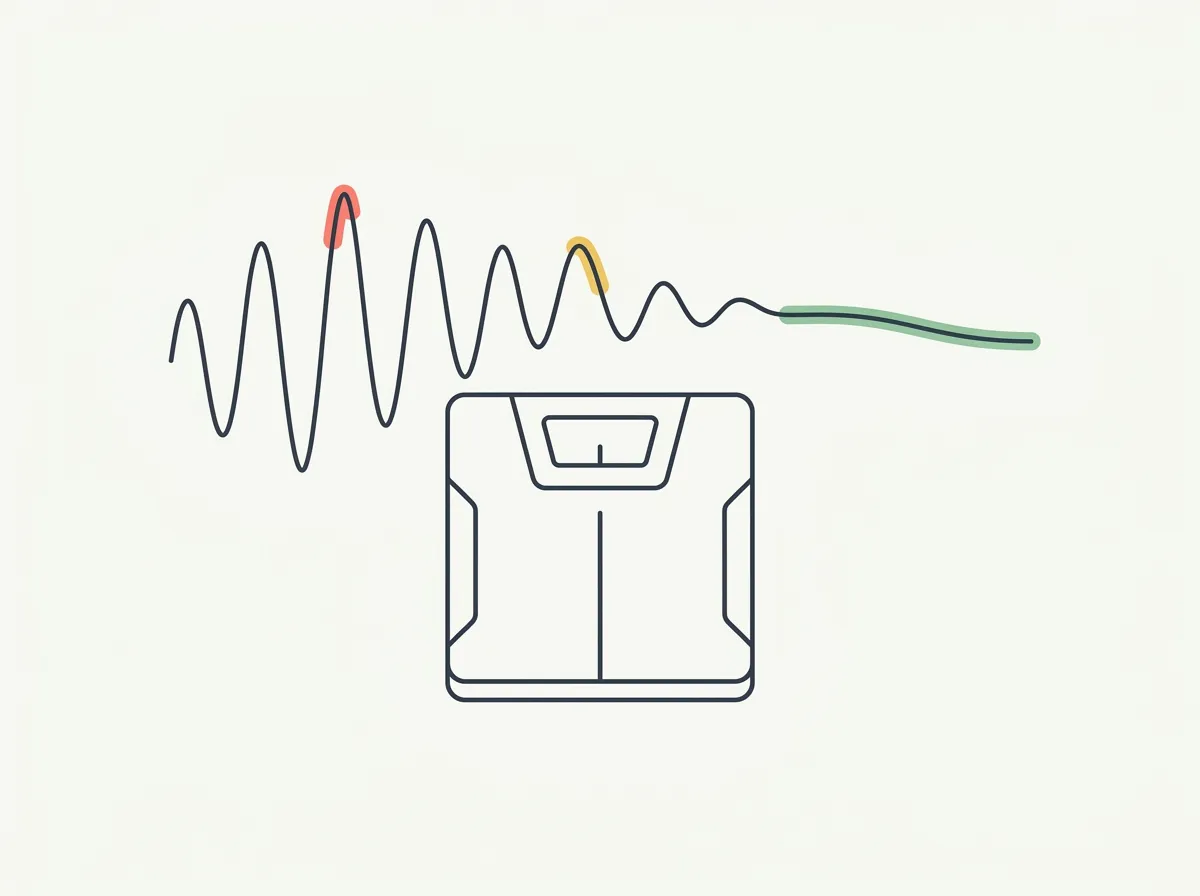
Quick answer: Daily weight swings of 2–5 pounds are commonly water, glycogen, sodium, and gut contents — real fat change tops out around half a pound a day even in an aggressive deficit. Weigh at the same time under the same conditions, judge only the 7-day average, and ignore any single morning.
Tuesday morning: 182.4. Wednesday morning: 185.1. You ate normally, trained normally, did nothing that could plausibly build 2.7 pounds of anything — and yet there it is, glowing on the scale, quietly accusing you.
The accusation is false, and this post is the acquittal. What follows is the full list of mechanisms that move a scale overnight, with typical magnitudes, plus the arithmetic showing why a multi-pound daily jump essentially cannot be fat. If your question is less "why" and more "what should I do about the head games" — that's a different post, and we've written it: why daily weigh-ins sabotage long-term progress. This one explains the machine.
Why does your weight change so much day to day?
Because the scale weighs everything — muscle, fat, bone, and also the water in your tissues, the glycogen in your muscles and liver, this morning's coffee, and yesterday's dinner in transit. Fat and muscle change slowly, over weeks. Almost everything else on that list changes daily, some of it hourly.
So your daily weight is best read as one slow signal buried under several fast ones. The slow signal — actual tissue change — moves in ounces per day. The fast ones — water and contents — move in pounds. On any single morning, the fast signals dominate, which is why a day-over-day reading tells you almost nothing about fat.
How do glycogen and water swing your weight?
Glycogen is the headline act. Your muscles and liver store carbohydrate as glycogen, and glycogen binds water — commonly cited figures run around 3 grams of water per gram of glycogen. A typical body carries roughly a pound or so of glycogen when topped up, which with its water commonly translates to a swing capacity around 2–4 pounds between depleted and full.
This is why the first week of any low-carb diet "loses" several pounds almost instantly, and why a single high-carb day "regains" them overnight. Nothing about fat changed in either direction — the glycogen tank drained and refilled, water included. It's also why cutting carbs before a beach trip flattens the scale while changing your actual fat by approximately nothing.
What else moves the scale overnight?
The full lineup, with the magnitudes commonly reported for each:
| Mechanism | Typical swing | How long it lasts |
|---|---|---|
| Glycogen + bound water | ~2–4 lb capacity | Days, tracks carb intake |
| Sodium-driven water retention | ~1–3 lb after a salty day | 1–3 days |
| Gut contents and fiber timing | ~1–3 lb | Until, well, transit completes |
| Training inflammation | ~1–3 lb after hard or novel sessions | 2–5 days |
| Cycle-related retention (women) | commonly several lb | Days, resolves after period starts |
| Hydration status | ~1–2 lb either direction | Hours |
| Weigh-in timing inconsistency | ~2–4 lb of pure noise | Instant, self-inflicted |
A few of these deserve a line of explanation. Sodium: a restaurant meal or takeout day commonly carries several times your usual sodium, and your body retains water to keep concentrations stable — the puffy 2-pound morning after pizza is electrolyte physics. Gut contents: a high-fiber day literally weighs more in transit, and irregularity can hold a couple of pounds for days. The hydration paradox: drinking too little can read heavier, because a dehydration-stressed body tends to hold water — while well-hydrated bodies cycle it through freely.
Training is its own special case: hard or unfamiliar sessions cause temporary water retention in the repairing muscles, which is why the scale often jumps right when you start a new program — we covered that whiplash in why your weight goes up when you start lifting. And cycle-related retention commonly adds several pounds of water in the days before a period, stacking a monthly wave on top of all the daily noise — our body recomposition guide for women covers reading the scale around it, to the extent the scale deserves reading at all.
How much of a daily change can actually be fat?
Here's the arithmetic that should permanently calm the Wednesday-morning panic. A pound of body fat is commonly estimated at roughly 3,500 calories. To gain a real pound of fat in a day, you'd need to eat about 3,500 calories beyond your maintenance — on top of the 2,000–3,000 you burn just existing. Three pounds overnight would require a surplus north of 10,000 calories. You would remember that meal.
The same math runs in reverse. Even an aggressive 1,000-calorie daily deficit produces roughly 0.3 pounds of actual fat loss per day; call the practical ceiling about half a pound a day for anyone not on a medically supervised protocol. Which yields a rule worth keeping: any day-over-day change bigger than roughly half a pound is, essentially by definition, water and contents — the energy required for it to be tissue doesn't fit in a day.
So the 2.7-pound Wednesday jump decomposes into some sodium, some glycogen, some gut contents, and zero panic. And the flip side matters just as much: the morning the scale drops 3 pounds, you didn't lose 3 pounds of fat either. The noise is symmetric, and it flatters exactly as often as it insults.
What should you do about the fluctuations?
You can't stop the swings — they're physiology. You can stop them from reaching your decisions. Three habits do it:
Standardize the weigh-in. Same time (morning), same state (after the bathroom, before food or water), same dress code. This removes the timing row from the table above — the only noise source that's entirely optional.
Judge the 7-day average, never the reading. Averaging a week of daily weigh-ins smooths out sodium days, training days, and transit days, leaving something close to the real trend. A trend app does this automatically; a notes app and thirty seconds of arithmetic works too. Compare this week's average to last week's, and ignore every individual number along the way.
Or let photos carry the trend. Weight is one noisy channel; your body is the actual subject. Weekly progress photos under consistent conditions skip the water question entirely — retention doesn't change your silhouette the way the scale pretends it does. GainFrame pairs a weight trend view with photo-based body fat estimates, so a noisy scale week sits next to visual evidence of what's actually changing. The estimates come from photos, not clinical gear — but they don't care what you ate for dinner, which on some mornings is the entire point. (If the scale is noisy and the tape is moving, that disagreement is usually good news — losing inches but not weight explains why.)
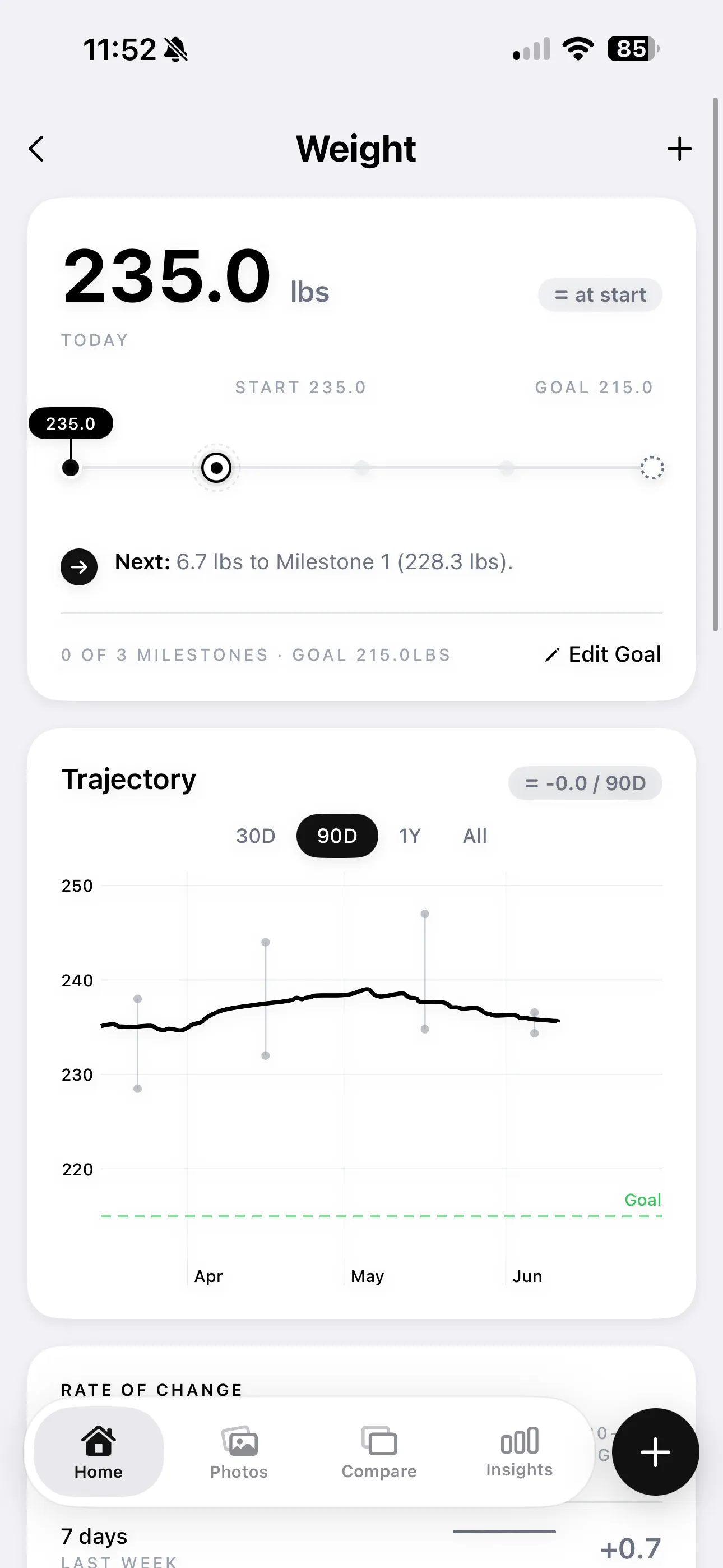
The trend line is the honest version of the scale — daily readings feed it, but no single morning gets to steer it.
Frequently asked questions
Why did I gain 3 pounds overnight?
Almost certainly water and gut contents, not fat. Gaining three pounds of fat overnight would require roughly 10,500 surplus calories beyond maintenance — an amount almost nobody eats accidentally. A salty or carb-heavy dinner commonly adds several pounds of retained water and food weight by morning, and it clears over the following days as sodium and glycogen normalize.
How much daily weight fluctuation is normal?
Swings of 2–5 pounds within a day or between consecutive mornings are commonly reported as normal, driven by glycogen, water, sodium, and gut contents. Larger swings can follow big restaurant meals, hard training, travel, or, for women, cycle-related retention. A fluctuation only deserves attention when the multi-week average trends the wrong way.
When is the best time to weigh yourself?
First thing in the morning, after using the bathroom, before eating or drinking, in the same state of dress. That's the most repeatable point of the day, which matters more than the number itself — consistent conditions make day-to-day readings comparable. Weighing at random times can add several pounds of pure timing noise on top of everything else.
Why do I weigh more after starting a workout program?
New or unusually hard training causes temporary water retention in and around the worked muscles as part of normal repair — commonly a pound or several, lasting days. Add the glycogen your muscles store with water if you're also eating more carbs, and the scale can rise while fat is unchanged or falling. It generally settles as your body adapts.
When should I worry about weight fluctuations?
Daily swings are noise; trends are signal. A 7-day average moving consistently in the wrong direction for three or more weeks reflects a real change worth acting on. Rapid, unexplained gain or loss that persists — especially alongside swelling, fatigue, or other symptoms — is worth raising with a doctor rather than a fitness app.
Track the trend, not the noise
GainFrame pairs a smoothed weight trend with photo-based body composition estimates — so a salty dinner can move the scale without moving your read on progress. Free to start on iOS.
Download GainFrame Free