
Quick answer: Commonly circulated strength standards say an intermediate male lifter benches around bodyweight, squats around 1.5×, deadlifts around 1.75-2×, and presses around 0.75× overhead. Most gym-goers never reach intermediate on all four. Use our free strength standards calculator for benchmarks scaled to your sex, bodyweight, and age.
The first time I benched 135, I was quietly proud for about nine seconds - until a guy two benches over unracked 275 like it owed him money. Every lifter has a version of this moment. The gym gives you no scoreboard, so your brain builds one out of whoever happens to be training nearby, and that scoreboard is wildly miscalibrated.
Strength standards exist to replace that broken scoreboard with a real one. This page covers what they are, the commonly cited numbers for the four main lifts, what the average lifter actually lifts, and how to use standards as a progress tool instead of a gatekeeping stick.
What are strength standards?
Strength standards are bodyweight-relative benchmarks - typically expressed as multiples of your own bodyweight - that describe how much lifters at different experience levels can lift. A 180-pound man benching 180 has hit a "1× bodyweight bench," and standards tables tell you where that performance sits on the spectrum from untrained to advanced.
The commonly published tables are compiled from lifter populations: aggregated gym logs, competition results, and coaching observation, refined over decades. No single official body certifies them, and different sources disagree at the margins - treat every table, including the one below, as a well-informed consensus rather than a measurement.
The bodyweight scaling is the entire point. A 150-pound lifter and a 220-pound lifter pulling the same 315 deadlift are not equally strong - the lighter lifter is much further along. Absolute numbers flatter heavy lifters and gaslight light ones; multiples put everyone on the same axis.
What are the commonly cited strength standards by bodyweight?
Here is the landmark table you'll see versions of everywhere - commonly circulated coaching benchmarks for men, expressed as one-rep max in bodyweight multiples:
| Lift | Untrained | Novice | Intermediate | Advanced |
|---|---|---|---|---|
| Bench press | ~0.50× | ~0.75× | ~1.00× | ~1.50× |
| Squat | ~0.75× | ~1.00× | ~1.50× | ~2.00× |
| Deadlift | ~1.00× | ~1.25× | ~1.75-2.00× | ~2.50× |
| Overhead press | ~0.35× | ~0.55× | ~0.75× | ~1.00× |
Rough translation of the tiers: untrained is what a healthy person lifts on their first serious attempt, novice comes after months of consistent training, intermediate typically takes a couple of years of structured work, and advanced usually represents many years of dedicated training - a small minority of any gym's membership.
Women's multiples at the same stage commonly run around 60-70% of these for upper-body lifts, with a notably smaller gap on squats and deadlifts. Rather than mentally adjusting a men's table, put your actual numbers into our free strength standards calculator - it scales the benchmarks to your sex, bodyweight, and age and tells you which tier each lift sits in.
How strong is the average man, really?
Gym culture has a settled answer: 225 bench, 315 squat, 405 deadlift, and anything less is a work in progress. The commonly observed reality is very different, and it's worth saying kindly, because the gap makes a lot of people feel behind when they're actually on schedule.
Most men cannot bench their bodyweight on day one - a first-session bench commonly lands around half bodyweight, which is why the untrained row starts there. A 225 bench works out to roughly 1.2-1.3× bodyweight for an average-weight man, which the table above places between intermediate and advanced. That's typically years of consistent training, and most gym members - who train inconsistently, by commonly cited attendance patterns - never reach it.
So if you're benching 155 at 170 pounds of bodyweight after a year, the internet may shrug, but the table says you're tracking right through novice toward intermediate. The loudest reference points - lifters on social media, the strongest guy at your gym - are a heavily filtered sample. Standards exist precisely to un-filter it.
What do strength standards actually miss?
Standards are a map, not the territory. Three honest caveats before you take your tier personally:
- They assume barbell proficiency. The untrained tier means "untrained but performing the lift competently." Your first months of benching are partly a skill acquisition phase - early PRs reflect learning the movement as much as building muscle, and someone strong from other sports may still test poorly until technique catches up.
- Scaling matters more than one table can show. Age, sex, and bodyweight all shift the benchmarks. Multiples get harder to hit at heavier bodyweights (strength doesn't scale linearly with mass), and commonly used age adjustments credit lifters past their 40s with a percentage handicap. This is exactly why a calculator beats a static table.
- Strength is not size. Leverages, limb lengths, tendon insertions, and neural efficiency mean two lifters with identical muscle mass can differ enormously on the platform. If you've ever wondered why you lift respectable numbers but don't look like it, our strong but look small guide covers that mismatch - and metrics like FFMI track the size side of the ledger separately.
How should you actually use strength standards?
As a progress marker, pointed backward at your own history - not as a gate you must clear to deserve the squat rack.
The healthiest use is longitudinal: log your lifts, check your tier a few times a year, and watch the multiples climb. Moving from 0.8× to 1.0× on bench is a real, earned transition, whatever anyone else in the gym is lifting that day. Our beginner vs intermediate vs advanced guide goes deeper on what actually separates the training stages, because time served matters less than most lifters think. If you need a starting dose rather than a benchmark, the 2025 ACSM resistance training guidelines turn the evidence into a simple sets, effort, and frequency plan.
It also helps to track the other axis at the same time. Strength numbers say what your body can do; composition says what the training is building. GainFrame reads progress photos and returns an estimated body fat percentage, FFMI, a physique score, and ratings for 12 muscle groups - estimates from photos, not clinical measurement, but consistent enough to show whether the strength gains are showing up as visible muscle. It tracks bodyweight too, which is half of every multiple in the table above.
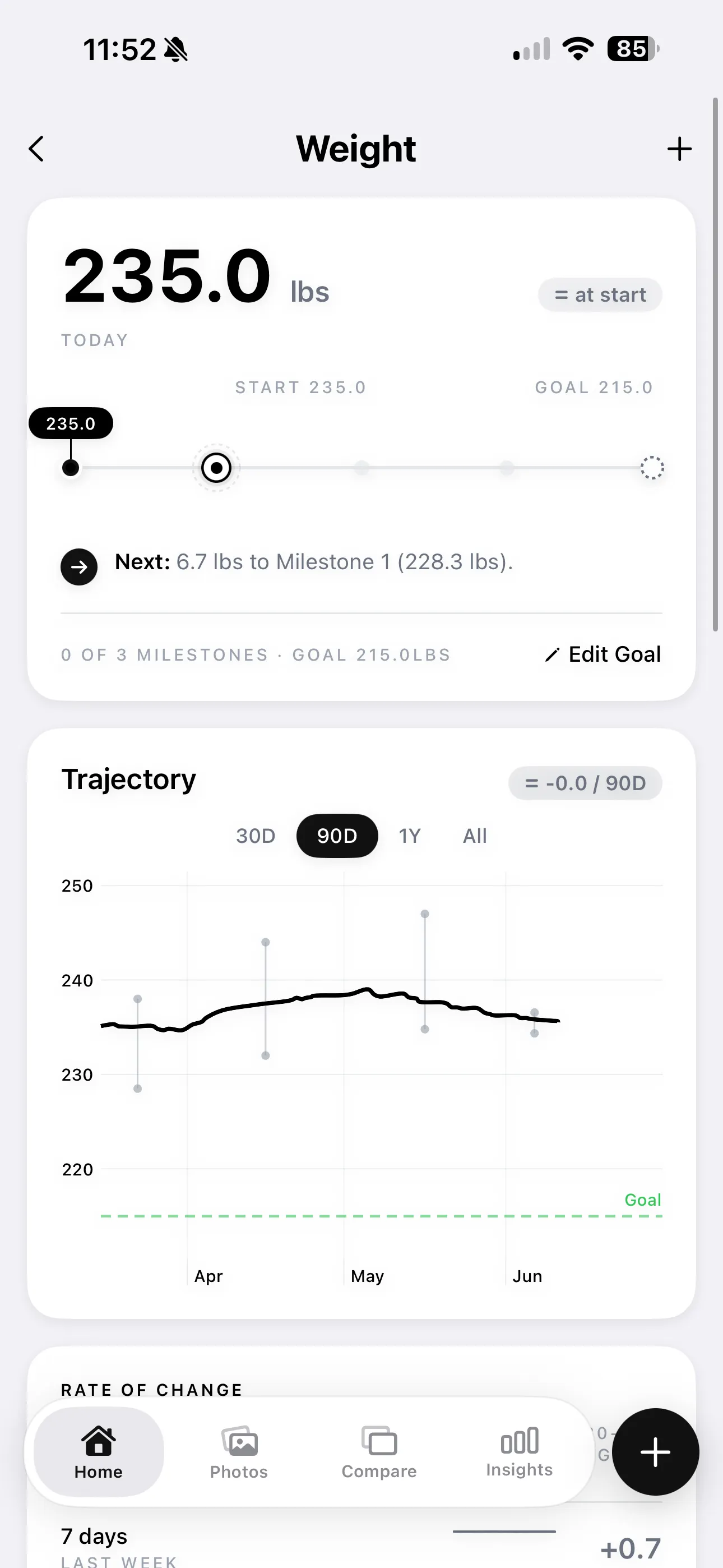
Every standard is a multiple of bodyweight - so the bodyweight trend is half the math.
One warning from the other direction: don't let a tier chart set your ceiling. "Advanced" in a table is a population descriptor, not your genetic limit - plenty of lifters blow past it, and our natty limit breakdown covers what long-term natural progress commonly looks like.
If your log contains multiple repetitions, estimate a one-rep max from a recent set before using a one-rep reference chart. Inspect the formula spread and record the set conditions; an estimate does not confirm a tested maximum.
Frequently asked questions
How strong am I compared to other lifters?
Compare your best lifts to your bodyweight, not to absolute numbers. Commonly circulated coaching benchmarks call a bodyweight bench, a 1.5× squat, and a 1.75-2× deadlift intermediate for men. If you're anywhere near those, you're ahead of most gym-goers. A strength standards calculator scaled to your sex, bodyweight, and age gives a sharper answer than any single table.
What is a good bench press for my bodyweight?
Commonly circulated benchmarks for men: around half bodyweight is a typical untrained starting point, 0.75× marks a novice with some training, a full bodyweight bench is a solid intermediate milestone, and 1.5× is advanced territory that usually takes years. Women's multiples commonly run around 60-70% of these at the same training stage.
Can the average man bench 225?
No - not close. Gym culture treats two plates as table stakes, but it works out to roughly 1.2-1.3× bodyweight for an average-weight man, which commonly cited benchmarks place between intermediate and advanced. Most men who train consistently take years to get there, and most gym members never do. It's a genuine milestone, not a minimum.
Are strength standards different for women?
Yes. Women's bodyweight multiples at each training stage commonly run around 60-70% of men's for upper-body lifts, with a smaller gap on squats and deadlifts - lower-body strength is relatively closer between sexes. A woman deadlifting 1.5× bodyweight is roughly as far along as a man pulling 2×. Use a calculator that scales for sex rather than reading a men's table.
Do strength standards mean I'll look muscular?
Not necessarily. Strength reflects muscle size plus leverages, tendon insertions, limb lengths, and neural efficiency - some lifters hit advanced numbers while looking modest, and vice versa. Standards measure performance; body composition metrics like body fat percentage and FFMI measure appearance. If the mirror is your goal, track both signals separately rather than assuming one implies the other.
Track the numbers and the mirror
GainFrame turns progress photos into scored check-ins - body fat %, FFMI, 12 muscle ratings - plus a bodyweight trend, so you can see whether the strength gains are building the physique. Free to start on iOS.
Download GainFrame Free